What If D-Day Had Failed?
Eisenhower secretly wrote a note accepting full blame in advance for D-Day's failure. What if the Normandy landings had actually gone that way?
Read Wikipedia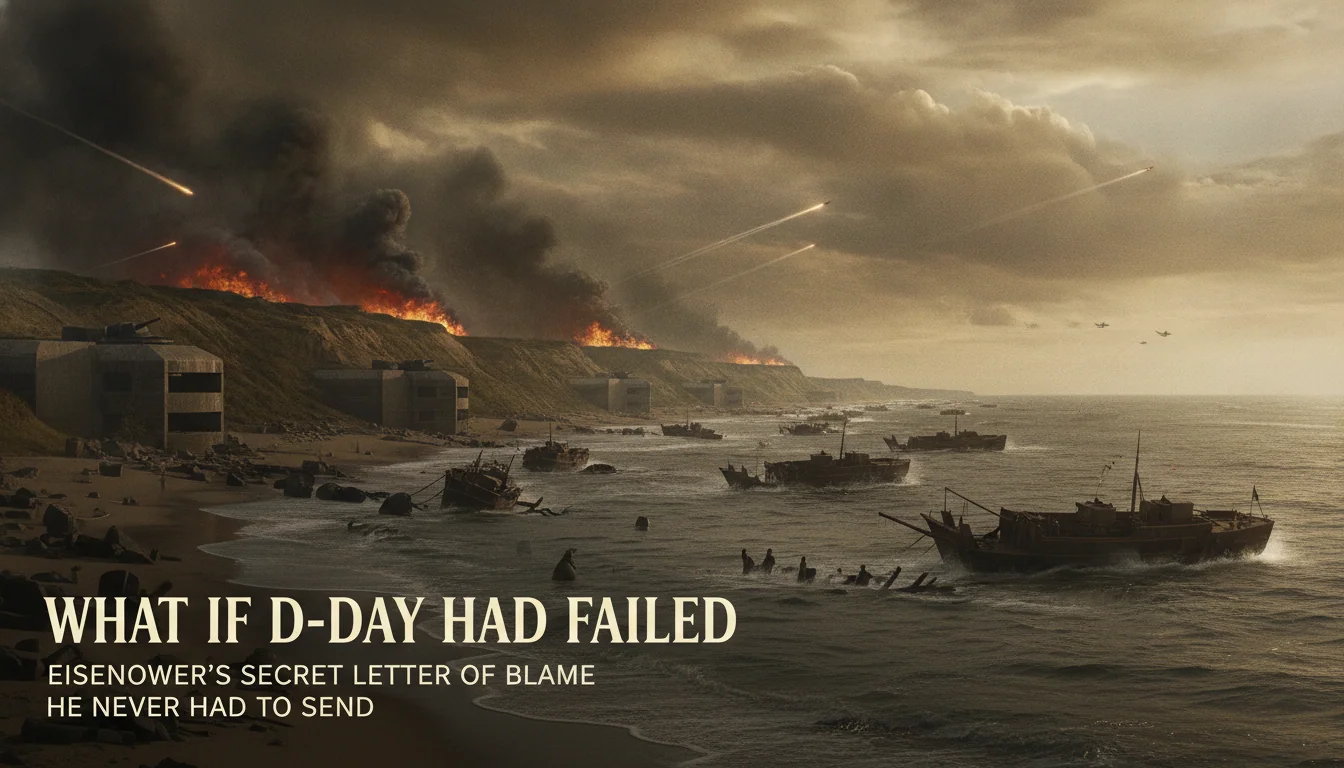
On the evening of June 5, 1944, Dwight D. Eisenhower took a pencil and a small pad of paper and wrote nine sentences he hoped no one would ever have to read. It was not an order. It was a confession, prepared in advance, for a disaster that had not happened yet. In his exhaustion he misdated it July 5. The note survived in his pocket, unused, and was found weeks later by an aide. That a supreme Allied commander felt compelled to write such a thing at all is a useful corrective to any story of D-Day that treats the outcome as inevitable.
What actually happened
Operation Overlord, the Allied invasion of Normandy, launched on June 6, 1944, after Eisenhower postponed the original date, June 5, by twenty-four hours because of a Channel storm. The decision to go at all rested on a narrow window identified by the chief meteorologist, Group Captain James Stagg, who forecast a brief break in the weather. Eisenhower weighed reports of rough seas and low cloud against a hard fact: the next combination of the right tides and moonlight would not recur for roughly two weeks, and secrecy could not be guaranteed that long. He gave the order to proceed with a sentence that has become almost as well known as his written note: "OK, let's go."
Nearly 156,000 troops landed by sea and air along five code-named beaches: Utah and Omaha for American forces, Gold and Sword for British forces, and Juno for Canadian forces, supported by airborne drops inland and a naval and air bombardment meant to soften German coastal defenses. The landings succeeded, but not uniformly, and not easily. At Omaha Beach, American troops of the 1st and 29th Infantry Divisions ran into a well-positioned veteran German division, rough surf that swamped landing craft and swept away amphibious tanks, and bluffs that gave defenders clear fields of fire onto an open beach. American casualties at Omaha that day are usually put at around 2,000, and for several hours the outcome there was genuinely in doubt, with some commanders afloat considering whether troops could be withdrawn rather than reinforced. It held, but barely, and largely through the initiative of small groups of soldiers improvising their way off the sand rather than through any plan surviving first contact.
Eisenhower had reason to know how thin the margin was, because he had already put it in writing. His note, prepared before the landings and carried in case they failed, read in part: "Our landings in the Cherbourg-Havre area have failed to gain a satisfactory foothold and I have withdrawn the troops. My decision to attack at this time and place was based upon the best information available. The troops, the air and the Navy did all that bravery and devotion to duty could do. If any blame or fault attaches to the attempt it is mine alone." He folded it into his wallet and, by most accounts, forgot about it amid the flood of decisions that followed. It was rediscovered by his naval aide, Captain Harry Butcher, months later. The note is real, it is preserved today among Eisenhower's papers, and it is one of the clearest documented pieces of evidence that the man who ordered the invasion genuinely did not know it would work.
The point of divergence
The most plausible single change is not a wholesale rewriting of Allied strategy but a shift in how quickly German armor reached the beaches. The 21st Panzer Division was already stationed near Caen, close enough to strike the landing zones directly, and it did counterattack on June 6 itself, briefly reaching the coast near Sword Beach before being pushed back for lack of infantry support. The stronger armored reserves, including the 12th SS Panzer and Panzer Lehr divisions, sat further inland under a command arrangement that required Adolf Hitler's personal authorization to release them, a structure historians have long debated as one of Erwin Rommel's real frustrations, since Rommel favored meeting any invasion at the beach with immediate, concentrated armor rather than holding it back for a decisive counterstroke inland. Hitler was asleep on the morning of the landings, reportedly for hours after the first reports arrived, and aides were unwilling to wake him. It is plausible, and argued by a number of historians of the campaign, that had those reserves been released and directed decisively in the first hours rather than the afternoon, German armor could have reached at least one beachhead, most plausibly the already-strained Omaha sector, while it was still shallow and unconsolidated.
A second, related factor makes this plausible rather than fanciful: Operation Fortitude, the Allied deception campaign built around a fictitious army group under George Patton, had convinced much of the German high command that Normandy was a diversion and the real invasion would come at Pas-de-Calais. That belief, which persisted for weeks after the actual landings, is a documented reason German reserves elsewhere in France were held back even after June 6. A version of events in which Fortitude's effect frays a few days earlier, or in which the Normandy beachhead is pushed back into the sea before that deception even matters, is grounded in a real vulnerability the Allies themselves worried about at the time.
The consequence chain
If Allied forces had been thrown back into the Channel at one or more beaches, most plausibly Omaha given how close the real fight there ran, the immediate consequence would likely have been catastrophic losses among the troops caught on the sand and in the surf, echoing the scale of Eisenhower's private draft. A second attempt could not simply be relaunched the next week. The invasion depended on a specific alignment of low tide at dawn, exposing German beach obstacles, and a nearly full moon for airborne operations, a combination that would not recur for roughly two weeks. Any Allied force pulled back would have needed to regroup, resupply, and quite possibly find a new landing sector, since German defenders would now know Normandy had been a genuine target rather than a feint.
That delay runs into a real and well-documented hazard: a severe Channel storm struck from June 19 to 22, 1944, wrecking one of the two prefabricated Mulberry harbors the Allies towed across the Channel to supply the invasion in the absence of a captured port. That storm caused serious damage to the actual buildup as it was. A postponed invasion attempting its second try in that same window would plausibly have faced the same weather, this time without any beachhead or supply infrastructure already established, compounding the setback rather than merely repeating it.
The political fallout is easier to sketch than to size precisely. Winston Churchill and Franklin Roosevelt had staked enormous political and military capital on Overlord as the long-promised second front demanded by Joseph Stalin since 1942. A failed or badly bloodied invasion would plausibly have delayed any renewed cross-Channel attempt into 1945, strained Anglo-American relations with the Soviets over the timing of relief for the Eastern Front, and, in an American election year, handed Roosevelt's opponents a serious line of attack going into November 1944. The Soviet summer offensive, Operation Bagration, launched on June 22, 1944, and devastated German Army Group Center regardless of events in Normandy, so it is reasonable to think the Eastern Front's momentum would have continued largely on its own timeline even if the Western Allies had been forced to regroup, though a failed Overlord would likely have left German forces freer to shift some reserves eastward sooner than they actually could.
The limits
What almost certainly would not have changed is the eventual outcome of the war in Europe. By June 1944, Allied material superiority in aircraft, shipping, and industrial output was overwhelming, the strategic bombing campaign against German industry and oil was already grinding down German capacity, and the Soviet Union was advancing from the east regardless of what happened on any single Norman beach. A failed D-Day most plausibly means a later, costlier, and more painful path to the same broad destination, not a different one. It is reasonable to think Germany's defeat would still have arrived, likely still within a year or two, but at a higher cost in lives and with a longer occupation of France and the Low Countries under German control in the meantime. Where speculation should stop is any attempt to trace precise dates, borders, or postwar arrangements from a single reversed beach landing; the underlying arithmetic of the war by mid-1944 was not close enough for one failed invasion to plausibly change who won it.
None of this is a claim about what would have happened, only an exercise in tracing plausible consequences from a real and documented near-run thing. Eisenhower's note was never sent because he never had to send it. The fact that he wrote it, carried it, and forgot it in his wallet through the tensest days of his military career is the clearest evidence available that the man in charge understood exactly how thin the margin was on the beaches of Normandy.
Quick Answers
Common questions about this topic
What actually happened on D-Day?
On June 6, 1944, Allied forces landed on five Normandy beaches, Utah, Omaha, Gold, Juno, and Sword, after Eisenhower delayed the original June 5 date because of a Channel storm. The landings succeeded overall, but at Omaha Beach American troops faced a well-positioned German division, rough surf, and heavy casualties, and the outcome there was in genuine doubt for hours.
Could D-Day have actually failed?
Plausibly, yes, most historians agree the margin at Omaha Beach was thin enough that a harder push by German armor in the first hours could have reversed the outcome there. Whether that alone would have collapsed the entire invasion is less certain and remains a matter of historical debate, since four of the five beaches secured their footholds with comparatively less difficulty.
What was Eisenhower's backup plan if D-Day failed?
Eisenhower wrote a private note before the invasion, misdated July 5 instead of June 5, accepting sole responsibility in case the landings failed and had to be withdrawn. It reads in part that the troops, air, and Navy did all that bravery and devotion to duty could do, and that any blame or fault belonged to him alone. He never had to send it, and it was found in his wallet weeks later.
What would have happened if D-Day had failed?
It is reasonable to think a failed invasion would have meant catastrophic losses, a delay of weeks before tides and moonlight allowed another attempt, and serious political strain between the Allies and the Soviet Union. Most historians who consider this scenario still expect an eventual Allied victory in Europe given the material imbalance by 1944, only later and at a higher cost. This remains informed speculation, not a documented outcome.

Debate the Timeline
Chat with historical figures about how differently it could have gone.
Create your free account →No card required. Talk to anyone in history with 8 free credits a day. Some features require a paid plan.
Join the HistorIQly Club
Get smarter about the past.
Weekly stories, deep dives, and exclusive content straight to your inbox.