What If Lee Had Won at Gettysburg?
Pickett's Charge failed by a matter of yards on July 3, 1863. What if the Confederate assault on Cemetery Ridge had actually broken the Union line?
Read Wikipedia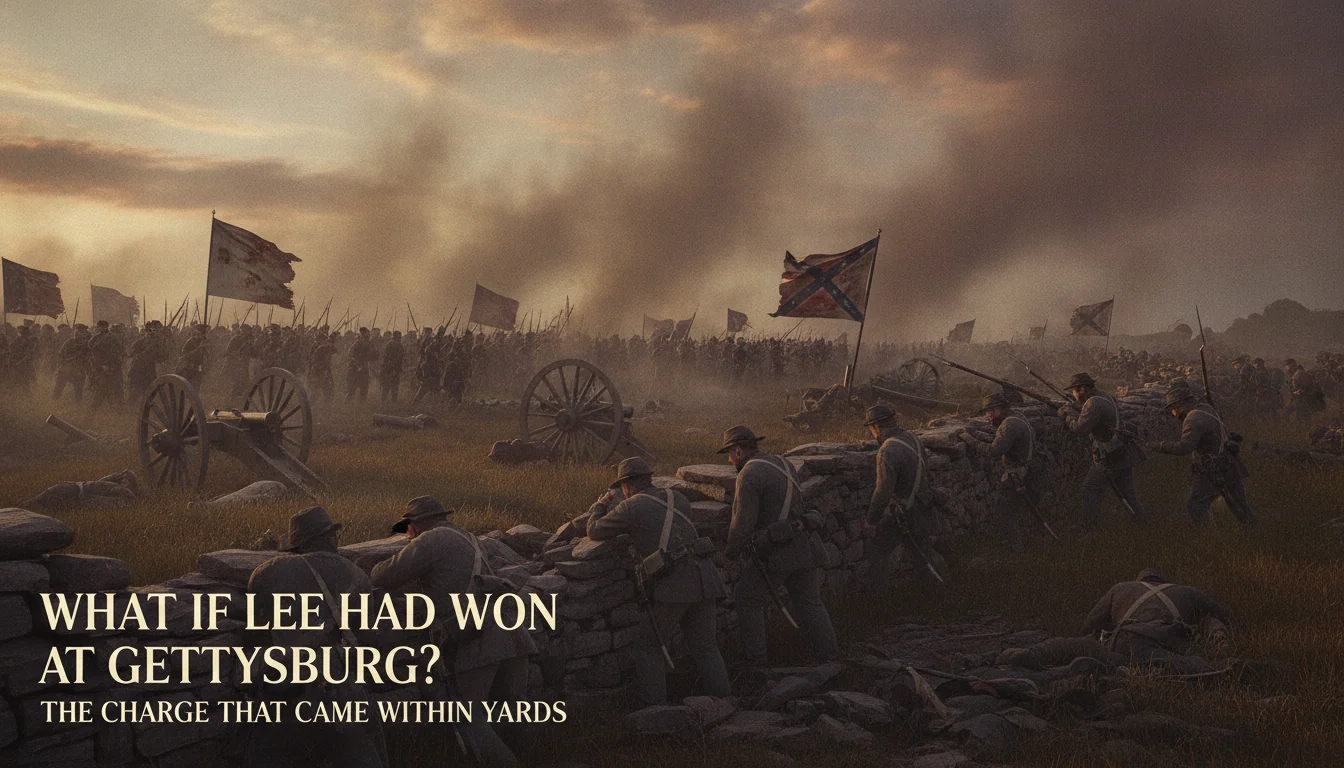
On the afternoon of July 3, 1863, roughly 12,500 Confederate soldiers stepped out of the tree line on Seminary Ridge and walked three-quarters of a mile across open farmland toward a stone wall on Cemetery Ridge. Fewer than half of them made it back. The assault, forever known as Pickett's Charge, came within a few dozen yards of breaking the Union center before it collapsed. What if it hadn't?
What actually happened
By the summer of 1863, Robert E. Lee had taken his Army of Northern Virginia north for the second time, hoping a decisive victory on Union soil might shake Northern political will and encourage foreign powers to consider recognizing the Confederacy. The armies collided almost by accident at the crossroads town of Gettysburg, Pennsylvania, and the fighting stretched over three days. Lee's cavalry commander, Jeb Stuart, had ridden off on a raid around the Union army and did not rejoin Lee until the second day of the battle, leaving Lee without reliable intelligence on Union troop positions during the critical opening hours.
By July 3, the Union army under George Meade, who had held command for barely a week, occupied a strong defensive position along Cemetery Ridge, anchored by Winfield Scott Hancock's II Corps at its center. Lee, believing the Union flanks had been weakened by two days of fighting, ordered a massed assault on that center, preceded by the largest artillery bombardment the Confederacy had ever assembled. James Longstreet, Lee's most trusted corps commander, argued against the plan, reportedly telling Lee that no fifteen thousand men ever arrayed for battle could take that position. Lee overruled him.
The Confederate bombardment fired for close to two hours but largely overshot the Union line, and Confederate artillery ran low on ammunition just as the infantry began its advance. Union artillery, only lightly damaged, opened devastating enfilading fire on the advancing lines. A small group of Confederates under General Lewis Armistead briefly broke through at a stone wall near a copse of trees, a point later called the High Water Mark of the Confederacy, but Union reinforcements sealed the breach within minutes. The charge collapsed. Confederate casualties across the three-day battle numbered in the tens of thousands, with estimates for the combined Union and Confederate losses running to roughly 51,000 killed, wounded, captured, or missing. Lee withdrew toward Virginia the next day.
The point of divergence
The most plausible point of divergence is not a wholesale change of plan but a narrower one: the Confederate artillery preparation actually silencing or driving off the Union guns along the target sector, rather than mostly overshooting them, giving Pickett's, Pettigrew's, and Trimble's divisions an open path across the final stretch of ground. A second, more structural divergence sometimes debated by historians is Lee accepting Longstreet's alternative, a maneuver around the Union left flank to force Meade into attacking a strong defensive position of the Confederacy's choosing rather than the reverse.
Either change is plausible without requiring a wholesale rewrite of the battle. Artillery counter-battery fire in the Civil War was genuinely inconsistent, and a slightly different wind, sightline, or ammunition supply could reasonably have produced a more effective bombardment. It is this genuine, if narrow, margin that makes the counterfactual worth taking seriously rather than treating it as pure fantasy.
The consequence chain
If the artillery had cleared a real gap and Pickett's men had broken through in force rather than in a brief, isolated pocket, the most immediate and well-grounded consequence is that Meade's line would have been split, forcing the Army of the Potomac into a chaotic retreat, likely toward Washington, with Lee's army in a position to press the advantage, at least in the short term.
Beyond that immediate tactical picture, the chain grows more speculative. It is reasonable to think a visible Confederate victory on Northern soil, arriving in the summer before the 1864 presidential election, would have added real pressure on Abraham Lincoln's administration and strengthened the hand of Northern politicians pushing for a negotiated peace, though whether it would have been enough to force actual peace talks is a genuinely contested question among historians, since Lincoln's political position recovered substantially over the following year regardless.
It is also plausible, though far from certain, that a dramatic Confederate battlefield win could have reopened conversations in Britain and France about diplomatic recognition of the Confederacy, a possibility that had been seriously discussed after Confederate victories in 1862 but had cooled considerably by mid-1863, not least because Lincoln's Emancipation Proclamation of January 1863 had made supporting the Confederacy politically toxic for European governments that had already abolished slavery. Whether one more battlefield victory would have overcome that political cost is speculative and disputed.
The limits
What almost certainly would not have changed is the Confederacy's underlying strategic weakness. On July 4, 1863, the day after Pickett's Charge failed, Ulysses Grant accepted the surrender of Vicksburg, giving the Union uncontested control of the Mississippi River and splitting the Confederacy in two, entirely independent of anything happening in Pennsylvania. Lee's army, even in the scenario where it broke the Union center, would still have been deep in hostile territory, stretched thin on supplies, and facing a Union war machine with far greater manpower and industrial capacity to draw on. Most historians agree that even a clear tactical victory at Gettysburg would not by itself have secured Confederate independence; it would have bought time and morale, not victory.
Why the margin still fascinates
Part of what keeps this counterfactual so compelling is how close the actual event came to a different outcome without requiring anything implausible. Armistead's men did reach the stone wall. The breach was real, if brief and unsupported. Historians have long noted that Pickett's Charge is less a story of an impossible attack than of an attack that came startlingly close to working, undone by an artillery preparation that missed its mark and reinforcements that arrived just in time on the Union side. That thin margin, rather than any grand strategic miscalculation, is why the "what if" of Gettysburg has been argued over by soldiers, historians, and armchair generals for more than a century and a half.
A reminder
None of this is a claim about what did happen. It is an informed exercise in tracing plausible consequences from a documented near-miss, built on the actual troop positions, ammunition records, and after-action reports from the summer of 1863. The real history is what happened on that Pennsylvania farmland on July 3: an assault that came within yards and minutes of breaking the Union line, and did not.
Quick Answers
Common questions about this topic
What actually happened at the Battle of Gettysburg?
Over three days in July 1863, Robert E. Lee's Army of Northern Virginia attacked George Meade's Army of the Potomac at Gettysburg, Pennsylvania. The battle climaxed on July 3 with Pickett's Charge, a frontal assault on the Union center at Cemetery Ridge that was repulsed with devastating Confederate casualties. Lee retreated to Virginia, and the battle is widely regarded as the war's turning point in the East.
Could Pickett's Charge have actually succeeded?
Plausibly, if the Confederate artillery bombardment had knocked out more Union guns before the infantry advance, or if James Longstreet's preferred flanking maneuver around the Union left had been attempted instead of a frontal assault. Historians remain divided on how much difference either change would have made against Winfield Scott Hancock's entrenched II Corps.
Would a Confederate win at Gettysburg have won them the war?
Almost certainly not by itself. Vicksburg surrendered to Ulysses Grant on July 4, 1863, the day after Pickett's Charge failed, giving the Union control of the Mississippi River regardless of what happened in Pennsylvania. A tactical win at Gettysburg would have been a serious blow to Union morale but would not have solved the Confederacy's deeper problems of manpower and industrial capacity.
What happened to Lee after Gettysburg?
Lee led his battered army back across the Potomac into Virginia and offered his resignation to Confederate President Jefferson Davis, who refused it. Lee continued to command the Army of Northern Virginia until its surrender at Appomattox in April 1865.

Debate the Timeline
Chat with historical figures about how differently it could have gone.
Create your free account →No card required. Talk to anyone in history with 8 free credits a day. Some features require a paid plan.
Join the HistorIQly Club
Get smarter about the past.
Weekly stories, deep dives, and exclusive content straight to your inbox.