What If the US Never Dropped the Atomic Bomb on Japan?
The atomic bombings of Hiroshima and Nagasaki ended the Pacific War in days. What if Truman had chosen the invasion plan instead?
Read Wikipedia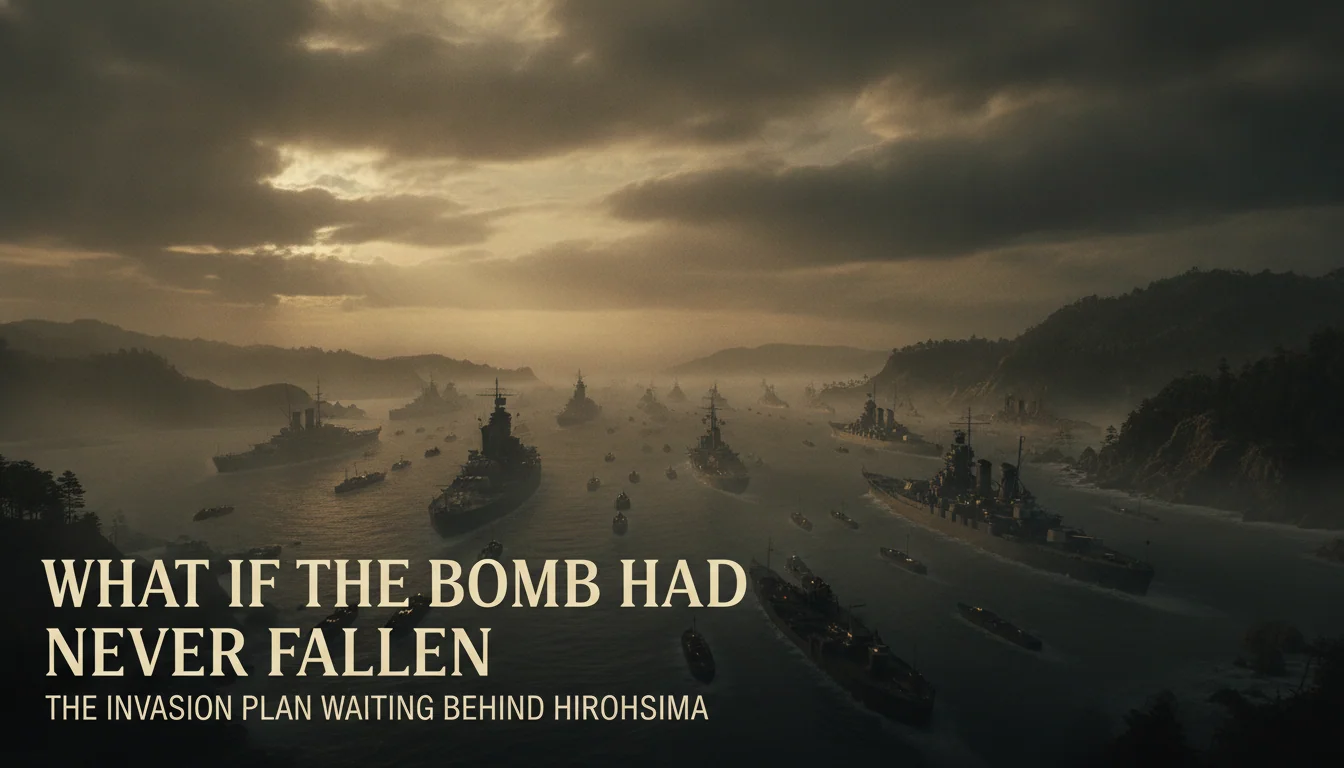
On August 6, 1945, a single American B-29 dropped one bomb on Hiroshima and killed tens of thousands of people within moments. Nine days later, Japan surrendered. The sequence looks, in hindsight, almost inevitable: bomb, then bomb again, then surrender. But American planners in the summer of 1945 were simultaneously preparing an entirely different ending to the war, one built around the largest amphibious invasion in history, and it is worth taking seriously what might have happened if Washington had gone that route instead.
What actually happened
By mid-1945, Japan's military situation was collapsing by any conventional measure. American submarines and mines had strangled its merchant shipping, a sustained firebombing campaign had devastated dozens of cities including a single raid on Tokyo in March that killed an estimated 100,000 people, and its navy and air force had been reduced to a fraction of their former strength. Yet Japan's government had not surrendered, and its military leadership, particularly the army, remained committed to a fight-to-the-end strategy built around inflicting such catastrophic casualties on any invading force that the Allies would negotiate rather than demand unconditional surrender.
The Allies had already drafted the alternative to negotiation: Operation Downfall, a two-phase invasion plan. Operation Olympic would land American forces on the southern island of Kyushu in November 1945, followed by Operation Coronet, a larger assault on the Tokyo plain of Honshu planned for the spring of 1946. Planning documents from the period show American commanders expected fierce resistance, informed by the brutal fighting already experienced at Iwo Jima and Okinawa earlier that year, where Japanese defenders had inflicted heavy casualties and civilian deaths had been catastrophic.
Instead, President Harry Truman authorized use of the atomic bomb, developed under the secret Manhattan Project, against Japanese cities. Hiroshima was bombed on August 6, and Nagasaki three days later on August 9, the same day the Soviet Union, honoring a commitment made at the Yalta Conference, launched a massive invasion of Japanese-held Manchuria. Japan's Supreme Council for the Direction of the War remained deadlocked between factions favoring surrender and those insisting on continued resistance until Emperor Hirohito personally intervened, in what is remembered in Japan as his "sacred decision," to accept the Potsdam Declaration's terms. Japan announced its surrender on August 15, 1945, days after a group of military officers briefly attempted a coup to seize the recorded surrender broadcast and prevent it from airing.
The point of divergence
The most plausible single change is not the invention of new Japanese resolve but a different decision in Washington: Truman choosing to rely on blockade, conventional bombing, and the shock of Soviet entry into the war, without using the atomic bomb, while continuing to prepare Operation Olympic as a fallback if Japan still had not surrendered by November. This is plausible because the decision to use the bomb was not universally settled even among Truman's own advisors and scientists; a documented minority, including some of the Manhattan Project's own physicists, argued for a demonstration of the weapon on an uninhabited target rather than direct use against a city, a position Truman's administration considered and ultimately rejected as unlikely to force a surrender on its own.
A second real, documented factor makes this divergence plausible rather than fanciful: American intelligence had intercepted and decoded Japanese diplomatic communications through the Magic program, revealing that Japan's government was divided and that some officials were exploring peace feelers, though none reached the point of accepting unconditional surrender before August 1945. It is reasonable to think that had Truman set aside the atomic option, the combination of continued blockade, conventional bombing, and the psychological impact of the Soviet invasion of Manchuria might still have pushed Japan's peace faction toward surrender, though on a slower and far less certain timeline than the nine days between Hiroshima and the actual surrender announcement.
The consequence chain
Without the atomic bombings, the most likely near-term outcome, grounded in the actual state of planning at the time, is that Operation Olympic proceeds as scheduled in November 1945. American war planners' own contemporary estimates, while varying considerably and now understood by historians to have been produced for competing bureaucratic purposes rather than as a single authoritative forecast, anticipated substantial American casualties in a Kyushu landing, potentially in the range of tens of thousands in the opening phase alone, with Japanese military and civilian casualties likely far higher given the fanatical defense mounted at Okinawa and the Japanese military's own doctrine of mobilizing civilians for close-quarters defense of the home islands.
A prolonged campaign would also plausibly have altered the endgame in the Pacific's northern theater. The Soviet Union's rapid advance through Manchuria in the real timeline was cut short by Japan's quick surrender; a longer war gives Soviet forces more time and more incentive to press further, and Soviet plans for landings on the northern island of Hokkaido were reportedly under consideration before Japan's surrender ended the question. It is plausible, though speculative, that a delayed Japanese surrender could have resulted in a Soviet-occupied zone on Hokkaido analogous to the postwar division of Korea and Germany, a scenario several historians have raised as a genuine possibility given Stalin's documented territorial ambitions in the region and the actual pace of the Soviet Manchurian offensive.
The atomic bomb's absence would also likely have delayed the war's end well beyond August 1945, plausibly into late 1945 or into 1946 if Operation Coronet became necessary, extending the suffering of Allied prisoners of war held in Japanese custody, whose treatment and survival odds were already precarious, and prolonging the strategic bombing and blockade campaign that was itself killing large numbers of Japanese civilians through starvation and firebombing raids that continued destroying cities throughout the summer of 1945.
The limits
What almost certainly would not have changed is the eventual outcome: an Allied victory and Japanese surrender, given the overwhelming material imbalance between Japan's shattered war economy and Allied industrial and naval superiority by mid-1945. It is reasonable to think Japan's defeat was not in serious doubt by this point in the war, only the timeline, the method, and the human cost of getting there.
Where the speculation should stop is any confident claim about exactly how many additional deaths a longer war would have produced, since the range of historians' estimates for both an invasion and for continued conventional bombing and blockade is genuinely wide and reflects real, unresolved disagreement about Japanese civilian mobilization, the durability of the peace faction's influence, and how quickly a naval blockade alone might have forced capitulation without any invasion at all. It is similarly speculative, though grounded in real Soviet military movements, to claim with confidence that a divided postwar Japan would have followed the German or Korean pattern rather than some other outcome entirely.
None of this is a claim about what would have happened, only a plausible chain traced from documented plans, real intelligence, and the actual military and political pressures bearing on Tokyo and Washington in the summer of 1945. The atomic bombings ended the war in days. The alternative, an invasion whose planning documents still exist in American and Japanese archives, remained the backup plan precisely because no one in August 1945 was certain the war would end any other way.
Quick Answers
Common questions about this topic
What actually happened with the atomic bombings of Japan?
The United States dropped atomic bombs on Hiroshima on August 6, 1945, and Nagasaki on August 9, 1945. The Soviet Union also invaded Japanese-held Manchuria on August 8. Japan's government announced its acceptance of the Potsdam Declaration's surrender terms on August 15, 1945, after Emperor Hirohito personally intervened to break a deadlock among his military and civilian leadership.
Was an invasion of Japan actually planned?
Yes. Operation Downfall was the codename for a two-phase invasion, Operation Olympic against the southern island of Kyushu planned for November 1945, and Operation Coronet against the Tokyo plain planned for spring 1946. Planning documents and troop allocations for both existed and were well underway by the summer of 1945.
How many casualties would an invasion of Japan have caused?
Estimates vary enormously and remain genuinely disputed among historians, ranging from tens of thousands to well over a million combined American and Japanese casualties depending on assumptions about Japanese resistance, kamikaze attacks, and civilian involvement in the defense. No single figure commands consensus, and any number should be treated as a rough planning estimate rather than a settled fact.
Would Japan have surrendered without the atomic bombs?
It is reasonable to think Japan would have eventually surrendered given its collapsing economy, naval blockade, and the Soviet entry into the war, but historians genuinely disagree on how much longer that might have taken and how many additional lives, Japanese and Allied, would have been lost in the meantime. This remains an actively argued historical debate, not a settled counterfactual.

Debate the Timeline
Chat with historical figures about how differently it could have gone.
Create your free account →No card required. Talk to anyone in history with 8 free credits a day. Some features require a paid plan.
Join the HistorIQly Club
Get smarter about the past.
Weekly stories, deep dives, and exclusive content straight to your inbox.