What If the Titanic Missed the Iceberg?
What if the Titanic missed the iceberg? The ship had roughly 37 seconds to react once it was spotted, and lookouts that night had no binoculars.
Read Wikipedia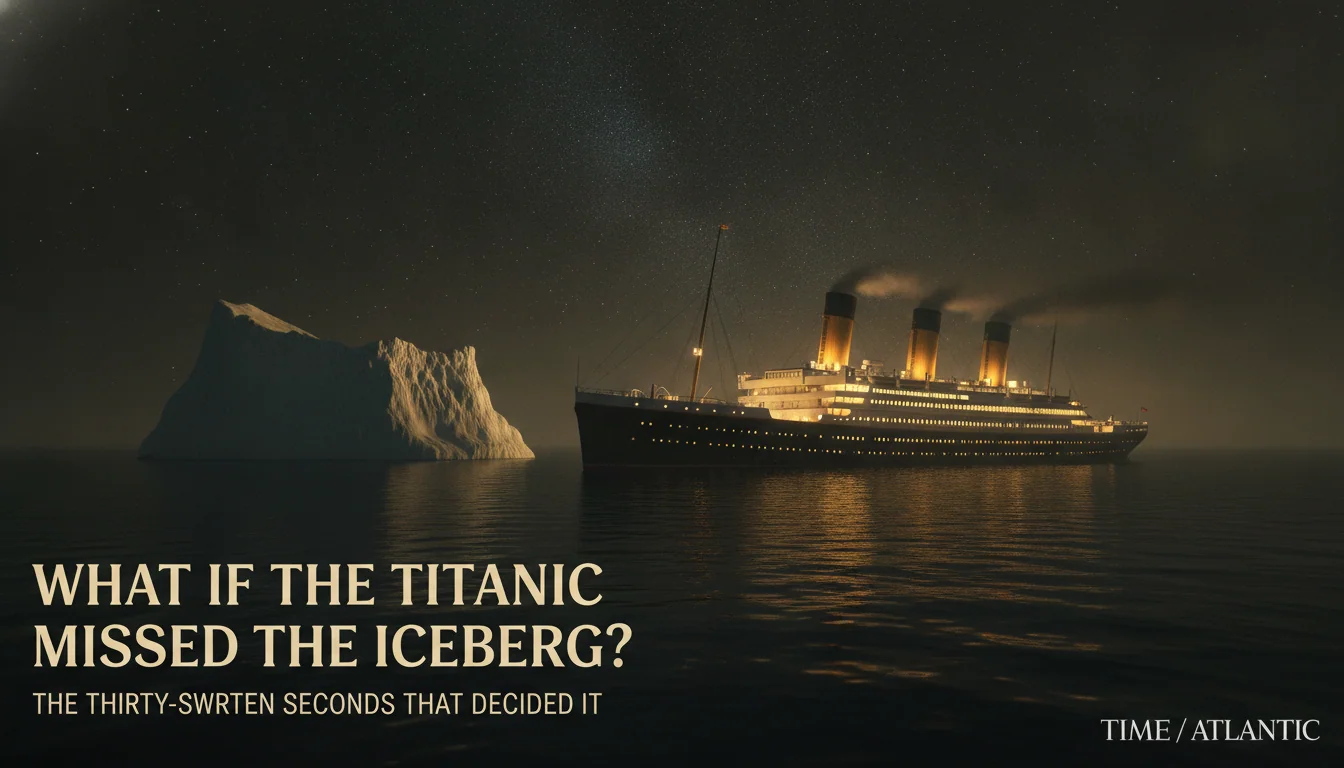
At 11:40 p.m. on April 14, 1912, lookout Frederick Fleet in Titanic's crow's nest spotted a dark mass rising out of the calm, moonless sea directly ahead. He rang the warning bell three times and telephoned the bridge: "Iceberg, right ahead." First Officer William Murdoch had perhaps thirty-seven seconds between that warning and impact. It was not enough. What if the Titanic missed the iceberg entirely?
What actually happened
Titanic was steaming at roughly 22 knots, near her top speed, through a stretch of the North Atlantic that had received multiple ice warnings from other ships over the preceding hours, several of which reached the ship's wireless operators but were not all relayed to the bridge with equal urgency, since the wireless room was, that night, also handling a backlog of passenger messages to Cape Race. The night was unusually calm and moonless, conditions that, counterintuitively, made icebergs harder rather than easier to spot, since there was no wave action breaking white water at the berg's base to catch a lookout's eye from a distance.
When Fleet's warning reached the bridge, Murdoch ordered the wheel put hard over and the engines reversed, a combination intended to both turn the ship and slow it. Titanic began to swing, but her length, over 880 feet, and her considerable momentum meant she could not complete the turn in the available distance. The iceberg scraped along the starboard side below the waterline for several seconds, not gouging one long open wound as popular imagination often pictures it, but buckling hull plates and popping rivets in a series of narrow gaps across roughly six of the ship's sixteen watertight compartments. Titanic had been designed to stay afloat with any two compartments flooded, or even four in some configurations, but not six. The ship was doomed within minutes of impact, though it took nearly two hours and forty minutes to fully sink, and 1,500 of the roughly 2,224 people aboard died, most from exposure in the freezing water rather than from drowning in the ship itself.
Investigators in both British and American inquiries afterward focused heavily on several contributing factors: the ship's speed given the ice warnings received, the decision to both turn and reverse engines rather than turn alone, which naval architects testified may have reduced the rudder's effectiveness at the critical moment, and the well-documented fact that the crow's nest lookouts had no binoculars that night, the pair intended for the voyage having reportedly been left locked in a cabinet whose key traveled off the ship with an officer reassigned before departure from Southampton.
The point of divergence
The most plausible point of divergence is a small one: Fleet or his fellow lookout Reginald Lee spotting the iceberg even thirty to sixty seconds sooner, whether through binoculars, marginally better visibility, or simple chance in a scan pattern across a dark horizon. Some maritime historians and naval architects have also argued a second, more technical divergence: Murdoch ordering a turn without simultaneously reversing the engines, since reversed propellers reduce water flow over the rudder and can measurably slow a ship's turning rate, a theory that remains debated rather than settled among Titanic researchers, some of whom argue the difference would have been marginal given how little time existed regardless.
Either change, even a modest one, plausibly gives Titanic the extra seconds and turning radius needed to scrape past the iceberg with a glancing blow, or clear it entirely.
The consequence chain
If Titanic had missed the iceberg cleanly, the most immediate and well-grounded consequence is straightforward: the ship continues to New York largely on schedule, all 2,224 passengers and crew arrive safely, and White Star Line's showcase liner completes her maiden voyage as intended, generating the kind of favorable press coverage the company had been counting on to compete with rival Cunard's Lusitania and Mauretania.
Beyond that immediate outcome, the consequence chain grows genuinely speculative and must be handled carefully. It is reasonable to think that, absent the disaster, the sweeping regulatory response that followed, including the 1914 International Convention for the Safety of Life at Sea, which mandated lifeboat capacity for all aboard, continuous wireless watch, and a formal International Ice Patrol, would not have arrived when it did. Whether comparable reforms would have eventually emerged from some other maritime disaster, given how common transatlantic ice-season crossings were, or been delayed by years or decades, cannot be known; the specific catalytic force of Titanic's scale and celebrity passenger list is difficult to substitute with a hypothetical alternative tragedy.
It is also plausible that White Star Line's later financial and reputational trajectory, and the broader public perception of transatlantic travel as fundamentally safe, would have looked different without the disaster, though the line still faced serious commercial pressure from Cunard and, within a few years, the disruption of the First World War regardless of Titanic's fate. Individual passengers who died, including prominent figures like industrialist John Jacob Astor IV, Macy's co-owner Isidor Straus, and mining magnate Benjamin Guggenheim, would presumably have continued their business and philanthropic activities, though tracing specific downstream effects of any one survival, beyond the general observation that their deaths removed significant wealth and influence from circulation at a particular moment, runs well past what the evidence can responsibly support.
The limits
What almost certainly would not have changed is the broader trajectory of early twentieth-century maritime engineering and the industry-wide tendency to build larger, faster liners with confidence that outpaced contemporary safety practice; that underlying pattern reflected competitive and commercial pressures across the whole industry, not a flaw unique to Titanic or White Star Line, and some other vessel or some other night in the same ice-choked shipping lanes could plausibly have produced a comparable disaster within a few years regardless. It is also worth noting that Titanic's crossing occurred during an unusually severe ice season in the North Atlantic that spring, meaning even a successful dodge of this particular iceberg would not have guaranteed a hazard-free remainder of the voyage.
Why the margin still fascinates
Part of what keeps this particular counterfactual so compelling, more than a century later, is how genuinely thin the documented margin was. This was not a case of an obviously doomed voyage narrowly failing to be saved by some sweeping structural change; it was a matter of seconds and a few hundred feet on a calm, clear night, decided by a handful of specific, traceable choices: a missing set of binoculars, a wireless room too busy with passenger telegrams to relay every ice warning promptly, and a maneuvering decision made in under a minute by an officer with no time to weigh alternatives. Naval historians have pointed out that Titanic's own sister ship, Olympic, and numerous other liners crossed the same ice-heavy waters that same week without incident, a reminder that the difference between a routine crossing and a maritime disaster that would define an era sometimes comes down to a matter of feet and seconds rather than any large systemic failure, much like Archduke Franz Ferdinand's driver taking a wrong turn two years later. For a broader look at how the ship's real record compares with its popular myths, see Titanic versus history.
A reminder
None of this is a claim about what did happen. It is an informed exercise in tracing plausible consequences from a genuinely documented near-miss margin of roughly half a minute and a few hundred feet, built on the testimony of the 1912 inquiries and the physical evidence gathered since the wreck's discovery in 1985. The actual history is what happened at 11:40 p.m. that night: a ship, an iceberg, and thirty-seven seconds that were not, in the end, quite enough.
Quick Answers
Common questions about this topic
What actually happened when the Titanic hit the iceberg?
On the night of April 14, 1912, lookout Frederick Fleet spotted an iceberg roughly a quarter mile ahead and rang the warning bell, giving the bridge under thirty-seven seconds to react. First Officer William Murdoch ordered the ship turned hard and the engines reversed, but Titanic's momentum meant it could not turn fast enough, and the iceberg scraped along roughly 300 feet of the starboard hull below the waterline, buckling steel plates and popping rivets across several compartments.
Could the Titanic have actually avoided the iceberg?
Plausibly, if the lookouts had spotted the berg even thirty to sixty seconds earlier, which some investigators have tied to the ship's missing binoculars in the crow's nest, or if Murdoch had ordered a turn without also reversing the engines, which some naval architects argue reduced the rudder's turning effectiveness at a critical moment. This is informed speculation about a genuinely contested historical question, not a documented alternative outcome.
Why didn't the lookouts have binoculars?
A pair of binoculars intended for the crow's nest had reportedly been left behind in a locker whose key was held by an officer transferred off the ship in Southampton before departure, and no replacement pair was issued for the voyage. Whether binoculars would have made a decisive difference at that distance and in those conditions is disputed among Titanic researchers.
How many people would have survived if the Titanic had missed the iceberg?
All 2,224 people aboard would very plausibly have survived the crossing entirely, since a near miss would have left the ship undamaged and free to continue to New York on schedule, though this assumes no other iceberg encounter occurred later that same night in a famously ice-choked stretch of the North Atlantic.

Debate the Timeline
Chat with historical figures about how differently it could have gone.
Create your free account →No card required. Some figures and features require a paid plan.
Join the HistorIQly Club
Get smarter about the past.
Weekly stories, deep dives, and exclusive content straight to your inbox.