The Zone of Interest vs. History: How Accurate Is the Auschwitz Commandant Film?
Zone of Interest historical accuracy: Glazer's film gets the Hoss household right. The thermal sequences are art, not archive. Score: 7/10 - and here is why.
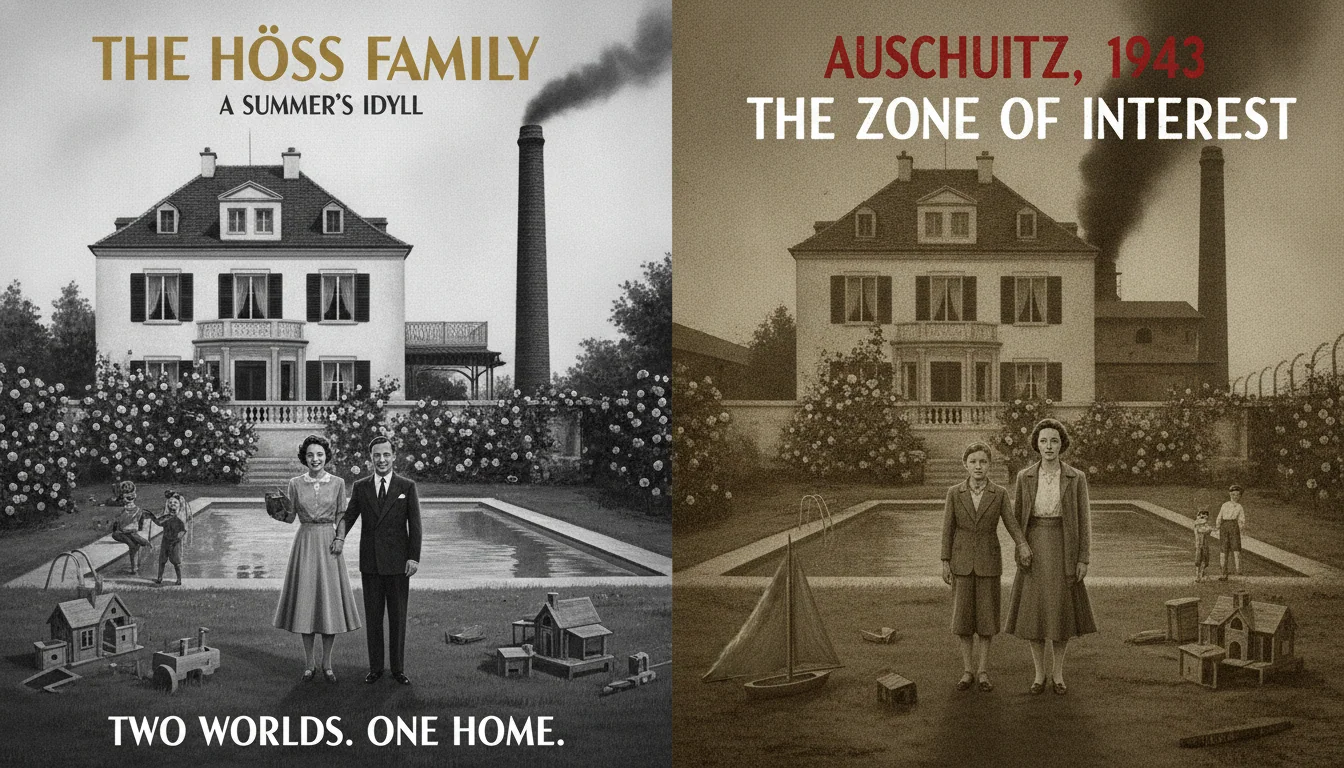
Jonathan Glazer's The Zone of Interest arrives as something unusual: a film about the Holocaust that never shows the Holocaust. We hear it through walls. We see its smoke. We watch Rudolf Hoss and his wife Hedwig manage a household, argue about curtains, host family gatherings, and discuss furniture - while the camp that Hoss runs sits twenty meters beyond the garden wall, audible and invisible.
The film won the Academy Award for Best International Feature Film in 2024. It also sparked the inevitable question that serious historical cinema always generates: what of this is real?
The answer is complicated, because The Zone of Interest is not trying to be a biopic in any conventional sense. Glazer is after a different kind of truth, and the film's relationship to the historical record reflects that priority. Some things it gets exactly right. Others it leaves undocumented. A few it deliberately reconstructs in ways that lean interpretive rather than archival. Understanding which is which makes the film considerably more interesting.
What the film gets RIGHT
The Hoss family at Auschwitz is documented fact
Rudolf Hoss - spelled Hoss, not Hoess - was commandant of Auschwitz-Birkenau from May 1940 to November 1943 and returned briefly in the spring of 1944 to oversee the deportation and murder of Hungarian Jews. During most of that time, he and his family lived in a villa immediately adjacent to the camp perimeter, on land that the SS had cleared from the village of Oswiecim.
This is not inference. It is one of the best-documented domestic arrangements in the history of the Holocaust, because Hoss himself described it in the memoir he wrote while awaiting trial in Warsaw - one of the most chilling documents to emerge from the postwar period - and because his wife Hedwig gave postwar statements about her life there. The Hoss family had five children. They swam in a pool on the grounds. They kept horses. Hedwig cultivated an elaborate garden.
Hedwig's attachment to the property is documented
Sandra Huller's Hedwig, who resists being moved even as the camp expands around her, is based on real statements. Hedwig Hoss described the Auschwitz estate as her paradise. She resisted pressures to relocate the family and was deeply invested in the house, the garden, and the life they had built there. This is not a screenwriter's invention. It is drawn from the historical record, and it is among the most disturbing facts about the Holocaust's domestic geography.
When the film shows Hedwig trying on a fur coat that has clearly come from a murdered deportee, or distributing confiscated cosmetics to her staff, it is working within a well-documented pattern of SS personnel and their families appropriating property from the murdered. This happened at Auschwitz and across the camp system.
The bureaucratic scenes are accurate in spirit
The film contains scenes in which Hoss meets with architects and engineers to discuss the expansion of the crematoria and the optimization of the killing process. These conversations, in which mass murder is discussed in the vocabulary of industrial logistics, are based on the documented reality of how the camp system was administered. Hoss's memoir describes his work in exactly this register: the problem to be solved, the bottleneck to be removed, the capacity to be expanded.
The Topf und Sohne company, which designed and built the crematoria at Auschwitz, is a documented case study in industrial collaboration with genocide. The bureaucratic indifference captured in Glazer's film reflects the historical record accurately.
The film was shot on location
The production rebuilt a period-accurate version of the Hoss villa adjacent to the actual Auschwitz site. The landscape, the proximity, the geography of a comfortable house abutting a murder complex - none of this required invention. The camera simply had to be pointed at what the site makes visible.
What the film invents or leaves undocumented
The visit of Hedwig's mother is compressed
The film includes a sequence in which Hedwig's mother visits, helps in the garden, and then leaves in the night, apparently horrified by what she has come to understand about the place. This is an effective scene but its historical basis is partial. While family members did visit the Hoss household, the specific arc of this character - arrival, dawning understanding, nocturnal departure - is a reconstruction without a clear documented source. It functions as the film's moral compass rather than a reported event.
The thermal camera sequences are interpretive
One of the film's most formally striking choices is a series of thermal-camera sequences, rendered in glowing infrared, that show a young girl in darkness moving through fields and buildings and hiding food at various locations. These sequences suggest that local Polish civilians were leaving provisions for camp laborers or prisoners.
Such acts of concealed aid did occur. Polish civilians around Auschwitz took enormous risks to help prisoners in various ways. But the specific sequences in the film are artistic reconstructions of a general historical truth rather than the documentation of a particular event. They are among the most beautiful images in the film and among the least strictly historical.
The film does not follow the historical timeline
The Zone of Interest does not attempt to trace Hoss's story chronologically. It does not show his 1943 transfer to Oranienburg to head the SS Economic-Administrative Main Office's concentration camp inspection unit. It does not show his return to Auschwitz in 1944 for the Hungarian deportations, during which approximately 430,000 Hungarian Jews were murdered in fewer than two months. It does not show his postwar flight, capture, memoir, trial, or execution.
These omissions are deliberate. The film is not a biography. But viewers who come to it expecting a complete portrait of Hoss's life and crimes will leave with a partial picture.
The film departs significantly from the Martin Amis novel
Glazer's film takes its title and its central conceit from Martin Amis's 2014 novel, but little else. The novel uses fictional characters: its commandant is named Paul Doll. The novel unfolds through a more satirical, literary register and covers a different time frame. Viewers who read the novel expecting the film to follow it, or vice versa, will find two distinct works that share only their premise and their moral concern.
Historical accuracy score: 7/10
The Zone of Interest scores well by the metrics that matter most to it: the factual setting, the documented behavior of the Hoss household, and the bureaucratic normality with which mass murder was planned and discussed. It is anchored in the real and builds its argument from the real.
It loses points not for dishonesty but for the selectivity and compression inherent in its artistic choices. The thermal sequences are beautiful and plausible but not documented. The mother's departure is inferred from what we know about complicity and realization, not transcribed from a record. The full historical arc of Hoss's guilt and punishment is absent.
But the score may also be the wrong frame. Glazer's film is not arguing that its scenes happened exactly as shown. It is arguing something stranger and more disturbing: that a man who supervised the murder of more than a million people could spend those same years planting a garden, celebrating birthdays, and worrying about whether his children were happy. That argument is not a fiction. It is one of the most rigorously documented facts of the twentieth century.
The film's accuracy lies in what it refuses to dramatize. It will not show you the camp's interior. It will not give you the catharsis of witnessing atrocity. It insists that the horror is the domestic scene - the garden, the laughter, the barbecue by the wall - and in that insistence it is, by the standards of documentary truth, correct.
For a direct comparison with Hollywood's most celebrated Holocaust film, see Schindler's List vs. History. For the film that portrays a Warsaw survivor's story, see The Pianist vs. History.
Quick Answers
Common questions about this topic
Is The Zone of Interest based on a true story?
The film is based on Martin Amis's 2014 novel of the same name, but departs significantly from it. Where the novel uses fictional characters, the film uses the real names of Rudolf Hoss, Auschwitz commandant, and his wife Hedwig. The core premise - a family living a comfortable domestic life in a villa next to Auschwitz - is historically accurate.
Did Rudolf Hoss really live next to Auschwitz?
Yes. Hoss was commandant of Auschwitz from 1940 to 1943 and briefly returned in 1944. He and his family lived in a villa immediately adjacent to the camp perimeter. His wife Hedwig cultivated an extensive garden on the grounds and by her own postwar account considered the estate her paradise.
What happened to Rudolf Hoss after the war?
Hoss disguised himself as a farm laborer and evaded capture for over a year after Germany's defeat. He was found by British forces in March 1946, testified at the Nuremberg trials, and was extradited to Poland. He was tried in Warsaw, convicted, and hanged at Auschwitz on April 16, 1947.
How accurate is The Zone of Interest compared to other Holocaust films?
The film is unusual in that it is not trying to be a conventional historical drama. It accurately depicts the documented domestic reality of the Hoss household, including Hedwig's obsession with her garden, the proximity to the camp, and the bureaucratic indifference to mass murder. Its accuracy lies in atmosphere and framing rather than scene-by-scene historical fidelity.

Debate the Accuracy with the Real Figures
Ask the real people what Hollywood got wrong about their lives.
Chat with HistoryJoin the HistorIQly Club
Get smarter about the past.
Weekly stories, deep dives, and exclusive content straight to your inbox.