Roman Concrete: The Self Healing Seawater Formula That Outlasts Modern Cement
Roman concrete harbors have stood in the surf for two millennia while modern seawalls crumble in decades. A 2023 MIT study finally explained why.
Read Wikipedia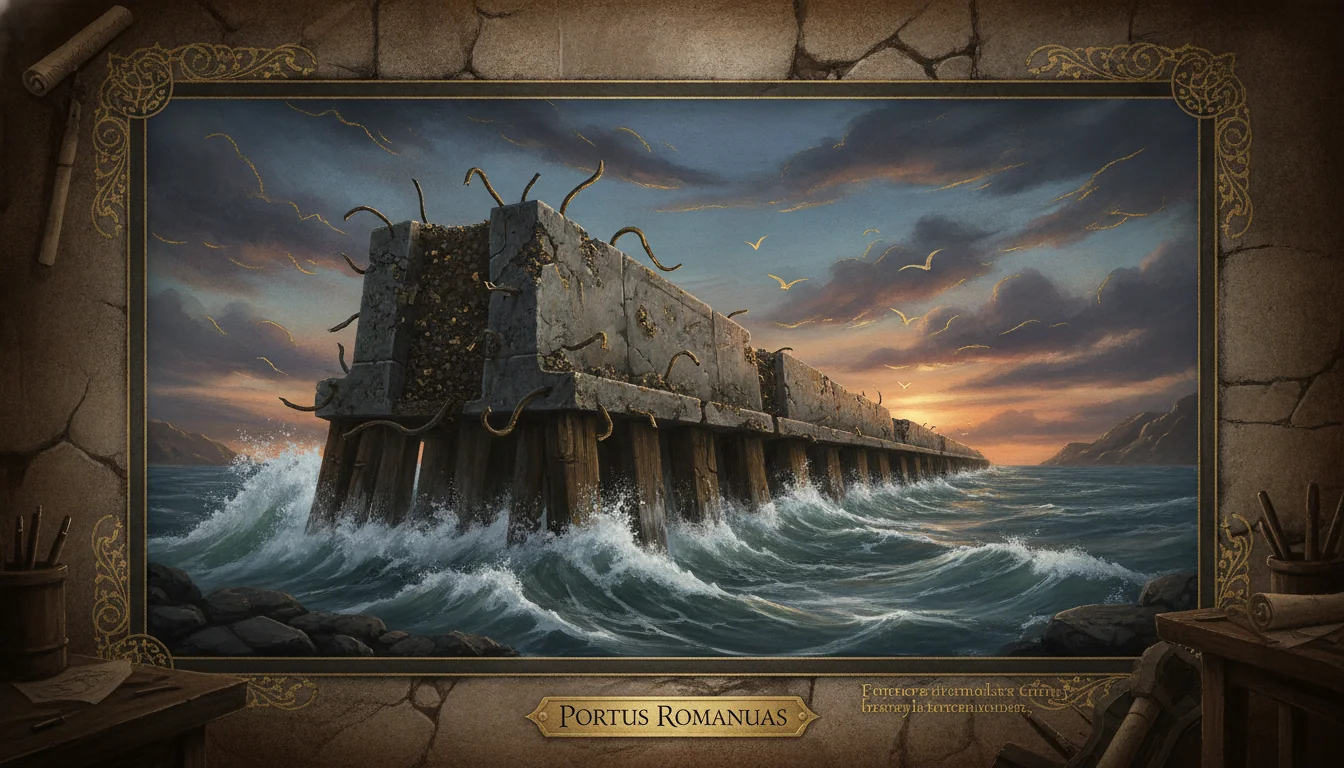
A Roman breakwater at Portus Cosanus, on the coast of Tuscany, has been sitting in salt water since before the birth of Christ. It is still there. A concrete boat ramp poured along the same coastline in the mid-1960s, by contrast, is already crumbling, its steel reinforcement rusting and splitting the material from the inside. For decades this was an amusing footnote about ancient overengineering. Then in early 2023 a team led by MIT materials scientist Admir Masic published a study explaining, at the chemical level, why Roman concrete does not just resist damage but appears to repair it. The paper went viral, and search interest in "Roman concrete" has stayed elevated ever since, flattening a decade of careful geology and chemistry into a single line about ancient super-cement. The real story is better than the meme, and it is a story about people, not magic.
The impossible object
Roman concrete, known to archaeologists as opus caementicium, was used to build the Pantheon's dome, the piers of Trajan's harbor at Ostia, the vaults of Roman bathhouses, and hundreds of miles of aqueduct. The Pantheon's dome, finished in the early second century AD under Hadrian, remains the largest unreinforced concrete dome on Earth and has needed remarkably little structural repair in nearly two thousand years. Roman harbor works are even more startling, because concrete poured directly into seawater is exactly the environment where modern concrete fails fastest: chloride ions eat into steel rebar, the rust expands, and the surrounding concrete splits from within, a process engineers call spalling. Most modern marine concrete needs major repair within 50 years and is not expected to last a century. Roman marine concrete has been submerged for roughly 2,000 years and, in places, is measurably stronger than when it was poured.
Geologists studying core samples pulled from these structures long noticed strange white lumps embedded throughout the material, called lime clasts. Standard concrete science treats visible lumps as a mixing failure, evidence of a sloppy batch. Nobody could explain why Roman engineers, who clearly knew what they were doing given how their buildings have performed, would tolerate an obvious defect running through every sample ever tested. That contradiction is what set the more recent research in motion.
How it actually worked
Roman concrete combined four ingredients: quicklime (calcium oxide), volcanic ash, water, and a coarse aggregate of rubble, brick, or tuff called caementa. The volcanic ash is the ingredient modern chemists get excited about. Ash from the area around Pozzuoli, near the Bay of Naples and known to the Romans as pulvis puteolanus, is rich in reactive silica and alumina. Mixed with lime, it undergoes what is called a pozzolanic reaction, forming durable calcium-silicate-hydrate bonds instead of the weaker compounds that form when lime cures with ordinary sand.
The 2023 MIT-led study focused on how that lime was prepared. The longstanding assumption was that Roman builders slaked their lime first, mixing quicklime with water in a controlled process to make a smooth putty before combining it with ash and aggregate. Analysis of ancient samples suggested something different: Roman workers frequently mixed quicklime directly with the ash and water on site, a technique researchers call hot mixing, because the reaction of quicklime with water releases substantial heat. Hot mixing is messier and faster than pre-slaking, and it leaves undissolved chunks of reactive lime scattered through the finished concrete, the very lime clasts long dismissed as sloppy work.
Those clasts, it turns out, are not a defect. They are a repair mechanism. Concrete inevitably develops microcracks from thermal expansion, settling, and load. When a crack reaches a lime clast, water seeping through dissolves calcium from the clast, and that calcium-rich solution recrystallizes as calcium carbonate, growing new mineral that fills the crack from the inside. Masic's team tested the mechanism directly: they cracked lab-made samples, some containing lime clasts and some made the "correct" pre-slaked way with none, then ran water through the cracks. The clast-bearing samples sealed themselves within about two weeks and stopped the water flow entirely. The clast-free samples never healed. The Romans had not made a mistake. They had built in redundancy.
The seawater story runs on a related but distinct mechanism, worked out over the prior decade by geologist Marie Jackson and colleagues, who drilled and analyzed cores from Roman harbor structures at sites including Baiae, Portus Cosanus, and Caesarea. In marine concrete, seawater percolating through the pozzolanic matrix over years and decades reacts with the volcanic minerals to grow new crystals, including a rare aluminous form of the mineral tobermorite and a related mineral called phillipsite. These crystals interlock through the concrete's pore structure, effectively knitting the material tighter the longer it sits in the ocean. Pliny the Elder, writing in the first century AD, described concrete piers exposed to the waves as becoming "a single stone mass, impregnable to the waves, and every day stronger." He was, it turns out, reporting a real chemical process rather than exaggerating for effect.
Who built it, and why
None of this was one inventor's discovery. Roman concrete construction developed gradually from the third century BC onward, likely building on earlier Greek and Etruscan lime-mortar traditions, and it matured into a mass-production system that supported the largest building program the ancient world had seen. The architect Vitruvius, writing in the first century BC, devoted part of his treatise De Architectura to the correct proportions of lime and pozzolana for different applications, including underwater work, which tells us the Romans understood they were using a specialized recipe rather than generic mortar.
The problem the technique solved was straightforward: Rome needed harbors, aqueducts, bathhouses, and public buildings built faster and cheaper than cut stone allowed, using a material that could be poured into a wooden form by relatively unskilled labor and still perform for centuries. Concrete let Roman engineers build domes and vaults with no precedent in stone architecture, because unlike a stack of cut blocks, poured concrete acts as a single continuous mass with no seams to fail along. The empire's engineering corps, its shipping network for hauling volcanic ash from the Bay of Naples across the Mediterranean, and its supply of skilled lime burners turned that materials advantage into thousands of buildings, harbors, and roads.
How the recipe was lost
The recipe did not survive the empire that built it. Producing hot-mixed pozzolanic concrete at scale required a specific supply chain: quarried volcanic ash from a handful of sources, kilns and skilled labor to burn quicklime, and engineering knowledge to proportion the mix for a given application, whether a bathhouse floor or a harbor mole. When the western Roman Empire fragmented in the fifth century AD, that supply chain and the institutional knowledge behind it broke apart along with the rest of the imperial economy. Nobody suppressed the technique or guarded it as a secret. It simply stopped being economically viable once the shipping networks, tax base, and centralized projects that justified it disappeared.
Medieval European builders reverted to simpler lime mortar bound with local sand, adequate for smaller buildings but nowhere near as durable, and to cut stone and brick for anything meant to last. Concrete construction did not meaningfully return until the invention of Portland cement in the early 19th century gave builders a manufactured, standardized binder that set reliably without needing a specific volcanic ash deposit. Portland cement was a better product for the industrial age: consistent, fast-curing, and compatible with the steel reinforcement that makes modern skyscrapers and bridges possible. It also traded away the self-healing chemistry the Romans had stumbled onto, because steel rebar and lime clasts do not mix well, and because speed and standardization mattered more to 19th-century builders than a repair mechanism that might not matter for a century or two.
Rediscovery and the honest state of replication
Interest in Roman concrete's durability goes back well over a century among archaeologists, but the materials-science push started in earnest in the 2000s, when an international research effort known as ROMACONS drilled core samples directly from Roman harbor structures for laboratory analysis rather than relying on surface observation. That work, led substantially by Jackson, identified the aluminous tobermorite crystal growth behind the seawater durability. The MIT-led 2023 study built on that foundation by explaining the separate, more general self-healing role of lime clasts, applicable to Roman concrete on land as well as at sea.
The honest state of replication is a partial success. Researchers have reproduced hot-mixed, lime-clast concrete in the lab and demonstrated real self-healing behavior on the timescale of weeks, and at least one startup connected to the MIT research has been working to commercialize the process. What nobody can yet do is prove that a lab-made batch will perform the way Roman concrete has performed, because that claim rests on roughly 2,000 years of evidence only time itself can generate. Modern construction also still depends on steel-reinforced concrete for tensile strength in tall buildings and long-span bridges, a requirement the Romans never had to solve since their structures worked in pure compression, and reactive lime clasts do not obviously make a good chemical match with steel. Roman concrete was never a lost superweapon. It was a well-engineered answer to the problems its builders faced, refined by generations of practical experience, and it happened to solve the seawater-durability problem so thoroughly that it embarrassed the industrial world that replaced it.
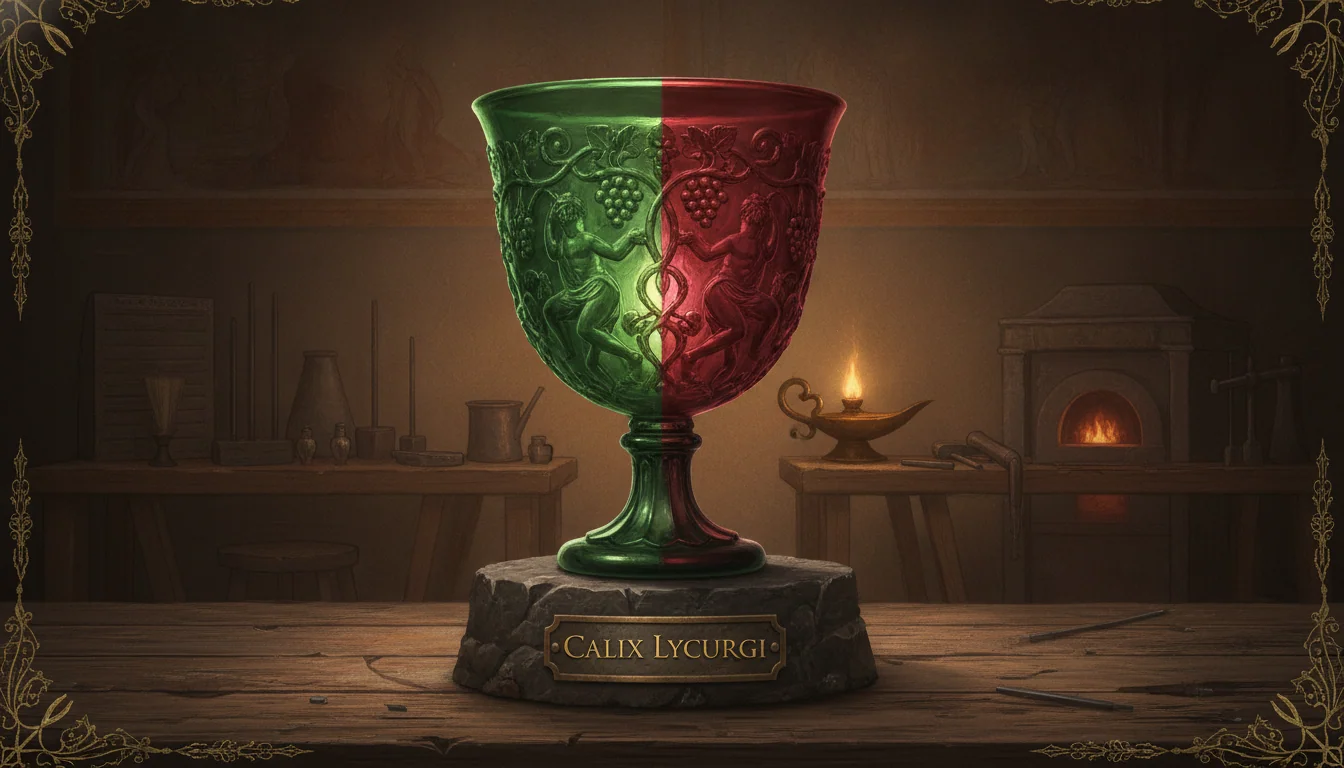
Roman concrete is not the only ancient object that has embarrassed modern materials science. The same pattern, an effect dismissed as folklore until an electron microscope proved it real, shows up in the Lycurgus Cup, a Roman glass vessel that changes color through nanoparticle chemistry nobody could explain until 1990. It also shows up in the Baalbek trilithon, whose 800-ton stones still leave modern engineers short on explanations for how they were moved.
Quick Answers
Common questions about this topic
How did Roman concrete actually work?
Roman builders mixed quicklime, volcanic ash, and rock aggregate using a hot-mixing process that left reactive lime clasts scattered through the concrete. When cracks later formed, water reached those clasts and triggered a chemical reaction that filled the crack with new mineral, effectively healing it. In harbor structures, the same volcanic ash reacted with seawater over decades to grow interlocking crystals that made the concrete denser with age instead of weaker.
Who invented Roman concrete?
There was no single inventor. Roman engineers refined the technique over centuries, and the process was documented by writers such as Vitruvius and Pliny the Elder, who both described mixing lime with volcanic ash from the area around modern Pozzuoli. The scale and consistency came from the organized labor, quarries, and kilns that supported Roman public works across the empire.
Why did the Roman concrete recipe get lost?
The technique depended on a supply chain of specific volcanic ash, skilled lime burners, and imperial engineering projects big enough to justify it. When the western empire fragmented, that infrastructure collapsed and builders reverted to simpler stone and brick masonry. The recipe was never formally banned or hidden; it simply had no economy left to support it, and it stayed lost for well over a thousand years.
Can we make self-healing Roman concrete today?
Laboratories have reproduced hot-mixed, lime-clast concrete and shown that cracked samples seal themselves within weeks under running water, and at least one startup is trying to bring the process to market. It has not replaced modern concrete, though, because skyscrapers need steel-reinforced concrete for tensile strength, a problem Roman engineers never solved, and no lab test can yet prove a modern mix will last two thousand years the way the original did.

Meet the Ancient Engineers
Chat with the inventors who built the impossible centuries early.
Create your free account →No card required. Some figures and features require a paid plan.
Join the HistorIQly Club
Get smarter about the past.
Weekly stories, deep dives, and exclusive content straight to your inbox.