Arsenal: The Bowie Knife
Bowie knife history: how a Mississippi sandbar duel in 1827 made a blade legendary, spread it across the American frontier, and prompted knife laws across the South.
Read Wikipedia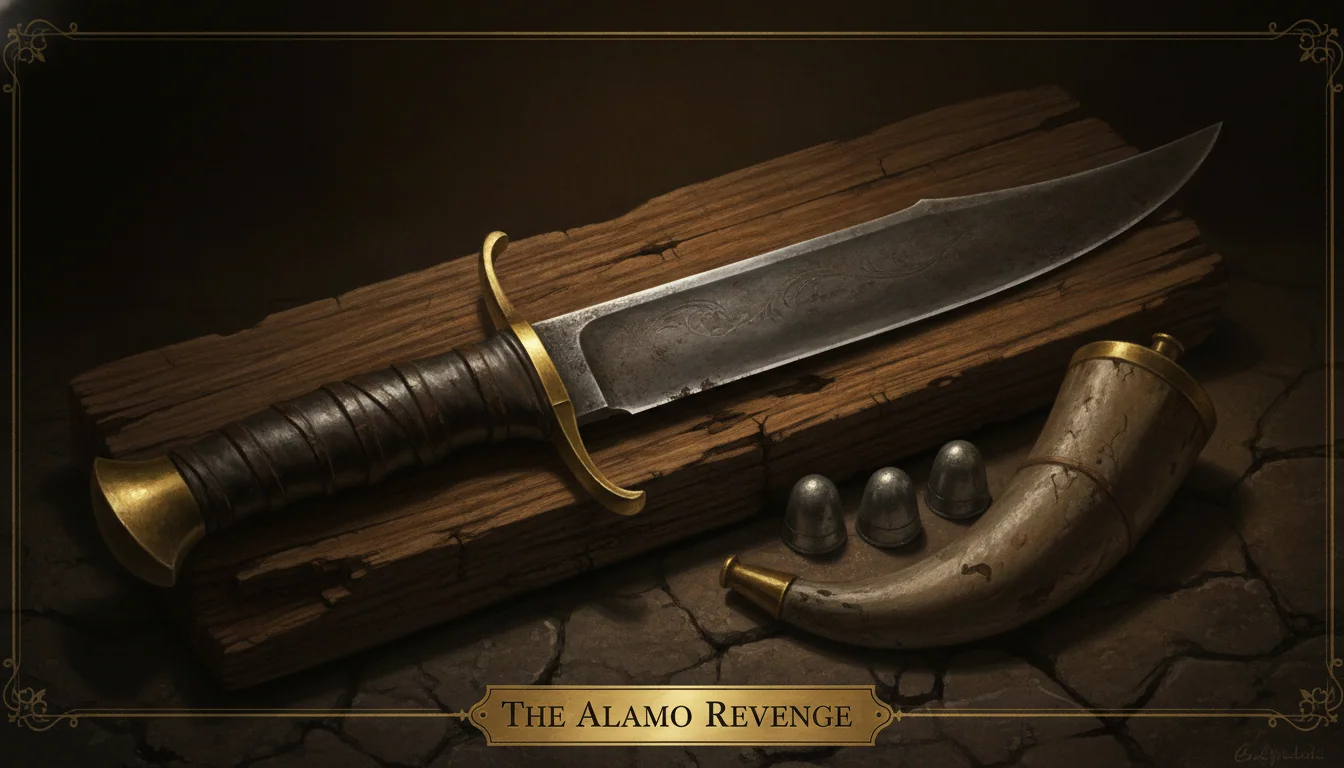
On September 19, 1827, on a sandbar in the Mississippi River near Natchez, a group of men who had just witnessed a duel between two other men got into a second, worse fight. One of them was James Bowie of Louisiana, who had come as a second in the original duel and had enemies on the opposing side. During the melee that followed, Bowie was shot twice and stabbed twice. He survived by using a large butcher-style knife to gut one of his attackers, stab another, and generally demonstrate that a man who could still stand was a man who could still fight.
The Sandbar Fight became one of the most reported violent incidents in antebellum American newspapers. The knife survived and became a legend. Within a decade, the "Bowie knife" was a cultural category, a legal problem, and an American institution.
Origins and disputed credit
The origin of the specific blade Jim Bowie carried at the Sandbar Fight is genuinely unclear. His brother Rezin Bowie wrote a letter decades later claiming that he had designed a large hunting knife and given it to Jim after Jim was wounded in a different altercation. That knife, or a version of it, was what Jim carried to the sandbar.
There is a second founding story involving a blacksmith named James Black, working in Washington, Arkansas, who reportedly forged a knife to Jim Bowie's specification sometime around 1830. Black's knives, made by a method he kept secret and that some claimed produced steel of unusual quality, became sought after across the frontier. Whether the Black version preceded or followed the Sandbar knife is impossible to establish definitively.
What is clear is that by the early 1830s, "Bowie knife" designated a recognizable type rather than a single weapon: a large fixed-blade knife, single-edged, with a clip point and usually a crossguard. The clip point was functionally significant - by curving the spine down toward the tip, it created a false edge along the top of the blade near the point, useful for thrusting and for certain cutting tasks that a simple drop point could not manage as well. The crossguard kept a wet or bloody hand from sliding forward onto the blade during a thrust - similar thinking to what made the Roman gladius effective in close infantry combat centuries earlier.
These features were not coincidences of craft. They were a design that had thought through what a close-quarters fight with a large knife actually required.
The sandbar and the legend
The Sandbar Fight of 1827 is worth understanding as more than a brawl. It was a public event attended by witnesses, reported in detail by newspapers across the South, and retold in ways that made Jim Bowie simultaneously a hero of almost supernatural toughness and a representative of a frontier masculinity that mixed self-defense, personal honor, and casual lethality.
Bowie had arrived at the sandbar as a second to one of the dueling parties. The duel itself, between Samuel Wells and Thomas Maddox, ended without casualties after both men fired and missed. What followed involved Bowie and several others who had grievances unrelated to the original dispute. Bowie was shot once, then stabbed with a sword-cane, then shot again as he grabbed his attacker. He used his knife to kill Major Norris Wright, a long-standing enemy, before collapsing from blood loss.
He recovered. Wright did not. The newspapers did the rest. Stories circulated in which Bowie's knife was described variously as a short sword, a dirk of supernatural length, a hand-and-a-half blade, and a weapon specifically designed to kill. Most of these accounts were wrong in detail. All of them understood that something significant had happened at that sandbar, and that the knife was the point of the story.
Texas and the Alamo
Jim Bowie moved to Texas in 1828, married a Mexican woman of aristocratic family named Ursula de Veramendi, and became a fixture of the turbulent politics of the Mexican province. He was already famous for the knife. He was now also a land speculator, a soldier of fortune, and a man with deep personal roots in a territory that was about to pull itself apart.
When the Texas Revolution began in 1835, Bowie was a natural participant. He commanded forces at the Battle of Concepcion in October 1835, one of the early Texian victories. In early 1836 he was at the Alamo garrison in San Antonio, jointly commanding with William Barret Travis while Jim continued to be seriously ill, possibly with typhoid fever or pneumonia.
Santa Anna's Army arrived and besieged the Alamo beginning in late February 1836. The final assault came on March 6. Bowie was by then too ill to stand. Every defender of the garrison died. The accounts of how Bowie met his death vary: several claim he was killed fighting from his cot, others that he was killed in the final rush through the mission buildings. His wife and both children had died of cholera the previous year. He had nothing to go home to.
The Alamo made Bowie and his knife permanently legendary. In the popular imagination they became inseparable from the founding mythology of Texas.
The knife as social problem
The Bowie knife spread across the American South and frontier West with a speed that alarmed legislators, foreign observers, and newspaper editors. By the mid-1830s, affordable versions of the basic design were being produced by cutlers in Sheffield, England, and shipped to American markets in quantity. You could buy one at any reasonable hardware or general store.
The result was a culture of knife-carrying that European visitors found frankly disturbing. Friedrich Gerstacker, a German travel writer who spent years in the American backcountry in the 1840s, wrote extensively about the prevalence of large knives at every gathering of men, and about the specific social codes around when and how they were used. An English traveler named Frederick Marryat noted that Bowie knives were carried as casually as walking sticks, and that dueling culture in the South had partially migrated from pistols to knives for reasons of economy and intimacy.
Several Southern states responded with legislation. Arkansas passed a law in 1837 taxing the sale of Bowie knives and related weapons. Alabama, Louisiana, Tennessee, and Georgia followed with their own restrictions, all specifically naming the Bowie knife. The laws acknowledged by name what they were trying to regulate, which was unusual legislative candor. Enforcement was erratic. The knives did not disappear.
Technical evolution
The original Bowie design evolved across the antebellum period in the direction of size and specialization. Makers produced hunting knives in the Bowie tradition, fighting knives with more pronounced false edges, and presentation pieces intended more for display than use.
The Sheffield trade produced a particularly notable variant: heavy knives with etched blades bearing patriotic American imagery, including eagles, flags, and mottoes, that were exported specifically for the American market. These were made in England for American buyers who wanted the Bowie aesthetic but lacked access to frontier smiths. They sold in large numbers.
By the time of the Civil War, Bowie-style knives were standard personal equipment for many Confederate soldiers, who carried them into the field alongside firearms. Union soldiers were more uniformly equipped with bayonets, but Southern volunteers often arrived with large personal knives that they considered essential. The knives saw use in the early months of the war, when both sides still expected close-quarters fighting to be decisive. As the conflict became a war of rifles and artillery, the large knife receded to a secondary role.
The decline
The Bowie knife did not disappear. It did lose its primacy. The revolver, particularly the Colt Single Action Army after 1873, displaced the large knife as the preferred means of self-defense across the American West. A revolver gave you six shots at distance. A Bowie knife required you to be close enough to smell your opponent.
What persisted was the design language. The clip point, the crossguard, the substantial blade length, the leather-wrapped handle - these elements entered the mainstream of American knife design and have never entirely left it. Modern hunting and survival knives owe a recognizable debt to the 1830s frontier form. The KA-BAR knife, the USMC's fighting utility knife used through World War II and beyond, is a lineal descendant of the same basic concept.
Jim Bowie himself never saw any of it. He died at 41 in a besieged mission in Texas. The knife outlived him by two centuries and is still outliving him.
Quick Answers
Common questions about this topic
Who invented the Bowie knife?
The attribution is disputed. Jim Bowie made the knife famous after the Sandbar Fight of 1827, but his brother Rezin Bowie claimed in a later letter that he had designed the original and given it to Jim. A blacksmith named James Black, working in Arkansas, is credited in some accounts with forging the most famous version, though the exact design is debated.
What made the Bowie knife distinctive?
A Bowie knife is generally a large fixed-blade knife with a single-edged blade between 8 and 15 inches long, a clipped point, and a crossguard to protect the hand. The clipped point - where the spine curves down near the tip - creates a sharp false edge useful for thrusting. The combination of size, the crossguard, and the versatile point made it formidable in close combat.
What happened to Jim Bowie at the Alamo?
Jim Bowie died at the Battle of the Alamo on March 6, 1836, along with the other approximately 180 defenders of the garrison. He had been seriously ill, probably with typhoid fever or pneumonia, in the weeks before the final assault and was unable to stand. Accounts of how he died vary: some say he was killed in his sickbed, others that he fought to the last from his cot.
Why did states pass laws against Bowie knives?
Between roughly 1836 and 1860, several Southern states including Arkansas, Alabama, Louisiana, Tennessee, and Georgia passed laws restricting or taxing the concealed carry of Bowie knives, specifically named. The knives' prevalence in dueling and spontaneous violence alarmed legislators and visitors alike. The laws were inconsistently enforced but reflected genuine social anxiety about a weapon that had become culturally ubiquitous.

Talk to the People Who Wielded These Weapons
Chat with the soldiers, smiths, and commanders whose lives were shaped by the weapons of their age.
Create your free account →No card required. Some figures and features require a paid plan.
Join the HistorIQly Club
Get smarter about the past.
Weekly stories, deep dives, and exclusive content straight to your inbox.