Arsenal: The Bren Light Machine Gun
Bren gun history spans five decades: the Commonwealth's most trusted light machine gun, designed in Brno and built at Enfield, served from 1938 to the Falklands.
Read Wikipedia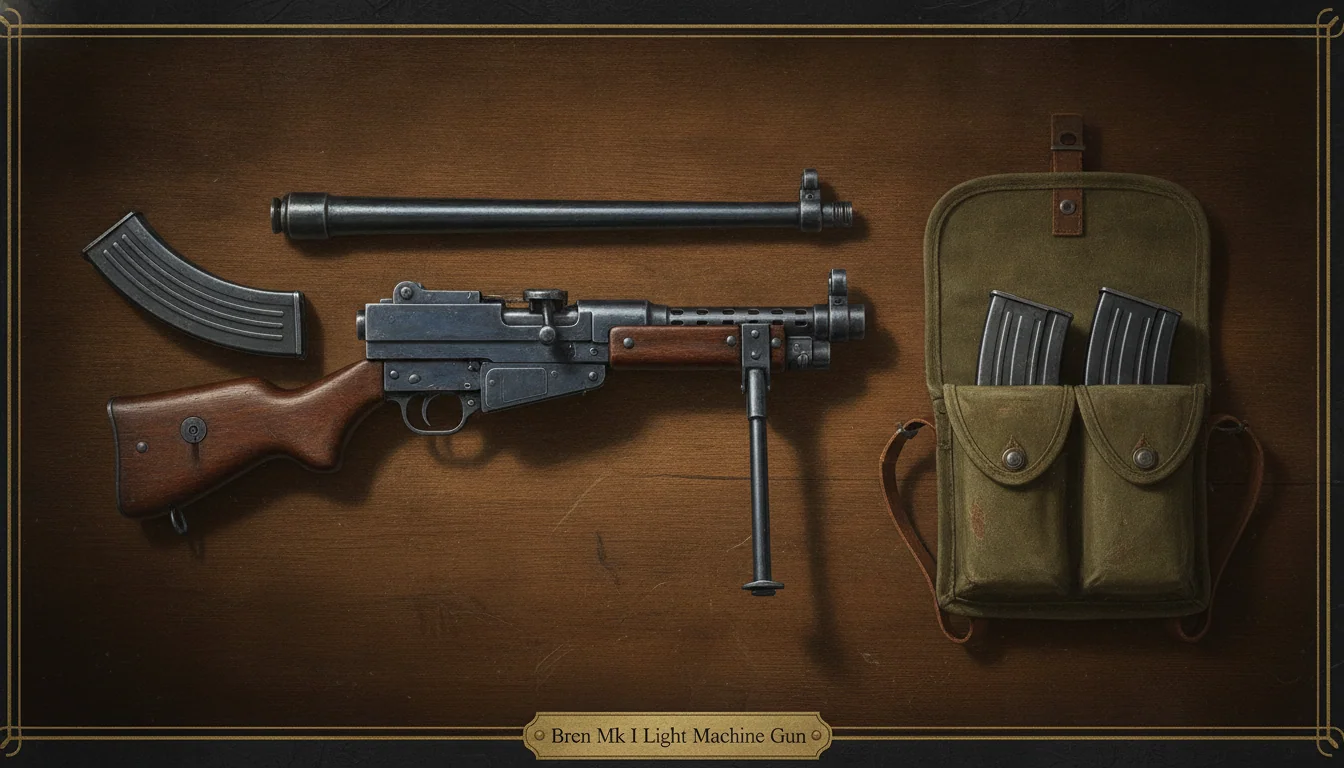
Somewhere in Brno, a city in Moravia that had been making arms since the 16th century, a designer named Vaclav Holek sat down in the mid-1920s with a specific problem. The new science of infantry tactics, refined through four years of Western Front horror, demanded a machine gun that a single man could carry, move, and fire accurately in short bursts. It had to be reliable in dirt. It had to be simple enough for a conscript to maintain. It had to be more accurate than its predecessor, the Lewis gun, and considerably lighter than the water-cooled Vickers that had anchored British defensive lines throughout the Great War.
What Holek built became the Bren. His name is not on the weapon. Brno's is, and so is Enfield's. But the gun that resulted from his work would be carried into combat by Commonwealth soldiers for five decades across three continents.
From Brno to Enfield
The ZB vz. 26, produced at Zbrojovka Brno from around 1926, was an immediate commercial success. Its tilting bolt and quick-change barrel were elegant solutions to the light machine gun's two hardest problems: reliability under sustained fire and the overheating that turned a sustained-fire weapon into a liability. Czechoslovakia adopted it. China bought it in large numbers. Bolivia used it in the Chaco War.
Britain noticed. The War Office had been looking for a replacement for the Lewis gun for years. A series of competitive trials between 1930 and 1935 evaluated multiple designs, and the ZB vz. 26 and its evolved variants consistently outperformed the competition for reliability and accuracy.
The problem was calibre. Britain used the .303 rimmed cartridge, while the Czech designs were built around 7.92mm Mauser, a rimless round that fed more smoothly from box magazines. Holek and his brother Jan, working with British engineers at Enfield, adapted the design to accept .303 while retaining the tilting bolt. The resulting gun was approved for service in 1938 and given the name that fused its two birthplaces.
The Royal Small Arms Factory at Enfield began production. So did the John Inglis Company in Canada, producing Brens for Canadian and Chinese forces. The gun that came off those production lines weighed about 10.3 kilograms loaded, measured 115 centimeters overall, and had a cyclic rate of approximately 500 rounds per minute - deliberately throttled compared to the 1,000-plus rpm of many contemporary designs, a feature that turned out to be one of its greatest advantages. The German MG 42, introduced in 1942, would demonstrate what the opposite approach looked like: around 1,200 rounds per minute, feared for its distinctive sound but far more demanding of ammunition and barrel changes under sustained fire.
The top-mounted magazine and what it meant
The Bren's most visible distinguishing feature was its curved 30-round box magazine mounted on top of the receiver, curved because .303 cartridges have a pronounced rim that demands a curved feed path. The design meant the gunner had to use offset iron sights set to the left side of the receiver, but it brought real benefits.
A machine gun fired prone, with its magazine hanging below the receiver, lifts the barrel further from the ground. The Bren's top-mounted feed allowed the barrel to sit low, which meant a prone gunner presented less of himself to incoming fire. In the flat open terrain of the North African desert or the paddy fields of Burma, the centimeters this saved mattered.
The magazine held 30 rounds, though experienced gunners loaded 28 to reduce feed-spring tension. The number was enough for a disciplined burst, a pause, and another burst - which was how the Bren was supposed to be used. Gunners who pulled long trigger-holds burned through magazines faster than their loaders could keep pace, heated their barrels faster than the quick-change mechanism was meant to compensate, and reduced what was an accurate automatic weapon to a spray-and-pray liability. Used as intended, the Bren was something else entirely.
North Africa and the Western Desert, 1940-1943
The Bren's first serious test came in terrain that punished every design flaw. The Western Desert's combination of fine sand and extreme temperature swings had reduced the British Army's previous weapons to frequent stoppages. The Lewis gun, the Bren's predecessor, was particularly vulnerable.
The Bren was not immune to sand. No mechanical weapon is. But its design minimized the problem. The gas system was relatively simple, and field maintenance was straightforward enough that a soldier could strip, clean, and reassemble the weapon without special tools in a few minutes. Reports from desert veterans consistently rated it as the most reliable automatic weapon available to Commonwealth forces in that theatre.
The 8th Army's infantry sections organized around the Bren. Each section of roughly ten men built its tactics around keeping the Bren team - a gunner and an assistant who carried spare magazines and barrels - positioned to deliver accurate fire while the rest of the section maneuvered. This was the section fire-and-movement doctrine that the British Army, drawing on hard experience from the First World War, had codified in its infantry manuals. The Bren made it work.
Burma, Italy, and Northwest Europe
Burma presented the opposite environmental extreme: dense jungle, monsoon rains, rivers and rice paddies that submerged weapons regularly and coated everything in organic mud. Here again, the Bren's reputation held. The 14th Army, fighting through some of the most difficult terrain in the war, depended on it.
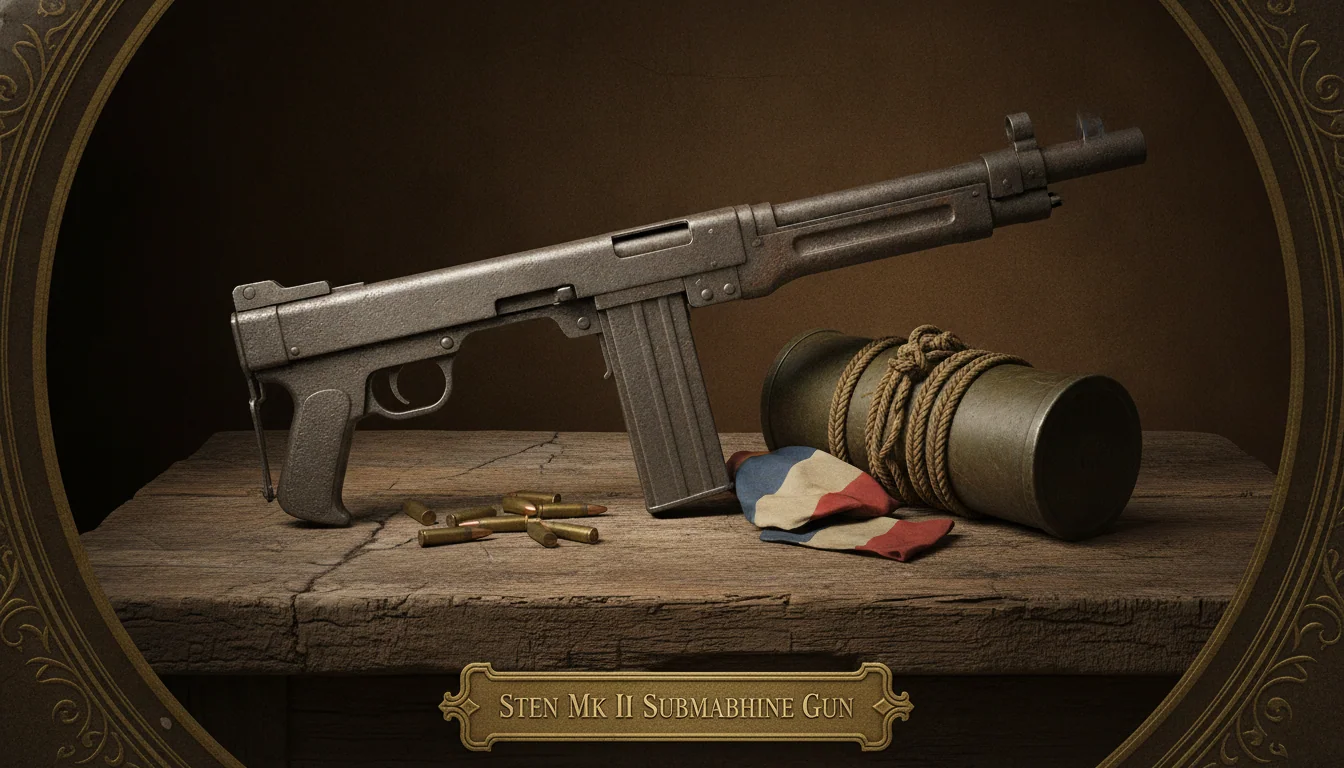
The Italian campaign, grinding up the peninsula through mountains and demolished towns from 1943 to 1945, and the Normandy invasion and subsequent fighting through northwest Europe from June 1944 onward, gave the Bren its most extensive publicity. British paratroopers at Arnhem carried Brens. The airborne operation at Pegasus Bridge on D-Day was supported by them. In photographs of the British Army from 1944 and 1945, the Bren appears as reliably as the steel helmet: the default automatic weapon of a generation of soldiers. Alongside the Sten submachine gun, which handled close-quarters work, the Bren gave British sections a flexible two-weapon fire system that served them from Normandy to the German surrender.
The quick-change barrel
One feature the Bren shared with its Czech ancestor was a barrel designed for rapid field replacement. A sustained-fire machine gun heats its barrel to dangerous temperatures within a few hundred rounds. Early designs addressed this with water cooling - the Vickers required a water jacket holding several liters - which made the weapon heavy and immobile.
The Bren's barrel locked with a simple rotating catch and could be swapped by a trained crew in roughly six seconds. Each Bren was issued with two barrels as standard. In a sustained firefight, the assistant gunner would monitor barrel temperature and swap on command. The hot barrel went into an insulated carrier to cool. The gun went back into action.
This mechanism was not unique to the Bren, but the combination of the system's simplicity and the weapon's accuracy made it work in the field in a way that more elaborate designs did not. The Bren was built around the understanding that a light machine gun would be operated under stress, by soldiers with limited time for maintenance, in conditions that punished complexity.
The L4 and the long tail
The postwar adoption of the 7.62x51mm NATO cartridge presented a challenge. Britain had committed to the new standard, which the .303-calibre Bren was not designed for. The solution was to re-barrel and modify existing Brens rather than replace them entirely. The resulting weapons, designated the L4 series, began entering service around 1958 and proved successful enough to serve through several more decades.
By the time British and Argentine forces clashed in the South Atlantic in 1982, Bren-pattern L4 guns were still present in some unit inventories. The Falklands War involved terrain - open tussock grass, peat bog, rocky ridgelines - that was not entirely unlike some of the conditions the original Bren had been designed for. The weapon performed there as it had performed for forty years.
British forces transitioned away from the Bren family with the introduction of the L86 Light Support Weapon in the late 1980s, part of the SA80 rifle family. The transition was not universal or instantaneous, and some Commonwealth nations continued using Bren-pattern weapons into the 1990s.
What made it last
Machine guns are not typically described with the word "beautiful," but people who worked with the Bren use it. The weapon's proportions - the curved magazine, the folding bipod, the well-balanced carrying handle - give it a functional elegance that photographs capture even in mud and field dust.
More practically: it worked. It worked in sand, in jungle, in cold European rain, and in the South Atlantic in 1982. Soldiers who trained on it reported that it was forgiving to operate accurately because its moderate rate of fire gave the shooter time to track targets and correct aim. Weapons with higher cyclic rates punish small errors in hold with whole magazines; the Bren made accuracy achievable by ordinary training.
The ZB vz. 26 that Vaclav Holek designed in Brno in the 1920s solved the problem it was given. The English engineers at Enfield adapted it without losing what made it work. The Commonwealth that carried it into every theatre of the Second World War kept it because nothing immediately available was better. That is a reasonably complete explanation of the bren gun history, and of a fifty-year service life.
Quick Answers
Common questions about this topic
Where did the Bren gun come from?
The Bren was derived from the Czech ZB vz. 26, designed at the Zbrojovka Brno arms factory in Czechoslovakia in the mid-1920s. Britain adopted a modified version chambered for .303 British and began manufacturing it at the Royal Small Arms Factory in Enfield. The name Bren combines the first two letters of Brno and Enfield.
Why was the Bren's magazine on top?
The curved 30-round box magazine was mounted on top of the receiver rather than below it, which allowed the gun to be fired from a prone position with the barrel closer to the ground. This was a practical advantage for infantry in the open. The offset sighting arrangement compensated for the magazine blocking the direct line of sight.
How long did the Bren stay in service?
The Bren entered British service in 1938 and remained in frontline use in various forms until the late 1980s. British units carried L4 variants, the 7.62mm NATO version, during the Falklands War of 1982. Some Commonwealth and allied nations continued using Bren-pattern weapons well into the 1990s.
Was the Bren reliable in the field?
Exceptionally so. The Bren was praised throughout WWII for its reliability in desert sand, Burmese jungle mud, and North European autumn rain. Its deliberate rate of fire - roughly 500 rounds per minute against more than 1,000 for many contemporary machine guns - reduced jamming and made ammunition management easier. Soldiers who used it rarely wanted to swap it for anything else.

Talk to the People Who Wielded These Weapons
Chat with the soldiers, smiths, and commanders whose lives were shaped by the weapons of their age.
Create your free account →No card required. Some figures and features require a paid plan.
Join the HistorIQly Club
Get smarter about the past.
Weekly stories, deep dives, and exclusive content straight to your inbox.