Arsenal: The Sten Gun - The Two-Hour Weapon That Armed Europe's Resistance
The Sten gun history is one of wartime improvisation: cheap, fast to build, and dropped to thousands of resistance fighters across Nazi-occupied Europe.
Read Wikipedia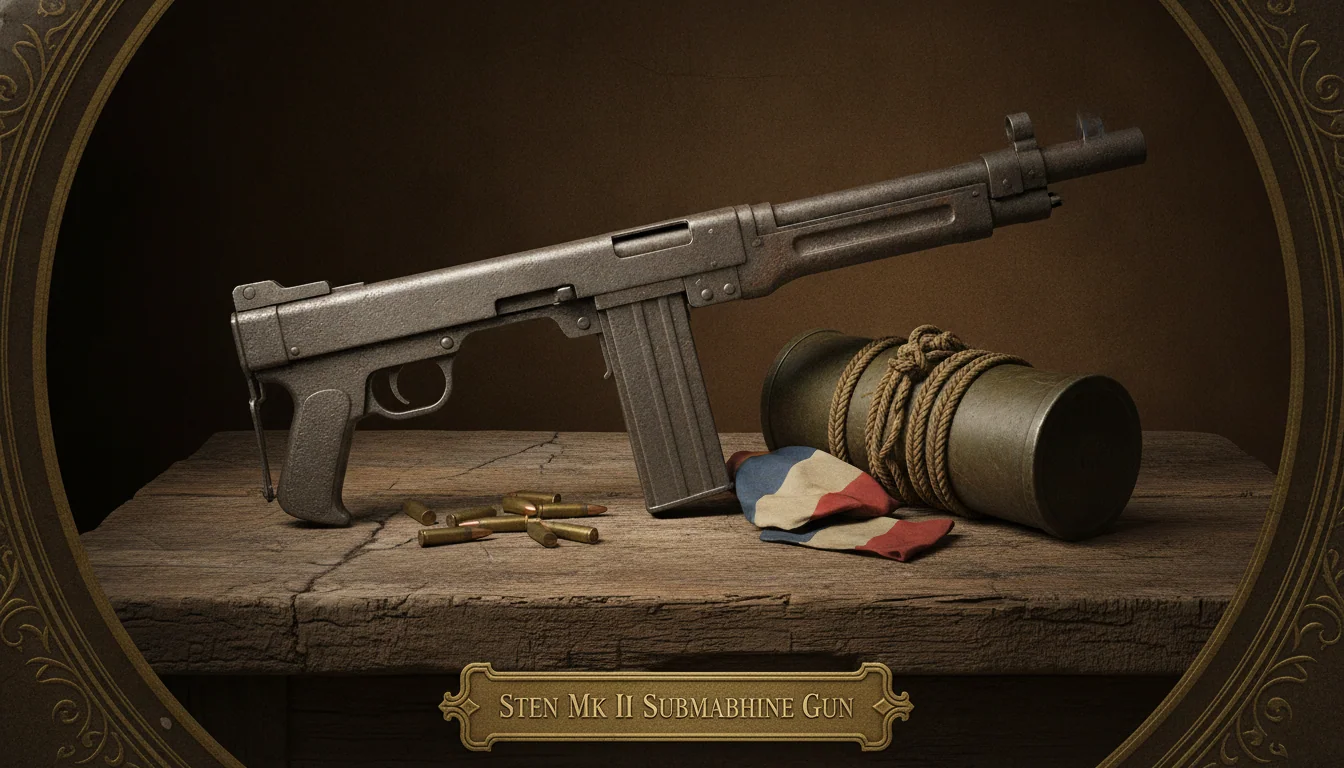
In the summer of 1940, Britain had just evacuated its army from Dunkirk, leaving behind approximately 90,000 rifles, 2,500 guns, and almost 400 anti-tank guns on the beaches of France. The Home Guard - the roughly 1.5 million men who would defend Britain against a German invasion - was initially armed with shotguns, pikes, and whatever sporting firearms their members owned. The situation was specific and urgent: Britain needed more guns than it could produce using conventional manufacturing, and it needed them fast.
The weapon that emerged from this crisis was named for its designers and its place of manufacture: R.V. Shepherd and H.J. Turpin, working at the Small Arms Factory in Enfield. The first letters of those surnames and that place spelled STEN. The gun they produced was everything a precision firearm is not. It was also, arguably, one of the most important weapons of the 20th century.
The design problem it was solving
Before understanding what the Sten was, it helps to understand what it was replacing. The Thompson submachine gun, adopted by the British Army in 1940, was an American design that fired the .45 ACP pistol cartridge from a heavy box or drum magazine. It was reliable, powerful, and well-made. It was also expensive, heavy at nearly five kilograms, and machined to tolerances that required skilled labor and serious manufacturing time. At a moment when Britain was spending foreign exchange it could not afford on American weapons it could not produce domestically, the Thompson was a problem.
The brief given to Shepherd and Turpin was economically radical: design a submachine gun that could be made by workers with no firearms manufacturing experience, using machine tools that any general engineering workshop might have, at a cost that didn't require transatlantic gold shipments. It should fire the 9mm Parabellum cartridge - the German standard - so that captured enemy ammunition could be used. It should be simple enough to strip and reassemble in the dark.
They delivered on the brief in six weeks. Whether what they delivered was a good gun is a more complicated question.
What the Sten actually was
The Sten Mk I appeared in 1941 and the Mk II, the most widely produced variant, arrived the same year. The basic design was stamped sheet steel for the receiver and magazine housing, a bare tubular steel barrel with minimal shrouding, a steel wire stock that folded in some models, and a side-mounted horizontal magazine that fed 9mm rounds from the left. The trigger mechanism was a simple open-bolt design with a rudimentary safety that consisted of a notch cut into the receiver that the bolt handle could be rotated into.
The total weight was about three kilograms - significantly lighter than the Thompson. The length was around 76 centimeters, or about 56 centimeters with the stock removed or folded. The magazine held 32 rounds.
Production cost dropped to approximately five pounds sterling per unit in volume manufacture. Factories that had been making bicycles, toys, or agricultural equipment were converted to Sten production within weeks. The War Office's accounting records show that Britain eventually procured around two million Stens at a total cost that, divided by the Thompson's unit price, would have purchased a fraction as many of the American gun.
Four million Stens were produced across all marks before the war ended. Canada manufactured several hundred thousand. New Zealand produced them. And in occupied Europe, the design was simple enough that clandestine workshops operated by resistance organizations in Poland and Belgium produced functional copies from pilfered steel and machine shop time, working from reverse-engineered parts and distributed instructions.
The SOE connection
The Special Operations Executive, the British organization established in 1940 to coordinate sabotage and resistance across occupied Europe, made the Sten its primary dropped weapon. The gun could be disassembled into five or six major components that fit into a cylindrical container designed to survive an airdrop. A resistance fighter who had never handled a firearm could learn to reassemble one and operate it safely - or at least, more safely than not - in an afternoon.
The logistical elegance extended to ammunition. German and Italian military sidearms and submachine guns predominantly fired the 9mm Parabellum. A French partisan who received a Sten and a supply of ammunition could, if he ran out of what was dropped with the weapon, acquire resupply by other means from the enemy's own stocks. This was not an accident. The 9mm standardization with occupied Europe's dominant military caliber was deliberate.
Between 1941 and 1944, the SOE coordinated the delivery of hundreds of thousands of Stens to resistance networks in France, Norway, Yugoslavia, Greece, the Netherlands, Denmark, and Poland. The Polish Home Army, the largest resistance organization in occupied Europe, received Stens by the crate and also manufactured copies in Warsaw's underground workshops. The Norwegian resistance used Stens extensively in sabotage operations against German industrial targets.
The problem with the Sten
The Sten was not safe. This requires saying plainly because the gun's wartime history is sometimes romanticized in ways that minimize how genuinely dangerous it was to the people carrying it.
The open-bolt design meant that when the gun was cocked, the bolt sat at the rear of the receiver under spring tension, and a round fed into the chamber on the firing stroke. This was not unusual for submachine guns of the era. The specific problem was the Sten's safety arrangement. The notch-in-receiver system required the user to manually rotate the bolt handle into a slot to prevent firing. This was easy to miss and easy to knock out of engagement by a bump or a fall.
SOE training records and after-action reports document a pattern of accidental discharges - Stens firing when dropped, when slung against a hard surface, when bounced in the back of a vehicle. The gun was also sensitive to magazine lip deformation: if the lips of the box magazine bent even slightly, the round could fail to feed, producing jams at the worst possible moment. Resistance fighters learned to handle the magazine carefully and to never fully load it - leaving out two or three rounds reduced feed-spring tension and dramatically improved reliability.
Field modifications appeared throughout the war. Some users welded additions to the safety. Others wrapped tape around the selector area. The Mk V variant, introduced in 1944, added a proper trigger-group safety and improved ergonomics, including a wooden pistol grip and fore-end that made accidental discharges less common. By the time the Mk V arrived, four million earlier models were already in circulation.
The Sten in action
The Sten was effective at the ranges it was designed for. It was a close-quarters weapon optimized for ambushes, room clearances, and urban fights where the engagement distance was measured in meters rather than hundreds of meters. Its 9mm cartridge was adequate against unarmored targets at such distances, and its rate of fire - roughly 500 rounds per minute in the Mk II - made it useful for volume at short range.
The most historically significant Sten use may have been the assassination of Reinhard Heydrich in Prague on May 27, 1942. Czech paratroopers trained in Britain ambushed Heydrich's open car at a hairpin bend on the road from his villa to central Prague. One paratrooper's Sten jammed at the critical moment - the magazine lip failure that the weapon was notorious for. The second paratrooper threw a modified anti-tank grenade. The combination of the grenade blast and wounds from his own car's upholstery fibers caused fatal septicemia, and Heydrich died on June 4, 1942.
The Sten's jam did not prevent the outcome, but it is among the more consequential mechanical failures in the history of the weapon.
In France, Norway, and Yugoslavia, Sten-armed resistance units conducted hundreds of sabotage actions and ambushes through 1943 and 1944. The volume of weapons available through SOE drops allowed resistance forces to arm cells that had previously been dependent on captured German weapons or converted hunting rifles. The Sten democratized partisan capability in a way that slower, more expensive weapons could not have done at the scale required.
After the war
The Sten served in British forces through the Korean War. Israel's Haganah used Stens during the 1948 Arab-Israeli War and also manufactured their own copies, called the Sten Dror, from salvaged materials. The Indian Army carried Stens into independence. In Malaya, during the counterinsurgency campaign of the late 1940s and 1950s, both British security forces and the Malayan Communist Party's armed wing were sometimes armed with Stens from the same wartime supply chain.
The gun was finally replaced in British service by the Sterling submachine gun in 1953, a design that corrected the Sten's worst reliability problems while maintaining the basic blowback architecture and 9mm chambering. Many Stens remained in reserve inventories for decades longer, and some are still in circulation in conflict zones today, a testament to both the weapon's durability and its radical simplicity.
The economics of improvised war
The Sten's legacy is not really about the gun. It is about the principle the gun demonstrated: that in a large enough industrial conflict, the weapon that can be produced by the millions cheaply and distributed globally will shape the war more than the weapon that is finely engineered and precisely made. The Thompson was a better firearm by almost every technical measure. The Sten won the distribution war.
That principle - cheap, simple, good enough, and manufacturable by anyone with basic tools - has defined guerrilla warfare weaponry ever since, from the AK-47 to the improvised weapons produced today in clandestine shops from the Khyber Pass to the Gaza Strip. The Sten did not invent the philosophy, but it demonstrated it at unprecedented scale. Four million copies in four years, assembled by people who had never made a gun before, distributed to people who had never fired one.
For other weapons defined by what they gave up in quality to gain in scale, see our coverage of the PPSh-41, the Soviet submachine gun mass-produced in similar numbers and distributed to partisan forces across Eastern Europe.
Quick Answers
Common questions about this topic
How long did it take to manufacture a Sten gun?
The Sten Mk II, the most common variant, required approximately five man-hours of labor to produce and could be assembled by unskilled workers using basic machine tools. Some accounts reference production times as low as two to three hours at peak efficiency. The total cost per unit was approximately five pounds sterling, compared to around fifteen pounds for a Thompson submachine gun.
Was the Sten gun reliable?
The Sten was notoriously prone to misfires and accidental discharges. Its most dangerous failure mode was the open-bolt design combined with a poorly designed safety: a knock, a drop, or vibration could cause the weapon to fire on its own. SOE officers reported that more Allied agents were injured by accidental Sten discharges than by many other causes of non-combat injury.
Why was the Sten gun given to resistance fighters?
The Sten's simplicity made it ideal for clandestine distribution. It could be broken down into five or six major parts that fit into a suitcase or canister, dropped by air, and reassembled by someone with minimal training. It used the 9mm Parabellum cartridge, which was the standard German and Italian military round, meaning resistance fighters could resupply from enemy ammunition.
How many Sten guns were made?
Approximately four million Sten guns were produced between 1941 and 1945, across multiple marks and in multiple countries including Canada, New Zealand, and clandestine workshops in occupied Europe. The basic design was simple enough that the Polish Home Army and Belgian resistance produced copies from scratch with limited machine shop access.

Talk to the People Who Wielded These Weapons
Chat with the soldiers, smiths, and commanders whose lives were shaped by the weapons of their age.
Create your free account →No card required. Some figures and features require a paid plan.
Join the HistorIQly Club
Get smarter about the past.
Weekly stories, deep dives, and exclusive content straight to your inbox.