Arsenal: The Desert Eagle
The Desert Eagle history begins with a genuine engineering puzzle: a handgun that works like a rifle, built for action cinema and never for war.
Read Wikipedia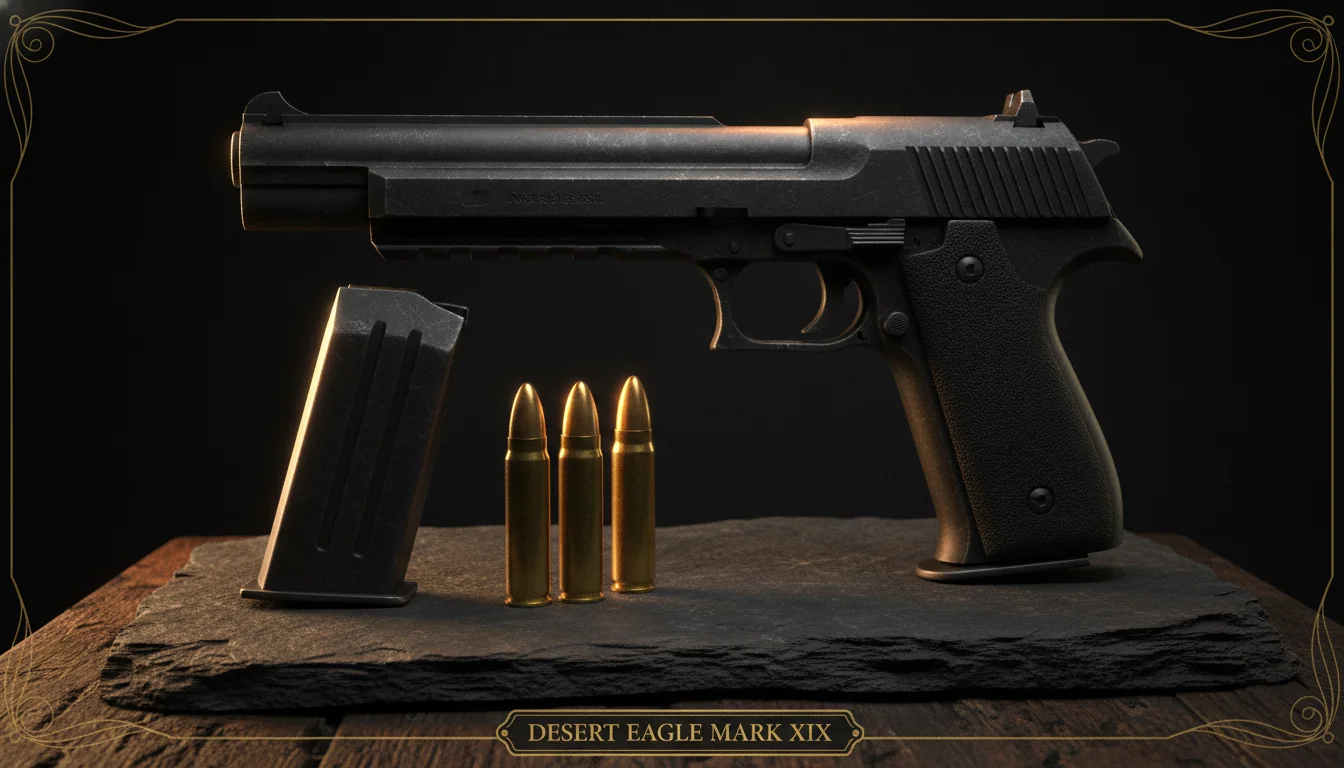
Most weapons earn their reputations on battlefields. The Desert Eagle earned its reputation on film sets. In the history of actual combat it occupies a footnote so small as to be invisible. In the history of action cinema it is the handgun - the oversized, casually impossible signature prop of two decades of blockbusters and at least three generations of first-person-shooter games.
That would be a simple story of marketing and cultural momentum if the Desert Eagle were not also, underneath the theatrical exterior, a genuine engineering curiosity. The silhouette is theatrical. The mechanism is not. Inside that angular frame is an operating system borrowed from military rifles, built to solve a problem that conventional pistol design could not handle. The result is a weapon that works in a fundamentally different way from almost every other handgun in existence, and that found its audience not in any army but in the imagination of a global entertainment industry.
Origins in Minneapolis
Magnum Research Inc. was a small firearms company in Minneapolis, Minnesota, when designer Bernard White began developing what would become the Desert Eagle in the late 1970s. The commercial aim was specific: produce a semi-automatic handgun capable of reliably chambering the .357 Magnum and .44 Magnum revolver cartridges, which were then among the most powerful commercially available handgun rounds.
The engineering obstacle was substantial. Revolver cartridges, particularly the .44 Magnum, generate chamber pressures far higher than standard semi-automatic pistol loads. The conventional short-recoil operated system used by most semi-automatic pistols - in which the barrel and slide travel backward together briefly under recoil, then return under spring tension to chamber the next round - handles 9mm and .45 ACP without difficulty. At .44 Magnum pressures, maintaining controlled function with a tilting-barrel short-recoil design would require springs and components of impractical weight and complexity.
White's solution was to borrow the operating mechanism of the gas-operated rifle. Near the muzzle end of the Desert Eagle's barrel, a small port channels propellant gas into a cylinder running below the barrel. This gas drives a piston rearward, which rotates and unlocks the bolt, cycles the action, and chambers the next round from the magazine. The rotating bolt locks into the barrel at multiple engagement points, the same principle used in the Stoner AR platform, the AK-47, and the Garand. It had never been applied at scale to a semi-automatic pistol before.
The first production Desert Eagle appeared around 1982, chambered in .357 Magnum. The .44 Magnum version followed shortly after. The gun was large - intentionally so, because the gas system required significant frame volume to accommodate - and it photographed dramatically against the smaller pistols that were then standard for police and military use.
The .50 Action Express
The cartridge that made the Desert Eagle famous arrived in 1988, when Evan Whildin of Action Arms developed the .50 Action Express specifically for the platform. The .50 AE fires a 12.7mm bullet - the same bore diameter as the .50 BMG machine gun cartridge, though at considerably lower velocity and in a completely different case geometry. In terms of bore diameter, it remains the largest cartridge chambered in any production semi-automatic pistol.
The .50 AE version of the Desert Eagle weighs approximately 1.9 kilograms unloaded, with a standard 6-inch barrel. Extended barrels of 10 inches and 14 inches were produced for hunting applications. The magazine holds 7 rounds. The muzzle blast is substantial and the recoil impulse, while manageable with practice, is unlike anything most shooters encounter from a handgun. The projectile exits the barrel with enough energy to take large game at reasonable distances, and Magnum Research marketed it toward handgun hunters pursuing deer, bear, and elk.
By any standard military assessment, the .50 AE Desert Eagle is impractical. Too heavy, too large to conceal, too expensive, too maintenance-demanding for field service in dust and mud. But none of those qualities matter to the entertainment industry.
The film career begins
The Desert Eagle began appearing in American action films in the mid-1980s, when the cycle of one-man-army movies starring Sylvester Stallone and Arnold Schwarzenegger was at its commercial peak. The gun's size reads unmistakably on a cinema screen, its muzzle flash is dramatic, and its angular silhouette is distinctive in a way that the Beretta 92 or Smith and Wesson revolvers then in common cinematic use were not.
Its most culturally significant appearance came in the Wachowskis' 1999 film "The Matrix," in which Agent Smith carries a pair of Desert Eagles with pearl grips. The choice was deliberate: in a film about a world where physics is a programmable construct, the gun that looks most like it should not work became the antagonist's signature weapon. By 1999, the Desert Eagle's screen identity was already established. "The Matrix" amplified it globally.
"Wanted" (2008) used the Desert Eagle as James McAvoy's character's weapon of transformation - he acquires them early as the visual marker of his shift from ordinary life to trained assassin. "Snatch" (2000), "The Expendables" (2010), "Last Action Hero" (1993), "Johnny Mnemonic" (1995), and dozens of others followed. In each case the weapon served the same narrative function: the most extreme available option, the gun that signals that the person holding it has moved beyond normal scale.
The video game legacy is equally extensive. The Desert Eagle appears in multiple iterations of Counter-Strike, across the Call of Duty and Battlefield franchises, in Grand Theft Auto, in Halo's predecessor games, and in virtually every realistic-action shooter of the past two decades, typically as the most powerful handgun option available. The result is that generations of players who have never touched a real firearm carry a detailed and accurate mental image of the Desert Eagle's appearance, sound, and function.
Manufacturing and the Israeli connection
Israel Weapon Industries, then known as Israel Military Industries, became the primary manufacturer of the Desert Eagle in the late 1980s under a licensing and production arrangement with Magnum Research. The arrangement made commercial sense: IWI had established production facilities for precision firearms, access to export markets, and experience manufacturing for both military and commercial customers. Magnum Research handled North American marketing and retail distribution.
The Israeli connection contributed to the gun's mythos in ways that were partly deliberate. Israel's reputation for military competence and technical innovation gave the Desert Eagle an implied pedigree that its actual operational record did not strictly support. The gun was not a military development - it was a commercial venture that happened to be manufactured in Israel. But the association between Israeli military engineering and the gun's visual presence was real enough in popular culture to stick.
Some Israeli military and special-operations units did use the Desert Eagle in limited roles, which gave the myth a thread of truth to hang on. The gun was never standard issue anywhere.
What the Desert Eagle actually is
Four decades of production have established what the Desert Eagle's actual market is. It is a collector's piece, a range pistol, and for a small number of users, a hunting sidearm. The gas-operated mechanism is more maintenance-sensitive than a conventional pistol - the gas port requires regular cleaning, and ammunition that does not meet minimum pressure specifications can cause cycling failures. The tolerances that make it accurate also make it less forgiving of neglect.
None of this matters for most Desert Eagle owners, because most Desert Eagle owners do not carry it in the field. They buy it to own something that is, technically, the most powerful production semi-automatic pistol in the world, and that looks exactly like what Agent Smith was carrying. Those are both legitimate reasons to buy a firearm, and Magnum Research has been selling into that market continuously since 1982.
A weapon of culture, not of war
The Desert Eagle solved a genuine engineering problem and did it well. The rotating-bolt gas-operated mechanism handles cartridges that would defeat conventional pistol designs, and the gun has proven durable over more than forty years of production. That the solution found its lasting audience not in any military or police application but in cinema and interactive entertainment is not the story Magnum Research originally intended to tell.
It is, however, the story that happened. The Desert Eagle occupies a unique position in the history of firearms: a technically legitimate weapon whose entire cultural identity was built by artists who thought it looked like what the most dangerous gun in the world should look like. On that point, the artists were not wrong.
Quick Answers
Common questions about this topic
Who designed the Desert Eagle?
The Desert Eagle was developed by Magnum Research Inc. in Minneapolis, Minnesota, in the late 1970s and early 1980s, with design work attributed to Bernard White. Manufacturing was taken over by Israel Weapon Industries (previously known as Israel Military Industries, or IMI) in the late 1980s. Magnum Research has handled North American marketing while IWI has manufactured the majority of production units since then.
What makes the Desert Eagle mechanically different from other handguns?
Most semi-automatic pistols use a short-recoil operated system where the barrel and slide move together briefly after firing. The Desert Eagle instead uses a gas-operated rotating bolt, the same mechanism found in most military rifles. A port near the muzzle channels propellant gas into a cylinder below the barrel, driving a piston that cycles the bolt. This allows it to safely fire far more powerful cartridges than a conventional pistol design could handle.
What calibers is the Desert Eagle available in?
The Desert Eagle has been produced in .357 Magnum, .44 Magnum, and .50 Action Express (.50 AE). The three calibers share the same frame, and a caliber-conversion kit allows owners to switch between them. The .50 AE version fires a 12.7mm bullet and is the largest cartridge chambered in any production semi-automatic pistol.
Has the Desert Eagle seen military or police service?
Rarely. No major military or police force has adopted the Desert Eagle as standard issue. Some Israeli special-operations units are reported to have used it in limited roles. Its size, weight approaching 2 kg unloaded in .50 AE, and high unit cost make it impractical for field service. Its fame derives almost entirely from action cinema and video games rather than operational use.

Talk to the People Who Wielded These Weapons
Chat with the soldiers, smiths, and commanders whose lives were shaped by the weapons of their age.
Create your free account →No card required. Some figures and features require a paid plan.
Join the HistorIQly Club
Get smarter about the past.
Weekly stories, deep dives, and exclusive content straight to your inbox.