Arsenal: The FP-45 Liberator Pistol
The FP-45 Liberator pistol was a single-shot .45 built by General Motors in 1942 to airdrop to resistance fighters. It cost two dollars and was designed to fire once.
Read Wikipedia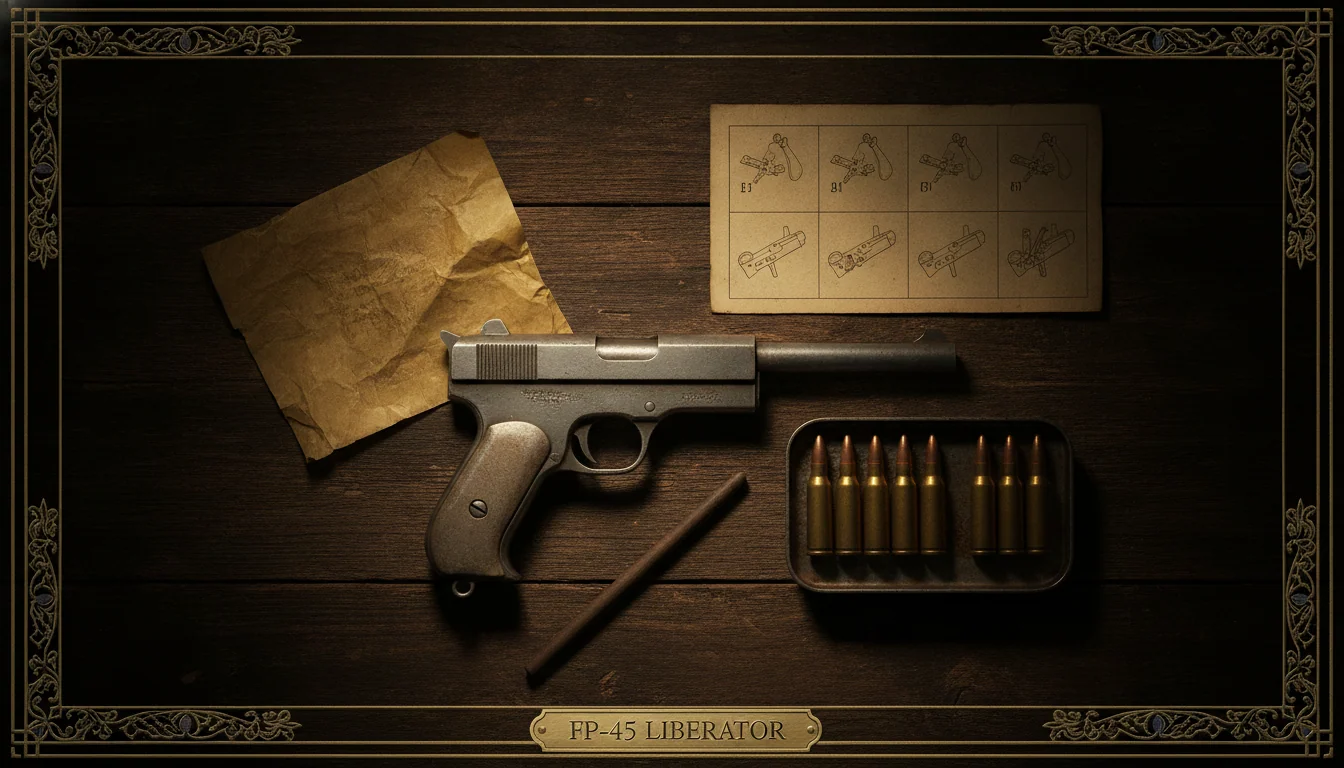
In the spring of 1942, a group of men from the Joint Army-Navy Psychological Warfare Committee sat down to solve a specific problem. Resistance movements in German-occupied Europe and Japanese-held Pacific territories desperately needed weapons, but standard military firearms were expensive, complex to manufacture, and difficult to smuggle. What the committee wanted was something that could be made by the millions, dropped from an airplane in a paper bag, and understood by a farmer with no military training who did not speak English.
The solution they arrived at was a single-shot pistol so crude that calling it crude is almost generous, stamped from zinc alloy and sheet metal by a car manufacturer, packaged with ten rounds of ammunition and a pictographic instruction sheet with no words. It cost about two dollars to make. The plan was to flood occupied territories with them and let the mathematics of desperation work.
The design brief
The requirements were extreme in their simplicity. The weapon had to be manufacturable in massive quantities at very low unit cost. It had to be small enough to conceal and light enough to airdrop. It had to be operable by someone with no training and no familiarity with firearms. It did not have to be accurate beyond a few feet. It did not need a long service life. It was not expected to survive more than a handful of shots.
The engineering team at the Inland Manufacturing Division of General Motors in Dayton, Ohio took the brief and produced a design in roughly thirty days. The FP-45 - the designation stood for Flare Projector, a deliberate misdirection meant to hide the program from the wrong eyes - was a rectangular block of metal with a barrel, a trigger, and a breech that slid open. The trigger was a direct-acting mechanism with no intermediate parts. The barrel was smooth-bored. There was no safety beyond the need to manually cock the weapon. There were no sights worth the name.
The material was mostly zinc alloy and low-grade steel stampings, the same category of metal used to make consumer appliances and car parts. A skilled machinist could tell immediately that the gun had been made to a price, not to a standard. A resistance fighter who had never seen a machined firearm would see something more important: a weapon that worked.
What you got in the box
Each Liberator came packaged in a small waxed paper bag. Inside was the pistol, ten rounds of .45 ACP ammunition stored in a hollow in the grip, a wooden dowel for extracting spent cartridge cases, and an instruction sheet with nine line drawings arranged in sequence like a comic strip.
The instruction sheet required no literacy in any language. Drawing one: open the breech by pulling back the housing. Drawing two: insert a cartridge. Drawing three: close the breech. Drawing four: cock the weapon by pushing back the housing again. Drawing five: aim. Drawing six: fire. The remaining drawings covered the post-firing sequence: use the dowel to knock out the spent case, reload, repeat.
The surplus rounds had nowhere to go except the shooter's pocket or, as designed, back into the grip compartment. In the scenario the weapon was designed for, the shooter would fire once, take the dead soldier's rifle, and never use the Liberator again. The ten spare rounds were an afterthought for anyone who needed to try more than once.
How it was supposed to be used
The tactical concept was blunt and acknowledged its own limitations openly. The FP-45 Liberator pistol was not a combat weapon. It was not meant to be drawn in a firefight. It was not intended for use at distances beyond a few feet. The barrel produced no useful accuracy beyond conversational range, and the zinc frame would not survive sustained use in any case.
The intended use was a single moment: a resistance fighter who could get close enough to an isolated enemy soldier to shoot him before being seen. A guard at a post. A sentry on a road. An officer examining papers. A patrol member separated from the rest of his unit. From two or three feet, the .45 ACP round was lethal regardless of the platform firing it, and the Liberator could manage two or three feet.
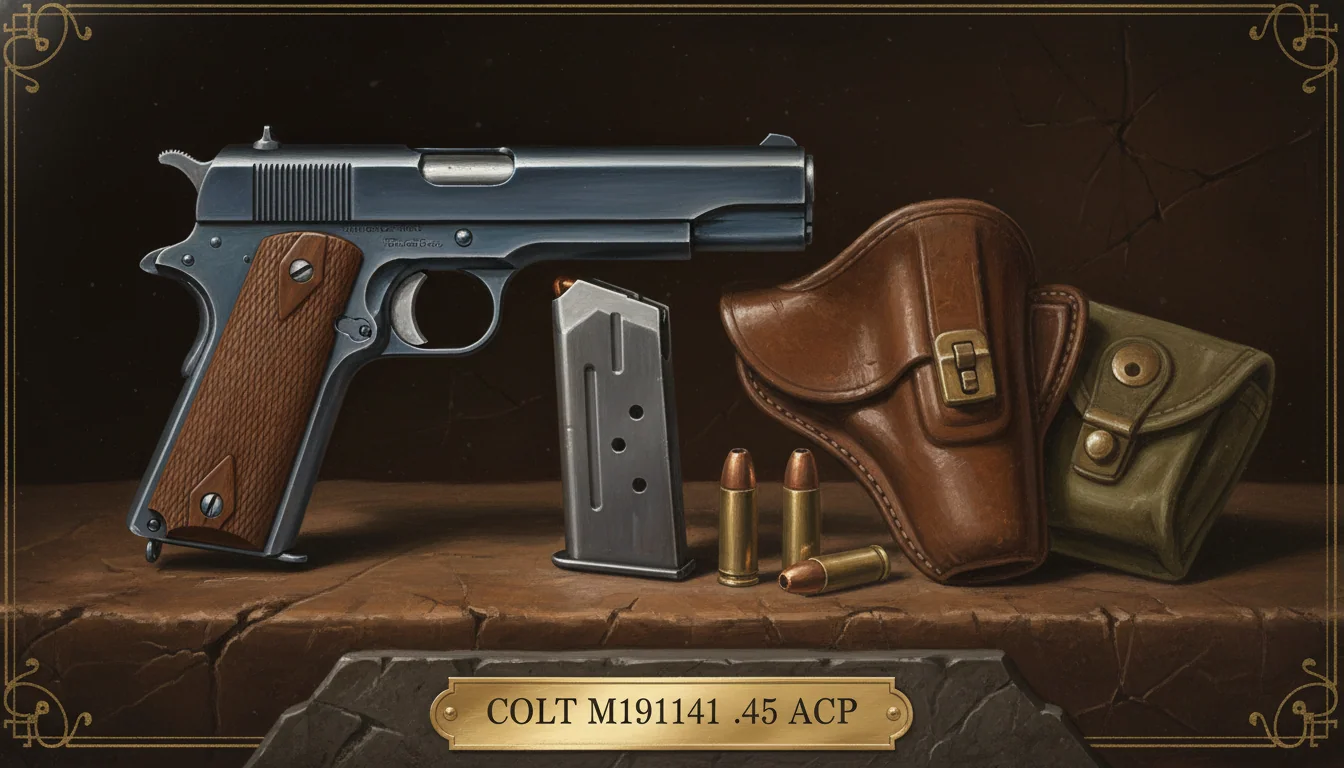
The downstream logic was what made the weapon worthwhile on paper. A resistance network that acquired an enemy soldier's rifle had acquired, at the cost of two American dollars and one life-threatening moment of proximity, a weapon worth fifty times as much and capable of real military use. The Liberator was a key. The enemy's weapon was the door. It was a poor substitute for the Colt 1911 that American servicemen carried into the same war, but it was never meant to be a substitute at all - only a way of getting to something better.
The distribution reality
One million FP-45 Liberators were manufactured at Inland between June and August 1942, in roughly eleven weeks. By any standard of wartime production, this was an extraordinary feat. The gun was designed to be assembled quickly; individual units moved through the production line at a rate that allowed the factory to produce a finished pistol in under a minute of actual assembly time.
Getting them to resistance fighters was a harder problem than making them.
The OSS, which planned the distribution, ran into the persistent obstacle of wartime clandestine logistics. Airdropping weapons to scattered resistance cells required aircraft, coordination with local networks, and the acceptance that a meaningful percentage of any drop would fall into the wrong hands or be found by occupation forces. The Liberator, with its pictographic instructions, was somewhat insulated against the language problem, but it was not insulated against the basic difficulty of finding resistance fighters and getting them the weapons without being caught.
In the Philippines, some Liberators were distributed to Filipino guerrilla groups operating against Japanese occupation. In occupied France, a smaller number reached OSS-backed networks. But the large-scale airdrop campaigns envisioned in 1942 largely did not happen. The practical challenges accumulated, the strategic picture shifted as Allied advances made some resistance operations obsolete, and millions of Liberators sat in warehouses.
After the war, the remaining stocks were largely destroyed. Collectors today prize surviving examples precisely because most were never distributed and the ones that were rarely came back. A complete Liberator with its original bag, dowel, and instruction sheet is a sought-after piece of WWII-era manufacturing history. The price has climbed considerably beyond two dollars.
What the Liberator represents
The FP-45 is a fascinating object for reasons that go beyond its combat utility, which was limited. It represents a specific theory of insurgency: that the most powerful thing you can do for a resistance movement is lower the threshold for taking an enemy weapon. One improvised, nearly disposable pistol plus one moment of extraordinary courage equals one rifle. One rifle, multiplied by a million distributed guns, is the beginning of a change in the correlation of forces.
Whether the theory would have worked at scale was never tested, because the distribution never happened at scale. What did work was the manufacturing. The Inland Division demonstrated that wartime industrial production could be redirected toward almost anything, could produce a million of almost anything, and could do it in eleven weeks. That capacity - the capacity to make things cheaply and in vast quantity - was itself a weapon, even if the specific things being made never reached their intended recipients.
For another weapon designed around the minimal-training concept, see the Blunderbuss, the boarding pistol whose flared barrel compensated for the fact that most of its users were sailors, not marksmen.
Quick Answers
Common questions about this topic
What was the FP-45 Liberator designed for?
The Liberator was designed to be airdropped in vast quantities to resistance fighters in German-occupied Europe and Japanese-held Pacific territories. The concept was simple: a fighter could pick one up, shoot an enemy soldier at close range, and take his superior weapon. The gun itself was almost incidental - it was a key to acquiring a real rifle.
How much did the Liberator cost to make?
Each FP-45 cost approximately two dollars to manufacture, and the full packaged unit with its ten rounds of .45 ACP ammunition and a wooden dowel for extracting spent cases cost around two dollars and ten cents. One million were produced in under three months in 1942. It was almost certainly the cheapest purposefully manufactured firearm ever issued in quantity.
Did the Liberator actually reach resistance fighters?
In limited numbers. Some were distributed in the Philippines to Filipino resistance groups. A smaller number reached occupied France through OSS channels. The majority of the million produced were stored in warehouses and many were eventually destroyed without ever leaving Allied hands. The logistical challenges of distributing single-shot pistols secretly, in meaningful quantities, to scattered resistance cells proved harder than the manufacturing.
How did the Liberator work?
To fire, the shooter pulled back the breech housing, inserted a single .45 ACP cartridge, closed the breech, and pulled the trigger. After firing, the spent case had to be manually removed using a wooden dowel stored in the grip. The gun could then be reloaded. With practice this could be done in a few seconds. The weapon was only accurate at point-blank range - it was designed for use against someone who did not see it coming.

Talk to the People Who Wielded These Weapons
Chat with the soldiers, smiths, and commanders whose lives were shaped by the weapons of their age.
Create your free account →No card required. Some figures and features require a paid plan.
Join the HistorIQly Club
Get smarter about the past.
Weekly stories, deep dives, and exclusive content straight to your inbox.