Arsenal: The Chinese Jian - Two Thousand Years of the Gentleman's Sword
The Chinese jian sword: two thousand years of Chinese warfare and culture shaped by a double-edged blade that was as much a scholar's emblem as a soldier's sidearm.
Read Wikipedia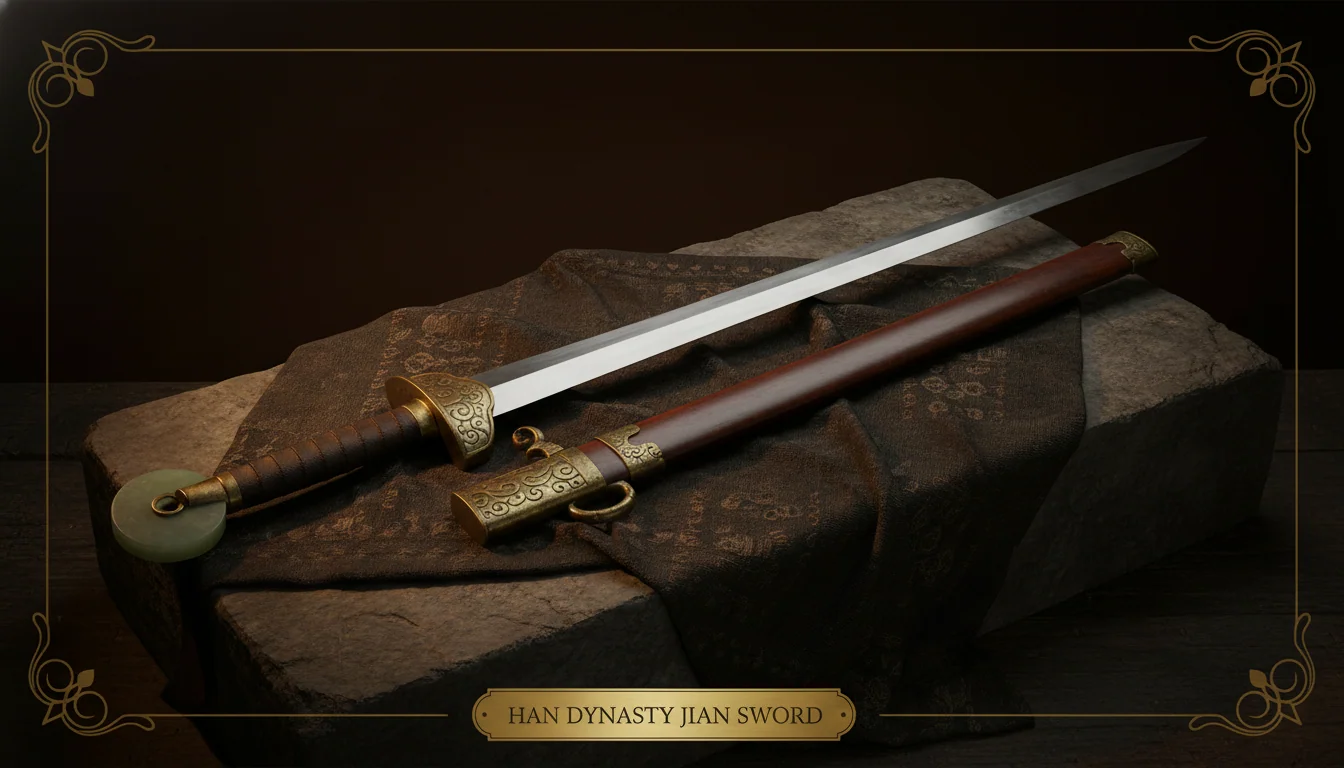
The sword has a name in China that translates roughly as the gentleman's weapon, and the name is not wrong. The jian has been carried by emperors and philosophers, court officials and wandering Taoist sages, military officers and martial arts masters. Confucius reportedly wore one as standard dress. The Han dynasty standardized it as the officer's sidearm of choice. A thousand years later, when it had been largely superseded on the battlefield by the single-edged dao, it persisted in Chinese culture as the weapon of the cultivated person, the one who had mastered something more than brute force.
The story of the jian is not just a weapon story. It is a window into how a civilization thought about the relationship between violence, refinement, and the kind of person worth becoming.
Origins in bronze
The earliest ancestors of the jian appear in the late Spring and Autumn period, roughly the 7th to 6th centuries BC, when Chinese bronze-casting reached a level of technical sophistication that allowed thin, elegant, double-edged blades of genuine quality. The Yangtze River delta states of Wu and Yue were particularly renowned for their swordsmiths, and the names of legendary blade-makers from this era - Ganjiang and Moye, whose story became a staple of Chinese folk literature - reflect how seriously the culture took the craft.
The classical form of the jian emerged in the Warring States period (475-221 BC), when the competing Chinese states were constantly at war and the demand for quality weapons was sustained and well-funded. The Warring States jian is typically narrow, with a diamond or lenticular cross-section that provides rigidity with minimum material, a short guard of bronze or jade, and a pommel that balances the blade's weight. The construction required deep knowledge of bronze alloy ratios to achieve both hardness and flexibility - a blade too hard would shatter; too flexible and it would bend without returning.
The most famous artifact from this period is the Sword of Goujian, recovered from a burial tomb in Hubei Province in 1965. The blade, 55.7 cm long, was attributed to King Goujian of Yue, who reigned from 496 to 465 BC. What made the discovery remarkable was not the attribution but the condition: nearly 2,500 years in a sealed lacquered case had left the blade almost uncorroded, and the edge was still sharp enough to cut hairs. The surface treatment, a copper sulfide patina applied deliberately to resist oxidation, showed that Warring States metallurgists had solved problems in preservation chemistry that modern researchers took time to fully understand. The blade is now held in the Hubei Provincial Museum and is considered one of China's most significant archaeological objects.
The transition to iron and the Han dynasty
The Qin unification of China in 221 BC and the subsequent Han dynasty brought the gradual replacement of bronze jian with iron and then steel versions. The transition was not instantaneous - bronze blades persisted in some military use through the early Han - but by the 1st century BC the iron jian had become the standard sidearm of Han military officers, cavalry officers, and court officials.
Han-era iron jian are longer and more refined than their bronze predecessors. Excavated examples from Han tombs run to 90-100 cm in total length, with blades in the 70-80 cm range. The cross-section became thinner and more elegant as steel-working improved. The jian of a Han-period senior officer was a prestige object as well as a functional weapon, often fitted with jade or gilded bronze furniture, lacquered scabbards with metal fittings, and carried at the hip as a visible mark of rank.
The cultural weight of this association - sword as officer's credential, sword as scholar-official's emblem - was set during the Han dynasty and never fully disappeared from Chinese culture.
How the jian fought
The jian is fundamentally a thrusting and cutting weapon, optimized for speed and precision rather than heavy-impact combat. Its double edge allows cuts in both forward and return strokes, while its acute point is designed for thrusts to vulnerable areas. The grip, typically short and wrapped in ray skin or cord, allows rotation in the hand for the rapid changes of angle that define jian fencing.
In formation warfare, the jian was a sidearm - the primary offensive weapon was the spear or halberd, and the jian came into play when spears were lost or in the close-quarters fighting that followed a line's collapse. Cavalry officers carried the jian at the hip and reached for it after throwing a javelin or after the lance was broken.
What the jian rewarded was training. Unlike the broad-bladed dao, which a reasonably strong person could use effectively with minimal instruction, the jian's narrow geometry meant that a poorly placed blow delivered little damage. The sword punished improvisation. The educated, disciplined fighter gained the most from it. This is not incidental to why Chinese culture attached the jian to the scholar class.
The jian-using style that developed over centuries in Chinese martial arts reflects this. Jian technique emphasizes deflection over blocking, circular footwork over rooted stances, and the smallest possible motion that achieves the desired result. The weapon is often described in classical texts as an extension of the practitioner's mind - a description that sounds mystical and is also literally accurate about the mechanical demands.
The competition with the dao
From the Han dynasty onward, the jian faced a serious practical rival: the dao, the single-edged curved or straight saber that was easier to make, easier to use in mass infantry formations, and more effective for the mounted cavalry combat that dominated Chinese military strategy for much of the middle imperial period.
The dao won the military argument comprehensively. By the Tang dynasty (618-907 AD), the dao was the standard infantry and cavalry weapon of the imperial army. The jian remained in officer service and in ceremonial roles, but the mass-produced blade in the hands of the average soldier was single-edged.
This competitive loss paradoxically elevated the jian's cultural status. The weapon that required years of dedicated training and rewarded the refined practitioner became associated precisely with that refined practitioner. The dao was the soldier's weapon. The jian was the swordsman's weapon - and in Chinese literary culture, those were different things.
The jian in literature and culture
The wuxia genre, the vast tradition of Chinese martial-arts literature that stretches from Tang dynasty tales to the modern novels of Jin Yong, is built substantially around the jian. The wandering swordsman of Chinese fiction - free from bureaucratic obligation, loyal to personal codes of honor, capable of near-supernatural feats of skill - almost always carries a jian.
The association runs deeper than genre convention. Taoist tradition linked the jian to spiritual cultivation, and Taoist priests and sages of the Tang and Song periods were depicted carrying swords as symbols of the ability to cut through illusion. The concept of the jian as an expression of the practitioner's inner state appears in both martial arts manuals and in poetry.
Confucius himself, by multiple accounts, wore a jian as part of formal dress - not because Confucius was a warrior, but because in his period the sword was an inseparable element of the gentleman's appearance, like a scholar's cap or formal robes. The man who wore a sword badly was not just physically unprepared; he was aesthetically wrong.
The sword that stayed
The jian never disappeared. Unlike many historical weapons that exist only in museums and reconstructions, the jian remains in living practice. Chinese martial arts schools worldwide teach jian forms as part of their curriculum, and competitions at the national and international level include jian events. The weapons used in these settings are generally lighter and more flexible than historical combat blades, but the body of technique they preserve is directly descended from the military and cultural tradition developed over two millennia.
Contemporary China has turned the jian into a national symbol with some care. The Sword of Goujian appears on currency, in museum campaigns, and in the visual vocabulary of Chinese historical films. The image of the refined swordsman with the jian persists in wuxia film and television production, where the weapon codes instantly as the marker of a certain kind of protagonist - skilled, principled, dangerous in the service of something larger than personal gain.
Two thousand five hundred years from its first appearance in Yangtze delta workshops, the gentleman's weapon is still being carried. The civilization that made it changed in every other way. The sword stayed the same.
For the Japanese sword tradition that evolved in parallel, see Arsenal: The Katana. For its curved predecessor in Japanese history, see Arsenal: The Tachi.
Quick Answers
Common questions about this topic
What is a jian?
The jian is a Chinese double-edged straight sword, typically 70-80 cm in blade length, with a diamond or lenticular cross-section, a short guard, and a pommel that aids balance. It is one of the four traditional weapons of Chinese martial arts, alongside the staff, the spear, and the dao (single-edged saber). The jian is associated with officers, scholars, and practitioners of internal martial arts, and its cultural prestige in China is roughly comparable to the katana in Japanese culture.
How old is the jian?
The earliest jian-like bronze swords appear in the late Spring and Autumn period, around the 7th to 6th centuries BC. The weapon reached its classical form during the Warring States period (475-221 BC), when bronze-casting techniques produced thin, elegant blades of exceptional quality. The transition to iron and then steel jian occurred during the Han dynasty (206 BC - 220 AD), and by the first century BC the iron jian was the standard sidearm of Chinese military officers.
What is the Sword of Goujian?
The Sword of Goujian is a bronze jian found in 1965 in a lacquered burial case in Hubei Province, China. Attributed to King Goujian of Yue (r. 496-465 BC), the blade is 55.7 cm long, decorated with geometric patterns using copper sulfide inlay, and was still sharp when discovered nearly 2,500 years after burial. The sulfide-resistant alloy used in its surface treatment has been studied by metallurgists as evidence of sophisticated bronze-working chemistry in the Spring and Autumn period.
Was the jian mainly a military weapon or a cultural symbol?
Both, at different periods. During the Warring States and Han dynasty eras, the jian was a standard military sidearm for officers, cavalry, and nobles. From the Tang dynasty onward, as the single-edged dao became dominant in military use, the jian's role shifted. It remained a prestige item for scholars and officials, a required accessory for gentlemen in some periods, and the central weapon of Chinese internal martial arts traditions. Today the jian survives primarily as a cultural and martial arts weapon.

Talk to the People Who Wielded These Weapons
Chat with the soldiers, smiths, and commanders whose lives were shaped by the weapons of their age.
Create your free account →No card required. Talk to anyone in history with 8 free credits a day. Some features require a paid plan.
Join the HistorIQly Club
Get smarter about the past.
Weekly stories, deep dives, and exclusive content straight to your inbox.