Arsenal: The Tachi - Japan's First Great War Sword
The tachi sword history: Japan's mounted samurai weapon for five centuries, and the blade-making tradition that shaped every Japanese sword that followed.
Read Wikipedia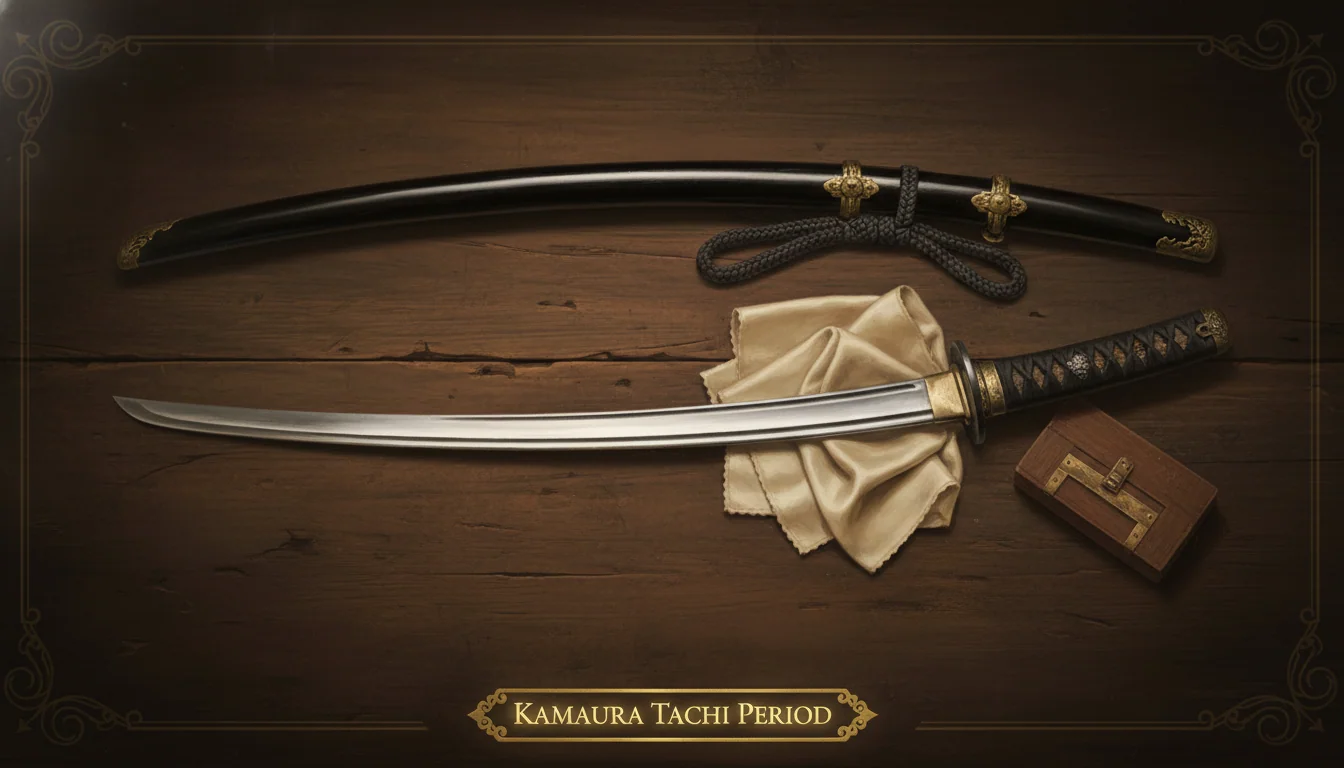
Long before the katana became the symbol of the samurai, another sword defined Japanese warfare. It was longer, more deeply curved, and worn edge-down from the belt, suspended on cords rather than thrust through a sash. It was the sword of the mounted warrior in an era when cavalry dominated Japanese battle, and it produced the blade-making traditions, the forging techniques, and the aesthetic philosophy that made Japanese swords the most studied and collected in the world.
The tachi is the sword that came before. Dismissing it as simply "the katana's ancestor" is like calling the warship that won Trafalgar merely the ancestor of the dreadnought. It is technically accurate and completely misses the point.
Origin and design
Japanese sword-making traces its lineage back to continental Asia, where the blade-forging traditions of China and Korea crossed the sea with Buddhism, writing, and administrative culture in the first millennium. The straight blades of the Nara period (710-794 AD), influenced by Tang dynasty Chinese swords, were already sophisticated objects. But the curve that defines the Japanese sword appears in the archaeological record as Japanese smiths developed their own traditions, and by the late Heian period, roughly the late 10th to early 11th century, the distinctly Japanese curved long sword was established as the weapon of the mounted warrior class.
The tachi as a mature form is defined by several features. The blade, called the ha, is single-edged, curved along its length, typically between 70 and 80 centimeters and sometimes longer. The curvature - the sori - tends to be distributed across the full length of the blade. The surface shows the characteristic hamon, the temper line that marks the boundary between the hardened cutting edge and the tougher body of the blade, an aesthetic and structural feature produced by the differential clay-coating technique during quenching.
The materials are tamahagane, a carbon-variable steel produced in a traditional smelting process from iron sand and charcoal. Japanese swordsmiths folded and worked the steel to distribute the carbon content, producing a blade that combined a hard cutting edge with a more flexible body. This combination - hard enough to take and hold an edge, flexible enough not to shatter on impact - was the technical achievement that gave Japanese swords their lasting reputation.
The tachi is worn differently from the katana. It is suspended from the belt by two cords, called the sageo, attached to the scabbard, with the cutting edge facing downward. This configuration is not an aesthetic choice. A sword worn edge-down and suspended from the hip can be drawn in a long, sweeping arc by a man on horseback without catching the edge on the belt or fouling the draw. The geometry works with mounted movement. The katana, worn edge-up, is optimized for a standing draw from a foot soldier.
The mounted warrior and his sword
The social class that wore the tachi, the samurai, emerged in the Heian period as provincial warriors who administered land on behalf of the imperial court. By the 10th and 11th centuries they were the de facto military force of Japan, and their warfare was conducted primarily on horseback. A samurai of the high Heian or Kamakura period (1185-1333) was a mounted archer first and a sword-fighter second: he rode toward his opponent, fired arrows, and drew the sword when the distances collapsed.
The tachi in this context was a cavalry saber, used for the downward slashing stroke that works best from above and at speed. The deep curvature of the blade concentrates the cutting arc at the point where it intersects a standing opponent at full gallop. The long grip, allowing a two-handed hold even while managing reins, provided the leverage for powerful strikes from horseback.
The aesthetic culture around the tachi developed in parallel with its military function. Blades were signed by their makers - a tradition that makes the provenance of Japanese swords more traceable than almost any other ancient weapon. The great workshops of the Bizen tradition in what is now Okayama Prefecture produced enormous quantities of tachi, and their output for the warrior class of the Kamakura period is represented in hundreds of surviving signed examples.
The wars that shaped the sword
The Genpei War of 1180 to 1185 is the defining military event of the tachi era. The Taira and Minamoto clans, rivals for dominance over the imperial court, fought a five-year conflict across Japan that ended with the Minamoto victory and the establishment of the Kamakura shogunate. The war's battles, recorded in the Tale of the Heike and other chronicles, show the tachi in its primary role: samurai identifying individual opponents on the battlefield, calling out their names and lineage, and closing to fight in the mounted single combat that defined the warrior culture of the period.
The combat was not exclusively single-combat theater. Large formations of infantry and cavalry clashed at battles like Ichi-no-Tani and Dan-no-ura. But the ideology of the individual samurai duel, and the tachi as its instrument, was fully formed by 1185.
A century later, Japan faced a different kind of challenge. The Mongol invasions of 1274 and 1281 brought large infantry forces using coordinated tactics, noise, and explosive projectiles at Hakata Bay on Kyushu. The Mongol archers carried the composite bow that had made the steppe cavalry unmatched across Eurasia. Japanese samurai accustomed to mounted individual combat found the massed Mongol infantry formations difficult to fight in the traditional way. The tachi and traditional archery remained effective, and Japanese resistance, combined with the famous storms that destroyed the Mongol fleets in both invasions, prevented the conquest. But the experience exposed the limitations of a warrior culture organized around mounted individual combat.
The sword's technical evolution
Over the roughly five centuries of tachi dominance, the form evolved in response to changing martial requirements and the tastes of the patrons who commissioned the finest work.
The early blades of the late Heian period tend to be long, with a pronounced taper from hilt to tip. The Kamakura period produced what many consider the pinnacle of tachi making: blades with a fuller body, maintained width, and the deep temper lines - ko-nie, nie, and nioi - that are the markers of the greatest smiths. The Soshu tradition, associated with the Sagami Province near Kamakura, produced work attributed to smiths including Masamune, whose name has become synonymous with the highest level of Japanese sword-making. Whether specific blades attributed to Masamune were actually made by him, given the centuries of attribution and re-attribution, is a question sword scholars continue to debate.
The Nanbokucho period (1336-1392), during which rival imperial courts contested control of Japan, saw a fashion for extremely long blades, some exceeding 90 centimeters, suited to cutting through the heavier armor of a period of intense and desperate fighting. These blades were sometimes shortened in later centuries when their length became impractical for changing battlefield conditions.
The shift to the katana
The transformation from tachi to katana was not a single decision but a gradual shift driven by changing tactics. During the Nanbokucho period and accelerating through the Muromachi period (1336-1573), Japanese armies increasingly fielded large numbers of foot soldiers alongside the mounted samurai elite. Fighting on foot, in tight formations, against multiple opponents at close range, changed what a sword needed to do.
The katana - worn edge-up, drawn in a faster and shorter arc, requiring less clearance around the body - suited infantry fighting in a way the tachi did not. During the Sengoku period (roughly 1467-1615), when Japan was in continuous civil war between rival warlords and their mass armies, the katana became standard. The mounted samurai did not disappear, but he was no longer the dominant tactical element.
The tachi did not vanish. It was worn in formal and ceremonial contexts throughout the Edo period and beyond, and many tachi were mounted as katana by shortening the tang and reversing the orientation of the fittings. A blade that had been worn edge-down on the hip of a Kamakura samurai sometimes ended up worn edge-up in the belt of an Edo-period official, with nobody at the time noting the inconsistency.
What the tachi left behind
The finest surviving tachi are national treasures of Japan. The Dojigiri Yasutsuna, attributed to a late Heian smith named Yasutsuna, is considered one of the five greatest swords in Japan. It is in the collection of the Tokyo National Museum and has not been displayed publicly for years. The Onimaru Kunitsuna is another, held by the Imperial Household Agency. These are not relics - they are cutting instruments of extraordinary technical sophistication that have survived centuries through a combination of careful ownership and the remarkable durability of the steel they are made from.
The traditions of tamahagane smelting, folded steel construction, clay-coat hardening, and blade polishing that were developed for the tachi are still practiced by licensed swordsmiths in Japan today, producing blades by the same techniques used in the Kamakura period. The tachi is where those traditions matured, and nothing since has needed to improve on the fundamentals it established.
Quick Answers
Common questions about this topic
What is the difference between a tachi and a katana?
The tachi is generally longer than the katana - typically 70 to 80 centimeters in blade length compared to the katana's 60 to 73 centimeters - and has a deeper curvature. The most important practical difference is how they are worn: the tachi is suspended edge-down from the belt by two cords, while the katana is thrust edge-up through the belt or sash. The tachi's configuration was designed for mounted use, allowing a clean draw and slash from horseback.
When was the tachi used in Japanese warfare?
The tachi was the dominant Japanese long sword from roughly the late Heian period (late 10th century) through the Nanbokucho period (14th century). It remained in ceremonial and formal military use well into the Edo period. As battlefield tactics shifted away from mounted cavalry combat during the Sengoku period in the 15th and 16th centuries, the shorter and more versatile katana gradually replaced it as the primary combat sword.
What battles defined the tachi era?
The tachi was central to the Genpei War (1180-1185), in which the Taira and Minamoto clans fought for control of Japan in a series of cavalry-heavy engagements that defined samurai warfare. It remained standard through the Mongol invasions of 1274 and 1281, when Japanese forces using tachi and other traditional weapons clashed with Mongol infantry and naval forces at Hakata Bay.
Are tachi considered superior to katana?
They are different tools suited to different contexts, not a progression from inferior to superior. The tachi was optimized for mounted combat at speed; the katana was optimized for foot combat at closer range. Katana became dominant because Japanese warfare shifted toward infantry. The finest tachi blades - made by smiths of the Bizen, Yamashiro, and Soshu traditions - are considered among the greatest achievements in the history of bladesmithing.

Talk to the People Who Wielded These Weapons
Chat with the soldiers, smiths, and commanders whose lives were shaped by the weapons of their age.
Create your free account →No card required. Talk to anyone in history with 8 free credits a day. Some features require a paid plan.
Join the HistorIQly Club
Get smarter about the past.
Weekly stories, deep dives, and exclusive content straight to your inbox.