Arsenal: The Urumi - India's Flexible Whip-Sword
The urumi sword is a razor-edged strip of tempered steel worn coiled at the waist, capable of shredding multiple opponents in a single stroke.
Read Wikipedia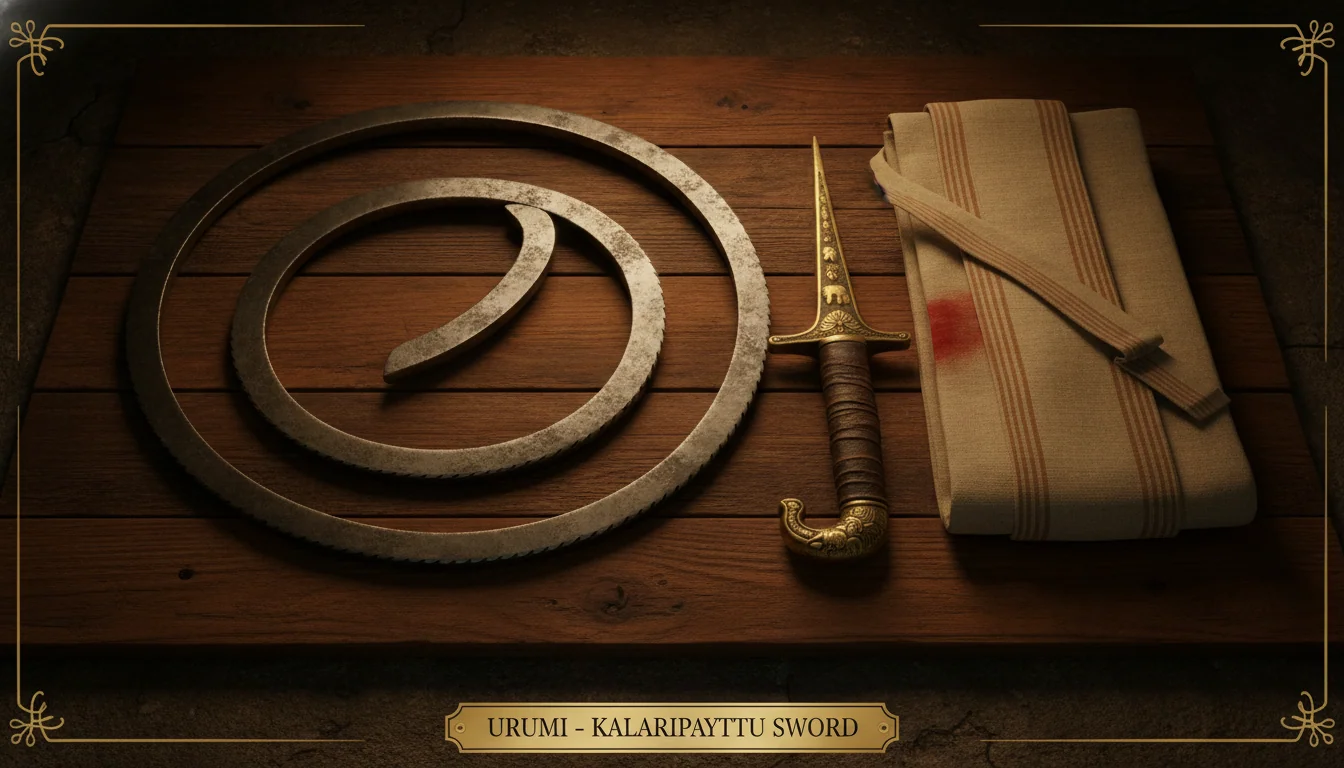
A length of steel thin enough to bend into a coil, long enough to wrap around a human waist, and sharp enough on both edges to cut clean through muscle and bone. When the warrior wearing it draws and swings in a single motion, the blade uncoils into a screaming arc of metal that moves faster than a human eye can follow. It bypasses shields. It wraps around guard positions. It requires no particular strength to wield lethally.
The urumi sword is among the most technically demanding weapons in any martial tradition on earth. Mastering it is the final stage of Kalaripayattu, the ancient combat system of Kerala, because a student who hasn't spent years building the prerequisite skills will simply cut themselves to pieces before they cut anyone else.
Origins in Kalaripayattu
Kalaripayattu is among the oldest documented martial traditions in Asia. Its origins are traced in texts and oral traditions to Kerala, the southwestern coastal strip of India, and references in ancient Tamil Sangam literature suggest formalized combat training in the region going back at least to the first centuries of the common era. The tradition encompasses empty-hand combat, a sequence of weapons ranked by the years of training required, and a closely related system of therapeutic massage and healing that practitioners called marma therapy.
Unlike the rigid-bladed weapons more familiar from other Indian traditions, such as the talwar carried by Mughal and Rajput cavalry, the urumi belongs to a rarer family of flexible arms. The weapons are taught in a specific order that reflects increasing complexity and danger. A student begins with wooden staves and works through progressively shorter and more demanding weapons: spear, sword and shield, dagger. The urumi is last. The logic is practical: the urumi requires the full-body coordination, spatial awareness, and muscle memory built by everything that came before it. A student who cannot yet read how an opponent moves has no business holding a flexible blade.
The Kalaripayattu tradition distinguishes between northern and southern styles, associated broadly with the northern and southern regions of Kerala, and the urumi is most associated with the northern tradition, sometimes called Vadakkan Kalari. Both traditions continue today, taught in training centres called kalari.
The technology
A war-grade urumi blade is made from high-carbon spring steel, tempered to hold flexibility without brittleness. The key metallurgical problem is the same one that faces all spring-steel work: the blade must be hard enough to hold an edge, ductile enough to bend without cracking under repeated flexion, and resilient enough to return to shape after being coiled and uncoiled. Kerala's metalworking tradition solved this problem, and traditional bladesmiths in the region developed the urumi alongside other characteristic weapons of the tradition.
The typical weapon has a single blade roughly 1.5 to 2 metres long, though some variations carry multiple blades attached in parallel to a single handle, effectively creating a flexible fan of cutting edges. The handle is rigid - usually a sword-type hilt with a grip and guard - which provides a stable control point for the flexible mass attached to it. The cross-section of the blade is thin and narrow, not unlike a whip in its profile, which is what gives it both its flexibility and its cutting power.
The practice weapon used in training has a dulled or thickened edge - experienced practitioners have been cut badly enough by training versions - and the live-edged war version is reserved for performance demonstrations and, historically, for actual combat.
Coiled and worn at the waist, the weapon looks like a wide leather belt. It conceals completely under a shawl or draped garment. An opponent who has not seen an urumi drawn before has no preparation for what happens when the wearer reaches to their side and swings.
The physics of a flexible blade
Understanding why the urumi is so difficult to defend against requires understanding why all flexible weapons create problems that rigid weapons do not, a problem European armies also grappled with in the design of the flail.
A rigid sword thrust can be parried because the blade moves on a predictable line. A rigid sword cut follows a circular arc defined by the reach of the arm. A trained defender can read both. The urumi blade does not move on a predictable line. The tip travels on an arc, but the blade behind the tip is flexing, oscillating, and moving on a secondary curve independent of the primary swing. Against a practitioner who knows how to direct that movement, the blade can wrap around a guard, change direction mid-swing, and arrive at angles a rigid weapon cannot reach.
Multiple blades compound this further. A practitioner swinging a multi-bladed urumi covers a volume of space simultaneously rather than a single line. Anyone within range is inside a zone of cutting surfaces that cannot all be blocked at once.
The critical limitation is range control. At long range the urumi is less effective than a longer rigid weapon. In the close quarters where most historical combat occurred, it was devastating. Against multiple opponents standing near each other, a wide circular swing could wound several simultaneously - which is precisely the scenario the weapon appears to have been designed for.
Historical use
The urumi was a specialist weapon, not a mass-military one. Armies in Kerala, as elsewhere, fought primarily with spears, bows, shields, and short swords. The urumi was associated with the Chekavar warrior caste of Kerala, who functioned as professional fighters available for hire and who resolved disputes between noble families in formalized one-on-one and small-group combat.
This context explains why the weapon's specifications map so precisely to its technique. The Chekavar were not battlefield soldiers fighting in formations where a two-metre flexible blade would be as dangerous to allies as to enemies. They were individual specialists, fighting at close range against small numbers of opponents, in circumstances where a weapon that could simultaneously address multiple attackers from unexpected angles had a decisive tactical value.
Kerala's coastal position and its extensive trade networks meant it was in contact with Persian, Arab, and later Portuguese and Dutch traders and soldiers from the medieval period onward. The Portuguese arrived on the Malabar Coast in 1498, and the conflicts between local powers and European trading companies through the 16th and 17th centuries created sustained demand for skilled fighters. How much the urumi was used in these encounters is not documented in surviving sources, but the weapon remained in active use through the period.
Decline and modern survival
The arrival of firearms progressively reduced the tactical relevance of all close-quarters weapons, and the urumi's advantages - surprise, unpredictability, multi-directional threat - could not be translated into a musket age. The Kalaripayattu tradition itself declined during the British colonial period, when the colonial administration suppressed martial practices across India as a security measure.
The tradition survived in private instruction and family lineages rather than formal schools, and was substantially revived in Kerala during the 20th century. Kalaripayattu was recognized by the Indian government as a significant intangible cultural heritage, and training centres proliferated through the latter half of the century.
The urumi is today taught as the pinnacle of the Kalaripayattu system in the traditional way: only after a student has completed the full progression of earlier weapons, only with appropriate safety precautions in the early stages, and only by instructors who have the lineage to teach it properly. Demonstrations appear at cultural festivals and martial arts exhibitions across Kerala and in diaspora communities worldwide.
The weapon's visual impact has made it one of the most recognizable images of Indian martial arts internationally, appearing in films produced in Kerala, Tamil Nadu, and Bollywood, often at the expense of technical accuracy. The real urumi moves faster and is more dangerous than most film choreography suggests - because the actors playing the masters have not spent ten years learning the earlier weapons first.
Quick Answers
Common questions about this topic
What is an urumi?
The urumi is a flexible bladed weapon originating in Kerala, southern India. It consists of one or more long strips of tempered spring steel, typically around 1.5 to 2 metres in length, attached to a rigid handle. The blade is flexible enough to be coiled around the waist like a belt when not in use. In combat it is swung in wide arcs that function like a metal whip, with cutting edges on both sides.
How is the urumi used in combat?
The urumi is swung in rapid circular motions, generating a whipping trajectory that is extremely difficult to predict or block. A practitioner who has mastered it can control multiple blades simultaneously and attack several opponents from different angles in a single movement. The flexible blade bypasses rigid guards because it wraps around defensive positions.
Why is the urumi so hard to learn?
The urumi's greatest danger is to its wielder. Without years of training, a practitioner swinging 1.5 to 2 metres of razor-edged spring steel in close circles is as likely to cut themselves as the opponent. The Kalaripayattu tradition teaches the urumi only after a student has mastered all the system's other weapons, typically requiring many years of prior training.
Is the urumi still practiced today?
Yes. The urumi remains part of the Kalaripayattu martial tradition, which was designated an intangible cultural heritage of India. It is taught in Kalari training centres in Kerala, particularly in the northern style. Demonstrations at cultural festivals show the weapon in the context it was designed for: a display of extreme technical skill by a practitioner who has spent years learning to control something that wants to cut everything within reach.

Talk to the People Who Wielded These Weapons
Chat with the soldiers, smiths, and commanders whose lives were shaped by the weapons of their age.
Create your free account →No card required. Some figures and features require a paid plan.
Join the HistorIQly Club
Get smarter about the past.
Weekly stories, deep dives, and exclusive content straight to your inbox.