Arsenal: The Kris Dagger
Kris dagger history spans twelve centuries: a living object with a soul and a social credential, the most spiritually charged blade in the Malay world.
Read Wikipedia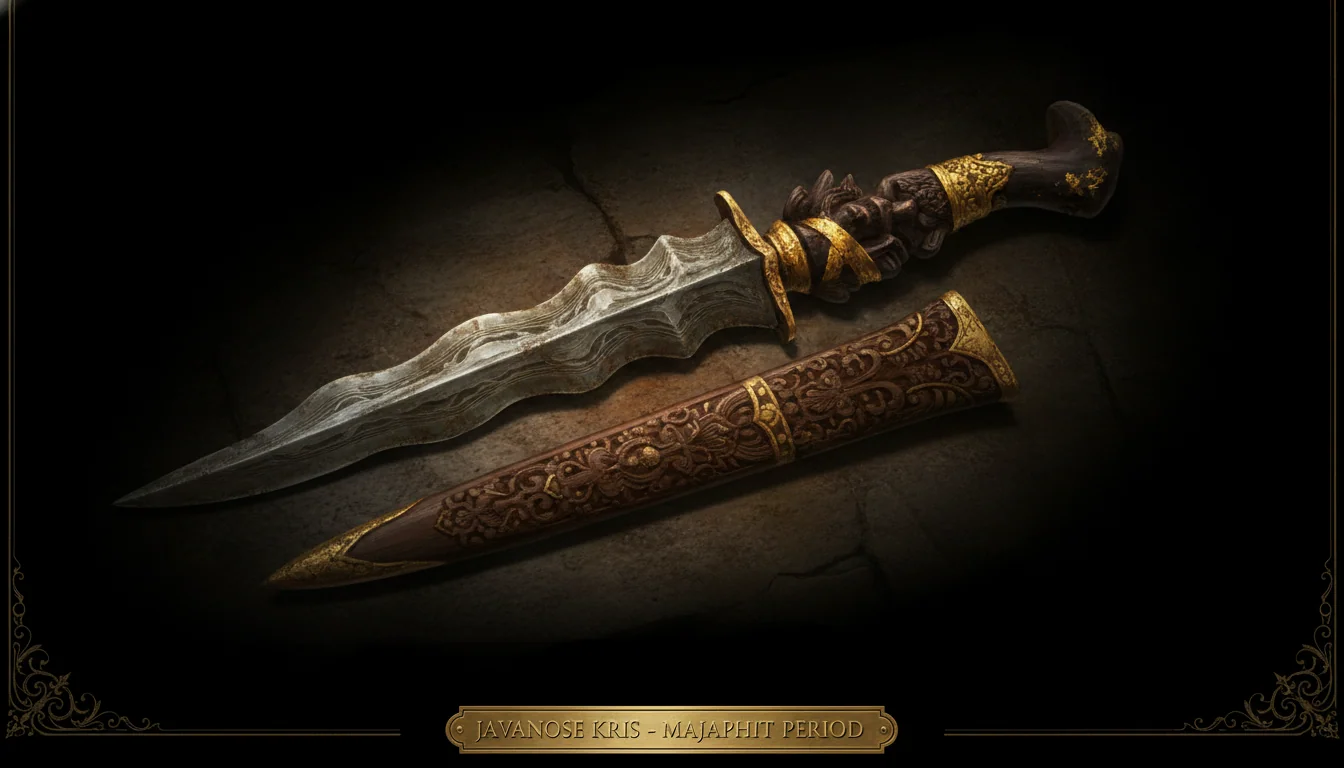
Most weapons have a straightforward biography. Designed for killing, refined for efficiency, eventually replaced by something more lethal. The kris, the distinctive asymmetrical dagger of the Malay world, does not have that kind of biography. It is a weapon that is also a sacred object, a social document, a family heirloom, and - if you accept the traditions that have surrounded it for twelve centuries - a living thing with a personality of its own.
UNESCO's 2008 inscription on the Representative List of the Intangible Cultural Heritage of Humanity describes the kris as "a symbol of heroism, courage, prowess and personal dignity." That is a remarkably modest list of what the kris has been understood to be.
Origins in Java
Kris dagger history begins with the earliest reliable evidence for the weapon, found in the Borobudur relief carvings in central Java, completed around 800 CE. Among the carved scenes depicting warriors and ceremonial figures, certain individuals carry daggers with the distinctive asymmetrical base profile - the ganja - and pointed blade that define the kris form. Literary sources from the East Javanese period, roughly the 10th to 14th centuries, mention the keris by name and describe its properties in terms that already indicate a spiritually active object, not a simple tool.
The weapon developed from earlier blade traditions in the archipelago, but the specific combination of features - the asymmetrical blade, the ganja flare at the base, the pattern-welded pamor - appears to be a Javanese innovation. By the period of the Majapahit Empire (roughly 1293 to the early 16th century), the kris had become central to Javanese court culture. It was worn by men of rank, given as diplomatic gifts between kingdoms, and catalogued in palace records alongside other treasury objects.
The Majapahit connection is important. The empire was the most extensive and influential polity in Southeast Asian history, stretching across much of the modern Indonesian archipelago and projecting cultural authority across the peninsula and islands of maritime Southeast Asia. Wherever Majapahit trade, conquest, or prestige reached, the kris followed. By the 15th century it had spread to the Malay peninsula, the Philippine archipelago, Brunei, coastal Thailand, and as far as the Maldives.
Each region developed its own style. Balinese kris have different proportions and handle designs from Javanese ones. Malay kris from the peninsula handle differently from Bugis kris from Sulawesi. But the underlying object - the asymmetrical blade, the ganja, the pamor - remains recognizable across the entire tradition.
The pamor
What makes a kris blade visually unlike almost any other weapon tradition is the pamor - the pattern visible in the finished metal. Pamor is produced through pattern welding: the smith folds two or more different types of metal together repeatedly, then works the composite billet into a blade. When acid-etched during finishing, the different metals respond at different rates, revealing the pattern the folding created.
The materials traditionally used were iron and a nickel-rich alloy. Historically, the preferred source for this alloy was meteoritic iron - nickel-iron meteorites give a consistent and distinctive pattern when worked into a kris blade. As meteoritic material became scarce over the centuries, Javanese smiths developed terrestrial alternatives, including iron-nickel ores from specific geological deposits. The Prambanan meteorite in central Java was one historically important source.
Each pamor pattern has a name and a meaning within the tradition. A blade with the weteng bolong pattern ("hollow belly") is considered inauspicious. A blade with the ron genduru pattern is associated with attracting wealth. A blade with the buntel mayit pattern ("wrapped corpse") is considered dangerous and difficult to own. A blade with the wengkon pattern is said to provide protection to its household.
These meanings vary by region and by the lineage of the empu who made the blade. But the underlying principle - that the pattern of the metal carries functional spiritual properties - is consistent across the entire tradition.
This is not superstition replacing craft knowledge. The Javanese empu who produced pattern-welded blades was executing a demanding technical process: controlling forge temperatures precisely, folding accurately, maintaining the differential between the two metals through dozens of working cycles. The spiritual significance was understood as layered on top of, not instead of, genuine technical skill. The empu's mastery of the craft was precisely what made the spiritual transfer possible.
The empu
The smith who forges a kris occupied a unique position in Javanese society. He was not a craftsman in the ordinary sense. He was a spiritual practitioner whose technical ability was understood as inseparable from his religious and ritual standing.
The forging process was not a manufacturing procedure. The empu would fast before and during significant stages of the work. He would consult the Javanese calendar to identify auspicious days for starting, for the critical folding stages, and for the final finishing. He would not forge during inauspicious periods even if a commission was urgent. He would discuss with the client what spiritual properties the finished kris needed to carry - protection, prosperity, martial effectiveness - and design the pamor pattern accordingly.
The belief underlying all of this is direct: the spiritual condition of the empu during forging transfers into the blade. A kris made in ritual purity by an empu of high standing carries positive spiritual energy. A kris made carelessly, during an inauspicious period, or by a smith of questionable character carries negative energy. These were not metaphors within the tradition. They were practical assessments that determined how a finished kris was valued, accepted, or rejected.
Certain empus became figures of legend. The Javanese chronicle tradition preserves names of master smiths from the Majapahit period and later, and blades identified as their work, where they survive in museum collections or royal palace arsenals, carry substantial cultural and monetary value in modern Indonesia.
The kris in warfare
The kris was a sidearm throughout most of its history, not a primary battlefield weapon. Javanese and Malay warriors went to battle with spears, shields, bows, and later matchlock firearms. The kris was the close-quarters tool of last resort - used when a spear broke, when an enemy closed to grappling distance, or when individual combat required a shorter blade than a sword.
This reduced battlefield role does not mean the kris was militarily incidental. Accounts from the Majapahit period and the subsequent Javanese and Malay sultanates describe it as the weapon of personal honor: the instrument used in individual combat, in assassination, and in formal duels. A Javanese noble's kris was the equivalent of a European knight's sword - the object that marked you as someone who could and would defend his standing.
Portuguese and Dutch accounts from the 16th and 17th centuries, as Iberian and later Dutch power extended into the archipelago, describe Malay and Javanese warriors in close combat with kris when firearms ran empty or misfired. The wars of the Mataram Sultanate against the Dutch East India Company in the 17th century saw the kris carried by officers who regarded it as a matter of identity as much as tactics.
Persistent traditions, found across the Malay world, describe individual kris with the capacity to act without a human hand - to move independently toward enemies, to protect their owners while they slept. These accounts are not taken literally in most contemporary Indonesian or Malaysian contexts. But they indicate how completely the kris was understood as an active agent rather than a passive tool.
Care, inheritance, and identity
A kris is not just owned. It is housed, maintained through specific rituals, and inherited.
Traditional practice across Java, Bali, and the Malay peninsula requires that a kris be periodically washed in a ritual preparation - typically containing lime juice, arsenic sulphide derived from orpiment mineral, and aromatic compounds - then oiled and rewrapped in a fresh cloth. The washing is called siraman and is typically performed on specific nights of the Javanese calendar, particularly during the month of Suro (Muharram in the Islamic calendar).
A kris that is neglected is believed to become restless and to bring misfortune to its household. A kris that is properly maintained is believed to protect the family that keeps it. These are not purely archaic beliefs: Javanese families maintain kris in their homes today, store them in purpose-made cases, and perform the siraman at traditional intervals.
When a kris passes from father to son, it carries the history of the family as a physical object. A blade made for a Majapahit-era court official, if such a blade survives in a family's possession, carries the weight of that lineage. The pamor pattern, the handle carving, the sheath material, the specific features the empu chose - all of these record the social position and aspirations of the families that commissioned and maintained it across generations.
UNESCO's inscription recognized this dimension explicitly: the kris is intangible cultural heritage because it carries a living practice, not merely the memory of one.
The kris today
The kris is no longer a battlefield weapon anywhere. It is a ceremonial object, a collector's item, a marker of cultural identity in Indonesia, Malaysia, the southern Philippines, and Javanese diaspora communities around the world. The Indonesian government has designated it national cultural heritage. Bali maintains the most active living tradition of kris use in ritual, where the weapon appears in temple ceremonies, sacred dances, and exorcism rites performed according to the Balinese Hindu calendar.
What the kris represents now is perhaps clearest when a Javanese groom wears one at a traditional wedding. The blade he carries may be centuries old. Its pamor pattern was chosen by an empu whose name is recorded in family oral history. Its care across the intervening generations - the ritual washings, the oilings, the rewrappings - is a form of continuous memory that the object itself carries forward.
The blade is not simply inherited. It is tended, like a relationship. And in that specific sense, the tradition surrounding the kris is stranger and more interesting than the weapon itself.
For other weapons with unusual cultural weight beyond their tactical role, see our piece on the kukri, the Gurkha blade whose ceremonial obligations have outlasted the tactical conditions that produced it.
Quick Answers
Common questions about this topic
What is a kris?
A kris (also spelled keris) is a distinctive asymmetrical dagger originating in Java, Indonesia. It is characterized by its often-wavy blade, its distinctive flared base called a ganja, and the use of pamor - a pattern-welded composite of iron and nickel-rich alloy that creates visible patterns in the finished blade. UNESCO recognized the kris as Intangible Cultural Heritage in 2008.
Why is the kris blade wavy?
The waves, called luk, carry spiritual and symbolic meaning rather than a functional combat purpose. Different numbers of waves - always odd, running from 3 to as many as 29 - correspond to different properties, from protective to aggressive to commercially fortunate. A kris with an even number of waves is considered inauspicious. The wavy form developed over centuries alongside earlier straight-bladed predecessors.
Who forges the kris?
The master smith who forges a kris is called an empu. The empu was historically a figure of spiritual authority as well as technical skill. The forging process involved prayer, fasting, consultation of auspicious days on the Javanese calendar, and careful selection of materials. The spiritual state of the empu during forging was believed to transfer into the finished blade.
What is pamor?
Pamor is the pattern visible in a kris blade, produced through pattern welding - folding iron together with a nickel-rich alloy derived historically from meteoritic iron. When the blade is acid-etched during finishing, the two metals respond differently, revealing the pattern created by the folding. Each pattern has a name and documented meanings within the tradition: some are believed to attract wealth, others to provide protection, others to be dangerous to their owner.

Talk to the People Who Wielded These Weapons
Chat with the soldiers, smiths, and commanders whose lives were shaped by the weapons of their age.
Create your free account →No card required. Some figures and features require a paid plan.
Join the HistorIQly Club
Get smarter about the past.
Weekly stories, deep dives, and exclusive content straight to your inbox.