Time Traveler's Guide to the Majapahit Empire, Trowulan 1350
The Majapahit Empire in 1350 was the largest in Southeast Asian history. Here's how to dress, eat, and navigate Trowulan without getting killed.
Read Wikipedia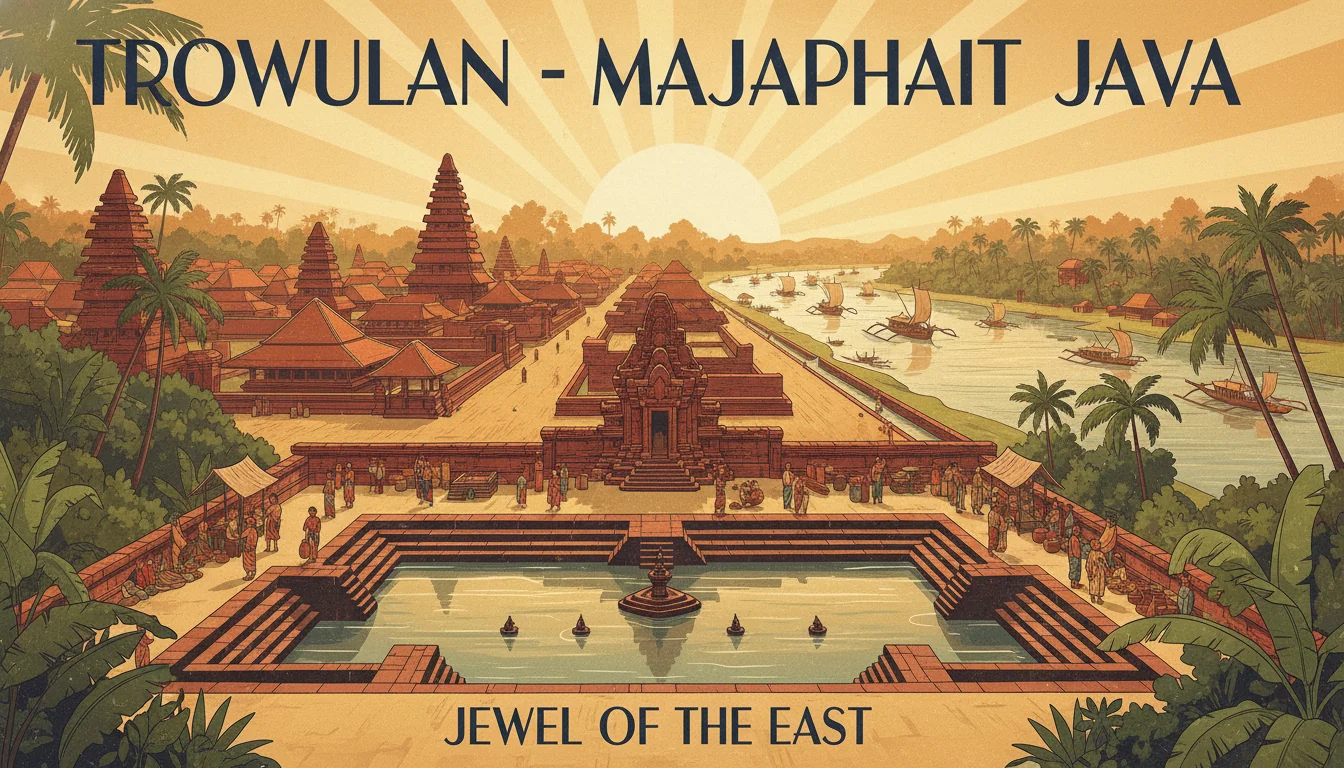
You have arrived at Trowulan in the year 1350, in the first year of the reign of King Hayam Wuruk, at the capital of the largest empire Southeast Asia has ever produced. The good news is that the city is magnificent, the market is extraordinary, and nobody will immediately try to kill you if you follow the protocol. The less good news is that the protocol is complicated, the hierarchy is rigid, and the prime minister is currently in the middle of a project to conquer most of the known world, which means court life is tense in specific ways that a traveler needs to understand before blundering into the wrong building.
Welcome to Majapahit. Pay attention.
The city you've arrived in
Trowulan sits on the flat alluvial plain of the Brantas River delta in East Java, at an elevation low enough that the seasonal monsoon rains threaten to turn everything into a floodplain. The engineers of Majapahit solved this problem over generations with one of the most ambitious water-management systems in medieval Asia. The city is threaded with channels, reservoirs, and drainage canals that route the rains away from the palace district and into controlled agricultural zones. The result is a planned capital of elegant red brick buildings set along a rational grid, with freshwater pools large enough to bathe an army and market streets that fill every morning with produce, cloth, spices, and animals arriving from across the archipelago.
The palace complex at the center, surrounded by a brick-walled compound, is where Hayam Wuruk lives and receives visitors. You will not be admitted casually. The temple complexes nearby - dedicated to Shiva and to the Buddha, often in the same compound, because Majapahit practices a syncretic religion that accommodates both - are more accessible, though correct behavior inside them is not optional.
The population of Trowulan may be somewhere near 100,000. By 14th-century standards, this makes it a major city. By 14th-century Java standards, it is the center of the world.
What to wear
You will be judged immediately and entirely by your dress. The Javanese court has a sophisticated textile culture built on batik-dyed cotton in geometric patterns, with silk reserved for the higher nobility. The color and complexity of your garments signals your rank at a glance, and arriving in ambiguous clothing is not neutral - it is suspicious.
Men wear a wrapped lower garment called a kain, tied at the waist, in lengths that indicate social position. The longer and more elaborately folded, the higher the status. A short wrap on a man arriving at court suggests he is a laborer who wandered in from the wrong district. Upper body coverings vary by rank and occasion; the highest courtiers wear elaborate cloths draped across one shoulder.
Women of status wear matching sets of wrapped textiles, with gold jewelry - rings, arm bands, and anklets - that serve as portable indicators of wealth. Gold is the material of court. If you have it, wear it. If you are uncertain, err toward more fabric and better quality rather than less.
Footwear: sandals are acceptable for commoners in the market streets. The palace compound requires bare feet, as it always has in Hindu-Buddhist court culture across the region. Do not argue about this.
What to eat
The market in Trowulan is one of the great arguments for time travel. Java in 1350 produces rice of multiple varieties, some of which have not been grown for centuries. Alongside the rice you will find fresh coconuts, bananas in at least a dozen varieties, jackfruit, mangosteen, durian if you are committed, palm sugar, fresh fish from the rivers and the coast, and dried seafood that has arrived by boat from as far as the Maluku Islands.
The spices are the thing. Nutmeg, cloves, and mace from the Banda Islands arrive in Trowulan via the trading networks that Gajah Mada is simultaneously expanding by military force. What you are eating in the market has traveled two thousand kilometers and passed through multiple hands. It will never be cheaper in any era closer to yours.
Street food exists, in the form of vendors selling grilled items over charcoal and wrapped packets of rice and filling cooked in banana leaf. These are safe. The water is not, unless you are confident about which wells and channels serve the palace district versus the downstream areas.
Alcohol: the Javanese court drinks palm wine and a rice wine called tuak on social occasions. Buddhism and Shaivism both have complicated relationships with intoxicants, and court etiquette dictates when drinking is appropriate. In the market you can drink freely. At any religious site, you cannot.
The court and its structure
Hayam Wuruk is twenty-one years old in 1350, newly crowned, and politically dependent on his prime minister Gajah Mada, who has been running the empire's expansion since the 1330s. The relationship between them is formal and functional: the king is the divine center of the kingdom, the ritual anchor around whom all ceremony revolves, while Gajah Mada handles the practical work of administration, military command, and diplomacy.
The Palapa Oath that Gajah Mada swore - vowing not to eat certain spices until he had unified the archipelago under Majapahit - is not merely symbolic. It reflects a genuine strategic program. In 1350 he is in the middle of it. Bali has been subdued. Campaigns are active or recently concluded across Sumatra, the Malay Peninsula, and parts of Borneo. The court hears news of these campaigns regularly, and the mood in the palace depends heavily on how they are going.
If you are presented at court - unlikely unless you have come with a trading delegation or a diplomatic letter from a recognized tributary state - you will perform the sembah: press your palms together at chest height and bow until your hands are at forehead level. Do not look the king directly in the eye. Do not speak until spoken to. Do not refuse food or drink offered during an audience.
What will get you killed
Several things.
Disrespect toward the court brahmin priests is the fastest path to serious trouble. The Hindu-Buddhist religious establishment at Trowulan is not background decoration - the priests consecrate the king's divine status, manage the agricultural calendar, and perform the rituals that are believed to hold the kingdom together. A foreigner who treats them as optional is likely to be explained to the relevant authorities by the nearest official.
Involvement in any dispute about court succession is equally dangerous. Hayam Wuruk has no male heir in 1350, and the question of the succession is live. Anyone perceived as taking a side in court politics between factions is making enemies who have the tools to do something about it.
The market is generally safe. The areas near the palace that are marked with brick walls and guarded by armed men are not yours to enter without invitation.
What to see before you leave
The Segaran pool - a vast ceremonial reservoir in the heart of Trowulan - is the most impressive piece of civic engineering in 14th-century Southeast Asia. It is roughly 375 meters by 175 meters, walled in brick, and was used for royal water ceremonies and, by some accounts, for bathing elephants.
The temples outside the city proper are worth the walk. Candi Brahu, a brick temple of early Majapahit date, stands a few kilometers from the city center. The form is recognizably Hindu, related to the temple architecture of Cambodia's Angkor, but distinctly Javanese in proportion and decoration.
The poet Prapanca is somewhere in the city this year or shortly after it, composing a work called the Nagarakretagama, which will be finished in 1365 and will describe the empire's extent, its tributary states, its rituals, and the layout of the capital in extraordinary detail. If you encounter a court scholar working on a long Sanskrit-Javanese poem about the king's travels, you are probably in his vicinity.
The market has everything worth carrying home, assuming customs officials in your era are flexible about six-century-old spices.
For other great medieval Asian empires in the time-travel series, see Visiting Khmer Angkor, 1150 and Visiting Yuan Khanbaliq, 1280.
Quick Answers
Common questions about this topic
What was the Majapahit Empire?
Majapahit was a Javanese Hindu-Buddhist empire that at its height in the mid-14th century claimed suzerainty over much of the Indonesian archipelago, parts of the Malay Peninsula, and stretches of coastal Borneo and the Philippines. Its capital, Trowulan, in the Brantas River delta of East Java, was one of the largest planned cities in medieval Asia. The empire reached its peak under King Hayam Wuruk and his prime minister Gajah Mada between roughly 1350 and 1389.
Who was Gajah Mada?
Gajah Mada was the prime minister (mahapatih) of Majapahit who effectively directed the empire's military and administrative expansion under Hayam Wuruk. He is best known for the Palapa Oath, a vow he reportedly made not to taste certain spices until he had unified the archipelago under Majapahit's authority. He remains one of the most celebrated figures in Indonesian national history.
What did Trowulan look like?
Trowulan was a planned capital on a large scale, with a sophisticated grid of water channels, reservoirs, and drainage canals that managed the seasonal floods of the Brantas delta. The city had brick palaces, Hindu and Buddhist temples, bathing pools, and market districts. Archaeological surveys suggest it may have housed up to 100,000 people at its peak, making it one of the largest urban centers in Southeast Asia in the 14th century.
What happened to Majapahit?
The empire weakened after a succession crisis and civil war known as the Paregreg War, which began in the early 15th century. The rise of Islamic trading states along the Javanese coast and the Malay Peninsula gradually eroded Majapahit's commercial and political dominance. By the early 16th century, the Hindu-Buddhist empire had effectively ended, and its court traditions dispersed to Bali, where they survive in modified form.

Need Advice from Someone Who Lived There?
Get firsthand accounts from people who actually lived through these moments in history.
Create your free account →No card required. Talk to anyone in history with 8 free credits a day. Some features require a paid plan.
Join the HistorIQly Club
Get smarter about the past.
Weekly stories, deep dives, and exclusive content straight to your inbox.