Arsenal: The Mauser C96 Broomhandle
The complete Mauser C96 history: from Churchill at Omdurman to Lawrence's Arab Revolt to Han Solo's blaster. The story of the most eccentric sidearm ever built.
Read Wikipedia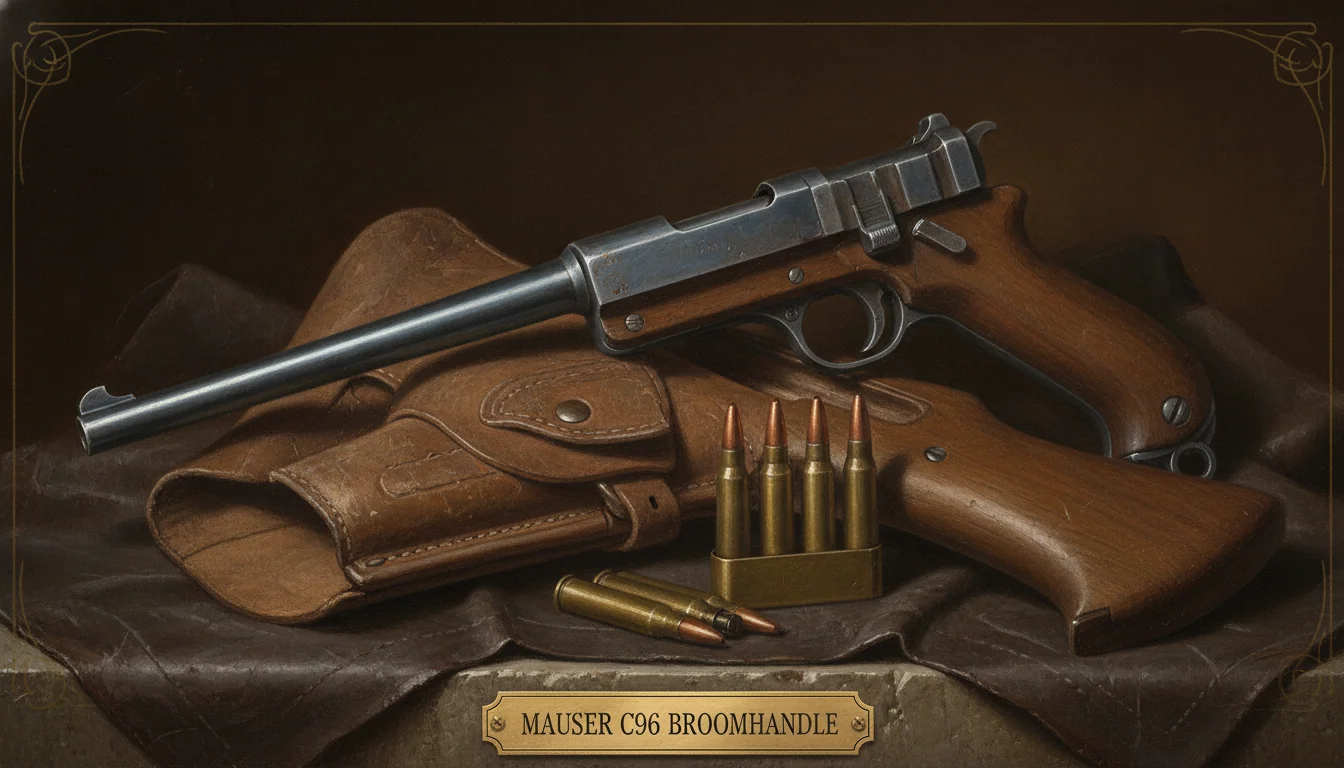
The Mauser C96 is a pistol that should not exist. It is too long, too heavy, too complex, and loaded in a way that no logical designer would choose if starting from first principles. The magazine is integral to the frame, ahead of the trigger, so the pistol is front-heavy in a way that requires training to shoot accurately. The mechanism is sophisticated to the point of fragility. The grip angle is unusual enough that even experienced shooters spend time adjusting their natural point of aim.
And yet the C96 was one of the most widely used and admired pistols of the early 20th century. It armed British colonial officers in Africa, Ottoman cavalry in the Balkans, Chinese warlords in Shandong, Soviet Red Army troopers in the Civil War, and anarchists on both sides of the Spanish Civil War. Winston Churchill carried one at the Battle of Omdurman in 1898. T.E. Lawrence had one throughout the Arab Revolt. A modified version became the most recognizable fictional firearm in cinema history.
The C96 outlasted its technical deficiencies through a combination of cartridge performance, mechanical robustness under adverse conditions, and an unmistakable visual identity that made it one of the most recognized sidearms on earth within a decade of introduction.
Origins
The pistol was developed at the Mauser Waffenfabrik in Oberndorf am Neckar in the mid-1890s, with most of the design credit belonging to the Feederle brothers - Fidel, Friedrich, and Josef - who worked as technicians in the factory's experimental shop. The Mauser company adopted the design and began commercial production in 1896, the year reflected in the C96 designation.
The cartridge came first, in practical terms. The 7.63x25mm Mauser round was designed to extract every possible velocity from the bottlenecked case, pushing a small-caliber bullet at speeds that contemporary revolvers and early semi-automatic pistols could not approach. The velocity gave the round unusually flat trajectory, good penetration of soft cover, and effective range well beyond what pistols were normally expected to deliver. In an era when most military pistols were considered effective only at close quarters, the C96 could, in the hands of a practiced shooter, make accurate hits at 50 meters or more.
The mechanism that cycled this cartridge was a short-recoil operated locked-breech design considerably more complex than the Colt and Browning designs that would eventually dominate the semi-automatic pistol market. The C96 had roughly a dozen more parts than the contemporary Colt M1900, and each of them had to be assembled in a specific sequence. A Mauser armorer could field-strip and reassemble one quickly. An inexperienced user under stress could produce a satisfying pile of parts.
The wooden holster-stock
The C96's wooden holster is one of its defining features and one of its genuine advantages. The holster is made of walnut, hollowed to accept the pistol, and fitted with a metal latch on the front. When the holster is clipped to the grip of the pistol, it becomes a shoulder stock. The combination turns the C96 into a short carbine that can be aimed from the shoulder at ranges where a pistol held at arm's length would not be accurate.
This was not unique to the C96 - other pistols offered detachable stocks in the same era - but the C96's combination of velocity and the carbine-mode accuracy made it genuinely useful as a short-range infantry weapon in the contexts where it was used. Cavalry troops, officers who needed something more capable than a standard revolver but could not carry a full rifle, and the irregular fighters who constituted much of its user base in Asia and the Middle East found the holster-stock combination practical rather than gimmicky.
British officers who acquired the C96 through commercial purchase - as many did, since personal sidearm selection was often at the officer's discretion - typically ordered the stock holster as standard. Churchill's account of the Battle of Omdurman in 1898 specifically describes using his Mauser one-handed, having injured his shoulder in an earlier action. The pistol's accuracy at moderate range and its high velocity were both relevant to what he describes.
Churchill, Lawrence, and the colonial era
The C96's commercial availability during the 1890s and 1900s made it accessible to the British officers, colonial administrators, and irregular fighters who were prosecuting the various frontier and punitive expeditions of the era. The German Mauser maker sold directly to anyone who could pay, and British military culture of the period encouraged officers to equip themselves with the best available sidearm regardless of official issue.
Churchill used his at Omdurman in September 1898, during Kitchener's reconquest of Sudan. He was serving with the 21st Lancers but attached himself to the charge for the experience of it. His memoir of the Sudan campaign describes shooting at Dervish warriors at close range and attributes his survival partly to the pistol's ability to function one-handed. Whether his specific account is precisely accurate in every detail is disputed, but the presence of his C96 at the battle is not.
T.E. Lawrence's C96 accompanied him through the Arab Revolt of 1916-1918 - a campaign explored in detail in our Lawrence of Arabia vs history fact-check. The Hejaz and Syrian campaigns were precisely the irregular warfare context for which the C96's range, penetration, and holster-stock were suited. Lawrence's later writings, particularly Seven Pillars of Wisdom, do not linger on specific weapons, but the pistol is documented in photographs from the campaign.
China and the Shanxi copy
The Mauser C96 found its largest non-Western market in China, where it arrived in the early 1900s and became the preferred sidearm of warlords, officers, and the various armed factions contending for control of the country through the 1920s and 1930s. The Chinese called it the "box cannon" for the holster-stock combination. It became so common that Chinese manufacturers in several provinces built unlicensed copies in local workshops. The Shanxi Arsenal produced a particularly well-known variant chambered in the locally popular .45 ACP cartridge, a combination that required significant engineering modification to the original design.
The sheer volume of C96s and Chinese copies flowing through the Chinese arms market meant that a distinctive German commercial pistol designed for European officers became, almost by accident, one of the characteristic weapons of Chinese civil conflict for three decades.
The Red Nine and the Schnellfeuer
Two variants extended the C96's service life significantly. The first was the "Red Nine" - a WWI-era C96 chambered in 9mm Parabellum rather than 7.63mm Mauser, ordered by the German Navy in 1915 to share ammunition with the Luger P08 that was the service's standard sidearm. The conversion required filing the grip with the number "9" in red paint to prevent confused loading - hence the nickname. Roughly 150,000 Red Nines were produced.
The second was the Schnellfeuer, or M712, introduced in 1931. This variant added selective fire capability and replaced the integral magazine with a detachable box magazine holding 10 or 20 rounds. The Schnellfeuer fired so fast in automatic mode that it was essentially uncontrollable unless shouldered with the stock holster, but in that configuration it offered the firepower of a submachine gun in a package that fit in a holster. It sold primarily to China and to various South American armed forces.
The blaster in the galaxy far away
The C96's post-WWII presence in cinema began in the 1950s and 1960s, when the distinctive silhouette made it a popular choice for exotic or villainous characters in European films. By the mid-1970s it was familiar enough as a "foreign" or "futuristic"-looking firearm that the Star Wars prop department selected a modified C96 as the base for Han Solo's DL-44 heavy blaster. The modifications - a scope rail, a muzzle device, and various cosmetic additions - preserved the fundamental C96 shape while adding enough visual strangeness to read as science fiction.
The original production prop was built on a functioning C96 receiver and was used for close-up filming before being damaged. Several versions of the DL-44 were made for different production purposes. All of them used the Mauser C96 as their visual foundation, and the association became so fixed in popular culture that C96 pistols began commanding significant premiums at auction from collectors whose primary interest was Star Wars rather than firearms history.
This is, in its way, a peculiar legacy for a pistol designed in the 1890s for colonial officers and warlords. The technical deficiencies that made the C96 awkward in purely military terms turned out to be precisely the visual qualities that made it unforgettable on screen.
Mauser produced the C96 from 1896 until approximately 1937, by which point the Luger P08, the Walther P38, and various newer designs had effectively ended its commercial viability in European markets. Production figures vary in historical accounts, but total output likely exceeded one million across all variants and copies. The pistol outlasted its era not through tactical superiority but through performance, distinctiveness, and the remarkable ability to find new users in new conflicts every decade or so until the world ran out of wars it was suited for.
Quick Answers
Common questions about this topic
Why is the Mauser C96 called the Broomhandle?
British soldiers and officers gave it the nickname because the grip, a slim wooden handle integral to the frame rather than attached grip panels, resembled a broomstick handle. The formal designation was Construktion 96, abbreviated C96, referring to the year of its design. The broomstick nickname stuck in English-speaking countries throughout both world wars.
What cartridge did the Mauser C96 fire?
The standard commercial version fired the 7.63x25mm Mauser cartridge, a bottlenecked round that drove an 85-grain bullet at roughly 1,400 feet per second - faster than virtually any contemporary pistol cartridge and enough to defeat most soft body armor of the era. A variant chambered in 9mm Parabellum was produced for WWI German Navy use, and some later variants used other calibers.
Was the Mauser C96 used in both World Wars?
Yes, though it was never the standard German service pistol. In WWI it was used by officers, cavalry, and specialist troops who purchased it privately or requisitioned it. By WWII it was obsolete as a frontline sidearm but remained in use in China, Spain, and among irregular forces. Its successor as the German service pistol was the Luger P08 and later the Walther P38.
What is the connection between the Mauser C96 and Han Solo's blaster?
The DL-44 heavy blaster pistol used by Han Solo in the Star Wars films was built on a Mauser C96 receiver fitted with a scope rail and various costume modifications. The C96's distinctive silhouette, the long barrel, exposed mechanism, and unusual proportions, made it visually alien enough to read as futuristic. The connection was confirmed by the props department and has made working C96 pistols among the most sought-after collector pieces in film prop history.

Talk to the People Who Wielded These Weapons
Chat with the soldiers, smiths, and commanders whose lives were shaped by the weapons of their age.
Create your free account →No card required. Talk to anyone in history with 8 free credits a day. Some features require a paid plan.
Join the HistorIQly Club
Get smarter about the past.
Weekly stories, deep dives, and exclusive content straight to your inbox.