Arsenal: The Naginata - Japan's Battlefield Polearm
Warrior monks, cavalry samurai, and castle-defending women all swung the naginata. This naginata history covers four centuries of Japan's most versatile polearm.
Read Wikipedia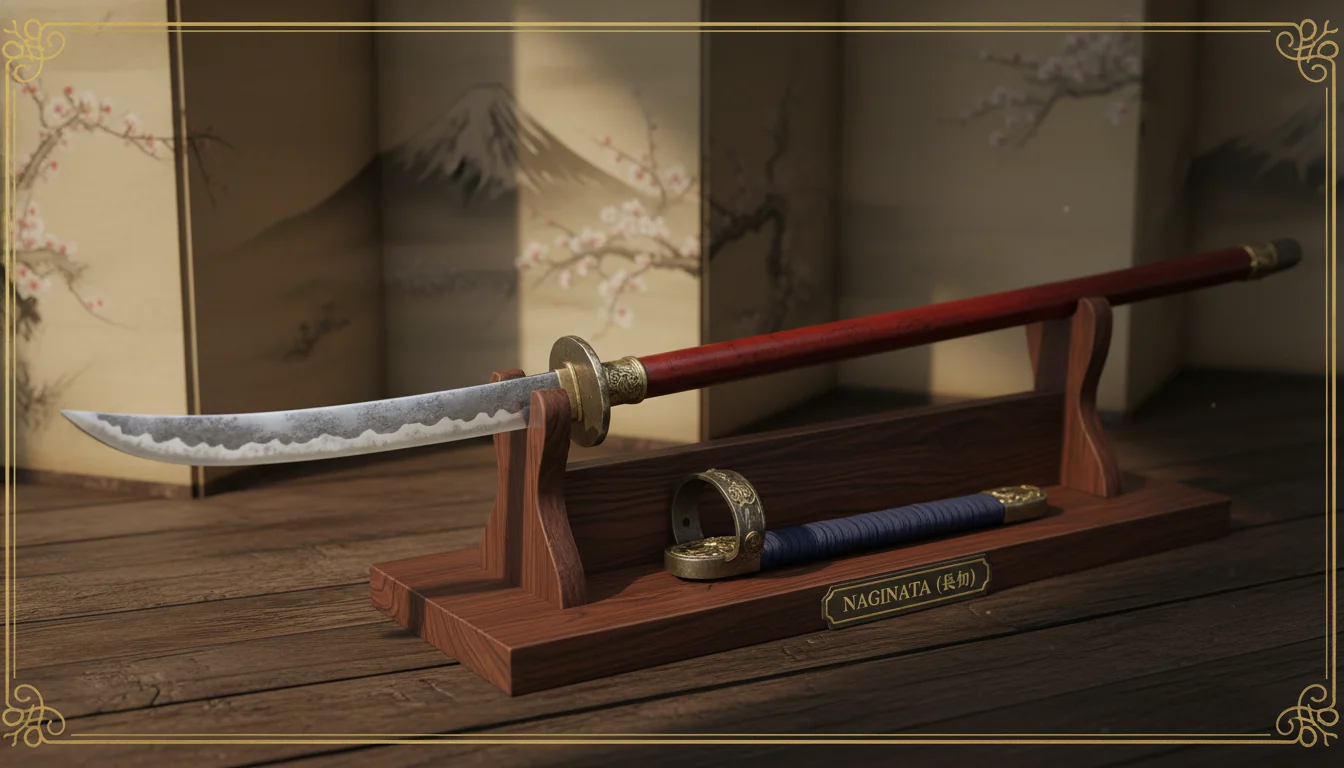
Japan's medieval battlefields were often decided not by the sword - the weapon of samurai legend - but by the long, sweeping arc of a blade mounted on a pole. The naginata, combining the reach of a spear with the cutting geometry of a curved sword, gave its users an unusual capacity: the ability to strike a mounted enemy at distance, sweep the legs from under a charging foot soldier, and defend a wide perimeter from a position of relative safety. For roughly four centuries, from the late Heian period through the Muromachi, it was one of the most important weapons in Japan.
Its decline came not from any inherent flaw in the design but from a shift in how Japanese armies organized themselves. And its afterlife - as the training weapon of samurai women and now a competitive martial art practiced by hundreds of thousands - is as interesting as its battlefield history.
Origins and earliest records
The naginata appears in Japanese records during the late Nara period (710-794 AD) or early Heian period (794-1185 AD), though precisely when it emerged as a distinct weapon form is difficult to establish from surviving texts. Early Japanese weapons drew on continental Chinese and Korean influences, and various long-shafted bladed weapons appear in Tang dynasty Chinese military manuals that were well-known to Japanese scholars and warriors of the period.
By the late Heian period, the naginata is firmly documented in literary and artistic sources. The weapon appears in picture scrolls depicting cavalry battles, and texts from the period name it specifically in accounts of combat. The basic configuration - a curved blade of one to two and a half feet attached to a wooden shaft of four to five feet, with a metal ferrule at the butt end for balance - appears relatively stable from early in the weapon's history.
The blade geometry shared ancestry with the tachi, the long cavalry sword worn cutting-edge down by Heian-period mounted warriors. Both weapons used the same curved, single-edged construction and the same principles of forging - a hard steel edge welded to a tougher core. The metallurgy that produced Japan's famous sword quality applied equally to naginata blades.
The warrior monks
The sohei - warrior monks attached to major Buddhist temples - became the most famous users of the naginata in the Heian period, and their patronage gave the weapon a cultural prominence it might not otherwise have achieved.
The great temple complexes of Nara and Kyoto maintained armed forces for a combination of reasons: genuine security needs, political muscle to exercise in disputes with rival temples and with the imperial court, and institutional pride. Enryakuji on Mount Hiei above Kyoto and Kofukuji in Nara were the two most powerful armed religious institutions, and their warrior monks carried the naginata as their signature weapon.
The reason was practical. Sohei were not professional soldiers in the mold of mounted samurai cavalry - they were monks who fought when necessary, and the naginata could be trained faster than the complex horsemanship and swordsmanship required of the warrior nobility. A monk with reasonable physical conditioning and a few months of practice could become a serious threat with a naginata. The same monk would need years to become a competent mounted swordsman.
The long reach of the weapon was also valuable in the contexts sohei actually fought: defending temple grounds, marching in procession through city streets to intimidate the court, and conducting the kind of close-quarters fighting that erupted at gates and corridors rather than on open cavalry fields.
The Genpei War and the weapon's battlefield peak
The Genpei War (1180-1185), the great civil conflict between the Taira and Minamoto clans that ended the Heian period and established the Kamakura shogunate, represents the naginata's moment of maximum battlefield prominence. The war is documented in the Tale of the Heike, one of the great works of Japanese literature, and the text is full of naginata combat.
The tactical picture in the Genpei War was dominated by mounted samurai archery - warriors on horseback exchanging arrows at distance before closing for melee combat. The naginata, wielded from horseback, gave a mounted warrior a reach advantage over infantry and a cutting option when the bow was no longer practical at close quarters. Cavalry with naginata could sweep through infantry formations, cutting both men and the legs of opposing horses, which was one of the most effective ways to neutralize a cavalry charge.
Famous individual combats described in the Heike - stylized and almost certainly embellished, but rooted in the weapon culture of the period - frequently feature the naginata as the climactic melee weapon. The warrior monk Benkei, the legendary companion of the tragic hero Yoshitsune, is traditionally depicted with a naginata.
Tomoe Gozen, the onna-musha (female warrior) who fought for the Minamoto general Yoshinaka, is perhaps the most celebrated naginata figure in Japanese legend. The Heike describes her as a formidable fighter with both the bow and the naginata. Whether she is historical or largely legendary is debated, but her association with the weapon established the connection between naginata skill and female warrior identity that would become institutionalized centuries later.
Technical evolution
Japanese weapon-makers refined the naginata continuously through the Heian and Kamakura periods. The blade's curve, thickness, and length varied by school and period. Blades became more standardized during the Kamakura period as the shogunate's administration brought more systematic military organization. Surviving examples from the Kamakura period show blades that are typically 30 to 60 centimeters long, slightly curved, with a pronounced ridge line and a well-defined point that allowed for thrusting as well as the more characteristic sweeping cuts.
The shaft, called the e, was typically made of hardwood and lacquered to resist moisture. A metal cap at the butt end, the ishizuki, served both as a counterweight for balance and as a secondary weapon - a blunt strike from the butt end of a naginata at close range could be decisive.
Naginata-jutsu, the formal martial art of naginata use, developed specific footwork, guard positions, and combination techniques that distinguished trained practitioners from untrained ones. Schools of instruction appeared during the Kamakura and Muromachi periods, and the technical vocabulary of the art became elaborate.
The yari replaces the naginata
The naginata's dominance on open battlefields began to erode during the Muromachi period (1336-1573). The tactical shift was away from individual mounted combat toward mass formations of ashigaru - foot soldiers equipped with spears - who fought in coordinated ranks. The yari, the straight-bladed spear, was better suited to this formation-based warfare than the naginata.
The yari was simpler to produce, required less skilled forging, and was easier to use in tight formation because its straight point allowed a precise thrusting motion without the wider arc that naginata technique required. A line of ashigaru with yari, disciplined and properly commanded, could hold against cavalry and break opposing infantry. Large-scale commanders like Oda Nobunaga systematized this approach during the Sengoku period (roughly 1467-1615), deploying ashigaru spearmen in the massed formations that would reshape Japanese warfare.
The introduction of firearms by Portuguese traders in 1543 accelerated this process. By the time Nobunaga fielded volley fire at the Battle of Nagashino in 1575, the military calculation that had made cavalry-era weapons like the naginata central to battlefield success was essentially over.
The onna-bugeisha tradition
As the naginata became less standard on open battlefields, it became increasingly associated with samurai women tasked with defending their households. The naginata's reach - its ability to keep a stronger male opponent at a distance - made it logical for women whose physical strength disadvantage was most significant in close grappling. Samurai daughters received naginata instruction as part of their education. A woman who could use a naginata could defend a castle interior or household compound if her husband's forces were away.
This association became formalized during the peaceful Edo period (1603-1868). With large-scale warfare reduced to memory, martial arts instruction became as much about discipline, character formation, and cultural identity as about battlefield survival. Naginatajutsu remained in the curriculum for samurai women even as it largely disappeared from male military training.
When the Meiji Restoration dismantled the samurai class, naginatajutsu survived as a codified martial art. In the 20th century it was reorganized into competitive naginata, with standardized rules and protective equipment. Today, naginata is practiced by several hundred thousand people in Japan and internationally, predominantly by women - a demographic continuity that runs from the Genpei War to the present in an unbroken if repeatedly reinvented line.
What the naginata tells us about Japanese warfare
The naginata's career illuminates a pattern in Japanese military history that the sword's overwhelming cultural dominance tends to obscure. Japanese warfare before the Edo period was not primarily a matter of samurai dueling with swords. It was cavalry archery, organized infantry formations, siege engineering, and logistics - the same mix of problems that military planners have always faced. The naginata was the tool that answered specific problems in that mix, particularly the problem of fighting mounted opponents with a weapon that could injure both rider and horse.
Its displacement by the yari was not the failure of an inferior weapon but the response of a military culture adapting its technology to a new tactical reality. Its survival as a women's martial art was not a demotion but a different kind of institutional persistence - the carrying forward of a technical tradition that had nowhere else to go and found, in samurai households and then in modern sports halls, a home.
The blade is still curved. The footwork is still the same. The warrior monks of Enryakuji would recognize the weapon, if not the practitioners holding it.
Quick Answers
Common questions about this topic
What is a naginata?
A naginata is a Japanese polearm consisting of a curved, single-edged blade mounted on a long wooden shaft, typically reaching six to eight feet in total length. It resembles a spear with a sword blade instead of a point, capable of both thrusting and wide sweeping cuts. It was a primary weapon of samurai cavalry and warrior monks from roughly the Heian period through the Muromachi period.
Who used the naginata?
The naginata was used by cavalry samurai, warrior monks (sohei) at major temple complexes, and later by women of samurai households. It became particularly associated with sohei during the Heian and Kamakura periods, then transitioned into a training weapon for women in samurai families during the Edo period. Today it is practiced as a competitive martial art, predominantly by women.
Why did the naginata decline on the battlefield?
The naginata was gradually displaced by the yari (spear) during the Muromachi period as large-scale infantry formations became the dominant tactical unit. The yari was cheaper to produce, easier to train with in large numbers, and better suited to tight ashigaru formations. The introduction of firearms by Portuguese traders in 1543 further accelerated the shift away from pole weapons as the primary offensive arm.
What is the difference between a naginata and a katana?
Both weapons share a curved, single-edged blade geometry, but the naginata blade is mounted on a long wooden shaft rather than a short handle, giving it dramatically greater reach. The naginata blade is typically longer and thinner than a katana, designed for sweeping cuts against mounted opponents rather than the close-range dueling geometry of the katana. The weapons are complementary rather than equivalent.

Talk to the People Who Wielded These Weapons
Chat with the soldiers, smiths, and commanders whose lives were shaped by the weapons of their age.
Create your free account →No card required. Some figures and features require a paid plan.
Join the HistorIQly Club
Get smarter about the past.
Weekly stories, deep dives, and exclusive content straight to your inbox.