Arsenal: The Panzerfaust
Panzerfaust history: the disposable German anti-tank weapon that cost 25 Reichsmarks and gave birth to the RPG-7 - how it worked, who used it, and why it still matters.
Read Wikipedia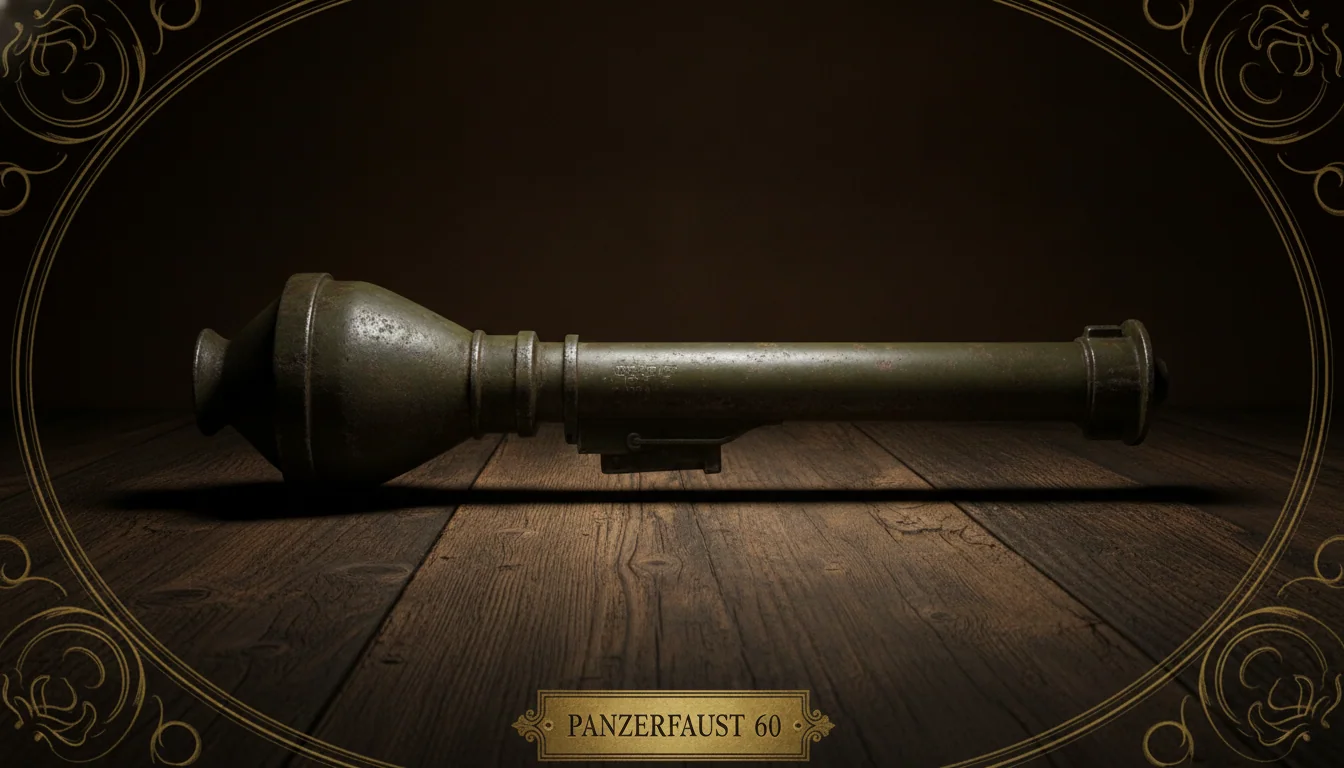
By the last winter of the Second World War, Germany was issuing single-shot anti-tank weapons to schoolchildren. Hitler Youth defenders of Berlin in 1945 received Panzerfausts, were trained in their use during a single afternoon, and were stationed in rubble to fire at Soviet armor at ranges that required holding their position until they could see the driver's vision port. Many of them did. The weapon worked. The boys, often, did not survive long after firing it.
The Panzerfaust's story does not begin in those final months, though they are what most people remember. It begins in a shortage, runs through five years of rapid engineering evolution, and ends as the direct ancestor of almost every shoulder-launched anti-tank weapon in service anywhere in the world today.
The problem that created it
By 1942, German infantry faced a problem shared by every army on every front of the war: a tank at close range, in a street or a forest or a hedgerow, where anti-tank guns cannot deploy and where there is no space to maneuver around it. The standard German anti-tank infantry weapons at the time were crude. The Geballte Ladung was a bundle of standard stick grenades strapped together - enough explosive to damage a tank's tracks or external fittings, rarely enough to kill the vehicle. The Hafthohlladung was a magnetic hollow-charge mine that had to be placed by hand on the side of an armored vehicle. Both weapons required the soldier to reach arm's range of a moving tank. Both killed a great many of the soldiers who used them.
The Army Weapons Office sought a practical one-man anti-tank weapon that could be manufactured in quantity, operated with minimal training, and issued to infantry at scale. The contract went to HASAG - Hugo Schneider Aktiengesellschaft, a Leipzig-based manufacturer. Heinrich Langweiler, their chief designer, had been working on the concept since early in the war. The first production Panzerfaust reached frontline units in the late summer of 1943.
How the weapon worked
The Panzerfaust was designed around deliberate simplicity, because simplicity was the military requirement, not a compromise.
A mild steel tube, roughly 100cm in length and about 4.4cm in diameter, served as the launch tube and was discarded after firing. The propellant was a small black-powder charge inside the tube. At the forward end, mounted on a finned stake that slid into the barrel, sat the warhead: a large bulbous projectile typically 14 to 15cm in diameter, painted field green. The warhead contained a shaped charge - an explosive formed around a conical copper liner.
When the propellant fired, it launched the warhead forward at a relatively modest velocity. When the warhead struck armor, the shaped charge detonated. The copper liner collapsed inward at high speed and formed a focused jet of gas and liquefied metal that moved along the weapon's axis at extreme velocity, penetrating armor by concentrated pressure rather than by kinetic impact. A shaped charge does not require high muzzle velocity to function. It requires geometry. Even at the Panzerfaust's low projectile speed, the warhead delivered a penetrating jet capable of defeating armor substantially thicker than the warhead's diameter.
The trigger mechanism was a folded metal blade on top of the tube - flip it up to cock the weapon, press the button to fire. The sight was a stamped metal leaf with notched marks for different ranges. A safety lever prevented accidental discharge. The total operation could be explained in five minutes and demonstrated in ten. This was the weapon's real military value: any soldier, or any teenager, could be made dangerous with it in a single training session.
The variants and their ranges
The number in the Panzerfaust's designation indicated its effective range in meters, and this number grew as engineers improved the design across successive models.
The Panzerfaust 30 was the original production model. At its nominal range of 30 meters, a firer was close enough to the target to be at serious risk from the detonation's back-blast if he did not take immediate cover. It penetrated approximately 140mm of rolled homogeneous armor. Introduced in late 1943, it was produced in the largest numbers of any variant.
The Panzerfaust 60, entering service in late 1944, extended effective range to 60 meters by using a larger propellant charge and improving the sight calibration. Armor penetration reached approximately 200mm, which exceeded the frontal protection of most Allied medium tanks, including the American M4 Sherman and the British Churchill.
The Panzerfaust 100, produced in early 1945, pushed the range to 100 meters and refined the trigger assembly. A more precisely calibrated sight accounted for different tank profiles at distance. This was the variant most commonly seen in the final defense of German cities.
Engineers were also developing a Panzerfaust 150 with a reusable tube - the most significant step toward what would come after the war. The reusable concept was underway when Germany surrendered in May 1945.
Numbers that define the weapon
Between summer 1943 and May 1945, Germany produced somewhere between 8 and 9 million Panzerfausts. At the peak of output in late 1944, factories were delivering more than 1.5 million per month. The original Panzerfaust 30 cost roughly 25 Reichsmarks to manufacture - a small fraction of what any alternative anti-tank system required.
Production was intentionally distributed across dozens of small workshops and factories, none of which held sufficient concentration of output to make a single bombing raid decisive. The steel tube could be stamped by any workshop that had previously made piping or ductwork. The warhead required more specialized capability, but the assembly process was designed for workers with minimal technical training. The Panzerfaust was the cheapest effective anti-tank weapon ever mass-produced.
What it changed on the battlefield
The Panzerfaust did not change the outcome of the Second World War. Germany was already losing when the weapon entered production, and the reasons it was losing - strategic overextension, resource shortage, Allied production capacity, and a two-front commitment from which it could not escape - were not addressable by an infantry anti-tank weapon. What the Panzerfaust did was substantially raise the cost, measured in tanks and men, of fighting German infantry in close terrain.
The weapon appeared in large numbers precisely as the character of the fighting shifted toward environments where it was most effective. The hedgerow country of Normandy after the June 1944 landings, the rubble of Aachen and Cologne, the river crossings of the Rhine, and the street fighting of Berlin were all terrain in which tanks could not maneuver freely or rely on distance to protect them. A soldier with a Panzerfaust concealed in a cellar window, at a range of 30 to 60 meters, was a lethal threat to any Allied armor that advanced without close infantry support.
Allied commanders adapted. American tank crews moving through German towns increasingly relied on infantry advancing room to room ahead of the vehicles, sweeping windows and doorways before the tanks followed. British commanders attached infantry sections to every tank move in urban terrain. The Panzerfaust's effective range remained short enough that a quick-reacting crew or accompanying infantry could often identify and engage the firer before a reload - but there was no reload. The first shot was what mattered.
Soviet forces in 1945 captured Panzerfausts in such numbers that they issued them to their own infantry alongside standard anti-tank rifles. Soviet after-action reports on the weapon's penetration performance were detailed and impressed. That detail was not forgotten.
The lineage
When Germany surrendered, captured Panzerfaust stockpiles distributed themselves through the hands of every occupying power and quickly into Cold War proxy arsenals on three continents. Soviet designers studied the weapon specifically. The RPG-2, introduced in the early 1950s, was a direct engineering refinement of Panzerfaust principles: a reusable launcher, a removable hollow-charge warhead, a simple propellant system. The RPG-7, which appeared in 1961 and which remains in production and continuous active service today in conflicts across four continents, refined those principles with a more capable warhead and improved range. It is arguably the most widely distributed infantry anti-tank weapon in history.
American weapons developers, working from captured German technical data and from analysis of the RPG family, produced the M72 LAW in the 1960s - a single-shot disposable tube with a shaped-charge warhead, extending to firing position and collapsing flat for storage. The LAW served in Vietnam, in the Falklands, in the Gulf, and across four decades of American and allied military operations. The Swedish AT4, designed in the 1980s, represented a further refinement of the same basic concept with improved propulsion and optics.
The soldier who fired a Panzerfaust 30 from a Berlin doorway in April 1945 was using a weapon at the end of its operational history. The weapon itself was nowhere near the end of its influence. What Langweiler's 1942 design established - that a single infantryman with a cheap, disposable, shaped-charge tube could threaten any tank in close terrain - remained true through every conflict in the decades that followed, and remains true today.
For related anti-tank weapon histories, see Arsenal: The Bazooka, the American equivalent that entered service in 1942 and fought in parallel through the same war, and Arsenal: The Flamethrower, which solved a different problem in the same close-terrain environments.
Quick Answers
Common questions about this topic
What is a Panzerfaust?
The Panzerfaust was a single-shot, disposable German anti-tank weapon used in World War II. It consisted of a lightweight steel tube with a small propellant charge and a large bulbous warhead containing a hollow-charge explosive. When fired at a tank, the shaped charge directed a jet of superheated gas and copper through the armor. Most variants were pre-loaded and discarded after firing.
How effective was the Panzerfaust against Allied tanks?
At close range, the Panzerfaust was highly effective. Later variants could penetrate armor exceeding 200mm of rolled homogeneous steel, which was beyond the frontal protection of most Allied tanks including the M4 Sherman. Its major limitation was range: the original Panzerfaust 30 was effective only to 30 meters, and even improved versions were marginal beyond 60 to 100 meters in field conditions.
How many Panzerfausts were produced in WWII?
Estimates range from approximately 8 to 9 million Panzerfausts produced between 1943 and 1945. At peak production in late 1944, German factories were producing over 1.5 million per month. The original Panzerfaust 30 cost roughly 25 Reichsmarks to manufacture, comparable to the cost of a small number of artillery shells.
Did the Panzerfaust influence later weapons?
Significantly. The Soviet RPG-2 and RPG-7, the American M72 LAW, and the Swedish AT4 all descend from design principles the Panzerfaust established: a pre-loaded tube, a hollow-charge warhead, and priority given to cheapness and simplicity over range and reuse. The RPG-7 alone, which is still in production, may be the most widely distributed anti-tank weapon in history.

Talk to the People Who Wielded These Weapons
Chat with the soldiers, smiths, and commanders whose lives were shaped by the weapons of their age.
Create your free account →No card required. Talk to anyone in history with 8 free credits a day. Some features require a paid plan.
Join the HistorIQly Club
Get smarter about the past.
Weekly stories, deep dives, and exclusive content straight to your inbox.