Arsenal: The Flamethrower from Greek Fire to Vietnam
Flamethrower history from Greek fire to Vietnam: how a weapon built on terror evolved from Byzantine galleys to the Pacific Theatre M2 and was eventually retired.
Read Wikipedia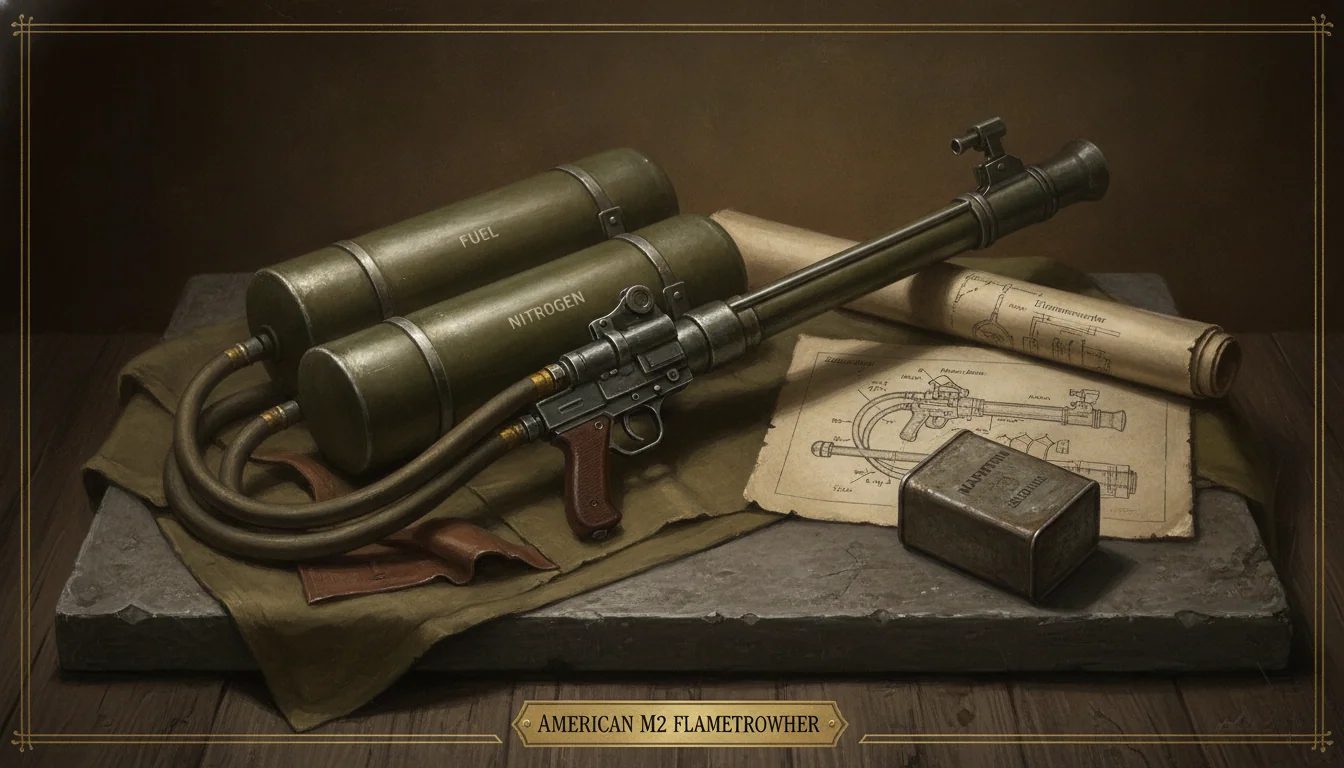
There is no weapon in the history of warfare that has produced the same combination of tactical effectiveness and pure psychological horror as the flamethrower. The bayonet kills one man at a time. The machine gun kills efficiently and at distance. The flamethrower does something different: it makes dying visible in real time, it turns a fortified position into an inescapable furnace, and it does so at close enough range that the operator can hear what is happening.
This is not an accident of design. From Byzantine Greek fire to the American M2 in the Pacific, every iteration of this weapon has been built partly around the knowledge that fire terrorizes before it kills, and that terror is tactical.
Greek fire and the Byzantine edge
The first documented large-scale incendiary projection weapon in military history belonged to the Byzantine Empire.
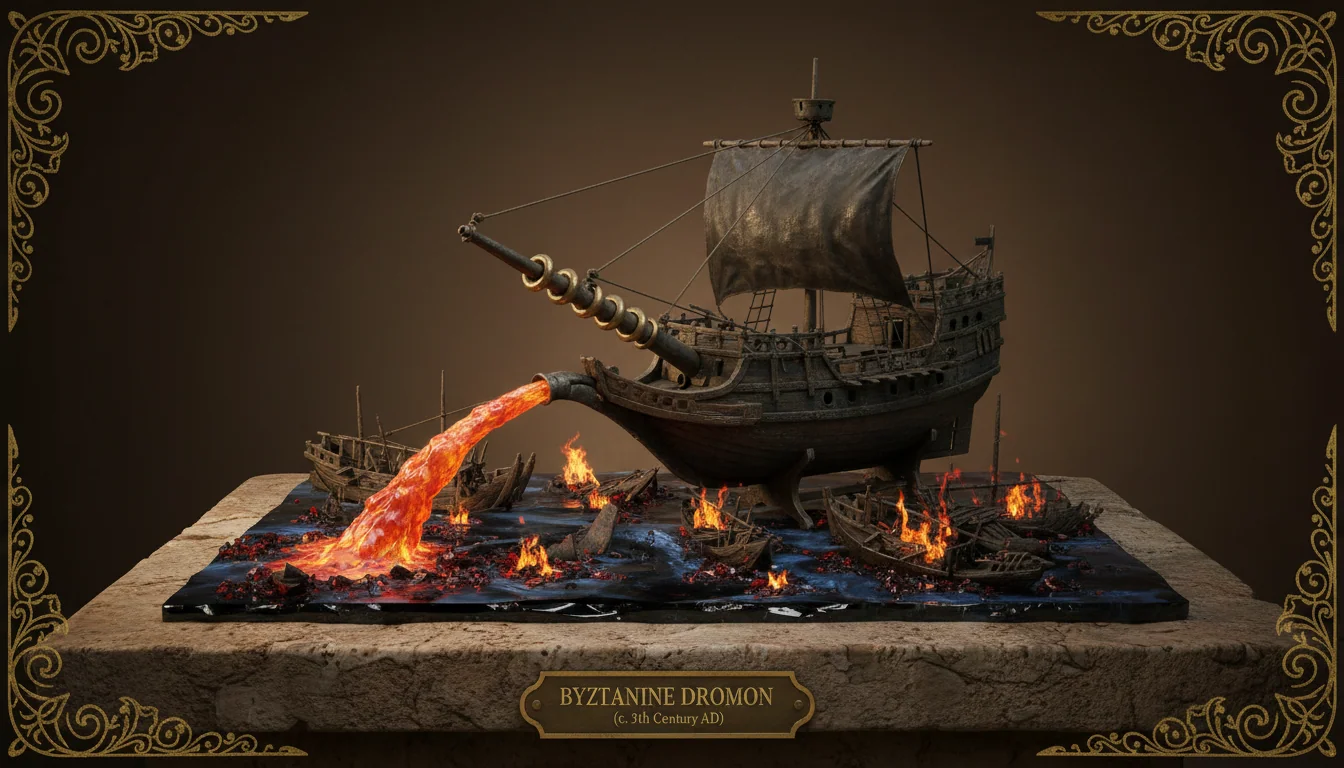
In 672 AD, Arab fleets attacked Constantinople as part of a sustained campaign to capture the Byzantine capital and break open the Mediterranean. The Arabs had superior numbers and a proven naval tradition. The Byzantines had something the Arabs had never encountered: bronze siphon tubes mounted on the prows of their warships, capable of projecting burning liquid across the water surface and onto enemy hulls.
Greek fire, as the weapon became known in European sources, was devastating. It burned on water. It reportedly burned hotter when splashed with water rather than being extinguished. The Arab fleet withdrew. Multiple subsequent attacks on Constantinople over the following decades were repulsed with similar results. The weapon became so central to Byzantine defensive strategy that the formula was designated a state secret, entrusted only to the Kallinikos family and a small number of imperial engineers.
The exact composition of Greek fire is unknown. It died with the empire. Modern attempts at reconstruction have suggested petroleum-based components (naphtha or crude oil from sources in the Black Sea region), quicklime (which reacts exothermically with water), possibly sulfur, and some thickening agent that gave the mixture its adhesive quality. None of the reconstructions fully replicate the Byzantine accounts' description of a substance that burns on water without diminishing.
What the Byzantines understood - and what every subsequent military that deployed incendiary projection would relearn - is that fire does not merely destroy. It routes, it paralyzes, and it deprives a defender of the will to continue fighting long before it kills the last person in a position. The Byzantine commanders who deployed Greek fire against the Arab fleets were not simply trying to burn ships. They were trying to break the nerve of the crews still alive.
The modern flamethrower's debut
The device that most people recognize as a flamethrower - pressurized fuel tanks worn on the back, connected by hose to a nozzle that projects burning liquid under pressure with a timed igniter - was a German development, and its combat debut was one of the most dramatic moments of the First World War.
On July 30, 1915, at the Battle of Hooge in Belgium, German assault engineers opened up with their Flammenwerfer on British positions. British troops in the forward trenches had encountered machine guns, artillery, and gas, but nothing that looked like this: a jet of burning fuel sustained for several seconds, sweeping the fire-step and the forward positions. The British fell back. The Germans advanced. The Flammenwerfer had performed exactly as designed.
The German WWI Flammenwerfer came in two principal forms: a smaller portable version carried by one operator and a larger ground-mounted model used in set-piece assaults on fixed positions. Both worked on the same principle - compressed gas (nitrogen or carbon dioxide) forcing fuel through a tube past an igniter at the nozzle. The fuel mixture was oil-based with tar components that burned hot and stuck to surfaces.
All major powers developed their own versions within months of Hooge. The French produced the Lance-flammes. The British experimented with the Livens Large Gallery Flame Projector. The basic principle was not hard to replicate once demonstrated.
The tactical lesson from WWI was specific: the flamethrower was devastating for dislodging defenders from enclosed positions - trenches, dugouts, bunkers, fortified buildings - where the burning fuel had nowhere to dissipate. Against dispersed infantry in open ground, at longer range, it was largely impractical. The operator had to close to within roughly 40 meters to be effective, which meant advancing under fire while carrying tanks of flammable liquid on his back.
That tactical calculus never changed. Every subsequent use of the weapon involved the same trade: enormous psychological and physical effect at short range, at significant personal risk to the operator.
The Pacific Theatre
The flamethrower's second major chapter, and the period that defined its image in Western memory, was the Pacific campaign from 1942 to 1945.
The American M2 flamethrower - introduced in 1942 and refined throughout the war - became the primary tool for clearing the cave systems and reinforced concrete bunkers that Japanese forces had constructed across Pacific island fortifications. At Peleliu, Iwo Jima, Okinawa, and dozens of smaller island-clearance operations, Marines found that rifle fire, grenades, and even direct artillery hits were frequently insufficient to force defenders out of positions cut into island rock or poured into thick concrete.
The M2 operated on the same principle as the WWI originals but with refined thickened fuel and a more reliable ignition system. A full tank held enough fuel for roughly eight seconds of continuous burn - enough to neutralize most fixed positions if the operator could reach the firing port or entrance. The psychological dimension was decisive in some of the Pacific campaign's hardest fighting: Japanese soldiers who held fortified positions through days of conventional bombardment could rarely sustain them against the flamethrower.
The cost to operators was severe. Flamethrower operators in the Pacific carried the highest casualty rates of most infantry specialties. The fuel tanks on a man's back were an immediately visible and targeted asset. Enemy snipers learned to aim for the tanks first.
The weapon also accelerated the development of napalm, the incendiary gel developed at Harvard in 1943 by the chemist Louis Fieser and colleagues. Napalm - a contraction of naphthenic and palmitic acids, the soap-based thickeners used in the original mixture - gave both man-portable flamethrowers and aerial delivery systems a more stable, adhesive, and longer-burning fuel than the earlier oil mixtures. By the end of the Pacific campaign, aircraft-delivered napalm in external tanks was already beginning to supersede the man-portable flamethrower for large-area incendiary operations.
Vietnam and the decline
By the time American forces deployed in numbers to Vietnam in the mid-1960s, the flamethrower was both mature technology and a weapon under increasing scrutiny. The M9A1-7 and later M2A1-7 variants were used for clearing jungle vegetation and destroying fortified tunnel systems. Aircraft-delivered napalm had largely taken over the large-scale incendiary role, and the moral and legal debate around its use against civilian areas was intensifying.
The 1980 Protocol III of the Convention on Certain Conventional Weapons restricted incendiary weapons against civilians, though it stopped short of banning them against military targets. Most Western militaries retired the man-portable flamethrower in the years following Vietnam - the United States removed the M9A1-7 from active inventory in 1978. The tactical functions it had performed were absorbed by thermobaric munitions, which use pressure and heat rather than burning liquid, delivered by rockets or grenades that do not require an operator to close within 40 meters of a fortified position.
The weapon that first appeared at Hooge in 1915 was in continuous military service for roughly six decades. It was replaced not by moral evolution but by more effective alternatives - which is, as always, how weapons disappear from armies. The principle remains. The delivery mechanism became something else.
What the flamethrower left behind is something harder to retire: the understanding, present from the Byzantine galley commanders to the Marine Corps fire teams on Iwo Jima, that the fear of burning is a force multiplier no other weapon has reliably matched.
For the Byzantine weapon that started the lineage, see Arsenal: Greek Fire. For the armored opponent the flamethrower was designed to defeat, see Arsenal: The Tank.
Quick Answers
Common questions about this topic
When was the flamethrower invented?
The modern military flamethrower was a German development, first used in combat at the Battle of Hooge in Belgium on July 30, 1915. However, incendiary projection weapons operating on a similar principle date back much further - Byzantine Greek fire, deployed from bronze siphon tubes mounted on warships, was used from around 672 AD and is often considered the ancient ancestor of the flamethrower concept.
What was Greek fire?
Greek fire was an incendiary weapon used by the Byzantine Empire in naval combat, first deployed against Arab fleets attacking Constantinople in the 670s AD. It burned on water, could not be extinguished by water, and was projected through siphon tubes. Its exact formula was a closely guarded state secret and has never been fully reconstructed, though it likely incorporated petroleum derivatives, possibly quicklime, and a thickening agent.
What flamethrowers were used in World War II?
All major powers used flamethrowers in WWII. The American M2 became the defining weapon of the Pacific Theatre, used to clear Japanese cave and bunker fortifications at Iwo Jima, Peleliu, and Okinawa. Germany deployed the Flammenwerfer 35 and later the Flammenwerfer 41. The Soviet Union used the ROKS-2, deliberately designed to resemble an ordinary rifle pack to conceal its nature from enemy snipers.
Are flamethrowers still used in modern warfare?
Most Western militaries retired man-portable flamethrowers in the decades after Vietnam. Thermobaric munitions delivered by rocket or aircraft became more effective and less legally fraught. Russia operated the TOS-1 thermobaric rocket system - sometimes described as a modern flamethrower - in Chechnya and later in Ukraine. The principle of burning an enclosed enemy position persists; the delivery mechanism has changed.

Talk to the People Who Wielded These Weapons
Chat with the soldiers, smiths, and commanders whose lives were shaped by the weapons of their age.
Create your free account →No card required. Talk to anyone in history with 8 free credits a day. Some features require a paid plan.
Join the HistorIQly Club
Get smarter about the past.
Weekly stories, deep dives, and exclusive content straight to your inbox.