Arsenal: The Bazooka
Bazooka history: the WWII rocket launcher that gave infantry a chance against tanks, inspired the German Panzerschreck, and defined shoulder-fired anti-armor weapons.
Read Wikipedia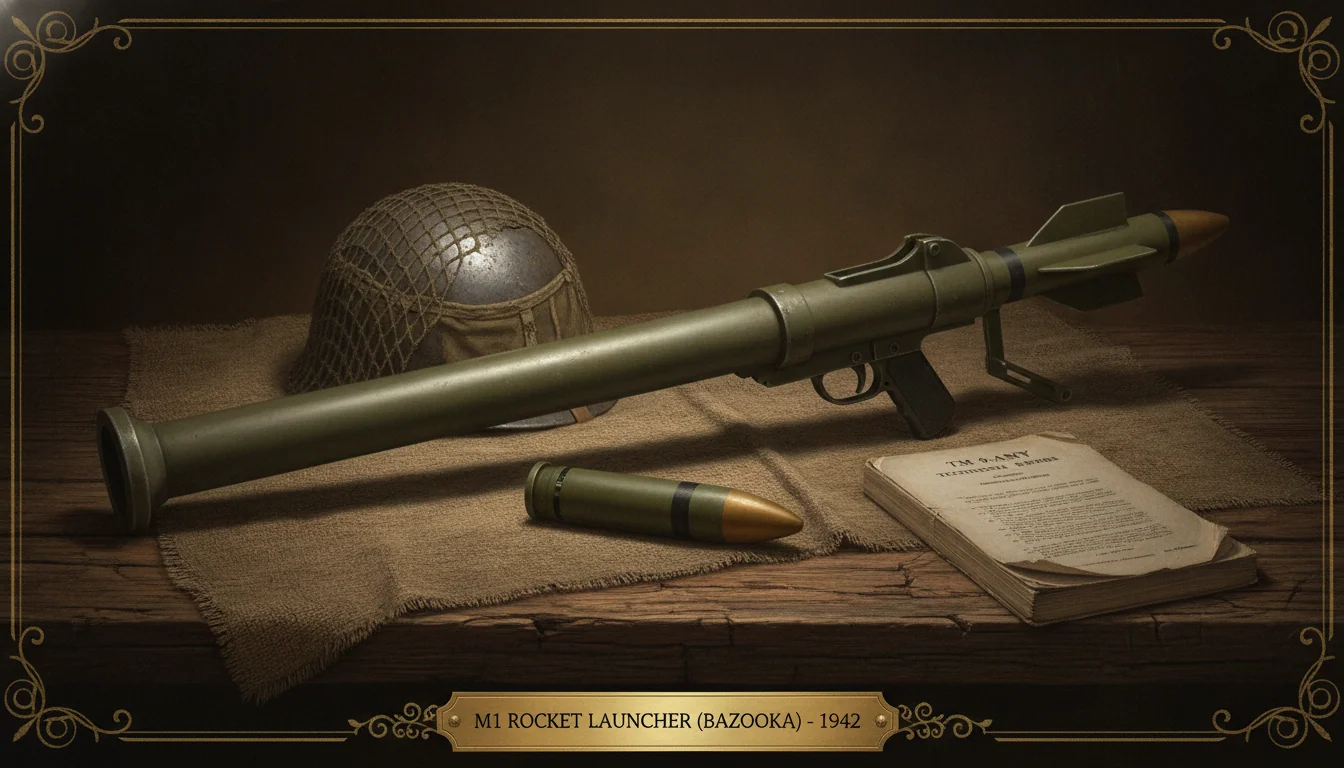
The problem of the infantry soldier and the tank is as old as the tank itself, and for most of the first two decades of armored warfare it had no satisfying solution. The tank was designed specifically to be invulnerable to the weapons that infantry carried. Artillery could stop it, but artillery was not something a squad of foot soldiers could carry into an ambush. Anti-tank rifles existed and worked against early light armor, but against the steel-plated machines that armies were fielding by the early 1940s, an anti-tank rifle was an exercise in optimism.
The bazooka changed the terms of the problem. It put a shaped-charge warhead in the hands of a two-man infantry team and gave them, for the first time, a genuine chance against armor at close range without requiring artillery support. It also helped Germany build a better version of itself.
The weapon problem and the rocket solution
By 1940, the shaped-charge warhead was understood well enough in principle. A high explosive formed into a particular geometry - the Monroe effect, or hollow charge effect - could focus the energy of the explosion into a narrow jet capable of penetrating armor far thicker than the explosive mass itself might suggest. The challenge was delivering it accurately to a tank.
Anti-tank grenades existed but required a soldier to throw them, which meant getting dangerously close to a moving tank in a way that tended to end one career quickly. The attachment of a rocket motor to a shaped-charge warhead pointed toward a solution: a tube from which a soldier could fire a rocket-propelled projectile that would carry its own shaped charge to the target at some distance.
Clarence Hickman at the National Defense Research Committee had been working on infantry rocket concepts derived from Robert Goddard's earlier research. Colonel Leslie Skinner, an artillery officer who had become a rocket enthusiast, pushed the concept within the Army Ordnance Department. Captain Edward Uhl assembled a prototype in 1942 that reportedly came together in a matter of hours: a steel tube about five feet long, an electrical firing mechanism, and a 2.36-inch rocket-propelled grenade loaded from the rear.
The first demonstration at Aberdeen Proving Ground in 1942 convinced the Army. The weapon was put into production almost immediately and designated the M1 Rocket Launcher - though nobody called it that for long. General Lesley McNair, observing an early demonstration, noted that the operator looked like he was playing Bob Burns's famous pipe instrument. The name bazooka attached itself and did not let go.
North Africa, 1942
The bazooka first went to war in November 1942 during Operation Torch, the Allied invasion of North Africa. American infantry carried the new weapon into combat against German and Italian armor in Tunisia and Algeria.
The initial results were mixed in the way that first uses of new weapons often are. The M1 could penetrate roughly 3 inches of face-hardened armor at close range - adequate against the Panzer III and lighter Italian tanks, marginal against the Panzer IV, and completely inadequate against the Tiger I, which the Germans were beginning to deploy in Tunisia. The weapon also required two soldiers to operate: one to shoulder the tube and aim, one to load the rocket from behind. This meant that setting up a shot against a moving tank required both men to be exposed and coordinated.
There were other complications. The rocket motor burned on exit, and the backblast behind the launcher was substantial and occasionally unpredictable. Standing directly behind the shooter during firing was inadvisable. Firing from enclosed spaces was a significant hazard. The weapon needed careful positioning, steady nerves, and a target that was close enough to matter.
What the bazooka lacked in its early form, however, it compensated for in its effect on German thinking.
Germany copies the design and improves on it
In early 1943, German forces in Tunisia captured several M1 bazookas in working condition. What they saw impressed them enough that they immediately began developing their own version - and they scaled it up.
The Raketenpanzerbuchse 43, universally called the Panzerschreck (armor terror), used an 88mm rocket compared to the American 2.36-inch. The larger warhead significantly increased armor penetration, and the weapon included a shield to protect the operator's face from the backblast, which had been a genuine burn hazard with the original American design. The Panzerschreck entered German service in 1943 and remained one of the more effective anti-tank weapons available to German infantry for the remainder of the war.
The Germans also developed the Panzerfaust - a simpler, lighter, disposable concept that fired a large hollow-charge warhead from a throw-away tube. The Panzerfaust required no two-man team and no reloading; you fired it and dropped the empty tube. It was cheaper to produce, easier to issue in quantity, and by the war's end was being pressed into the hands of teenagers defending German cities against Allied armor.
Both weapons were direct descendants, conceptually if not mechanically, of the bazooka concept the Americans had demonstrated in Tunisia.
The M9 and the limits of the original design
By 1944 the M1 had been succeeded by the M9, which addressed the bazooka's most practical operational problems. The M9 could be disassembled into two sections for easier transport by paratroopers jumping into combat or by infantry moving through dense terrain. It weighed slightly more than the M1 but offered better balance and a minor improvement in performance.
The armor penetration problem, however, was not solved by incremental design improvements. As German tank design evolved through the war - the Panther and Tiger II representing the far end of the thickness spectrum - the 2.36-inch warhead fell further behind. American infantry in Normandy and the subsequent campaigns in France and Germany were often carrying a weapon that was effective against German halftracks and light armor but required precise placement against the flanks, tracks, or rear of heavier tanks to achieve a kill.
This was not unique to the bazooka. The anti-tank arms race of the Second World War is largely a story of offense running ahead of defense and vice versa in alternating surges, and no single infantry weapon solved it definitively. But the bazooka's gap between promise and performance became starkly visible in Korea.
Korea and the Super Bazooka
When North Korean forces crossed the 38th parallel in June 1950 and drove southward with a force of T-34/85 tanks, American infantry were equipped primarily with the M9 bazooka. The T-34/85 was a Soviet medium tank with sloped armor that had been highly effective against German armor on the Eastern Front. The M9's 2.36-inch warhead was nearly useless against it. American anti-tank teams found to their dismay that their best weapon was not penetrating the tanks they were facing.
The Army responded by rushing the M20 Super Bazooka into production and to the front. The M20 fired a 3.5-inch (88mm) rocket - matching the caliber Germany had independently arrived at with the Panzerschreck - with a warhead capable of penetrating roughly 11 inches of armor. It was heavier and bulkier than the M9 but it worked against the T-34/85. The Super Bazooka was deployed to Korea within weeks of the initial crisis and became the standard American infantry anti-tank weapon for the remainder of the Korean War and into the Vietnam era.
The episode was instructive. The gap between the 2.36-inch design and the armor it needed to defeat had been visible before Korea. The war simply made the cost of that gap undeniable.
Vietnam and the end of the bazooka era
By the time of the Vietnam conflict, the bazooka in its traditional form was giving way to a new concept: the disposable rocket launcher. The M72 LAW (Light Anti-Tank Weapon), which entered service in the mid-1960s, was a single-soldier weapon in a sealed fiberglass tube that extended for firing and then was discarded. It was lighter than the Super Bazooka, required no team, and solved the logistics of carrying and reloading rockets in jungle terrain.
The LAW traded some penetration capability for portability. Against main battle tanks it was inadequate. Against light armor, bunkers, and defensive positions it was effective, and in Vietnam it was used primarily against the latter. The North Vietnamese and Viet Cong, operating with Soviet-supplied RPG-7s - the rocket-propelled grenade that most directly descends from the same conceptual lineage as the bazooka - had an arguably superior single-soldier anti-armor weapon for the terrain and conditions of that war.
The RPG-7, which entered Soviet service in 1961, would go on to become the most widely produced and most widely used anti-armor weapon in history. Its descendants are still in service across dozens of conflicts today. The concept the bazooka pioneered in a Tunisian desert in 1942 - shaped charge, rocket-propelled, shoulder-fired, two-man team - had become so ubiquitous that the weapon itself no longer needs a name anyone remembers.
What the bazooka changed
The bazooka did not win a single battle by itself, and by the end of the war it was already showing its limits. What it changed was the fundamental relationship between infantry and armor. For the first time, a squad of foot soldiers could meaningfully threaten a tank without artillery support. The psychological effect on armored doctrine - on how tank commanders thought about exposed flanks and close terrain and the threat from positions they could not see - was as significant as the physical toll.
The weapon also demonstrated, perhaps most decisively, that the best response to a new weapon is often a better version of the same weapon. Germany's Panzerschreck and Panzerfaust were direct improvements on a design they had captured and studied, and they outperformed the original in several respects. The M20's warhead caliber matched what Germany had independently concluded was the correct size four years earlier.
The bazooka ended its service life as a grandfather to a family of weapons that made armor permanently and globally vulnerable to individual soldiers. That is a significant inheritance for a steel tube that got its name from a radio comedian's homemade instrument.
For the German weapons the bazooka indirectly inspired, see Arsenal: The Panzerfaust. For the armored vehicles both sides were trying to stop, see Arsenal: The Tank.
Quick Answers
Common questions about this topic
Who invented the bazooka?
The bazooka was developed by a team that included Colonel Leslie Skinner, who championed the concept, Captain Edward Uhl, who built early prototypes, and Clarence Hickman of the National Defense Research Committee, who contributed the rocket technology. The weapon was developed in 1942 and first used in combat in North Africa later that year.
Why is it called a bazooka?
The weapon was named after the bazooka, a homemade pipe instrument played by American comedian Bob Burns on radio programs in the 1930s. Soldiers thought the rocket launcher resembled it. General Somervell reportedly used the name during a 1942 demonstration, and it stuck permanently.
Was the original bazooka effective against German tanks?
The M1 bazooka was effective against early and medium German armor in 1942-1943 but became inadequate as the war progressed. It could penetrate about 3 inches of armor, which was sufficient against Panzer III and IV tanks but not the Tiger or Panther. Germany captured examples in Tunisia and reverse-engineered a scaled-up version, the Panzerschreck.
What replaced the bazooka?
The M72 LAW (Light Anti-Tank Weapon) replaced the bazooka as the primary U.S. infantry anti-armor weapon in the 1960s. The LAW was lighter, disposable, and fired by a single soldier. Heavier guided anti-tank missiles like the TOW and later Javelin handled the role against main battle tanks.

Talk to the People Who Wielded These Weapons
Chat with the soldiers, smiths, and commanders whose lives were shaped by the weapons of their age.
Create your free account →No card required. Talk to anyone in history with 8 free credits a day. Some features require a paid plan.
Join the HistorIQly Club
Get smarter about the past.
Weekly stories, deep dives, and exclusive content straight to your inbox.