Arsenal: The Scottish Claymore - The Great Sword of the Highland Clans
The Scottish claymore defined Highland clan warfare for two centuries, from Flodden to Culloden. Here is the weapon's real history and its actual role on the battlefield.
Read Wikipedia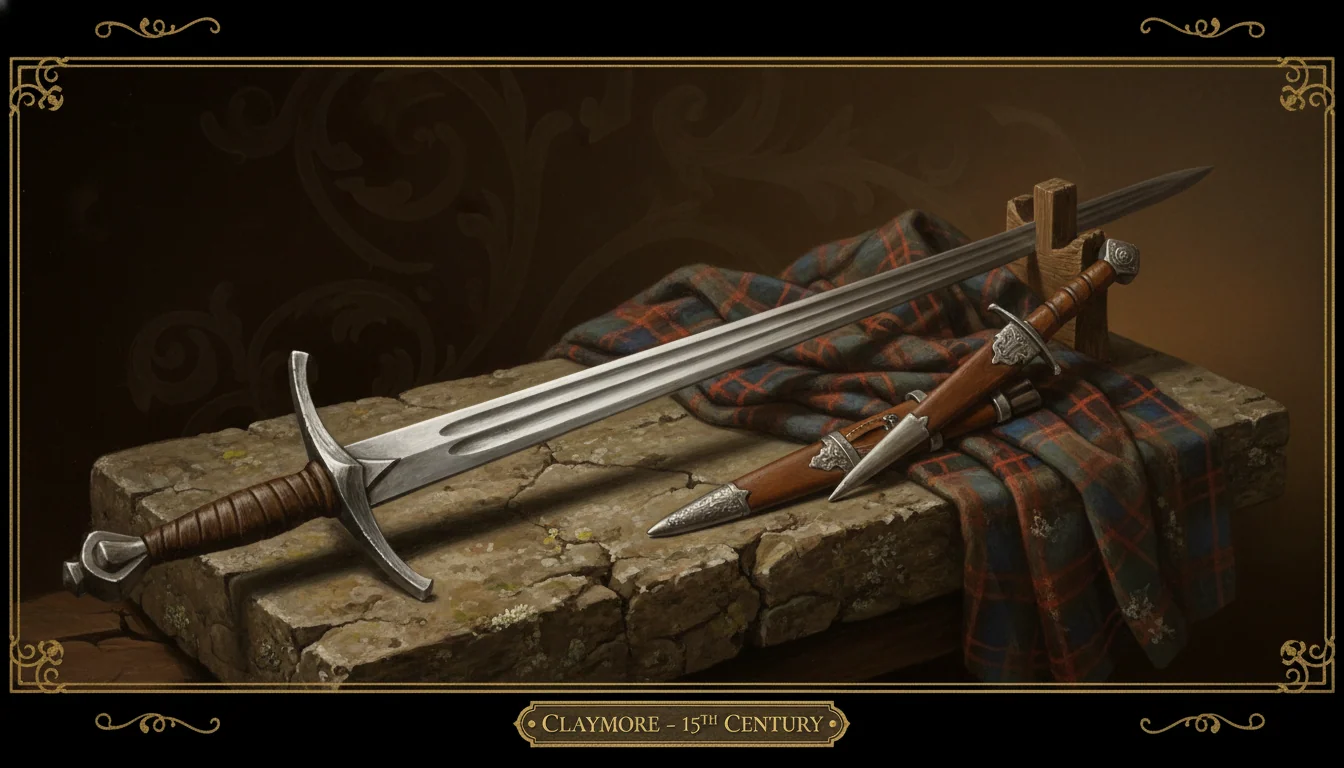
The name comes from the Gaelic for "great sword," which is accurate as far as it goes and tells you exactly nothing about the two distinct weapons that share it. The claymore has been, at different points in its history, a six-pound two-handed weapon for breaking pike formations on open ground and a lighter one-handed broadsword carried by Highland soldiers into the wars of the 18th century. Hollywood consistently conflates them. Historians do not.
Understanding the Scottish claymore properly means understanding why Scotland in the 15th and 16th centuries developed a taste for very large swords, how those swords were used in the specific conditions of Highland warfare, and why a weapon associated with individual heroism and clan identity turned out to be obsolete before the battles that made it legendary.
The Gaelic inheritance
The Scottish Highlands in the 15th century were a fragmented political landscape organized around clan systems rather than the centralized feudal structures developing in the rest of Europe. Clan warfare was real, frequent, and conducted on ground ranging from Highland glens to the open fields of the Lowland borders. The armies of the clans were not professional standing forces. They were assemblages of fighting men drawn from a clan's territory, armed with whatever they owned or could acquire.
In this context the large two-handed sword made practical sense. The weapon required no expensive armor. It could be made by local smiths from iron of variable quality. In the hands of a trained user charging a lightly armored formation, it was effective. The Scottish two-handed sword developed from the same broad European tradition of large swords that produced the German Zweihander and the English bill, but the Scottish version developed its own specific character: the forward-sloping guard with quatrefoil terminals, the relatively slender blade, and the blade length calibrated for users who might be charging downhill at speed.
It was not primarily a dueling weapon. It was a battlefield weapon, designed for situations where one side was going to break into a run and close with the other.
Technical character
A fully mounted two-handed claymore of the 15th or early 16th century ran between 130 and 145 centimeters overall, with a blade of perhaps 100 to 110 centimeters and a long grip designed for two hands. The blade was double-edged, tapering to a point, with a section near the hilt called the ricasso sometimes left unsharpened so the user could grip the blade directly for shorter-range leverage. This technique, known as half-swording, was common to two-handed swords across Europe.
The cross guard is the claymore's signature. The arms slope forward, toward the blade, at roughly 45 degrees, ending in quatrefoil decorative terminals. This configuration was not purely decorative. A forward-sloping guard could catch an incoming weapon blade and redirect it away from the user's hands in a way a perpendicular guard could not. Surviving examples in museums show consistent quality in the guard work even on weapons that were clearly field pieces rather than ceremonial objects.
The grip was wood covered in leather, occasionally wire-wrapped. The pommel was typically wheel-shaped or spherical, providing the counterweight that balanced a long blade and allowed more nuanced handling than the weapon's size might suggest.
Flodden and the limits of the sword
The Battle of Flodden in September 1513 is the most consequential engagement in which the claymore participated, and it did not go well. James IV of Scotland led an army south into England that included substantial numbers of Highland and Lowland swordsmen. The English force under Thomas Howard used bill-armed infantry in disciplined formations and maneuvered on ground that negated the Highland charge.
The Scots carried long spears called pikes in imitation of Continental practice, and the battle became in large part a test between English billmen and Scottish pikemen on muddy, uneven ground. The Scottish pike formations broke. When they broke, the sword-armed men who rushed forward found themselves facing organized, well-armed English infantry in a melee for which charging swordsmen were at a disadvantage. James IV himself was killed, along with an estimated ten thousand Scots, in one of the worst defeats in Scottish history.
Flodden was not a failure of the claymore as a weapon. It was a failure of tactical coordination and terrain judgment. But it illustrated a consistent problem with large two-handed swords on European battlefields: they were at their best leading an initial charge into a disordered or fleeing enemy. Against a steady formation of billmen or pikemen, they were dangerous to use and not reliably effective.
Killiecrankie, 1689
The tactical context changed by the late 17th century, but the Highland sword had evolved with it. By the time of the Battle of Killiecrankie in July 1689, the weapon of choice for Highland warriors was the basket-hilted broadsword, a lighter one-handed weapon with a complex guard of steel bars protecting the hand. This is the weapon often called a claymore in later accounts, and while the terminology is loose, the fighting style associated with it was specifically Highland.
At Killiecrankie, a Jacobite Highland force under John Graham, Viscount Dundee, faced a government army under Hugh Mackay on a narrow valley road in Perthshire. The Highlanders charged downhill at speed, discharged their firearms once at close range, and closed with the broadsword before the government infantry could fix bayonets. The government army broke almost instantly. Dundee himself was killed in the moment of victory.
The Highland charge, whether executed with two-handed claymore or basket-hilted broadsword, worked by shock and momentum. It was devastatingly effective against troops whose firearms required a long reload cycle and whose bayonets required a separate action to fix. It was entirely dependent on the charge reaching the enemy line before firearms fire could stop it.
Culloden and the end
The Battle of Culloden Moor in April 1746 did not fail because the Highland sword was a bad weapon. It failed because the terrain was chosen badly, the men were exhausted and underfed, the government artillery preparation was longer and more accurate than at any previous engagement, and the government infantry had specifically trained to defeat the Highland charge with platoon fire and socket bayonets.
When the Highland line finally crossed the boggy moor into musket range, it absorbed volley fire at shorter intervals than the charge could cover. The men who reached the government line were fewer than those who had started. Many of the government soldiers held their ground, used the bayonet on their right-side opponent rather than the man directly in front of them, and did not break. Culloden lasted perhaps forty minutes.
The Disarming Acts that followed banned weapons in the Highlands and targeted specifically the sword and the dirk. The legislation was punitive in intent and reasonably effective in practice. Within a generation the traditional Highland warrior culture had been dismantled, its practitioners either emigrated, absorbed into British regular regiments, or living in communities where the sword had become illegal.
The legacy the films built
The claymore entered modern consciousness primarily through the 1995 film "Braveheart," which depicted William Wallace (c. 1270-1305) carrying weapons that largely did not exist in his time. The great two-handed claymore of the 15th century had not yet been developed in the 13th century. The film's swords, armor, and tactics are drawn from multiple centuries of Scottish history collapsed together for dramatic effect.
"Highlander" (1986) and "Rob Roy" (1995) perpetuated the image of the claymore as a weapon of individual combat and personal honor, which captures something true about how the weapon was understood within Highland clan culture even if the choreography bears no resemblance to actual historical fighting. The claymore's association with personal honor and defiance of English authority has proven more durable than the weapon itself. It remains the recognizable symbol of a warrior culture that ended at Culloden and has never quite been forgotten.
For more on edged weapons that defined their eras, see our entries on the Viking Ulfberht sword and the rapier.
Quick Answers
Common questions about this topic
What does claymore mean?
Claymore is an anglicization of the Scottish Gaelic 'claidheamh-mor,' meaning literally 'great sword.' The term was applied in different eras to two distinct weapons: the original two-handed longsword with a downward-sloping cross guard, used from roughly the 15th to early 17th centuries, and the later basket-hilted broadsword used by Highland soldiers from the 17th century onward. Both are legitimately called claymores, which causes persistent confusion.
How large was the original claymore?
The two-handed claymore typically measured between 130 and 145 centimeters in overall length, with the blade accounting for roughly 100 to 110 centimeters of that. It weighed between two and three kilograms. Contrary to the giant swords of film, the claymore was designed for practicality in open-field battle, not for dramatic visual effect. It was large by the standards of a one-handed sword but not extreme among two-handed weapons of the period.
What made the claymore's cross guard distinctive?
The original two-handed claymore is immediately recognizable by its forward-sloping quatrefoil cross guard, where the arms of the guard angle downward toward the blade at roughly 45 degrees and terminate in four-lobed decorative ends. This design reinforced the guard and gave the sword a visually distinctive profile. No other major European two-handed sword used this specific configuration.
What replaced the claymore?
The two-handed claymore declined as firearms became standard in Highland warfare from the 17th century onward. It was succeeded in Highland use by the basket-hilted broadsword, a lighter one-handed weapon with an elaborate steel guard that protected the sword hand. After Culloden in 1746, the Disarming Acts banned weapons in the Highlands and accelerated the end of traditional Highland military culture entirely.

Talk to the People Who Wielded These Weapons
Chat with the soldiers, smiths, and commanders whose lives were shaped by the weapons of their age.
Create your free account →No card required. Some figures and features require a paid plan.
Join the HistorIQly Club
Get smarter about the past.
Weekly stories, deep dives, and exclusive content straight to your inbox.