Arsenal: The Indian Talwar - The Saber That Shaped the Subcontinent
The talwar sword history spans five centuries of Indian cavalry warfare - the curved blade that armed Mughal emperors, Maratha warriors, Rajput kings, and Sikh armies in turn.
Read Wikipedia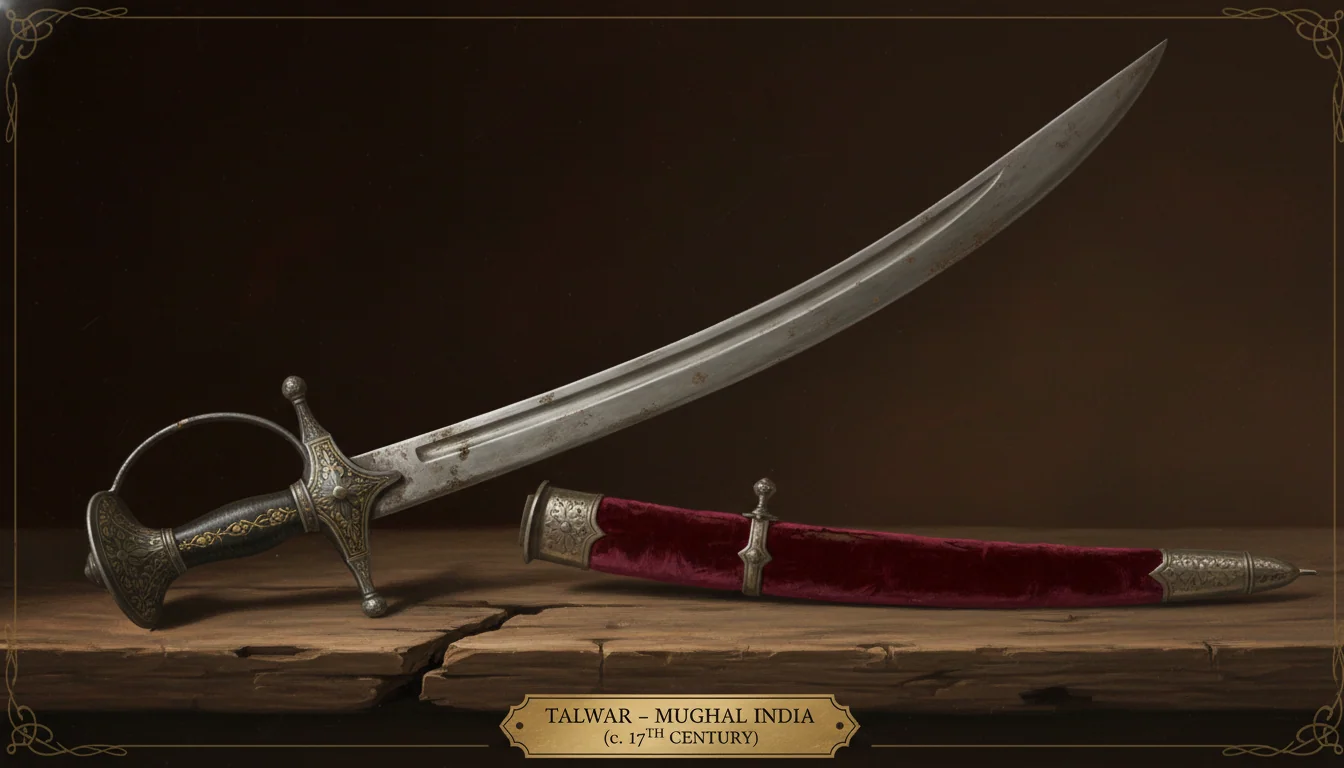
Sometime in the early 13th century, the horsemen of the Delhi Sultanate arrived in the subcontinent carrying weapons sharpened on Central Asian cavalry traditions going back centuries - curved, single-edged sabers designed for use at full gallop, optimized for the cut rather than the thrust, built around the geometry of a man on horseback swinging downward at an enemy below him. What emerged from five centuries of contact between those imported traditions and the particular metallurgical and aesthetic culture of India was the talwar: the sword that armed Mughal emperors, Maratha cavalry, Rajput kings, and Sikh warriors in turn, and that remains the most recognizable Indian edged weapon in history.
Talwar sword history begins with that name: almost embarrassingly simple, talwar means sword in Hindi and Urdu, from the Persian talwar, itself from an older Turkic root. The people who carried it did not need a specific name for a specific design. The talwar was simply the sword, the way the gladius was simply the sword to a Roman legionary. Its identity was so thoroughly merged with the act of bearing arms in India that the category and the implement became the same word.
Origins and the Central Asian inheritance
The talwar cannot be understood without its Central Asian predecessors. The Persian shamshir - deeply curved, with a minimal crossguard and a pommel angled back toward the hand - was the template from which most Islamicate sabers of the medieval period descended. When Mahmud of Ghazni raided northwestern India in the early 11th century, and when the Ghurid sultans established the Delhi Sultanate in the early 13th century, they brought that saber tradition with them.
On the subcontinent, the form encountered Indian metal-working practices of considerable sophistication. The wootz steel produced in south India, and exported across the Islamic world under names including Damascus steel and watered steel, was among the finest blade material available anywhere in the medieval and early modern world. It was produced through a crucible process that created a distinctive pattern in the metal and allowed blades to take and hold an edge that pattern-welded or bloomery iron could not match.
The talwar that emerged from this combination was distinct from its Persian parent. The curve was present but somewhat less extreme than the shamshir. The hilt was transformed almost completely. Where the shamshir had a simple crossguard and compact pommel, the talwar developed a wide, flat disc-shaped crossguard - the chakra guard - and a corresponding disc or down-curved pommel. The knucklebow present in some variants added additional hand protection. The grip itself was short, designed to be held in one hand, with no room for a second.
The disc pommel is the talwar's most distinctive feature and its most practical one. In cavalry combat, where a sword might be dropped or lost to a wrist cut, the wide pommel helped retain the grip and balanced the curved blade forward, naturally positioning the point of percussion in the middle third of the blade where cutting power was maximized.
The Mughal empire and the sword at its height
The first Battle of Panipat in 1526 announced the arrival of a new power in northern India. Babur, the Timurid prince who had lost Samarkand but retained an army of Central Asian cavalry and access to Ottoman-style field artillery, met the forces of Ibrahim Lodi on a plain north of Delhi and destroyed them. Babur's horsemen carried sabers - the talwar in its evolving form - and their combination of speed, archery, and the saber charge became the template for Mughal cavalry doctrine for the next two centuries.
Under Akbar, Jahangir, Shah Jahan, and Aurangzeb, the Mughal Empire at its height maintained an enormous cavalry arm. The talwar was the horseman's primary weapon after his bow, and the imperial workshops - karkhanas - produced talwars as court objects as well as battlefield tools. Mughal court swords were often spectacular: hilts inlaid with gold koftgari work, blades with calligraphy in the steel, scabbards covered in velvet and fitted with gold throat-mounts and lockets. The weapons collected in European royal armories from Mughal gifts and trade are among the most beautiful edged weapons ever made.
The functional battle sword was rather simpler. Cavalry-grade talwars from the 17th century typically had blades of 28 to 32 inches, a moderate curve appropriate for both cutting and thrusting, and hilts designed for durability rather than decoration. The steel was typically good but not always wootz - the finest crucible steel was expensive, and a provincial cavalry force had to balance quality against volume.
How it changed the battlefield
The talwar's military effectiveness was inseparable from the cavalry tradition that carried it. Indian cavalry of the Mughal period - particularly the heavy horse - operated in a tactical system where the initial shock of a massed charge, lance and saber in action, decided the engagement before infantry contact became the main event. The talwar's geometry made it efficient precisely in that context: mounted on a fast horse, swinging downward and to the right or left in a draw-cut, a skilled horseman could cover ground and strike faster than a dismounted opponent could track.
Against infantry, the calculus was different. Foot soldiers with spears or pikes could check cavalry charges by presenting a wall of points. The talwar's answer to this problem was speed and momentum - get past the points and the saber found unarmored targets immediately. Against armored infantry, the sword was less effective, which is why Mughal armies always combined cavalry with firearms and artillery.
The Rajput kingdoms, particularly those in Rajasthan, developed their own talwar traditions. Rajput swords were sometimes heavier than Mughal cavalry models and were closely integrated with the Rajput khanda, a straight double-edged sword also used in that tradition. The talwar suited the Rajput cavalry ideal - aggressive, personal, honorable in the almost theatrical sense that Rajput military culture prized.
The Maratha revival and the saber wars
After the death of Aurangzeb in 1707, the Mughal Empire began its long collapse. What filled the vacuum in central and western India was the Maratha Confederacy, a loose alliance of warrior chieftains whose light cavalry became the most feared mobile military force on the subcontinent for most of the 18th century. Maratha horsemen used a distinctive regional variant of the talwar - slightly lighter, sometimes with a more pronounced curve - and their warfare was based on rapid movement, raiding, and the kind of logistical exhaustion of an opponent that static armies could not counter.
At battles including Panipat in 1761 - the third and final battle at that historically significant plain, where a Maratha force was routed by Ahmad Shah Durrani's Afghan cavalry - the talwar-armed horseman was still the decisive arm of the most powerful indigenous armies in India. But the third battle of Panipat also showed the limits. Afghan cavalry using similar curved sabers and a better operational plan destroyed a Maratha force that had, in essence, run out of forage and maneuvering room.
The Sikh Empire, which emerged in the Punjab through the early 19th century under Ranjit Singh, added its own chapter. Sikh warriors used the talwar alongside the khanda and the kirpan, and the Sikh armies that faced the British East India Company in the Anglo-Sikh Wars of the 1840s were among the best-armed and best-led indigenous forces the Company had ever encountered. The talwars used in the Sikh tradition were often made with exceptional care - the Punjab had its own metalworking centers, and Sikh religious culture invested the sword with meaning beyond its tactical function.
The decline
The British East India Company's military system did not defeat the talwar with a superior blade. It defeated the military culture that the talwar represented. The Company's infantry, trained to volley fire in disciplined lines, reduced cavalry charges to suicidal gestures against muskets and, later, rifles. By the time of the Anglo-Maratha Wars (three campaigns between 1775 and 1819), the outcomes showed the pattern clearly. By the Anglo-Sikh Wars of the 1840s, the pattern was settled.
The last major Indian armies to use the talwar as a frontline weapon were defeated within a few decades of each other. After annexation, the Company and then the Crown reorganized Indian military institutions. The talwar moved into the register of the ceremonial, the traditional, and the honorific.
What remained
The talwar never disappeared from the subcontinent. It exists today in Indian police ceremonial dress, in the hands of temple guards, in traditional martial arts schools, and in the ordinary ceremonial contexts of communities whose military identity is inseparable from the sword. The kirpan of Sikh practice is a descendent of the same blade tradition, carrying an obligation rather than a tactical function.
Museum collections in London, Jaipur, Delhi, and Paris hold examples of extraordinary beauty - court talwars with jade hilts, hilts of solid gold, blades inlaid with Quranic verses in gold koftgari that catch light after three hundred years in a display case. The craft that produced them is not entirely lost, though the bladesmithing tradition that made wootz steel has been recovered only partially and imperfectly.
The talwar is what a cavalry tradition looks like when it has centuries to find its form. For the context of Mughal India it served, see our time traveler's guide to Mughal Delhi, 1650. For a comparison with another legendary cavalry sword, see the Japanese katana.
Quick Answers
Common questions about this topic
What is a talwar?
The talwar (also spelled tulwar) is a curved, single-edged sword used across the Indian subcontinent from roughly the 13th century onward. The word simply means 'sword' in Hindi and Urdu. It is closely related to the Persian shamshir and the Turkish kilij but developed its own distinct form, including a characteristic flat disc-shaped crossguard and pommel assembly that makes it immediately identifiable.
Who used the talwar?
The talwar was used by virtually every major military power on the Indian subcontinent: the Mughal Empire, the Maratha Confederacy, the Rajput kingdoms, the Sikh Empire, and numerous regional sultanates and nawabs. Each culture produced its own regional variants, but the basic form - a curved single-edged blade with the distinctive disc pommel - was shared across them all.
How was the talwar used in battle?
The talwar was primarily a cavalry weapon, designed for use on horseback. The curved blade optimizes cutting power on a downward diagonal draw-cut, the dominant strike in horseback fighting. Dismounted, it could also be used for thrusting and close-in defense, but its length and curve made it less versatile than a straight sword in tight infantry formations. Speed and aggression were the talwar's idiom.
What replaced the talwar?
British firearms and the disciplined infantry volleys of the East India Company's Bengal Army made traditional cavalry charges progressively less viable through the late 18th and early 19th centuries. By the mid-19th century, following the Anglo-Maratha Wars and the defeat of the Sikh Empire, the talwar had effectively become a ceremonial weapon in most contexts. It remains in use today in Indian police and military dress uniform.

Talk to the People Who Wielded These Weapons
Chat with the soldiers, smiths, and commanders whose lives were shaped by the weapons of their age.
Create your free account →No card required. Talk to anyone in history with 8 free credits a day. Some features require a paid plan.
Join the HistorIQly Club
Get smarter about the past.
Weekly stories, deep dives, and exclusive content straight to your inbox.