Arsenal: The Tanegashima Japanese Matchlock
The tanegashima matchlock arrived in Japan with Portuguese traders in 1543 and turned a feudal war into a firearms revolution, before the Tokugawa shogunate suppressed it.
Read Wikipedia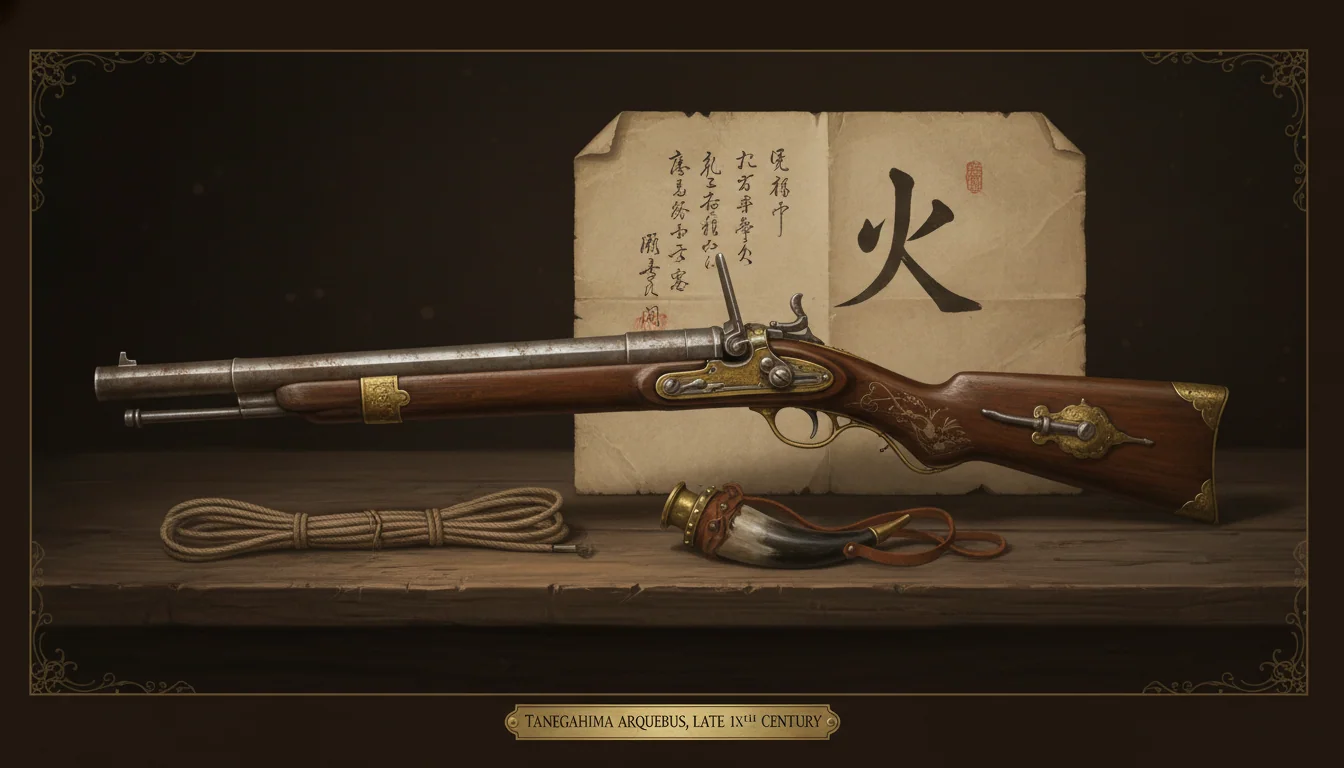
In 1543, a Chinese trading vessel carrying Portuguese merchants was driven by storm onto the small island of Tanegashima, off the southern tip of Kyushu. The event should have been a footnote: a ship in distress, local fishermen, an exchange of goods, a departure. What the Portuguese carried with them changed the arc of Japanese history for the next century.
They had firearms. Specifically, matchlock arquebuses - smoothbore long guns fired by a slow-burning match cord clamped in a serpentine mechanism. The guns were not new. Europeans had been developing matchlock firearms for a century. But Japan had no gunpowder weapons in this tradition, and when the lord of Tanegashima, Tokitaka, fired one of the Portuguese guns and watched its ball punch through a wooden target at a range no bow could match with the same certainty, he made an immediate decision.
He bought two guns. He ordered his metalworkers to take them apart and make copies. Within months they had succeeded in replicating the barrel and the lock mechanism. Within years, the weapon had a new name: tanegashima, after the island where it arrived.
The technical problem and how Japan solved it
The Portuguese matchlock the Japanese acquired was a functional weapon, but it had one component that initially resisted copying: the breech screw that sealed the firing chamber. The threading of a precision metal screw was a technique that Japanese metalworking had not previously needed, and early attempts to replicate it were imperfect.
The story goes that the daughter of Lord Tokitaka was given in marriage to a Portuguese captain, who in exchange taught a Japanese swordsmith the screw-threading technique. How much of this is documented and how much is legend is difficult to separate at five centuries' distance. What is certain is that within a few years, Japanese craftsmen had fully mastered the mechanism, and the tanegashima began to be produced in substantial numbers.
Japan in 1543 was in the midst of the Sengoku period, the era of warring states, in which regional lords called daimyo fought for dominance in a sustained civil conflict that had been burning since the mid-15th century. Into this environment, a weapon arrived that could kill a trained warrior at fifty meters by a man who had never held a sword. The military incentives to adopt it immediately were overwhelming.
Scale and adaptation
Within twenty years of the Portuguese landing on Tanegashima, arquebuses were being manufactured in quantity at centers across Japan, particularly in the province of Kii and in the city of Sakai, which became something like an arsenal for the Sengoku warlords. Japanese gunsmiths proved to be not merely capable copyists but skilled adapters. They modified the Portuguese firing mechanism to address problems specific to Japanese conditions - particularly the need to fire in wet weather, which the slow match handled poorly. Lacquered covers and improved match cord followed. Japanese tanegashima of the later 16th century are better-finished weapons than the originals they were based on.
The rate of adoption was extraordinary. By the time Oda Nobunaga, the most ruthless and innovative of the Sengoku daimyo, was making his bid for national domination in the 1560s, firearms were already a standard component of Japanese armies. Nobunaga saw further than most of his rivals.
Nagashino, 1575
The Battle of Nagashino is one of the pivotal moments in Japanese military history, and the tanegashima is at the center of it. Nobunaga, allied with Tokugawa Ieyasu, faced the cavalry of the Takeda clan, who remained committed to mounted shock tactics that had been effective for generations. Nobunaga's response was to deploy his arquebusiers behind wooden palisades, organized to fire in rotating sequence - while one rank reloaded, another fired, creating a sustained rate of fire that a single line could never achieve.
The Takeda cavalry, riding into sustained musket fire at the palisades, was destroyed as a coherent force. The battle's outcome was not solely about the guns - the position, the defensive barriers, and the discipline of Nobunaga's infantry all mattered - but the firearms were decisive. Nagashino demonstrated that a disciplined block of tanegashima could stop cavalry, break infantry formations, and reshape an engagement in ways that archery could approximate but not match with the same reliable penetration at range.
Historians have debated whether Nobunaga's volley rotation system was as formally organized as later accounts portray it. Some argue the sequential firing was less systematic than the famous ukiyo-e woodblock prints suggest. What is not in dispute is the scale: Nobunaga fielded a number of arquebusiers at Nagashino that sources put in the thousands, a concentration of gunpowder weapons unprecedented in Japanese warfare.
Japan as the world's most armed society
By the early 17th century, Japan had accumulated a remarkable distinction: it may have had more functioning firearms per capita than any country in Europe. Estimates of the total number of tanegashima in circulation during the late Sengoku period run into the hundreds of thousands. Entire armies were composed primarily of ashigaru - foot soldiers - armed with arquebuses rather than spears or bows.
This trajectory was interrupted, and then reversed, by one of the most deliberate decisions in military history.
The suppression
After Tokugawa Ieyasu won the Battle of Sekigahara in 1600 and established the shogunate that would govern Japan for two and a half centuries, the political landscape changed fundamentally. The existential conflict between rival daimyo was over. The new regime needed stability, not military innovation. And firearms posed a specific political problem: they allowed a peasant conscript to kill a samurai.
The sword was the weapon of social status in Japan, the marker of the warrior class, the object around which elaborate ritual and hierarchy had been constructed for centuries. A tanegashima in the hands of a low-ranking ashigaru who had trained for weeks could kill a samurai with a lifetime of martial training. This was militarily useful during wartime and politically dangerous during peace.
The Tokugawa shogunate did not ban firearms outright - that would have been logistically impossible. Instead, they progressively concentrated gun manufacture under shogunate supervision, issued licenses for production, and allowed the supply of tanegashima to dwindle quietly over generations. By the mid-17th century, firearms production had contracted dramatically from its Sengoku peak. By the 18th century, the tanegashima existed primarily as a ceremonial object and a hunting weapon.
Japan was not technologically incapable of continuing to develop firearms. The country that had mastered screw-threading in months was not going to be defeated by a matchlock mechanism. The decision to suppress was deliberate, political, and effective. It was also eventually fatal: when American commodore Matthew Perry arrived with steam-powered warships in 1853, Japan was a century behind the West in firearms technology.
What the tanegashima changed
The tanegashima's century of dominance in Japanese warfare had lasting consequences beyond the battlefield. It accelerated the decline of the traditional mounted samurai as the central unit of Japanese armies, which had been underway since the Sengoku period began. It made the ashigaru - the foot soldier - a decisive military actor in a way that archery and spear had not fully achieved. It forced the construction of new styles of fortification, since traditional Japanese fortresses had been designed around archery and not around the need to provide cover from gunfire.
The Tokugawa suppression then reversed these lessons, at least officially. Samurai culture reestablished its prestige. The sword was elevated back to its position as the defining weapon of social rank. The tanegashima became a curiosity.
The Shogun legacy
The tanegashima's cultural afterlife in the West runs largely through James Clavell's novel Shogun and its television adaptations. Clavell used the arrival of a fictional English navigator at a thinly fictionalized version of the Sengoku court to dramatize the collision of Japanese and European cultures at the precise historical moment when firearms were transforming Japanese warfare. The weapon is central to the story because it was central to the history.
The tanegashima arrived on a storm-tossed junk and changed a civilization. It was then, with deliberate care, set aside. That combination - radical adoption, deliberate reversal - makes it one of the stranger weapons in the story of human violence, and one of the clearest demonstrations that technological diffusion is not inevitable. Societies can choose what to do with what arrives on their shores. Japan chose twice.
For more on the Sengoku world the tanegashima transformed, see Visiting Sengoku Japan in 1560. For the Western firearm that dominated a later era, see The Brown Bess Musket.
Quick Answers
Common questions about this topic
How did firearms arrive in Japan?
In 1543, a Chinese trading junk carrying Portuguese passengers was blown off course and wrecked on the island of Tanegashima, off the southern coast of Kyushu. The Portuguese carried matchlock arquebuses. The lord of Tanegashima, Tokitaka, purchased two of the guns and ordered his swordsmiths to replicate the mechanism. Japanese gunsmiths mastered the basic design within months, and production spread rapidly across the country.
What was the Battle of Nagashino?
The Battle of Nagashino, fought in 1575, is the most famous demonstration of firearms in Japanese history. Oda Nobunaga deployed thousands of arquebusiers behind wooden palisades in rotating volley formations against the cavalry of the Takeda clan. The result was a tactical rout. Historians debate whether the volley rotation was as systematically organized as later accounts suggest, but the battle's outcome was decisive and gunpowder weapons were central to it.
Why did Japan suppress firearms after unification?
After Tokugawa Ieyasu established the shogunate following the Battle of Sekigahara in 1600, the new regime progressively restricted the manufacture and possession of firearms. The reasons were political rather than technological: firearms threatened the social hierarchy by allowing any conscript to kill a trained samurai at range. The sword remained the weapon of status. Guns were not eliminated entirely but were strictly controlled and their production consolidated under shogunate supervision.
What did the Japanese call their matchlock guns?
The Japanese called the matchlock rifle a tanegashima, after the island where it was introduced, or alternatively a hinawaju, meaning 'rope-fire gun' (a reference to the slow match). The term tanegashima became the common informal name and is still used today when referring to the weapon historically.

Talk to the People Who Wielded These Weapons
Chat with the soldiers, smiths, and commanders whose lives were shaped by the weapons of their age.
Create your free account →No card required. Talk to anyone in history with 8 free credits a day. Some features require a paid plan.
Join the HistorIQly Club
Get smarter about the past.
Weekly stories, deep dives, and exclusive content straight to your inbox.