Arsenal: The Japanese Yumi and the Art of the Asymmetric Bow
The Japanese yumi bow was the samurai's primary weapon for centuries - its bizarre asymmetric shape a clever solution for shooting from horseback at full gallop.
Read Wikipedia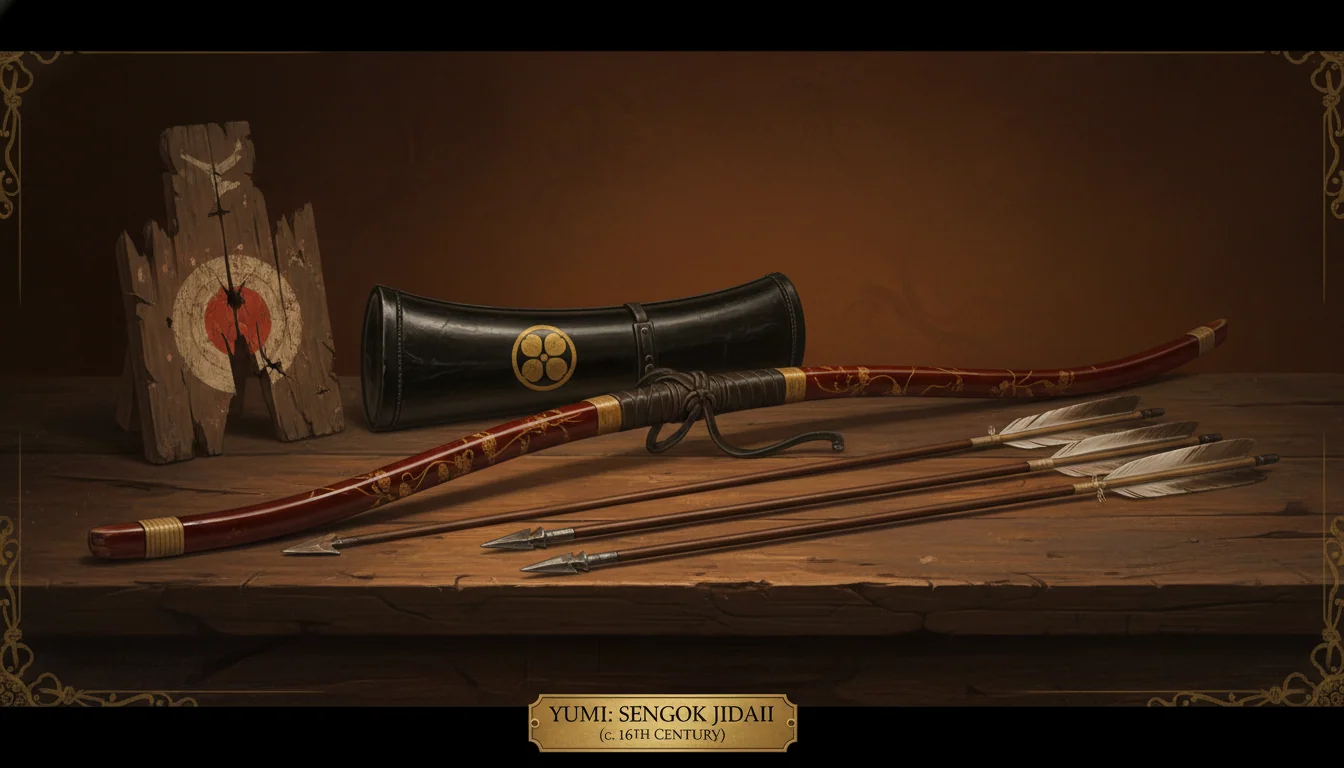
Pick up a Japanese yumi bow and the first thing you notice is that it looks wrong. The grip is not at the center - it sits roughly one-third of the way up the stave, which means the section above your hand is almost twice as long as the section below. Every other bow in the world, from the English longbow to the Mongolian recurve, places the grip somewhere near the middle. The yumi does something different, and there is a reason.
The reason is a horse.
The geometry of mounted archery
Archery from horseback is one of the oldest and most tactically demanding forms of combat. The problem with fighting from the saddle with a tall bow is simple: a bow long enough to generate serious power, held at its center, requires the archer to lift it above the horse's head during the draw. This is awkward, conspicuous, and mechanically limiting.
The Japanese solution was to shift the grip down. With the hand placed at the lower third of the bow, the upper limb extends well above the archer's head while the lower limb drops below the saddle level. The archer can draw the full length of the upper limb without the lower limb interfering with the horse. The result is a bow that develops power from the long upper limb while remaining manageable from the saddle.
The same shape also has implications for ground archery. When shooting on foot, the yumi can be held in front of the body with the upper limb angled slightly forward, giving a smooth release without the arrow-deflection problems that symmetrical bows can produce at certain angles. The asymmetry is not an aesthetic choice. It is functional geometry that emerged from a millennium of mounted warfare on Japanese terrain.
Construction
A high-quality yumi is one of the most technically demanding bows ever produced. The classical war bow was made from a laminated core of bamboo and wood - typically catalpa or Japanese wild cherry - bound with rattan and wrapped in lacquered linen. The bamboo used for the outer (tension) face of the bow came from the node-free section between bamboo joints, selected for its resistance to splitting under draw stress. The wood used for the inner (compression) face was chosen for its ability to resist crushing under the bend.
The lamination process required months. A master bowyer soaked and shaped each component separately, glued them in precise alignment under pressure, allowed long drying times between stages, and then wrapped the assembled stave in spiral-wound rattan strips before applying the lacquer finish that would protect against rain and humidity. The resulting bow was typically about 2.2 meters in length - comparable to the English longbow - but far more complex in its internal structure.
Draw weights for war-grade yumi typically ran from around 25 to 36 kilograms at a draw length of roughly 90 centimeters. These numbers are lower than the peak draw weights of English war bows recovered from the Mary Rose, but the yumi's laminated composite construction is significantly more efficient at converting draw energy into arrow velocity. The arrows (ya) were typically 90 to 100 centimeters long, fletched with hawk or eagle feathers in a three-fletch configuration, and tipped with a range of iron heads depending on the target.
War on the peninsula
The yumi was the primary offensive weapon of the Japanese military aristocracy from at least the Nara period (8th century CE) through the late 16th century. The samurai identity, before it became synonymous with the sword in the popular imagination, was defined first by mounted archery. The Chinese characters that composed the word "samurai" in its earliest usage referenced service and martial function broadly, but the aesthetic ideal of the Japanese warrior class throughout the Heian period was the mounted archer on a galloping horse - not the swordsman in a formal duel.
The Genpei War of 1180-1185, which ended with the establishment of the Kamakura shogunate, was documented extensively in the military chronicle the Heike Monogatari, which is saturated with archery. Single-combat archery duels preceded or accompanied major engagements. Commanders identified themselves by their distinctive arrow styles. Warriors boasted of their archery range and accuracy as markers of status. The great naval battle of Dannoura in 1185, which ended the war, featured archers firing across close water between opposing fleets.
The Mongol invasions of 1274 and 1281 disrupted Japanese archery doctrine in ways that are still debated. Japanese warriors arrived at the initial Mongol landing expecting individual duels; Mongol forces used massed infantry formations and projectile weapons including poison-tipped arrows and gunpowder bombs at scale. The Japanese adapted quickly, eventually using the yumi in massed volleys rather than individual engagements, but the confrontation with Mongol tactics left a lasting mark on Japanese military thought.
Yabusame and the ritual dimension
While the yumi was a weapon of war, it also occupied a sacred space in Japanese religious life that no other weapon matched. Archery contests at Shinto shrines predate the classical samurai period. The sound of a bowstring snapping was believed to drive away evil spirits - a practice encoded in kagura ritual music and in the use of bow-twanging as a purification rite before important ceremonies.
Yabusame - the practice of shooting three small wooden targets from horseback at a gallop - developed as both military training and religious ceremony. The first documented formal yabusame event was conducted by the shogun Minamoto no Yoritomo in 1187, who ordered his warriors to practice the discipline as a way of appeasing the gods before a military campaign. By the Kamakura and Muromachi periods, yabusame had become a fixture at major shrine festivals.
The archer's posture, breath control, and spiritual composure were considered as important as accuracy. A fumbled shot was not just a technical failure; it was an inauspicious sign. The ritualization of archery practice laid the cultural groundwork for kyudo, the formal martial art that would emerge in the Edo period and that is still practiced today by hundreds of thousands of Japanese practitioners.
The end of the war bow
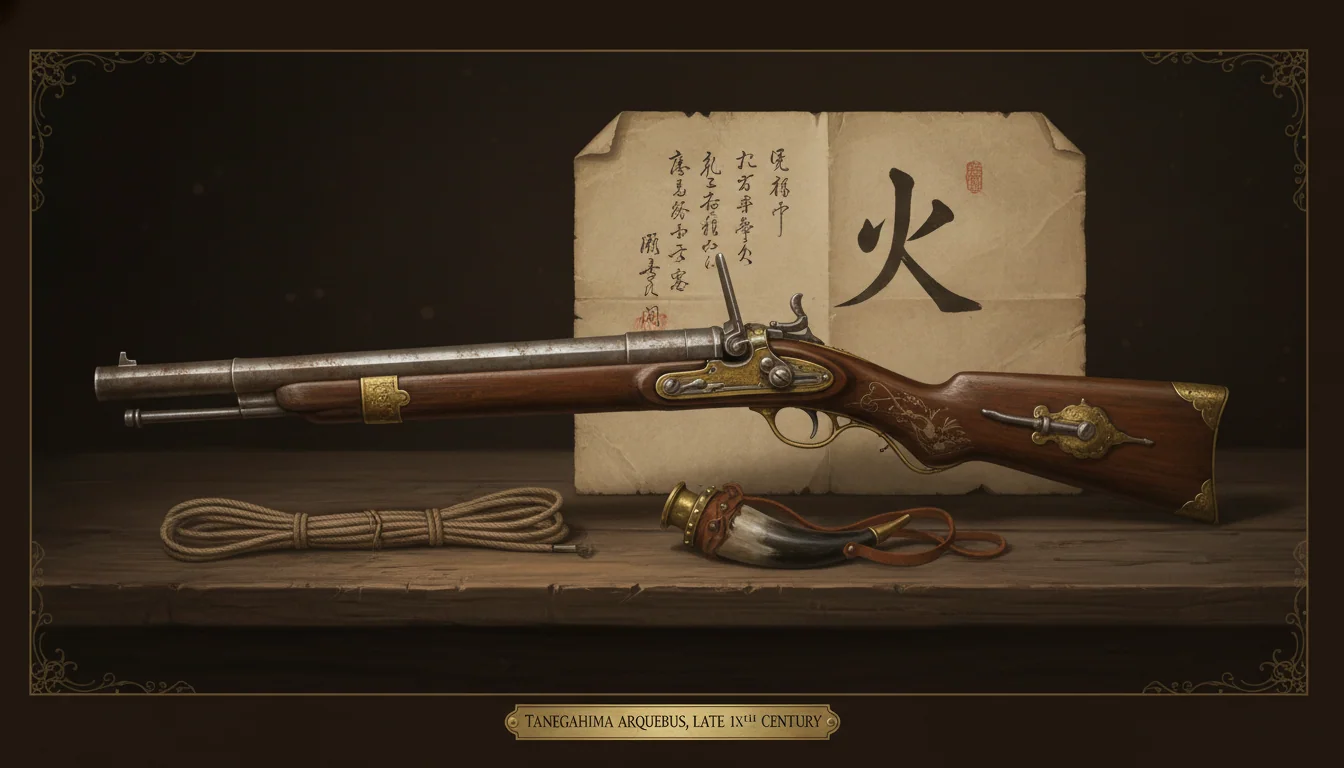
The Portuguese arrived in Japan in 1543, landing on the island of Tanegashima. They brought matchlock arquebuses. The local lord who acquired two of these weapons had local craftsmen copying them within months - a Japanese adaptation story so fast it borders on legendary. The tanegashima, as the Japanese called the matchlock, spread rapidly through the Sengoku Jidai, the century-long period of civil war.
Oda Nobunaga was the general who understood what mass arquebusiers meant for tactical doctrine. At the Battle of Nagashino in July 1575, he deployed a force estimated at around 3,000 arquebusiers in rotating volley lines behind a defensive palisade. When Takeda Katsuyori's renowned cavalry charged the position, the rotating volleys produced sustained fire that shattered the charge completely. The Takeda cavalry, armed with bows and lances, had no counter.
The yumi did not disappear overnight. It remained a secondary weapon through the late 1500s and into the 1600s, and skilled horse-archers retained tactical value in specific situations. But the logic was irreversible. Training an arquebus-equipped foot soldier took weeks. Training a war archer to the standard required for battlefield effectiveness took years of childhood practice. Once gunpowder weapons improved enough to close the accuracy and reliability gap, no army would build its doctrine around a weapon that took a decade to produce a competent user.
What survived
Kyudo formalized archery practice as a path of spiritual discipline in the Edo period, when the samurai class had relatively few actual wars to fight and needed institutionalized rituals to maintain martial identity. The bow in kyudo is functionally identical to the historical war bow. The draw, the breath, the moment of release, and the follow-through are taught as elements of a unified practice with moral and spiritual dimensions.
Yabusame is still performed publicly at several Shinto shrines, most famously at Tsurugaoka Hachimangu in Kamakura during the Reitaisai festival each September. Horsemen in full Heian-period court dress gallop a 255-meter track and shoot at three targets in sequence. The crowds are large and the noise is tremendous.
The yumi outlasted its battlefield usefulness by centuries, which is one of the more reliable markers that a weapon was not just a tool. It was a symbol, and symbols have a different relationship to obsolescence than a matchlock ever will. For context on what the samurai period looked like from the ground, see our time traveler's guide to Sengoku Japan, 1560. For another mounted archery tradition, compare the Mongol composite bow.
Quick Answers
Common questions about this topic
Why is the yumi asymmetric?
The yumi's grip sits roughly one-third of the way up the bow rather than at the center, giving the upper limb roughly twice the length of the lower. The design solves the problem of drawing a tall bow from horseback: a centered grip on a bow of similar height would require the archer to raise the bow above the horse's head on the draw. The asymmetric grip keeps the lower limb below the saddle level while preserving the full power of the long upper limb.
What was the yumi made from?
War-grade yumi were laminated composites of bamboo, wood (usually catalpa or Japanese cherry), and rattan, wrapped in lacquered linen. Bamboo formed the core, combining a tension-resistant outer surface with a compression-resistant inner layer. The lamination process was extremely labor-intensive - a master bowyer could take weeks or months to produce a single bow of quality.
When did the samurai stop using the yumi as a primary weapon?
The shift came in the late 16th century, following the Portuguese introduction of the arquebus to Japan in 1543 and the subsequent mass adoption of firearms by Oda Nobunaga in the 1560s and 1570s. At Nagashino in 1575, Nobunaga deployed rotating volleys of arquebusiers that shattered Takeda cavalry. The yumi remained in ceremonial use and as a secondary weapon but lost its central battlefield role within a generation.
Is the yumi still used today?
Yes. Kyudo, the way of the bow, is one of the most widely practiced traditional martial arts in Japan, with hundreds of thousands of active practitioners. Yabusame, the practice of horseback archery at Shinto festivals, is performed publicly at shrines including Tsurugaoka Hachimangu in Kamakura. The yumi used in both contexts is functionally identical to the historical war bow, though modern versions are often made with synthetic materials.

Talk to the People Who Wielded These Weapons
Chat with the soldiers, smiths, and commanders whose lives were shaped by the weapons of their age.
Create your free account →No card required. Talk to anyone in history with 8 free credits a day. Some features require a paid plan.
Join the HistorIQly Club
Get smarter about the past.
Weekly stories, deep dives, and exclusive content straight to your inbox.