The Walther P38: The Pistol That Replaced the Luger and Changed Handgun Design Forever
The Walther P38 was Germany's WWII service pistol, the first double-action military sidearm adopted at scale. Its design shaped nearly every service pistol that followed.
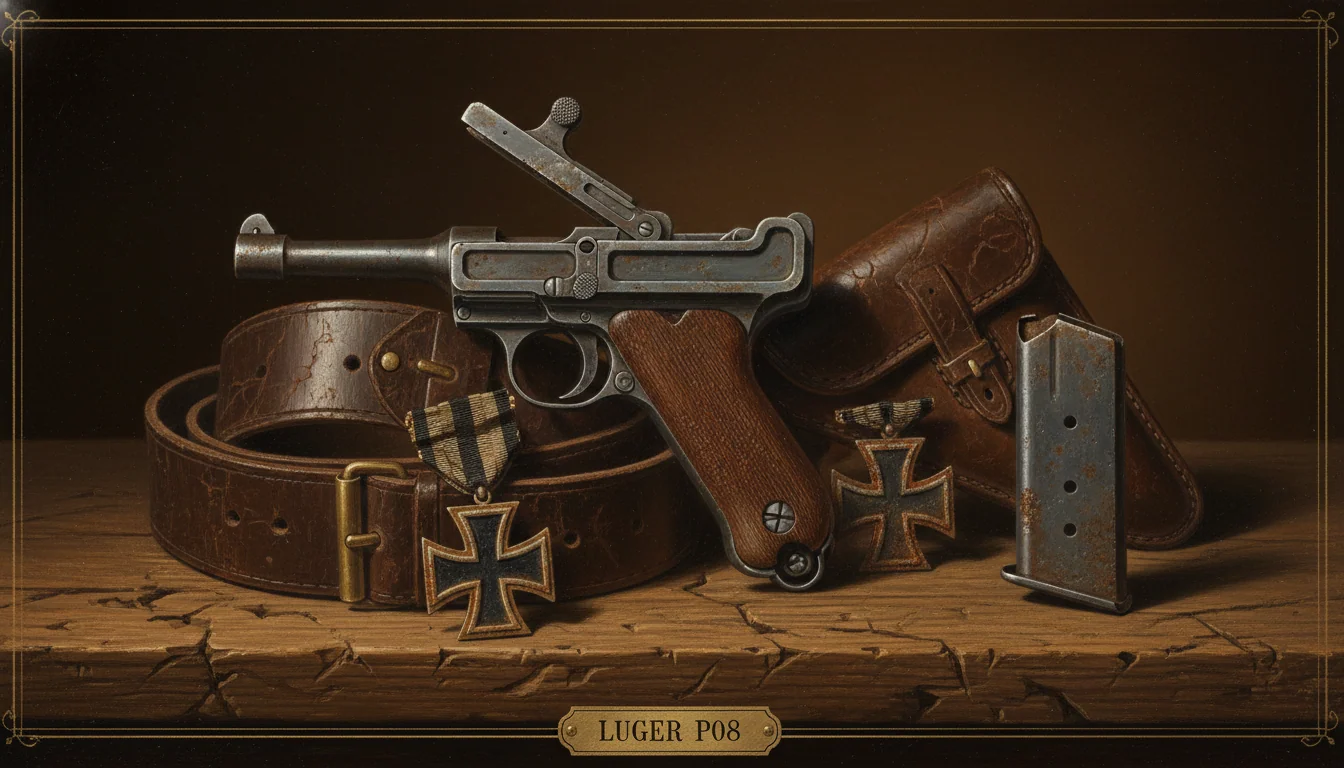
Germany's standard military sidearm at the start of the Second World War was the Luger P08, a pistol so visually striking that it became one of the most recognizable objects in the history of firearms. The toggle-link action, the angled grip, the precise mechanical beauty of the thing - the Luger looked like someone had designed a gun for a film that had not been made yet. It also cost a small fortune to manufacture, required skilled machinists to assemble, was sensitive to dirt and cold, and was nowhere near adequate for the production requirements of a continental war. By 1939, Germany knew it needed a replacement. What it got was a pistol that was less beautiful, less dramatic, and almost certainly more important.
The Walther P38 is not the most famous German pistol of the war. That distinction belongs to the Luger, whose distinctive profile appears in more film posters and museum cases. But the P38 is the one that changed handgun design permanently. Nearly every modern double-action service pistol - including the M9 that the United States Army carried for more than three decades - is built around principles the P38 established.
The weapon Germany's army actually needed
The Carl Walther Waffenfabrik in Zella-Mehlis had been designing innovative pistols since the 1920s. Their PP (Polizeipistole) of 1929 was the first commercially successful double-action pistol for police use, and the PPK that followed became one of the most copied pistol designs in history. But the police pistols were compact, chambered in less powerful cartridges, and not suited to frontline military service. What the Heereswaffenamt - the Army Weapons Office - needed was a full-size military pistol in 9mm Parabellum, the Wehrmacht's standard handgun cartridge.
Walther's development process ran through several prototypes: the Armee-Pistole of 1936, the Militarpistole of 1937, and finally the Pistole 38, which was formally adopted in April 1940 and began reaching frontline units in quantity from 1941 onward. It never fully replaced the Luger during the war - the Wehrmacht simply could not produce replacement pistols fast enough and continued issuing Lugers from existing stocks - but it became the designated replacement and the standard against which new production was measured. Among the other weapons the Wehrmacht was developing in the same period, the StG 44 was rewriting the rifle category with an equally fundamental innovation: intermediate cartridge and select fire in a weapon built for mass production.
Anatomy of the pistol
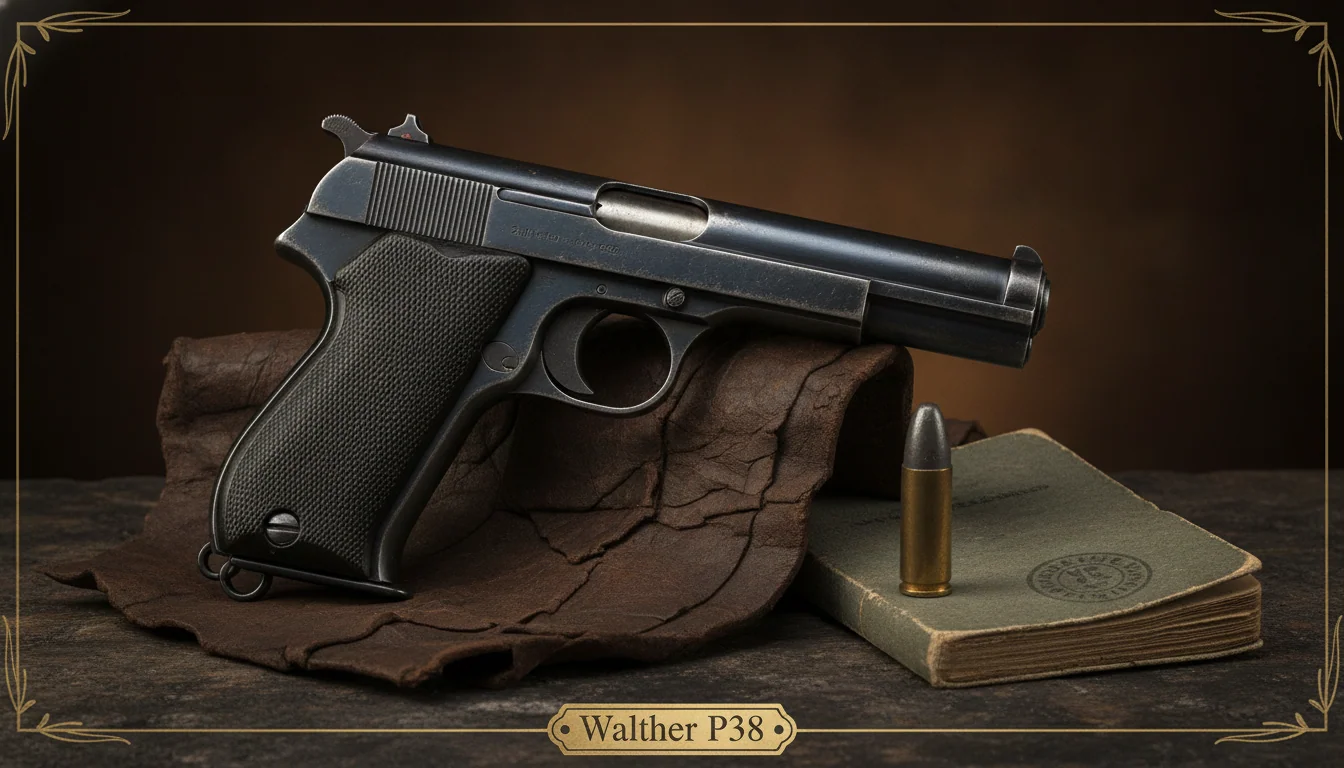
The P38 is a locked-breech, short-recoil operated pistol in 9x19mm Parabellum. The barrel measures approximately 125mm - roughly five inches. Loaded weight with the eight-round single-stack magazine is in the range of 1,000 grams, making it heavier than the Luger but comparable to other service pistols of the era. The frame is steel in early production; later wartime examples used aluminum alloy for weight and material savings.
The controls are placed logically: the magazine release is at the base of the grip, the safety-and-decocking lever is on the left side of the slide, and a small pin above the breech serves as a loaded-chamber indicator - visible to the eye and tactile to the finger in poor light or a tight holster. That indicator was a practical engineering decision that reflected the P38's core design philosophy: the pistol should be as safe and operationally simple as possible under field conditions.
The disassembly process is faster and more forgiving than the Luger's. A trained soldier could field-strip a P38 in seconds without tools. The Luger required more care and specific knowledge. Under combat conditions, in rain, mud, or extreme cold, that difference in complexity mattered.
The double-action revolution
The P38's most consequential feature was its trigger mechanism. The pistol operates in double-action/single-action mode. With a round chambered and the hammer down - the safe carry position - the shooter can fire immediately by pulling the trigger through a long, heavy double-action pull that simultaneously cocks and releases the hammer. Subsequent shots fire in single-action mode with the hammer already cocked, requiring a shorter, lighter pull.
Before the P38, most military pistols required either keeping the weapon uncocked (slow to fire) or keeping the hammer cocked (potentially dangerous on a belt or in a holster). The Luger had no conventional safety in the modern sense; carrying it cocked and ready was common practice but carried obvious risk. The P38 solved this with the decocking lever: a shooter could manually lower the hammer safely onto a loaded chamber with a single press of the lever, then draw and fire double-action when needed. Safe carry and immediate readiness were no longer in conflict.
This was not merely a technical refinement. It was a fundamental rethinking of how a military sidearm should relate to its user, and it produced a cascade of design descendants that continues to the present.
Through the war
Three manufacturers produced P38 pistols during the war, each identified by factory codes stamped on the frame: "ac" for Carl Walther, "byf" for Mauser-Werke (which took on P38 production in addition to its rifle output), and "cyq" for Spreewerk of Berlin. The codes were intended to obscure production sources from Allied intelligence, though by the time most of these codes were identified, the intelligence value had diminished.
Production quality correlates closely with date of manufacture. A 1941 or 1942 Walther-produced P38 is a well-finished, tightly toleranced pistol that performs reliably under field conditions. By 1944 and 1945, late-war P38s from any manufacturer show the effects of material substitution and accelerating production timelines: rougher machining, coarser surface finish, simplified parts, and sometimes variable function. A late Spreewerk example can feel almost like a different weapon from an early Walther one, though the operating principles remain identical.
The P38 served on every German front: North Africa, the Eastern Front, Italy, and Western Europe. It was issued primarily to officers, senior NCOs, vehicle crews, and specialist units. Ordinary infantry carried carbines and rifles, not pistols. The sidearm was a symbol of status and a backup weapon, not a primary combat tool. It served in that role reliably enough that it was widely retained as war-trophy by Allied soldiers who encountered it, a common enough occurrence that American military manuals included guidance on the P38's operation.
After the war
The pistol's story did not end in 1945. When West Germany rearmed and established the Bundeswehr in 1955, the question of what its soldiers would carry was immediately practical. The P38 design was well understood, and with Allied approval, West Germany adopted a modified version designated the Pistole 1 (P1). The primary change was a shift to an aluminum alloy frame to reduce weight, which introduced some long-term durability questions but was accepted as a workable compromise. The P1 became the Bundeswehr standard sidearm in 1957.
It remained in Bundeswehr service for decades. Soldiers carried P1 pistols on NATO exercises, in peacekeeping missions, and in the daily administrative life of a Cold War military alliance. The pistol that had been designed for the Wehrmacht ended up as the service weapon of the democratic German military it had fought against, which is one of the more striking continuities in postwar European arms history. The P1 was finally replaced in the 1990s by the Heckler and Koch P8.
The design's inheritance
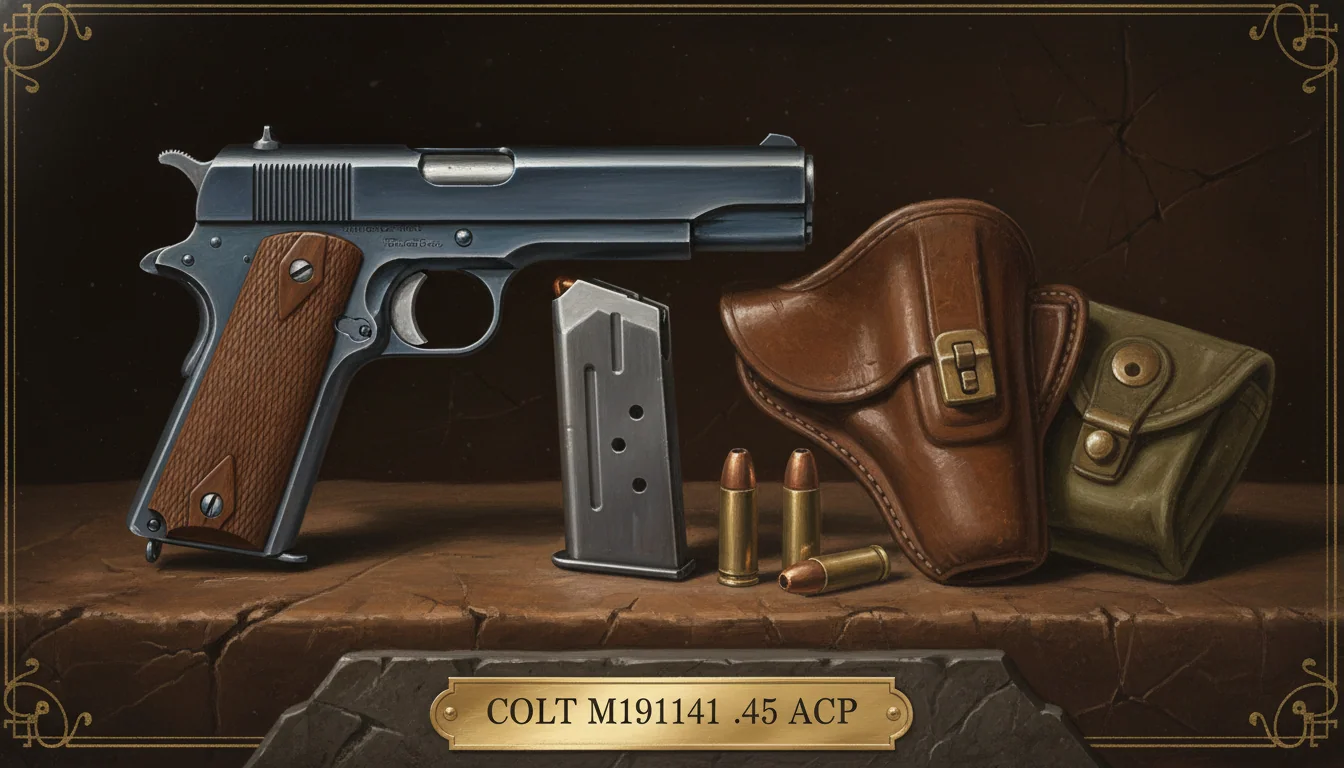
The P38's most important legacy is not the pistol itself but the family it founded. When the United States Army evaluated pistols in the early 1980s to replace the M1911A1 .45 ACP, the winner was the Beretta 92, which the Army designated the M9 in 1985. The Beretta 92 is operationally a direct descendant of the P38: same double-action/single-action mechanism, same open-slide design, same decocker arrangement. The influence is documented and the lineage is direct.
The SIG Sauer P226, adopted by various US special operations units and widely used by NATO police and military forces, similarly follows P38 principles. So does the Walther P88, the P99, and numerous other designs from European and American manufacturers. The fundamental safety logic - carry loaded, fire double-action on the first shot, single-action thereafter, decock without unloading - became the default framework for military and police handgun design in the second half of the 20th century.
The weapon that did not need to be beautiful
The Luger is the famous one. It appears in war films, museum displays, and collector catalogues. Its aesthetic is unmistakable. But the Luger was a weapon designed around an unusual mechanism that prioritized elegance and precision over durability and simplicity. It needed careful ammunition selection, careful maintenance, and careful users.
The P38 was designed for a different requirement entirely: reliable, reproducible function in the hands of a conscript army fighting across multiple climates and conditions. It accomplished that requirement and, in doing so, established the operating language of the modern service pistol. The Beretta that American soldiers carried in the Gulf War, the SIG that police forces carry today, the double-action pistol in almost any nation's holster - they carry a design idea that was first worked out in Zella-Mehlis and tested in the mud of the Eastern Front.
The P38 was never the iconic pistol. It was the influential one. In the long run, that matters more.
Quick Answers
Common questions about this topic
Why did Germany replace the Luger with the P38?
The Luger P08 was expensive to manufacture, mechanically complex, and sensitive to dirt and cold. The Wehrmacht needed a simpler, cheaper, more reliable alternative that could be produced at wartime scale. The P38 was mechanically simpler, significantly faster to produce, and introduced a double-action trigger that allowed safer carry with a round in the chamber.
What made the P38 revolutionary?
The P38 was the first successful double-action/single-action service pistol adopted by a major military. The double-action mechanism meant the pistol could be safely carried with a round chambered and the hammer down, then fired immediately by a long first pull of the trigger. This was a fundamental safety and operational improvement over previous service pistols.
Was the Walther P38 reliable?
Early production P38 pistols, manufactured by Walther in the first years of the war, were robust and well-regarded. Reliability declined significantly in late-war production as material shortages forced substitutions, aluminum frames replaced steel, and manufacturing tolerances widened. A late-war P38 could be markedly inferior to an early one despite identical designation.
Did the P38 influence later pistol designs?
Substantially. The P38's double-action/single-action mechanism, decocking lever, and loaded-chamber indicator became the template for most modern service pistols. The Beretta 92 series (adopted as the US M9 in 1985) operates on essentially the same principles. The SIG Sauer P220, P226, and related pistols similarly draw on the P38's fundamental design logic.

Talk to the People Who Wielded These Weapons
Chat with the soldiers, smiths, and commanders whose lives were shaped by the weapons of their age.
Talk to a WarriorJoin the HistorIQly Club
Get smarter about the past.
Weekly stories, deep dives, and exclusive content straight to your inbox.