Arsenal: The Halberd
The halberd history: how the Swiss combined axe, spear, and hook on a pole to break armored cavalry dominance and become Europe's most feared infantry for two centuries.
Read Wikipedia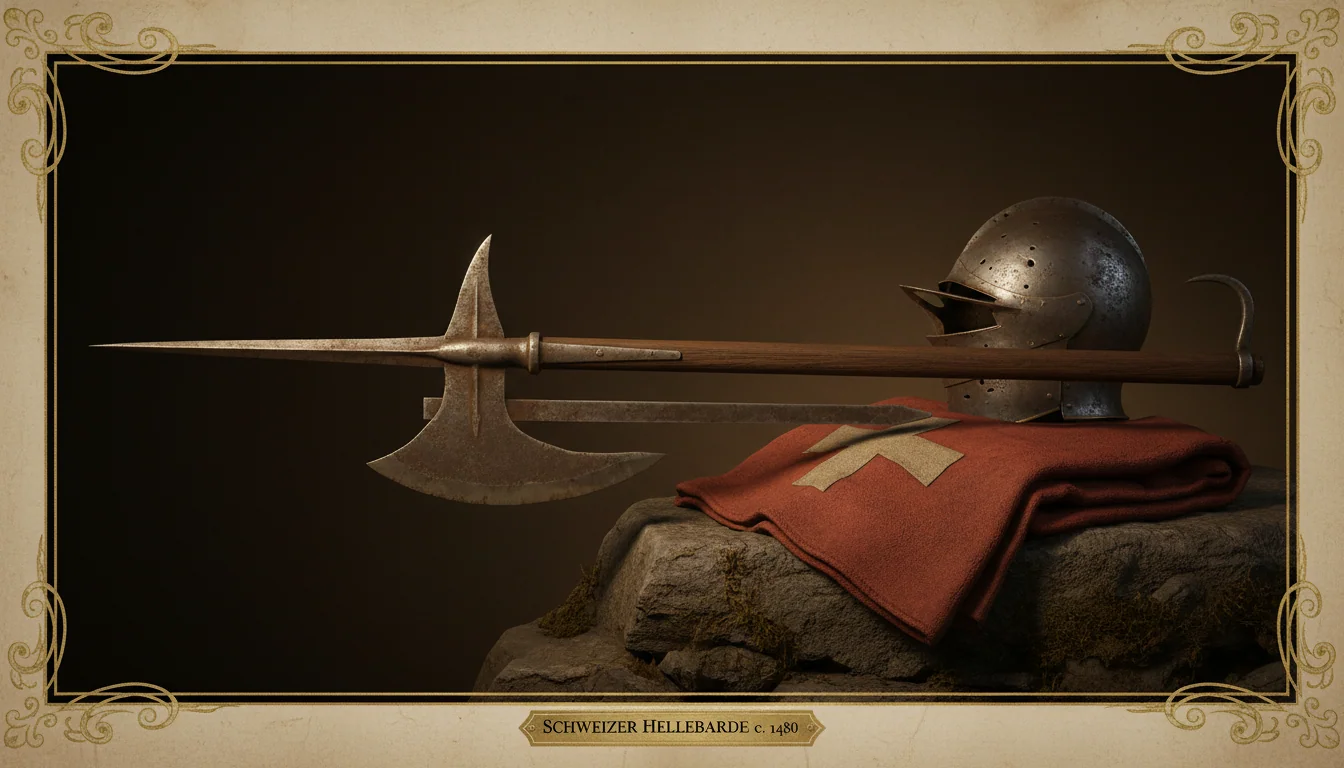
The halberd history spans two centuries of Swiss battlefield dominance. The halberd emerged from the Swiss cantons in the early 14th century as an answer to a specific tactical problem: how does an infantry force without cavalry or extensive armor defeat mounted knights in the open field? By the time Swiss halberds stopped Burgundian lances at the Battle of Grandson in 1476, the question had been answered so emphatically that it reshaped how European armies were designed.
Origins and design
The halberd appears in central Europe in recognizable form around 1300, developing from a tradition of staff weapons - voulges, guisarmes, war scythes, glaives - that had been mounted on poles in various configurations for generations. The specific combination that became the halberd, with a thrust spike, an axe blade, and a back hook all integrated into a single head, emerged in Swiss and German regions as a deliberate response to the challenge of armored cavalry.
The name comes from the Middle High German, most likely from Halm (shaft) and Barte (axe). Regional variants had many local names across German, French, and Italian linguistic territory.
The shaft was typically ash or beech, around five to six feet long. Ash was preferred for its combination of toughness and moderate weight - flexible enough to absorb impact without splitting, dense enough to resist cutting strokes aimed at the wood. The steel head was socketed onto the shaft and usually secured with langets, strips of steel running partway down the shaft on either side of the socket. The langets solved an early structural weakness: without them, a sword stroke aimed at the wood just below the head could shear through the shaft, disarming the wielder instantly.
The axe blade was the primary cutting tool, set at an angle that delivered maximum force against the surface of mail or early plate. The top spike, typically eight to twelve inches long, was a thrusting weapon designed for penetrating the gaps in armor - visor joints, armpit openings, the back of the knee. The hook on the reverse face of the head was the weapon's most distinctive feature: it could be used to drag a rider out of the saddle, to trap and redirect enemy weapons, or to hook behind a leg or arm in close fighting.
This combination was not decorative. Each element addressed a specific problem that infantrymen fighting armored opponents had previously had no good answer to.
How it changed warfare
The halberd changed warfare by reversing the assumption that had organized European military thinking for centuries. Heavy cavalry was expensive, prestige-laden, and tactically dominant. Infantry was numerous, cheap, and regarded as functional only in terrain where cavalry could not operate effectively. The formula was straightforward: noble cavalry wins; infantry dies.
The Swiss infantry of the 14th and 15th centuries broke this formula through a combination of disciplined formation, suitable terrain, and weapons that the cavalry of the period struggled to answer. The halberd was central to this. In a tight formation with overlapping weapons, a group of halberdiers presented a hedge of steel threats - hook, blade, spike - at multiple levels simultaneously. A horse facing this formation had its face and chest threatened by thrusting spikes. A rider trying to swing from horseback faced the hooks and blades of men below him. The momentum that made a cavalry charge devastating in open ground became a liability against stationary infantry that would not break.
The halberd was not effective in isolation. A single halberdier against a mounted knight on open ground has a serious problem. The weapon was a formation instrument, requiring the discipline to hold ground and coordinate movement as a unit. Swiss infantry developed exactly this discipline over the course of the 14th century, drilling in formations and maneuvering with cohesion that contemporary observers compared to Roman legionaries. The halberd enabled the tactic; Swiss training made the tactic work.
Key battles
Morgarten, 1315. The defining early test. Duke Leopold I of Austria led a Habsburg force along a narrow mountain pass in central Switzerland. The Swiss, under Waldstatter leadership, waited on the high ground and attacked from above once the column was compressed into the defile. The terrain neutralized cavalry's mobility; halberds and other weapons did the rest. The Swiss inflicted heavy casualties and the Habsburg force collapsed. The battle established Swiss infantry's reputation and began the long process of Swiss independence from Habsburg authority.
Laupen, 1339. The Swiss Confederation, allied with Bern, faced a combined force of Burgundian and Savoyard troops in a more open engagement. The halberd formations held against frontal attack and eventually drove the opposing force from the field. The battle demonstrated that Swiss infantry could fight effectively outside mountain terrain.
Sempach, 1386. Duke Leopold III of Austria faced the Swiss with a force of knights who had dismounted to fight on foot - the cavalry's tactical adjustment to the halberd threat. Armored men with swords and lances on foot still present a serious problem. What the adjustment lost was the cavalry's mobility and mass. The Swiss broke through the Austrian line, and Leopold was killed in the fighting. Sempach confirmed that Swiss infantry could defeat armored men in almost any tactical configuration.
Grandson and Murten, 1476. These two battles, fought within three months of each other, represent the apex of the halberd era. Charles the Bold of Burgundy commanded one of the best-equipped armies in Europe, incorporating experienced pike blocks, artillery, and cavalry in a combined system. At Grandson in March 1476, his army was routed by the Swiss and enormous quantities of equipment were captured. At Murten in June 1476, a larger Burgundian force was again defeated and thousands of soldiers were killed in the rout. Charles died at the Battle of Nancy in January 1477. His strategic ambitions in Lorraine and the Low Countries died with him.
Technical evolution
The halberd evolved as the armor it faced evolved. In the early 14th century, mail was the primary protection and the axe blade was effective against it. As plate armor became more comprehensive through the 15th century, halberds were modified: the axe blade became somewhat narrower and more pointed, concentrating force on plate seams and penetration rather than broad cutting; the top spike grew longer and more robust for thrusting into visor joints and armpit openings at armor gaps.
Some later halberds incorporated a small lug or secondary hook immediately below the axe blade to trap and redirect sword strokes. Others featured reinforced langets extending nearly half the shaft's length, making the weapon far more resistant to being cut through.
By the early 16th century, a heavier variant sometimes called the pole axe was in use for fighting in armored close quarters, often with a hammerhead face for bludgeoning plate. This is a distinct weapon with different applications from the battlefield halberd, though the two are frequently confused in period illustration and modern discussion.
Decline and successor
The pike displaced the halberd as the primary Swiss formation weapon during the mid-15th century. The reason was not that the halberd was ineffective but that larger engagements on more open terrain favored the pike's greater reach. A sixteen-foot pike block, held by disciplined infantry prepared to receive a charge, presented a threat at ranges where a halberd could not yet reach the enemy. As the scale of European warfare expanded and Swiss mercenary units fought across Italy and France, pike formations proved more versatile for the kind of open-field engagements that dominated 16th-century continental warfare.
Firearms were the larger structural force. The combined pike-and-shot formation that dominated 16th-century European warfare steadily increased the proportion of firearms to pole weapons. By the mid-17th century, the flintlock musket with socket bayonet had made the pike itself obsolete. The bayonet was the foot soldier's answer to cavalry, mounted on a weapon that could also shoot.
The halberd was not so much retired as reassigned. Palace guards, ceremonial units, and urban watch organizations adopted it as a weapon of presence and authority throughout the 16th and 17th centuries. The weapons that replaced it on the battlefield are covered in our Arsenal series: the crossbow and trebuchet represent the medieval ranged complement to the halberd's close-quarters dominance. The Papal Swiss Guard at the Vatican still carries halberds today, in forms closely modeled on the late 15th-century originals. The weapon transitioned from battlefield instrument to institutional symbol in roughly the same generation that the firearms revolution made it militarily redundant.
The lasting effect
The halberd's two centuries of battlefield use established something that the medieval world had not taken as given: that trained, disciplined infantry could defeat armored cavalry in the open field. This required the Swiss to spend a century demonstrating it repeatedly against major powers, and the proof changed how armies were thought about and designed.
The Swiss mercenary tradition - built on halberd and later pike formations, disciplined drill, and a willingness to hold ground - made Switzerland the dominant supplier of professional soldiers to European courts through the 15th and 16th centuries. They fought for France, for the Papacy, for the Sforzas in Milan, for the Habsburgs against each other. This mercenary dominance is why the Swiss Guard at St. Peter's Basilica is still Swiss.
The halberd itself is now a museum object. The originals, when they appear in collections, are remarkable things: steel heads intact after six centuries, langets still attached to the shaft remnants, the geometry of axe, spike, and hook still legible as a system built for a specific problem. It is not a beautiful weapon, in the way a katana or a rapier is beautiful. It is a practical weapon - the kind that emerges from people who needed to solve a problem badly enough to think it through clearly and build the solution.
Quick Answers
Common questions about this topic
What is a halberd?
A halberd is a European pole weapon consisting of a long wooden shaft - typically around five to six feet - topped with a steel head that combines three functional components: a thrusting spike at the top, an axe blade on one side for cutting, and a back hook for dismounting cavalry or controlling enemy weapons. It was the primary weapon of Swiss infantry during the 14th and 15th centuries.
Why was the halberd so effective against cavalry?
The halberd gave infantry multiple threats against mounted opponents simultaneously. The back hook could pull a knight from the saddle. The axe blade could reach over a shield or chop through light mail. The thrusting spike could penetrate visor gaps and armor joints. Crucially, it worked best in tight formations where multiple men with halberds created an overlapping threat that cavalry could not easily neutralize by charging.
What battles made the halberd famous?
The key battles are Morgarten (1315), where Swiss forces used halberds and ambush terrain to stop Habsburg cavalry; Sempach (1386), where even dismounted knights were defeated; and the two battles against Charles the Bold of Burgundy at Grandson and Murten (1476), which destroyed Burgundian military power and confirmed Swiss infantry dominance.
What replaced the halberd?
The pike replaced the halberd as the primary Swiss formation weapon during the mid-15th century because the pike's greater length was better suited to open-field engagements. Firearms eventually made both weapons obsolete as battlefield instruments. Halberds survived as ceremonial weapons and are still carried by the Papal Swiss Guard in Vatican City.

Talk to the People Who Wielded These Weapons
Chat with the soldiers, smiths, and commanders whose lives were shaped by the weapons of their age.
Create your free account →No card required. Some figures and features require a paid plan.
Join the HistorIQly Club
Get smarter about the past.
Weekly stories, deep dives, and exclusive content straight to your inbox.