Arsenal: The Persian Shamshir and the Art of the Curved Blade
The shamshir sword armed Persian emperors and Mughal cavalry. Forged from wootz steel and built for mounted combat, it shaped Islamic warfare for three centuries.
Read Wikipedia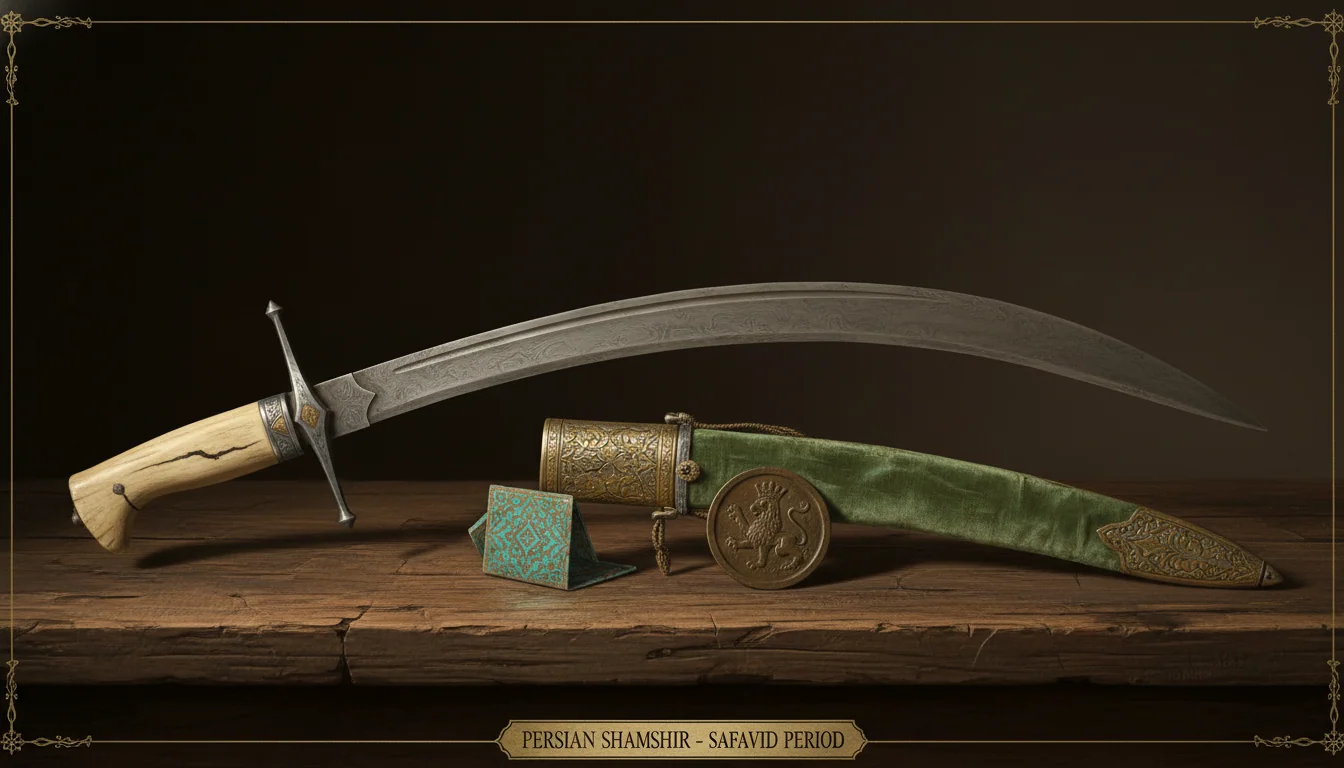
A sword designed to kill a man while you are moving and he is not is built differently from one designed to meet him in a formed line. The shamshir was built for the first task, and the civilization that refined it spent two centuries making sure it was the finest tool in the world for that purpose.
The curve is the key. A straight blade driven forward requires the wielder to stop, plant, and thrust. A deep-curved blade drawn across a target from above or beside does its damage as the horse carries you past, pulling through the cut the way a scythe pulls through grass. The shamshir, with its crescent bend and thin, needle-fine point, was the scythe of the Persian cavalry, and the armies that used it well dominated vast stretches of the medieval and early modern Islamic world.
Where the curve came from
Curved swords did not originate in Persia. The idea of curving a blade to enhance its draw-cut ability appears independently in several cultures, but the decisive transmission came from the steppes. The Turkic and Mongol nomads who swept across Central Asia from the 9th century onward used slightly curved sabers as their primary mounted weapon, and when those peoples moved into Persia, Anatolia, and northern India, they brought their sword culture with them.
The shamshir as a recognizable form crystallized in Persia sometime between the 13th and 15th centuries, in the period after the Mongol Ilkhanate controlled the region and Persian culture absorbed and refined the weaponry of its conquerors. By the time the Safavid dynasty established itself in Persia in 1501, the shamshir was already the established cavalry sidearm and was becoming the marker of noble martial culture.
The word itself is Persian. The most widely cited etymology derives it from "shir" (lion) and "sham" (claw), giving "lion's claw," though linguists dispute this and some prefer a derivation from "shamshad" (boxwood), a reference to the flexibility of the blade. The Persians who carried it did not seem much interested in resolving the debate.
The blade
The ideal shamshir blade measured roughly 87 to 92 centimeters in total length, with most of that in the curved body of the blade. The curvature was severe - considerably greater than the curve of a Turkish kilij or a Japanese katana, which are both roughly in the same family of slashing swords but represent different solutions to the same design problem. The shamshir's curve places the point well below the horizontal when the sword is held naturally, which gives it its distinctive silhouette and limits its use as a thrusting weapon.
The blade was single-edged, with the cutting edge on the outside of the curve and a thick, reinforced spine on the inside. It tapered steadily from hilt to point, and the finest examples had a false edge ground for the last several centimeters near the tip, giving the wielder a restricted thrust for emergencies. The geometry was not forgiving: a Persian horseman who found himself on foot fighting armored infantry in close quarters was in trouble, and historical accounts of engagements confirm that dismounted cavalry in the Safavid period often relied on daggers and secondary weapons rather than their main swords.
The grip was designed for a single hand and matched the curve of the blade in an ergonomic way that pulled the wrist naturally into the right cutting angle. The crossguard was small, sometimes little more than a narrow bar, because the shamshir was not primarily a parrying weapon. Persian swordsmanship relied on evasion, horse movement, and the momentum of the cut rather than the blade-to-blade contact of European fencing tradition.
Wootz: the steel that made the legend
The finest shamshirs were forged from wootz, a crucible steel produced in workshops in Persia, India, and parts of Central Asia through a process that was jealously guarded and imperfectly understood by outsiders. Wootz had an extremely high carbon content achieved through the crucible process, which produced a material with unusual hardness, resilience, and the distinctive surface pattern of fine carbide banding that European observers described as watered silk or flowing water and called Damascus steel after the Syrian trading city where they first encountered it.
The blade of a high-quality wootz shamshir showed this patterning along its length, a visual sign of quality that was also to some degree functional: the fine carbide bands allowed the blade to hold an edge that ordinary iron could not approach. Metallurgical analysis of surviving examples shows carbon content around 1.5 percent, well into high-carbon territory, and a microstructure that modern materials scientists still study for what it reveals about pre-industrial metallurgy.
The process was eventually lost, probably sometime in the late 18th or early 19th century, as Indian steel production declined under colonial economic pressure and the specific ore sources and charcoal types used in the original process became unavailable or uneconomic. Modern attempts to replicate wootz have been partially successful but the original technique remains reconstructed rather than continuous.
Under the Safavids and Mughals
The Persian Safavid empire (1501-1736) was the great age of the shamshir as both a weapon and an art object. Safavid shahs commissioned blades from the finest smiths in Isfahan, Shiraz, and Khorasan. The finest examples were inlaid with gold inscriptions from the Quran or classical Persian poetry, their hilts set with rubies and turquoise, their scabbards covered in velvet and fitted with silver or gold mounts. These were weapons, but they were also statements: who you were, what you owned, how seriously you took the martial tradition.
The Mughal emperors in India absorbed the shamshir tradition from Persian artistic culture, which heavily influenced the Mughal court from its founding. Mughal miniature paintings show cavalry officers and courtiers carrying shamshirs in the standard Persian style, and the weapon itself was adapted in India into the related talwar, which introduced a more pronounced disk-shaped pommel and a heavier blade suited to Indian combat conditions and the specific demands of fighting the various infantry armies the Mughals encountered.
Shah Abbas I, who ruled Persia from 1588 to 1629 and is considered the high point of Safavid power, standardized the cavalry arm and made the shamshir central to his heavy cavalry's equipment alongside the composite bow and the matchlock musket. The combination of firepower at range, bow fire at closer range, and the shamshir for the final mounted charge represented the Safavid tactical system at its most refined.
The Ottoman connection
The Ottoman Turks, Persia's great rivals and occasional allies, carried a related but different sword, the kilij, which was somewhat shorter, had a curved blade with a distinctly widened tip section designed to add weight and cutting power to the drawing stroke. The two traditions cross-pollinated constantly: Ottoman workshops absorbed Persian craftsmen after conquests, Persian princes received Ottoman gifts, and the weapons traded hands along the established routes of diplomacy and commerce.
Napoleon Bonaparte reportedly received a magnificent shamshir as a diplomatic gift, a weapon now in the Louvre collection. European travelers throughout the 17th and 18th centuries brought back shamshirs as prestige objects and souvenirs, and several excellent examples ended up in the arms collections of European kings, where they can still be examined today.
The decline
The shamshir did not lose to a better sword. It lost to the rifle. The transition from mounted close combat to infantry firearms that unfolded across the 18th and 19th centuries rendered the deep curve and the cutting focus of the shamshir tactically irrelevant in the same way it had rendered every other cavalry saber obsolete everywhere else. A sword built to draw-cut from horseback has nothing to offer against a man with a Martini-Henry rifle at 400 meters.
In Persia, the transition was partly internal. The Zand and Qajar dynasties that succeeded the Safavids maintained the tradition of ornamental shamshirs as court objects, royal gifts, and symbols of authority, but the fighting army increasingly relied on firearms. By the mid-19th century the shamshir was a ceremonial weapon and a collector's item rather than a military tool.
The weapon's aesthetic legacy survived its functional decline. The curve of the shamshir became the template for the curved sabers adopted by European light cavalry, the hussar saber, the British 1796 Light Cavalry Sabre, and ultimately the American cavalry saber, which all borrowed the same cutting geometry from the same source. The Persian horsemen who refined the curve on the steppes around Nishapur and Isfahan would not have recognized the troopers who carried their idea into the Napoleonic wars, but the logic of the drawn cut traveled with the blade. For comparison with other iconic cavalry and infantry sidearms, see the entries on the Japanese katana and the Mongol composite bow, both weapons that defined the mounted warfare of their respective empires.
Quick Answers
Common questions about this topic
What is a shamshir?
A shamshir is a Persian curved sword with a single-edged blade typically 87-92 cm long, deeply curved toward the point, with a small crossguard and a pistol-grip-style handle. The name derives from Persian and the sword was the primary sidearm of the Persian military from roughly the 14th century onward, spreading across the Mughal and Ottoman empires.
What is shamshir made of?
The finest shamshirs were forged from wootz steel, also called Damascus steel, a crucible steel produced in Persia and India with a distinctive watered or wavy surface pattern. This material held an exceptionally sharp edge and had a reputation, partly mythological, for superior resilience. Lesser examples were made from ordinary high-carbon steel.
Was the shamshir effective in battle?
The shamshir was optimized for mounted slash-and-draw cutting against lightly armored opponents, which made it highly effective in cavalry-heavy conflicts across Central Asia and the Middle East. Its deep curve made thrusting difficult, which limited its use against heavily armored infantry in close formation. Persian and Mughal armies compensated by using it alongside spears, bows, and firearms.
How does a shamshir differ from a scimitar?
Scimitar is a general European term applied loosely to various curved Middle Eastern swords including the shamshir, the Ottoman kilij, and the Indian talwar. These are related but distinct weapons. The shamshir is specifically the deep-curved Persian form with no pronounced tip flare; the kilij has a widened, almost yatagan-style tip called a yelman; the talwar has a more pronounced disc pommel and wider crossguard.

Talk to the People Who Wielded These Weapons
Chat with the soldiers, smiths, and commanders whose lives were shaped by the weapons of their age.
Create your free account →No card required. Talk to anyone in history with 8 free credits a day. Some features require a paid plan.
Join the HistorIQly Club
Get smarter about the past.
Weekly stories, deep dives, and exclusive content straight to your inbox.