Back to Black vs. History: How Accurate Is the Amy Winehouse Biopic?
Back to Black accuracy check: the 2024 Amy Winehouse biopic gets the Camden atmosphere and Blake relationship right, but the executive producer credit shapes everything.
Read Wikipedia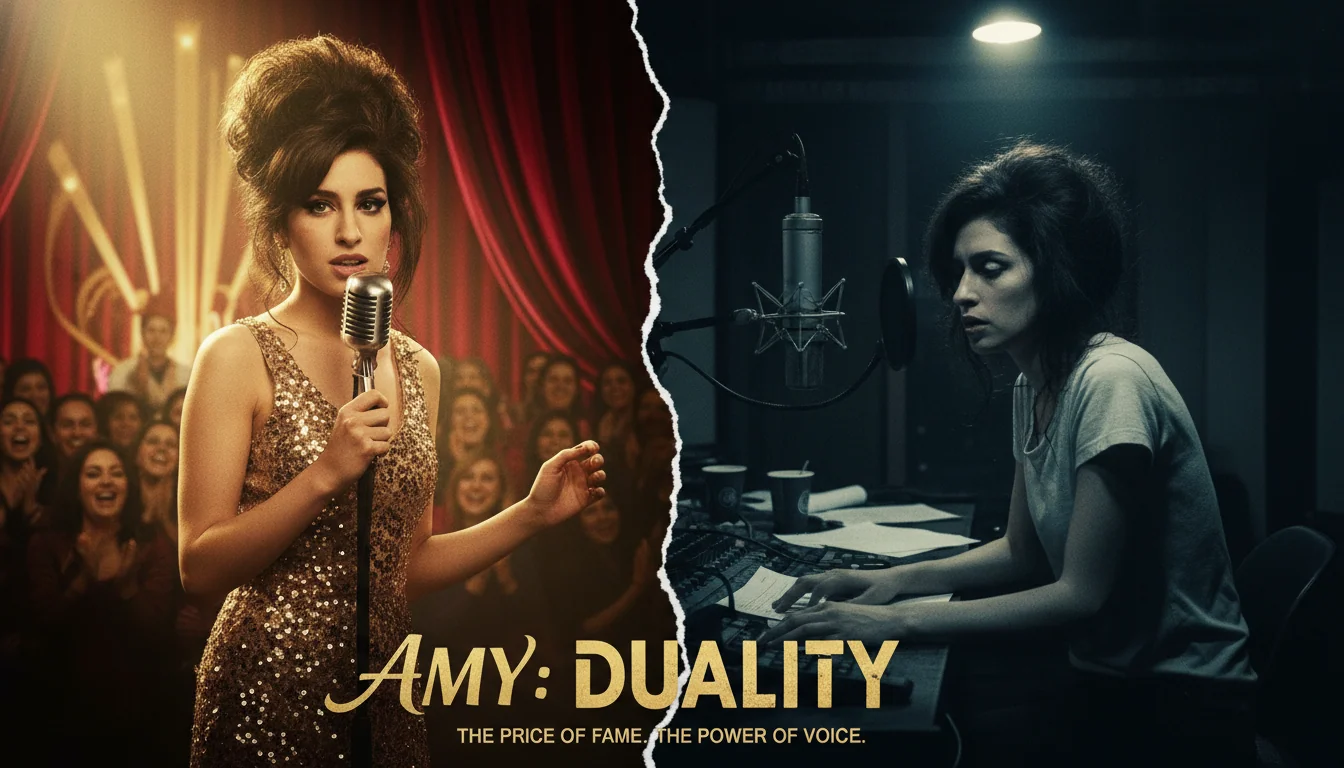
The Amy Winehouse biopic was always going to be a trap. Winehouse was not simply famous - she was iconic, specific, and possessed of a voice that could not be imitated without the audience knowing immediately. Any actor cast as her would be compared to recordings tens of millions of people know by heart. The emotional template of her life was so compressed and so public - north London Jewish girl, jazz obsessive, catastrophically self-destructive love affair, five Grammys won via satellite from London, dead at twenty-seven - that every framing choice the film made would be measured against everything the audience already carried into the cinema.
Sam Taylor-Johnson's Back to Black, released in 2024 and starring Marisa Abela, largely survives those traps. It is a well-crafted film. The question of how accurate it is, however, depends partly on accuracy to the public record and partly on something more structural: the person who gave the film its most detailed source access was Mitch Winehouse, Amy's father, who served as executive producer.
What Hollywood Got RIGHT
The Camden setting and Amy's musical identity
The film locates Amy Winehouse correctly in the landscape of mid-2000s north London. Camden, the Stables Market, the small venues where she first played - these are captured with period texture and genuine affection. Winehouse was a product of a specific London subculture: Jewish north London, jazz record shops, the culture of musicians who drank at the same pubs where their heroes had once played. The film earns this atmosphere.
Her influences are right, too. Sarah Vaughan, Dinah Washington, Thelonious Monk, Billie Holiday - the jazz and classic soul canon that shaped Winehouse's voice and phrasing. The film depicts her absorbing these as a teenager, which matches the accounts of those who knew her during her early career. The musical biography is precise where it needs to be precise.
The Blake Fielder-Civil relationship
Back to Black, the album, was about Blake Fielder-Civil. That is not a biographical tidbit but a fact that Winehouse stated repeatedly in interviews. She wrote the songs during and after their first breakup in 2005. The album is an act of obsessive mourning for a relationship that had not yet fully destroyed her.
Jack O'Connell plays Blake as someone who was genuinely loved, not merely a convenient villain. That choice is historically honest. Fielder-Civil was also genuinely charming, and the mutual pull between them was real enough that they married in 2007 and divorced in 2009. The film does not sanitize this by making one party wholly sympathetic and the other wholly monstrous. The record of their relationship, confirmed in accounts from multiple sources over many years, is that it was mutually intense and mutually destructive.
Mark Ronson and the album sessions
The film depicts Mark Ronson arriving as a producer and being decisive in shaping the Back to Black sound. This is accurate. Ronson brought the retro-soul Motown arrangement style - the horns, the Wall of Sound drums, the structured song architecture - that gave Winehouse's raw material its commercial form. The collaboration between Ronson and Winehouse on those sessions is one of the better-documented creative partnerships in recent British music history, and the film reflects it without inflating Ronson's role at the expense of Winehouse's songwriting.
The Grammy satellite performance
One of the film's emotional peaks is Amy's performance at the 50th Grammy Awards in February 2008. Denied a US visa - reportedly connected to pending proceedings in Britain - she could not travel to Los Angeles. She performed live by satellite from London while the ceremony broadcast in America. The film renders this correctly, including the slightly surreal quality of watching a British artist become the evening's biggest winner from several thousand miles away. She won five Grammy Awards: Record of the Year, Song of the Year, Best New Artist, Best Female Pop Vocal Performance, and Best Pop Vocal Album. It was, by any measure, the peak of her commercial recognition.
The moment works in the film because it was genuinely extraordinary in the room. The ceremony cut to her satellite feed repeatedly as she collected awards she could not physically receive.
What Hollywood Got WRONG
The Mitch Winehouse problem
Mitch Winehouse, Amy's father, is a figure about whom opinion remains sharply divided. Those who regard him as a loving parent who did his best in impossible circumstances and those who regard him as someone whose ambitions and public visibility made a difficult situation worse are arguing from the same set of facts but reaching opposite conclusions.
The film's Mitch is not a villain. He is complicated, and complicated in ways the film renders with working-class warmth. That is not an inaccurate description of a man who is documented as genuinely loving his daughter while also, in the view of many who knew Amy, making choices that complicated her recovery. But the film's framing of his complications leans noticeably toward the sympathetic - which is not surprising given that Mitch Winehouse was the film's executive producer, a fact the filmmakers disclosed themselves, and which critics noted immediately.
The producer credit does not make the film dishonest. It creates a structural incentive that is impossible to ignore when evaluating the portrayal of a central figure in the story. A film produced by your subject's father will not be the harshest possible account of your subject's father.
Amy's mother is nearly absent
Janis Winehouse, Amy's mother, suffered from multiple sclerosis and was a significant presence in her daughter's life. The film reduces her to near-invisibility. Journalists and authors who have written about Winehouse at length tend to discuss Janis as an important figure in understanding Amy's emotional formation. The film's decision to center on Mitch while marginalizing Janis reflects the executive-producer interest and leaves the portrait structurally incomplete.
The film ends before the story does
Back to Black concludes at roughly the 2008 Grammy performance. Amy Winehouse lived for three more years. Those years - the deterioration, the failed comeback shows, the summer of 2011 - were the period in which the full trajectory of her life became visible. A biopic that ends at the triumph avoids the hardest question the material raises.
There are understandable reasons for this choice. Depicting a recent death in graphic detail raises ethical questions about the living people involved. But the truncation means the film does not fully account for the life it is telling.
The lip-sync dissonance
Marisa Abela gives a committed and physically precise performance. The film used Winehouse's original recordings as its soundtrack throughout. The gap between Abela's appearance and the voice the audience hears creates an uncanny effect that critics noted at the time. Winehouse's voice was so particular - not just the timbre but the phrasing, the nasal rasp, the blues-trained note-bending - that hearing it emerge from someone clearly miming produces a dissonance that no amount of commitment can fully bridge. This is not Abela's failure. It is an inherent structural problem with casting any actor as someone whose voice is this recognizable.
Historical Accuracy Score: 6/10
Back to Black is a well-made film that is broadly accurate about the events it chooses to depict. The Camden atmosphere, the Blake relationship, the album sessions, the Grammy moment - these are rendered with care and period honesty. The film fails not on the facts but on the framing. The Mitch Winehouse producer credit introduces a bias that shapes the most contested parts of the story. The decision to end before Amy's death leaves the film feeling like a promotional treatment of a tragedy rather than a full reckoning with it.
What the film gets most right: the texture of Winehouse's musical world and the emotional reality of the central relationship.
What it gets most wrong: the structural distortion introduced by the producer credit, and the truncation of a life whose most important chapter was still to come when the credits roll.
The bottom line is that Back to Black is a partial portrait of a remarkable artist, made with skill and obvious affection, and shaped by exactly the conflict of interest you would expect from a film made with her father's cooperation. Watch it for the music. Read everything else before you trust it.
For other music biopics fact-checked against the historical record, see Bob Marley: One Love vs. History and Walk the Line vs. History.
Quick Answers
Common questions about this topic
Is Back to Black based on a true story?
Yes. Back to Black (2024) is a biographical drama covering Amy Winehouse's life from her teenage years in north London through her international breakthrough with the Back to Black album and her Grammy performance in 2008. It draws on documented events in Winehouse's life, her interviews, and her own lyrics.
How accurate is the Back to Black film?
The film is broadly accurate about Amy Winehouse's Camden roots, her relationship with Blake Fielder-Civil, and the creation of the Back to Black album with Mark Ronson. Critics noted, however, that Mitch Winehouse serving as executive producer created a structural bias in how her father is portrayed.
What does Back to Black get wrong about Amy Winehouse?
The film's most significant weakness is its sympathetic framing of Mitch Winehouse, who was the film's executive producer, and the near-absence of Amy's mother Janis, who was a significant presence in her life. The film also ends before Amy's final years, leaving the full arc of her story incomplete.
Why did Amy Winehouse perform at the Grammys via satellite?
Amy Winehouse was denied a US visa in 2008, reportedly because of ongoing criminal proceedings in Britain connected to a video clip. Unable to travel to Los Angeles for the ceremony, she performed live via satellite from London and won all five Grammy Awards she was nominated for that evening.

Debate the Accuracy with the Real Figures
Ask the real people what Hollywood got wrong about their lives.
Create your free account →No card required. Talk to anyone in history with 8 free credits a day. Some features require a paid plan.
Join the HistorIQly Club
Get smarter about the past.
Weekly stories, deep dives, and exclusive content straight to your inbox.