Chevalier vs. History: How Accurate Is the Joseph Bologne Biopic?
Chevalier (2022) gets Joseph Bologne's extraordinary real career mostly right, but invents a violin duel with Mozart and a tragic love affair that never happened.
Read Wikipedia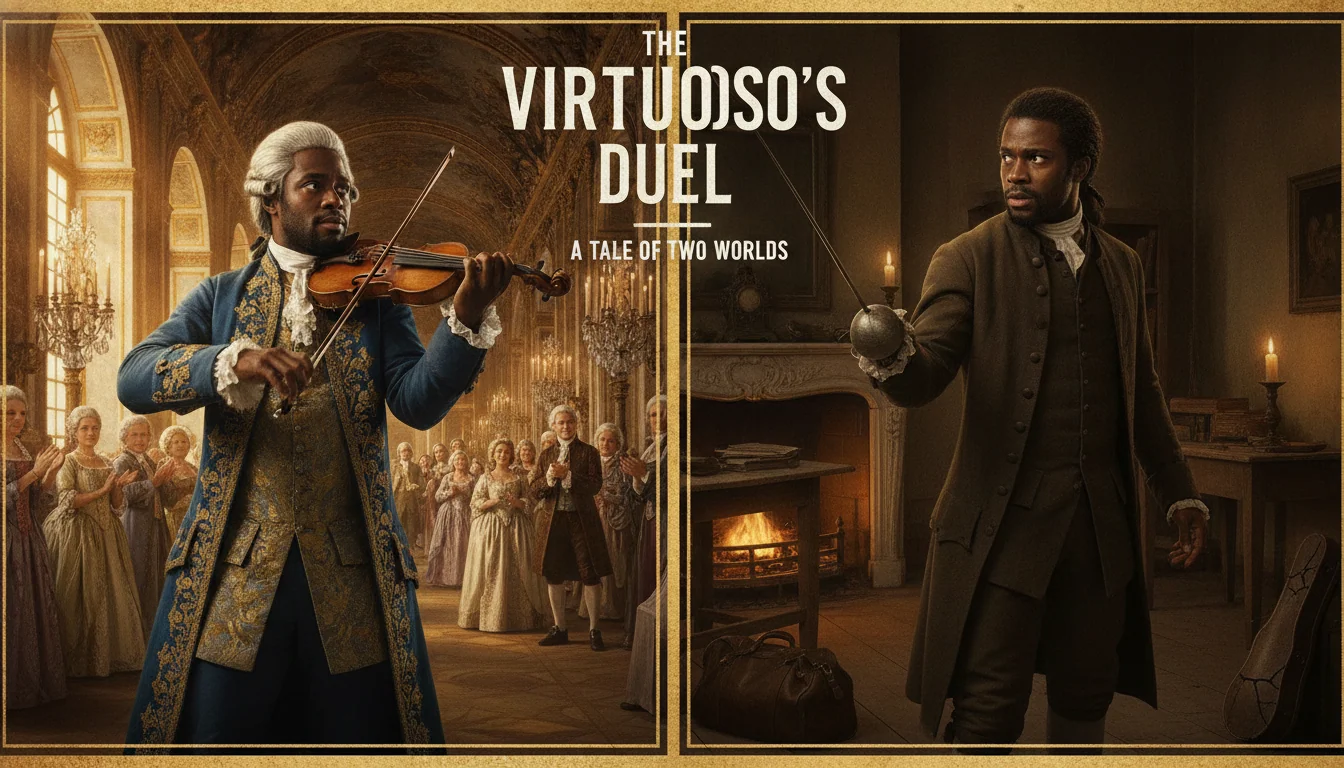
Chevalier (2022) had one of the more compelling pitches of any recent historical drama: a Black virtuoso violinist, composer, and champion fencer, born to an enslaved woman in the Caribbean, rises to become one of the most celebrated musicians in the court of Marie Antoinette, only to be pushed to the margins of history by the very racism that made his rise remarkable in the first place. Kelvin Harrison Jr. plays Joseph Bologne, Chevalier de Saint-Georges, in a film that clearly wants to correct the historical record on a genuinely extraordinary figure.
The instinct is right. Bologne's real career needs no embellishment to be astonishing. Whether the film needed to invent as much as it did is a fairer question.
What Hollywood Got RIGHT
Bologne's origins and his father's world
The film's account of Bologne's birth is essentially accurate. He was born on the French Caribbean island of Guadeloupe in 1745, the son of a wealthy French plantation owner and Nanon, an enslaved woman on his father's estate. His father brought him to France for his education while still a child, a decision that placed Bologne inside French aristocratic institutions from a young age despite his mother's enslaved status, a genuinely unusual and historically documented arrangement.
The championship fencing career
Bologne's training as a swordsman and his rise to become one of the most celebrated fencers in France are well documented and the film handles this fairly faithfully. He studied under a respected fencing master and built a public reputation for his skill that predated his fame as a musician, a career the film uses effectively to establish his standing at court before turning to his music.
A genuine virtuoso and orchestra leader
The film's portrayal of Bologne as a first-rank violinist and composer is grounded in the historical record. He led the Concert des Amateurs, one of the finest orchestras in Europe at the time, and later directed the Concert de la Loge Olympique, the ensemble that commissioned Joseph Haydn's Paris symphonies, a real and significant fact about Bologne's influence on the broader European musical world that the film gestures toward.
The Paris Opera controversy
The film's depiction of Bologne being considered for, and then denied, the directorship of the Paris Opera reflects a real and well-documented episode. Contemporary accounts describe performers petitioning against serving under a man of mixed race, and the appointment ultimately did not proceed. The film compresses and dramatizes the politics around this episode, but the underlying racial controversy, and the fact that Bologne's professional ceiling was set by prejudice rather than talent, is accurate to the historical record.
His revolutionary military service
The film's later scenes showing Bologne commanding troops are grounded in fact. During the French Revolution, Saint-Georges organized and led the Legion of Saint-Georges, sometimes called the Legion of Americans, a regiment made up largely of free men of color, one of the first such units in European military history. His service in the revolutionary army, despite his earlier prominence at the royal court, reflects the genuine political complexity of his later life.
What Hollywood Got WRONG
The Mozart duel never happened
The film opens with an invented set piece: a public violin "duel" between Bologne and a young Wolfgang Amadeus Mozart, staged as a direct head-to-head contest of skill. No historical record supports this event. The two men were almost certainly aware of one another, since Mozart visited Paris in 1778 and moved in overlapping musical circles, and some historians have speculated about professional rivalry or mutual awareness between them, but a staged public duel is a dramatic invention designed to open the film with an immediate, legible stakes-setting scene rather than a documented confrontation.
The central romance is fictional
Much of the film's emotional core rests on a passionate, ultimately tragic affair between Bologne and a fictional noblewoman invented for the story, married to a jealous, powerful husband. This relationship, along with its dramatic consequences, has no basis in the historical record. It functions as a narrative device to personalize the stakes of racism and court politics that Bologne actually faced in more diffuse, less melodramatic forms throughout his real career.
His mother's presence in his life is reordered
The film compresses and rearranges the timeline of Bologne's relationship with his mother, Nanon, for dramatic effect. In reality, Bologne's father did eventually bring Nanon to France to live near her son, but the exact timeline and the emotional beats the film builds around her arrival are dramatized rather than drawn from a detailed documentary record, since much of Nanon's individual life outside her relationship to Bologne and his father was not thoroughly recorded by contemporaries.
Marie Antoinette's relationship with Bologne is simplified
The film uses Marie Antoinette as a figure who first elevates Bologne and later abandons or betrays him as political pressure mounts, giving their relationship a clean arc of patronage followed by betrayal. The real historical relationship between Bologne and the queen was almost certainly messier and less personally focused than the film suggests, shaped as much by the shifting factions and prejudices of the broader court as by any direct personal decision she made regarding him specifically.
The pacing of his career achievements is compressed
As with most biopics covering a long, eventful life in under two hours, the film compresses years of real career development, including his rise through the Concert des Amateurs and later ensembles, into a tighter and more dramatically convenient timeline than the actual historical record supports.
His compositions get relatively little screen time
For a film about a composer, Chevalier spends comparatively little time on the actual substance of Bologne's musical output, which included violin concertos, string quartets, and an opera. Historians and musicologists who have championed the rediscovery of his work in recent decades have generally focused on the sheer range and quality of the compositions themselves, something the film gestures at through performance scenes without dwelling on the specific pieces or their place in the broader Classical repertoire.
Historical Accuracy Score: 6/10
Chevalier gets the shape of an extraordinary real life right: a man born to an enslaved mother who became one of the most accomplished musicians and swordsmen in pre-revolutionary France, only to hit a ceiling that talent alone could never break through. That is a true and important story, and the film deserves credit for bringing Bologne's name to a much wider audience than the history books ever managed.
Where it falls short is in how much invented drama it layers onto a life that was already remarkable. The Mozart duel and the central love affair are the two biggest fabrications, and both exist to give the film a conventional three-act shape rather than to illuminate anything true about Bologne's actual struggles. The result is a film that is emotionally effective but historically loose in exactly the places where the truth might have served the story just as well.
For another film that reshapes a real 18th century royal court for dramatic effect, see Victoria and Abdul vs. History. For a biopic that similarly compresses a real musician's career into an invented emotional arc, see Walk the Line vs. History.
Quick Answers
Common questions about this topic
Is Chevalier based on a true story?
Yes. Joseph Bologne, Chevalier de Saint-Georges, was a real composer, violin virtuoso, and champion fencer in 18th century France, born in Guadeloupe to a French planter and an enslaved woman. The film dramatizes real elements of his career but invents several major plot points, including his central romantic relationship.
Did Joseph Bologne really compete against Mozart?
There is no documented public violin duel between Bologne and Mozart. The two were almost certainly aware of each other and moved through overlapping Parisian musical circles when Mozart visited the city in 1778, but the dramatic head-to-head contest that opens the film is not supported by any known historical record.
Did Marie Antoinette really block Bologne from directing the Paris Opera?
A real controversy occurred around 1776 when Bologne was considered for the directorship of the Paris Opera. Contemporary accounts describe singers petitioning against being led by a man of mixed race, and the appointment did not go forward. The queen's exact role in the outcome is debated among historians, but the underlying racial controversy is documented.
Did Bologne really lead a military regiment during the French Revolution?
Yes. Saint-Georges commanded the Legion of Saint-Georges, also called the Legion of Americans, a regiment of free men of color that fought for the revolutionary French army, one of the first such units in European military history.

Debate the Accuracy with the Real Figures
Ask the real people what Hollywood got wrong about their lives.
Create your free account →No card required. Talk to anyone in history with 8 free credits a day. Some features require a paid plan.
Join the HistorIQly Club
Get smarter about the past.
Weekly stories, deep dives, and exclusive content straight to your inbox.