Bob Marley: One Love vs. History - How Accurate Is the Reggae Biopic?
Checking Bob Marley One Love accuracy: the 2024 biopic is broadly right on the assassination attempt and Exodus, but family oversight shapes every omission.
Read Wikipedia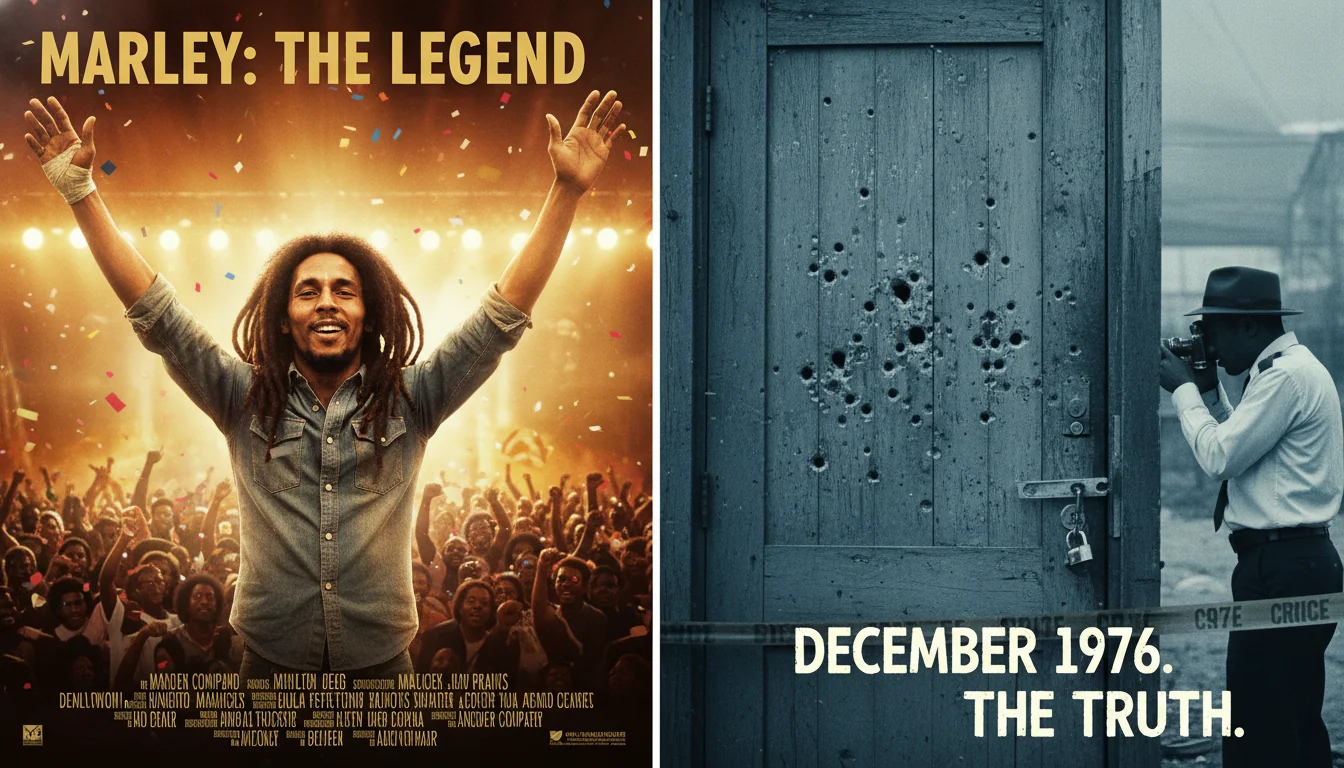
When a biopic is produced with the active cooperation of the subject's family, the viewer is entitled to a certain skepticism. Bob Marley: One Love, released in February 2024 and directed by Reinaldo Marcus Green, had Ziggy Marley as an executive producer and the full endorsement of the Marley estate. That context does not make it dishonest - the family has a legitimate interest in their father's legacy - but it does set limits on what the film is willing to examine.
Within those limits, One Love is a more careful piece of work than its critical reputation suggested. The broad arc of 1976 to 1977 - the assassination attempt, the Smile Jamaica concert, the exile to London, the Exodus album, and the cancer diagnosis in the toe - is rendered with reasonable fidelity to the documentary record. Where the film softens and where it compresses is worth examining, both because Marley's actual story is richer than the version on screen, and because the gaps reveal how hagiography operates even in the hands of competent filmmakers.
What Hollywood Got RIGHT
The assassination attempt
The film's most dramatic set piece is its most accurate. On December 3, 1976, two days before Marley was due to perform at the Smile Jamaica free concert in Kingston, seven armed men broke into his compound at 56 Hope Road. Marley was shot in the arm and chest. His manager Don Taylor was shot five times and survived critical surgery. His wife Rita Marley was shot in the head - the bullet lodged between her scalp and skull - and she survived.
The film depicts the attack accurately in its essential facts. The number and nature of the wounds, the chaos at the compound, the timing relative to the concert - all of it holds up. Two days later, on December 5, Marley took the stage at the National Heroes Park in Kingston with his arm bandaged, opened his shirt to show the crowd his wounds, and played for 90 minutes. The film shows this accurately, and it is still one of the most startling things any musician has ever done.
The exile and the London sessions
After the concert, Marley left Jamaica for the Bahamas, then relocated to London, where he settled into the recording sessions that would produce Exodus. The film correctly portrays this exile as both protective and creative - he was genuinely in danger, and London provided distance, creative latitude, and an audience that had been growing steadily through his earlier UK tours.
The recording of Exodus at Island Records' studio with the Wailers is handled accurately in its broad strokes. The album was recorded in 1976 and 1977 and released in June 1977. The film correctly shows Marley's close working relationship with his Island Records founder Chris Blackwell and the particular energy of the London sessions.
The cancer diagnosis
In July 1977, Marley injured his left big toe during a football match in Paris. When the wound did not heal, examination revealed amelanotic melanoma - an aggressive form of skin cancer that lacks the usual dark pigment and can be easily mistaken for a minor injury. The film shows this diagnosis, and it correctly shows Marley refusing amputation.
His refusal was not denial. Rastafarian faith holds that the body is a temple and that deliberate amputation violates its sanctity. Marley was a committed Rastafarian, and the decision was made on clearly religious grounds. Physicians told him that earlier amputation would likely have prevented the spread that eventually reached his brain and lungs. Marley knew this, accepted it, and refused anyway. That moral seriousness is something the film at least tries to convey.
Kingsley Ben-Adir's performance
The casting works. Ben-Adir is not Jamaican - he is British - but he builds something convincing from Marley's particular quality of gravity and warmth. Marley in real life was charismatic in the way that certain performers are charismatic: not through performance but through apparent sincerity, through the sense that what he was saying in his music was exactly what he believed. Ben-Adir gets close to that quality, which is harder than it sounds.
What Hollywood Got WRONG (or soft-pedaled)
The politics of 1976 Jamaica
This is the film's most serious failure. The Jamaica of 1976 was a specific and dangerous political landscape. Michael Manley's People's National Party government had moved leftward, developing close ties with Cuba. The opposition Jamaica Labour Party drew on different constituencies and a different Cold War alignment. The CIA had, by declassified accounts, been active in Jamaican politics, and the violence between PNP and JLP supporters in Kingston's garrison communities had claimed hundreds of lives in the mid-1970s.
The men who attacked 56 Hope Road were never formally identified or prosecuted. But the attack's timing, two days before a concert widely seen as PNP-adjacent, was not random. The political context is specific, documented, and genuinely complex.
The film gestures at all of this through atmosphere - the menacing Kingston streets, the implicit danger - but reduces it to a vague and impressionistic backdrop. Viewers who did not already know the details of Jamaican politics in 1976 would leave the cinema without knowing them. That is a significant omission in a film that wants to be taken seriously as biography.
Marley's personal life
Bob Marley had eleven confirmed children by seven women. His marriage to Rita was real, and by most accounts carried genuine affection and creative partnership alongside considerable complexity. The film centers the marriage sympathetically and skips almost everything that complicates it.
This is the predictable cost of family-controlled biography. The Marley estate has legitimate interests, and those interests do not include a nuanced examination of Marley's relationships with other women or the specific tensions of his marriage. The result is a portrait of domestic life that feels edited - not false in its details, but incomplete in ways that the viewer can sense.
The compressed and invented
The film's most clearly invented sequence involves Marley walking into a violence-torn Kingston neighborhood and, through the sheer force of his presence and music, de-escalating a confrontation between armed men from rival factions. The event is drawn, loosely, from the One Love Peace Concert of April 1978, a real event at which Marley brought Michael Manley and JLP leader Edward Seaga onto the stage and joined their hands. That moment actually happened and was genuinely remarkable.
The film relocates and dramatizes this into something more individual and more cinematic. The 1978 concert was a deliberate, organized event involving multiple parties. The film's version positions Marley as a spontaneous pacifying force, which is a different - and simpler - story than the real one.
The sound
Exodus is a great album. The film uses Marley's actual recordings, which is the correct choice, but the sequencing and context of specific songs is occasionally adjusted for narrative convenience. This is a small point - it is standard practice in music biopics - but it is worth noting that the album's real recording history is rich enough not to need rearranging.
The verdict: 6/10
Bob Marley: One Love is a careful, competent, and genuinely moving portrait of a specific two-year period in a remarkable life. The assassination attempt is handled with accuracy and weight. The Exodus sessions are given proper space. Kingsley Ben-Adir's performance earns the film considerable goodwill.
But the political context that made 1976 Jamaica one of the most volatile places in the Western Hemisphere is gestured at rather than examined. The personal complexity of Marley's life is smoothed over in exactly the ways a family-controlled production would smooth them. And the occasional invented set piece - particularly the confrontation scene - substitutes a mythological version of Marley for the more interesting documented one.
The actual story of Bob Marley walking onto a Kingston stage two days after being shot, in front of 80,000 people, and playing for 90 minutes with a bandaged arm - that story does not need improvement. It is already extraordinary. The film knows this and mostly lets it stand. Where it departs from the record, it tends to shrink rather than expand what Marley actually was.
For other music biopics measured against the historical record, see Back to Black vs. History and Bohemian Rhapsody vs. History.
Quick Answers
Common questions about this topic
Is Bob Marley: One Love based on a true story?
Yes. The film covers roughly 1976-1977 and is based on documented events in Bob Marley's life, including the assassination attempt at his Kingston home on December 3, 1976, his two-day recovery, his performance at the Smile Jamaica concert, his self-imposed exile to London, and the recording of the Exodus album. The film was produced with the cooperation and oversight of the Marley family, which shaped both its accuracy and its omissions.
Was Bob Marley really shot?
Yes. On December 3, 1976, seven armed men broke into Marley's compound at 56 Hope Road in Kingston, Jamaica, two days before he was due to perform at a government-backed free concert. Marley was shot in the arm and chest, though neither wound was life-threatening. His manager Don Taylor was shot five times and critically wounded. His wife Rita Marley was shot in the head and survived. Marley performed at the Smile Jamaica concert on December 5, visibly injured.
Did Bob Marley really have cancer in his foot?
Yes. In July 1977, Marley injured his left big toe during a football match in Paris. When the wound failed to heal, doctors in London diagnosed amelanotic melanoma, a particularly aggressive form of skin cancer. Physicians recommended amputation of the toe; Marley refused on religious grounds, as Rastafarian faith prohibits the mutilation of the body. The melanoma eventually spread, and Marley died in May 1981.
How accurate is One Love overall?
The film scores well on the broad sequence of events - the assassination attempt, the exile, Exodus, the cancer diagnosis - and Kingsley Ben-Adir's performance captures Marley's particular charisma convincingly. Where it falls short is in the political complexity of 1976 Jamaica, which the film reduces to atmospheric menace, and in its treatment of Marley's personal life, which the family's involvement predictably sanitized.

Debate the Accuracy with the Real Figures
Ask the real people what Hollywood got wrong about their lives.
Create your free account →No card required. Talk to anyone in history with 8 free credits a day. Some features require a paid plan.
Join the HistorIQly Club
Get smarter about the past.
Weekly stories, deep dives, and exclusive content straight to your inbox.