Philadelphia 1918 Flu: The Parade That Killed a City
The Philadelphia 1918 flu catastrophe began when the city marched 200,000 people down Broad Street against warnings, becoming one of the deadliest cities of the pandemic.
Read Wikipedia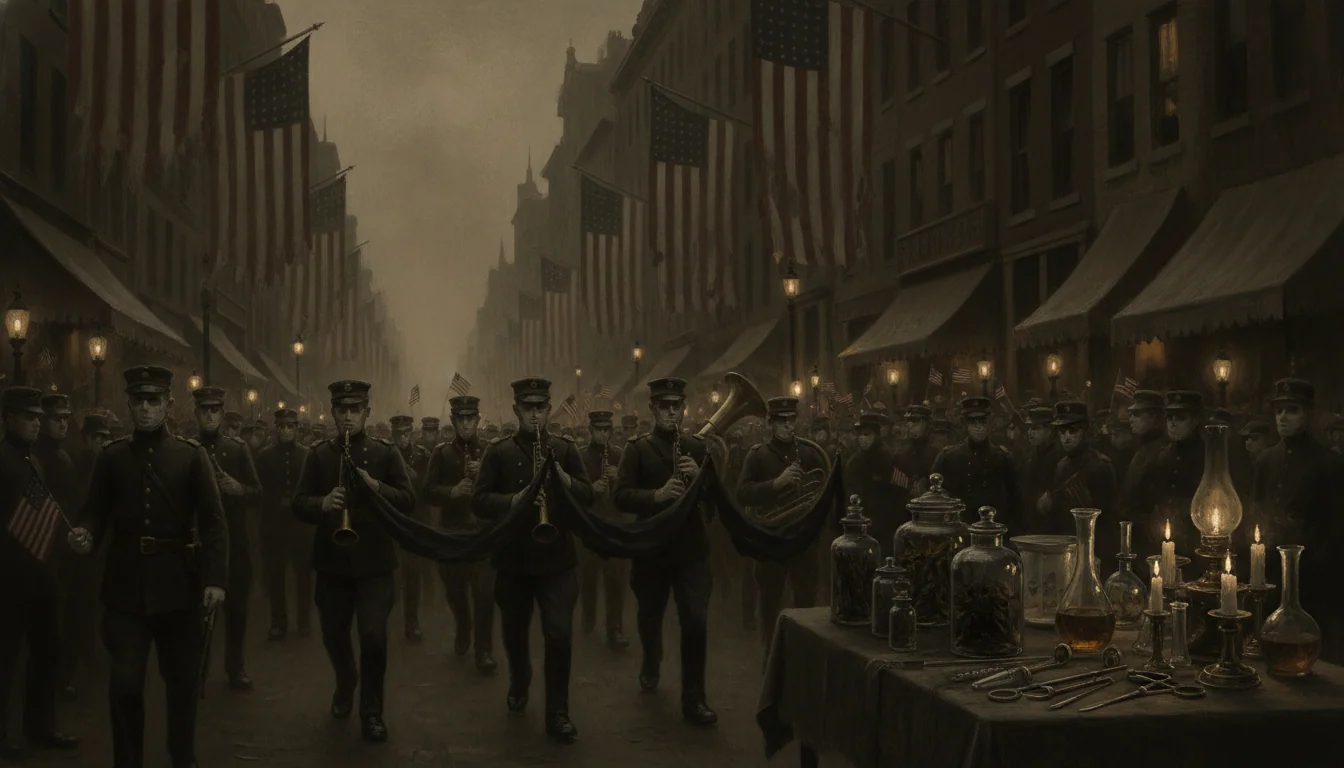
On September 28, 1918, an estimated 200,000 people packed both sides of Broad Street in Philadelphia to watch marching bands, sailors, Boy Scouts, and Liberty Loan floats parade for roughly two miles. Within days, the city's hospitals had no beds left, undertakers had no coffins left, and Philadelphia was recording more flu and pneumonia deaths per capita than almost any other city in the country. The parade did not cause the influenza pandemic of 1918. It did, however, turn the Philadelphia 1918 flu outbreak into one of the worst municipal disasters in American history, and it did so with city officials fully aware of the risk.
A war bond drive with a hidden guest
By September 1918, the disease now remembered as the Spanish flu had already been circulating in the United States for months, moving through military training camps and naval installations. It picked up its misleading nickname not because it started in Spain but because Spain, neutral in World War I, had no wartime press censorship. Spanish newspapers reported the outbreak openly while French, British, German, and American papers played it down to protect morale, leaving the false impression that Spain was the source.
Philadelphia had its own warning sign close at hand. Sailors at the Philadelphia Navy Yard began falling ill in mid-September, and by September 19 dozens were hospitalized with a severe, fast-moving respiratory illness. Wilmer Krusen, the city's director of public health, was told directly that the disease was spreading among the sailors and into the civilian population. He told the public it was ordinary influenza and assured reporters the outbreak was under control.
The city had a Fourth Liberty Loan parade already scheduled to sell government war bonds, a major event meant to draw enormous crowds and raise morale and money for the war effort. A local physician, Howard Anders, pressed Krusen and the press in the days beforehand to cancel or postpone the event, warning that packing hundreds of thousands of people shoulder to shoulder was an open invitation to the disease. Krusen refused. Canceling a patriotic bond parade in wartime, with the fighting in France not yet over, was politically unthinkable, and Krusen appears to have genuinely believed the illness was ordinary flu that posed no special danger.
The parade went ahead as planned, with bands, floats, and dense, cheering crowds for its full length down Broad Street. Spectators stood shoulder to shoulder for hours to watch the procession, and the enthusiasm of the crowd was, by every newspaper account, exactly what the city's bond drive organizers had hoped for. Within 72 hours, every hospital bed in the city was filled. Within a week, deaths were rising by the hundreds daily, and the same civic pride that had packed Broad Street now packed the city's overwhelmed wards.
What the era believed it was fighting
Philadelphia's doctors were not operating on primitive medical theory. Germ theory was well established by 1918, and physicians understood the disease was contagious and spread person to person, most likely through coughing and close contact. What they got wrong was the specific culprit. Many leading bacteriologists of the period, including some of the era's most respected researchers, believed the disease was caused by a bacterium then known as Pfeiffer's bacillus. That belief shaped a great deal of the medical response, from vaccine attempts to treatment choices, and it was mistaken. The actual cause was a virus, an organism far smaller than anything a 1918 laboratory microscope could resolve, and it would not be isolated and confirmed until influenza virus research matured in the following decades.
This gap mattered. Doctors could recommend quarantine and masks on sound epidemiological instinct, but they had no way to develop an effective vaccine or antiviral treatment against an enemy they could not see and had misidentified.
Gauze masks, whiskey, and dangerous doses of aspirin
Once the epidemic overwhelmed the city, Philadelphia's response was a scramble of supportive care rather than cure. Emergency hospitals were set up in armories and school buildings. Nuns, Boy Scouts, and off-duty nurses were pressed into service to nurse patients and collect the dead, since professional medical staff were stretched thin or ill themselves. Gauze masks were distributed and eventually required in some public settings, though their effectiveness against a virus that small was limited. Physicians prescribed whiskey, camphor, and quinine, none of which touched the underlying infection, and recommended fresh air and rest, which at least did no harm.
Aspirin was the most widely used treatment, and modern researchers have raised a troubling possibility about it. The standard dosing guidance circulating in 1918, including recommendations from the U.S. Surgeon General's office, called for doses that would be considered dangerously high by later medical standards. Some historians and physicians now argue that aspirin overdosing likely worsened outcomes for a meaningful share of patients, contributing to fluid buildup in the lungs that mimicked, and compounded, the viral pneumonia itself. This remains a hypothesis rather than settled fact, since teasing apart aspirin's contribution from the underlying disease a century later is difficult, but it illustrates how a well-intentioned standard treatment could have made a catastrophe worse.
Undertakers ran out of coffins within days. Bodies reportedly sat in homes for days awaiting burial because there was neither transport nor grave-digging capacity to keep pace, and the city eventually had to bring in help to dig mass graves with steam shovels. Priests and volunteers drove horse carts through affected neighborhoods collecting the dead, a scene closer to descriptions of medieval plague towns than to a modern American city only a generation removed from the automobile.
Schools, churches, theaters, and saloons across Philadelphia were finally ordered closed on October 3, 1918, five days after the parade and well after the epidemic had already taken hold. City officials framed the closures as a precaution rather than an admission that the parade had been a mistake, and public statements from Krusen's office continued for some time to minimize the scale of what was unfolding in the city's wards.
Blaming everyone but the parade
Every outbreak needs a scapegoat, and Philadelphia's was no exception. Public health officials and newspapers repeatedly pointed to the city's crowded immigrant and working-class tenement neighborhoods, framing the disease's spread there as a product of supposed filth and poor hygiene rather than acknowledging that a 200,000-person civic parade, held with official blessing, had done at least as much to seed infection across every neighborhood in the city. It's a pattern repeated elsewhere in this era, from radium companies that let the Radium Girls keep working around a poison they knew was dangerous, to a public health director who called a fast-spreading killer "ordinary influenza."
Wartime paranoia added a second scapegoat. Rumors circulated that the epidemic was a form of German biological sabotage, with some Americans whispering that German agents had poisoned aspirin supplies or released disease-carrying germs from a U-boat off the coast. None of this had any basis in fact, but it fit a wartime climate already primed to see enemy plots everywhere, and it conveniently redirected public anger away from the city officials who had staged the parade in the first place.
The comparison that outlived the war
Philadelphia's outbreak became famous for a second reason, decades later: it offered a stark contrast with St. Louis, which handled its own outbreak very differently. St. Louis's health commissioner, Max Starkloff, closed schools, churches, theaters, and other public gathering places within days of the city's first cases, well before the epidemic peaked. Philadelphia, by contrast, did not order similar closures until nearly a week after the parade, when the epidemic was already exploding.
The result was a substantial difference in outcomes. St. Louis's peak death rate from the epidemic came in well below Philadelphia's, and epidemiologists studying the 1918 pandemic decades later used the two cities as the textbook case for what early intervention, closing schools and banning large gatherings before an outbreak peaks, can achieve. That research became a direct reference point during the COVID-19 pandemic, when the phrase "flatten the curve" and comparisons to 1918's early versus late responders were repeated in health department briefings around the world. The underlying lesson, that mapping and swiftly cutting off a source can stop an epidemic in its tracks, echoes an even earlier public health breakthrough: John Snow's Broad Street cholera investigation in 1854 London.
Philadelphia's flu wave finally receded in November 1918, having run through roughly six weeks of catastrophic mortality, not because any treatment defeated it but because the belated closures slowed transmission somewhat and the virus eventually burned through much of the susceptible population. The city's overall death toll for the epidemic, spread across the following months, is commonly estimated in the range of 12,000 to 16,000, among the worst of any American city.
The Liberty Loan parade itself was, by the bond drive's own financial measure, a success. Philadelphia met its fundraising goal. It is remembered today not for that achievement but as a case study in what happens when a public health official chooses morale over caution, and a city pays the bill in the following weeks.
Quick Answers
Common questions about this topic
Why did Philadelphia hold the Liberty Loan parade despite flu warnings?
City officials, led by public health director Wilmer Krusen, needed the parade to sell war bonds and did not want to trigger panic or hurt morale during the final push of World War I. Krusen downplayed the flu cases already appearing among sailors as ordinary seasonal grippe and let the parade proceed on September 28, 1918, over the objections of at least one prominent local physician.
How many people died in Philadelphia's 1918 flu outbreak?
Estimates vary, but Philadelphia is generally counted as one of the hardest-hit American cities, with a death toll in the following months commonly put somewhere between 12,000 and 16,000. At the epidemic's peak in mid-October, some days reportedly brought several hundred deaths from influenza and pneumonia combined.
Who got blamed for the outbreak?
Crowded immigrant and working-class tenement neighborhoods were publicly blamed for spreading the disease through supposedly poor hygiene, even though the parade itself had drawn people from across the city. Wartime rumor also pinned the epidemic on German sabotage, including whispered claims that German agents had poisoned aspirin or released germs from a U-boat.
What finally slowed the epidemic in Philadelphia?
Belated closures of schools, churches, theaters, and saloons in early October helped, but the wave mostly ran its course over about six weeks as the virus burned through the susceptible population. The comparison to St. Louis, which closed public spaces before its outbreak peaked and recorded a much lower death rate, became the founding case study for what public health officials now call flattening the curve.

Consult the Physicians
Chat with the healers and survivors who lived through history's outbreaks.
Create your free account →No card required. Some figures and features require a paid plan.
Join the HistorIQly Club
Get smarter about the past.
Weekly stories, deep dives, and exclusive content straight to your inbox.