Blonde vs. History: How Accurate Is the Marilyn Monroe Drama?
Blonde 2022 accuracy, checked: Andrew Dominik's Ana de Armas biopic captures Monroe's childhood trauma but invents most of the Kennedy material from a novel, not fact.
Read Wikipedia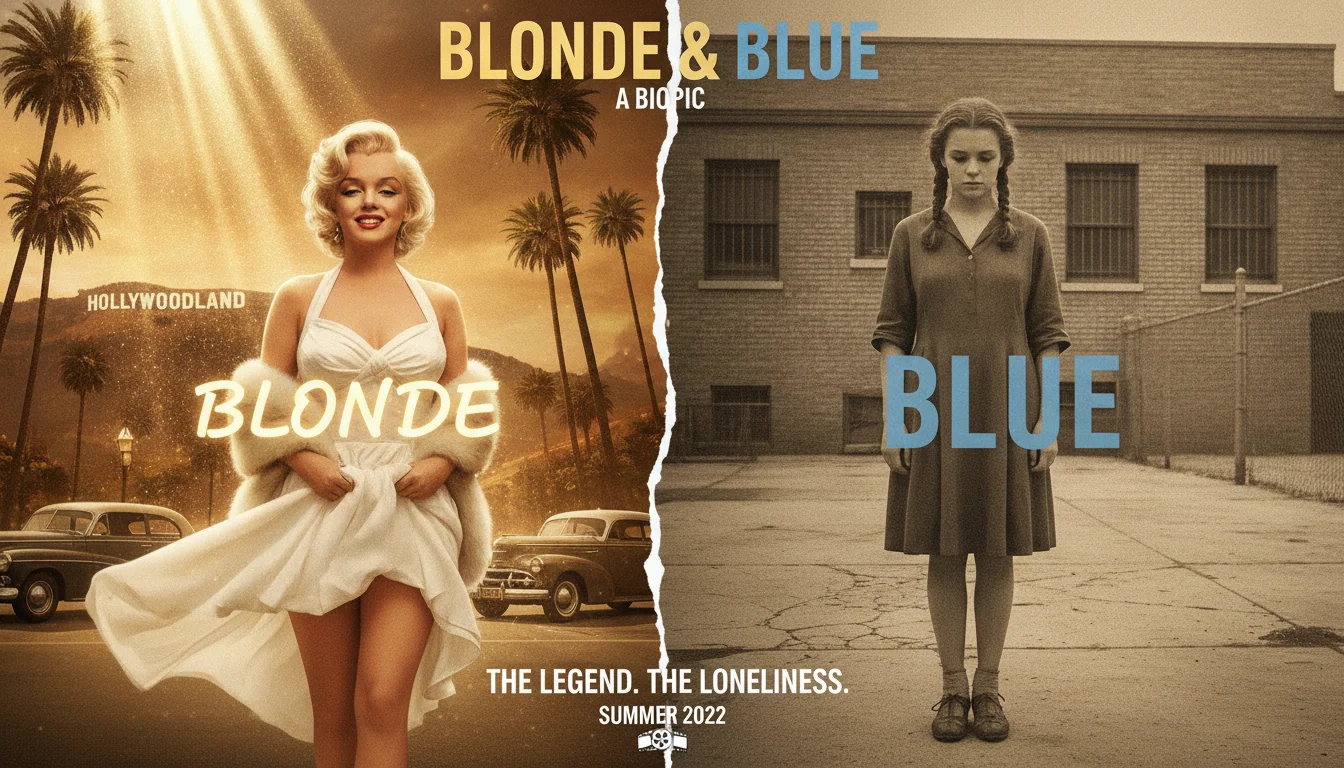
Andrew Dominik's Blonde arrived on Netflix in September 2022 with an NC-17 rating, a two-hour-and-forty-six-minute runtime, and a critical consensus so split it could have been reviewed as two different films. Defenders called it a harrowing piece of expressionist cinema. Critics called it exploitation dressed up as tragedy. Both camps agreed that Ana de Armas was extraordinary. Almost no one seemed to care that the film's relationship to actual history is tenuous at best and fabricated at worst.
That matters here.
Blonde is based on Joyce Carol Oates's 2000 novel of the same name, and the novel's own author has never claimed it as biography. It is fiction - licensed, imaginative, deliberately distorting fiction - and the film follows Oates rather than Monroe. The result is a portrait of a real woman built largely from invented scenes, invented dialogue, and invented psychology. How much of it tracks the historical record?
What Hollywood Got RIGHT
Monroe's childhood and institutional abandonment
Norma Jeane Mortenson was born in Los Angeles on June 1, 1926. Her mother, Gladys Pearl Baker, suffered from paranoid schizophrenia and was in and out of institutions for most of Monroe's childhood. Monroe spent years in the foster-care system and briefly in the Los Angeles Orphans Home. This factual backbone - that Monroe grew up without reliable parental care, that her mother was institutionalized, that she was passed between foster families - is well documented and the film depicts it accurately in broad strokes.
The psychological shadow this cast over her adult life is also credibly rendered. Numerous Monroe biographers, including Donald Spoto and Barbara Leaming, have traced her fear of abandonment, her desperate need for approval, and her complicated emotional relationships directly to this childhood. That the film treats this background as foundational is historically defensible.
The DiMaggio marriage and its violence
Monroe married baseball legend Joe DiMaggio on January 14, 1954. The marriage lasted nine months. DiMaggio was intensely jealous, controlling, and, by most credible accounts, physically abusive. The incident that accelerated the breakdown was real: DiMaggio witnessed Monroe filming the subway-grate sequence for The Seven Year Itch in September 1954, and the public spectacle of his wife's dress billowing for the cameras triggered a rage that witnesses described as alarming. Multiple contemporaries documented a physical confrontation that same night.
The divorce was finalized on October 27, 1954. The film's depiction of DiMaggio - his jealousy, his violence, his inability to separate Monroe's public image from his possession of her - is grounded in documented testimony. Bobby Cannavale's performance goes to extremes that even some sympathetic DiMaggio biographers would question, but the core characterization has historical backing.
Monroe's ambition for intellectual respect
One of the few dimensionalized truths in Blonde is Monroe's desire to be taken seriously as an actress and not merely as a commodity. She enrolled at the Actors Studio in New York in 1955 and studied under Lee Strasberg. She moved to New York partly to escape the studio system and reinvent her professional identity. She read widely, pursued relationships with writers and intellectuals, and pushed hard for roles that challenged her image.
She also co-founded Marilyn Monroe Productions with photographer Milton Greene in 1954 - a genuinely bold move for an actress of her era that forced 20th Century Fox to renegotiate her contract on substantially better terms. The film barely registers this entrepreneurial intelligence, which is one of its more significant distortions of the historical record, but her intellectual ambitions are at least acknowledged.
The dependency and the death
Monroe's growing reliance on barbiturates, particularly Nembutal, and on sleeping pills prescribed by multiple physicians is well documented across the final years of her life. Her death on the night of August 4-5, 1962, at her home in Brentwood, was officially ruled acute barbiturate poisoning. The film's depiction of her final months as a dissolution into dependency, isolation, and physical fragility is consistent with the testimonies of people who knew her during that period. Judy Garland, who came up through the same studio-system machinery a generation earlier, developed a comparable barbiturate dependency under MGM's watch, a parallel Judy vs. History explores in detail.
What Hollywood Got WRONG
The Kennedy relationship
This is where Blonde departs most dramatically from the historical record. The film presents Monroe's relationship with President Kennedy as central, extended, explicit, and degrading - a recurring sexual arrangement that Monroe experienced as both compelled and catastrophic.
The documented relationship between Monroe and the Kennedys is far thinner. Monroe performed "Happy Birthday, Mr. President" at the Madison Square Garden fundraiser on May 19, 1962, and she and Kennedy had some form of contact through his brother-in-law Peter Lawford's social circle. The extent of any private relationship is genuinely disputed by Monroe historians, with some arguing for a brief affair and others finding the evidence insufficient.
What Blonde depicts - the explicit scenes, the sense of Monroe as a sexual object in a long-running private arrangement - goes far beyond what any documented source establishes and follows Oates's novelistic invention rather than historical evidence.
The fabricated threesome relationship
One of the film's most unusual plot elements is Monroe's long romantic relationship with two men simultaneously, represented as composite fictional characters based loosely on Cass Chaplin and Eddy G. Robinson Jr. The film calls them the Gemini pair. This arrangement is Oates's invention and has no documentary basis in Monroe's actual biography. Monroe had many relationships, but this specific scenario is not drawn from the historical record.
The fetus speaking
The film includes scenes depicting Monroe's perspective from inside the womb and, more controversially, sequences in which a fetus speaks to Monroe in what appears to be a supernatural register of grief and accusation. This is entirely Oates's literary construction. It has no historical dimension whatsoever. Whether Monroe had miscarriages - which she apparently did, possibly more than one - is a documented historical question that the film treats as a launching pad for expressionist invention.
Monroe's agency, almost entirely erased
The most sustained historical distortion in Blonde is its treatment of Monroe as almost purely a passive victim of men, studios, and her own psychology. The historical Monroe was also a canny negotiator who extracted major contract concessions from one of the most powerful studios in Hollywood, co-founded her own production company before most male stars had done so, and leveraged her celebrity with deliberate intelligence.
Monroe biographer Lois Banner has argued at length that the "dumb blonde" self-presentation was a calculated performance and that Monroe was far more in control of her image than either the studios or most biographies have acknowledged. Blonde, built from a novel that Oates has described as excavating the mythological rather than the biographical Monroe, has no room for this woman.
The Arthur Miller characterization
The film's version of Arthur Miller - represented as "the Playwright" - depicts him as cold, intellectually condescending, and emotionally withholding. Their marriage (June 1956 to January 1961) was genuinely troubled, and Miller's 1964 play After the Fall, which many of Monroe's friends read as a betrayal, does suggest some of the distancing the film portrays. But Miller's own extensive writings about Monroe, and the testimonies of people close to both of them, present a far more complicated and reciprocal relationship than the film allows.
Blonde 2022 Accuracy Score: 2.5/10
Blonde is not a biography. Dominik has said as much, and the credits make clear the film derives from a novel. Judged as a work of historical fiction, it captures the emotional atmosphere of Monroe's vulnerability to the studio system and the cost of living as a cultural object. Judged as a source of information about who Marilyn Monroe actually was and what actually happened to her, it is unreliable at almost every specific turn.
What the film gets most right: Monroe's childhood, her complicated dependency on approval, and the broad outlines of her final years.
What it gets most wrong: the Kennedy material, the fabricated threesome relationship, and the near-total erasure of Monroe's considerable agency and professional shrewdness.
A viewer who watches Blonde and accepts it as biography will come away with a portrait that is wrong in most of its important details. That is a problem no amount of expressionist ambition fully solves.
For another musical-entertainment biopic that stretches its sources differently, see I Wanna Dance with Somebody vs. History, covering the Whitney Houston film's treatment of Clive Davis and Robyn Crawford.
Quick Answers
Common questions about this topic
Is Blonde based on a true story?
Blonde is based on Joyce Carol Oates's 2000 novel of the same name, which Oates explicitly described as a work of fiction inspired by Monroe's life. The film follows the novel, not the historical record. Many scenes, including the fetus-POV sequences, the threesome relationship, and most of the Kennedy material, are inventions of the novel with no documentary basis.
How accurate is Blonde 2022?
Blonde scores poorly as historical biography. It captures the broad arc of Monroe's life - troubled childhood, studio-system exploitation, abusive marriages, barbiturate dependency, and 1962 death - but systematically fictionalized or distorted the specific events, relationships, and timeline that historians and Monroe scholars have documented.
Did Marilyn Monroe have a relationship with JFK?
Monroe and President Kennedy did have some form of relationship, confirmed by the famous birthday performance at Madison Square Garden on May 19, 1962. The extent of any private relationship is disputed by historians. Blonde depicts the Kennedy relationship as explicit, central, and degrading - going far beyond what evidence supports and incorporating elements Oates invented for the novel.
What did Marilyn Monroe's estate think of Blonde?
Monroe's estate, through the Authentic Brands Group that controls her likeness, declined to endorse the film and publicly expressed concern about its content and tone. Several Monroe biographers also criticized the film for presenting a distorted, victimizing portrait of a woman who was, among other things, a shrewd businesswoman who challenged the studio system and co-founded her own production company.

Debate the Accuracy with the Real Figures
Ask the real people what Hollywood got wrong about their lives.
Create your free account →No card required. Some figures and features require a paid plan.
Join the HistorIQly Club
Get smarter about the past.
Weekly stories, deep dives, and exclusive content straight to your inbox.