Rush vs. History: How Accurate Is the Lauda-Hunt F1 Drama?
Rush movie accuracy, checked scene by scene: what Ron Howard's F1 drama about Niki Lauda and James Hunt got right, invented, and its final score.
Read Wikipedia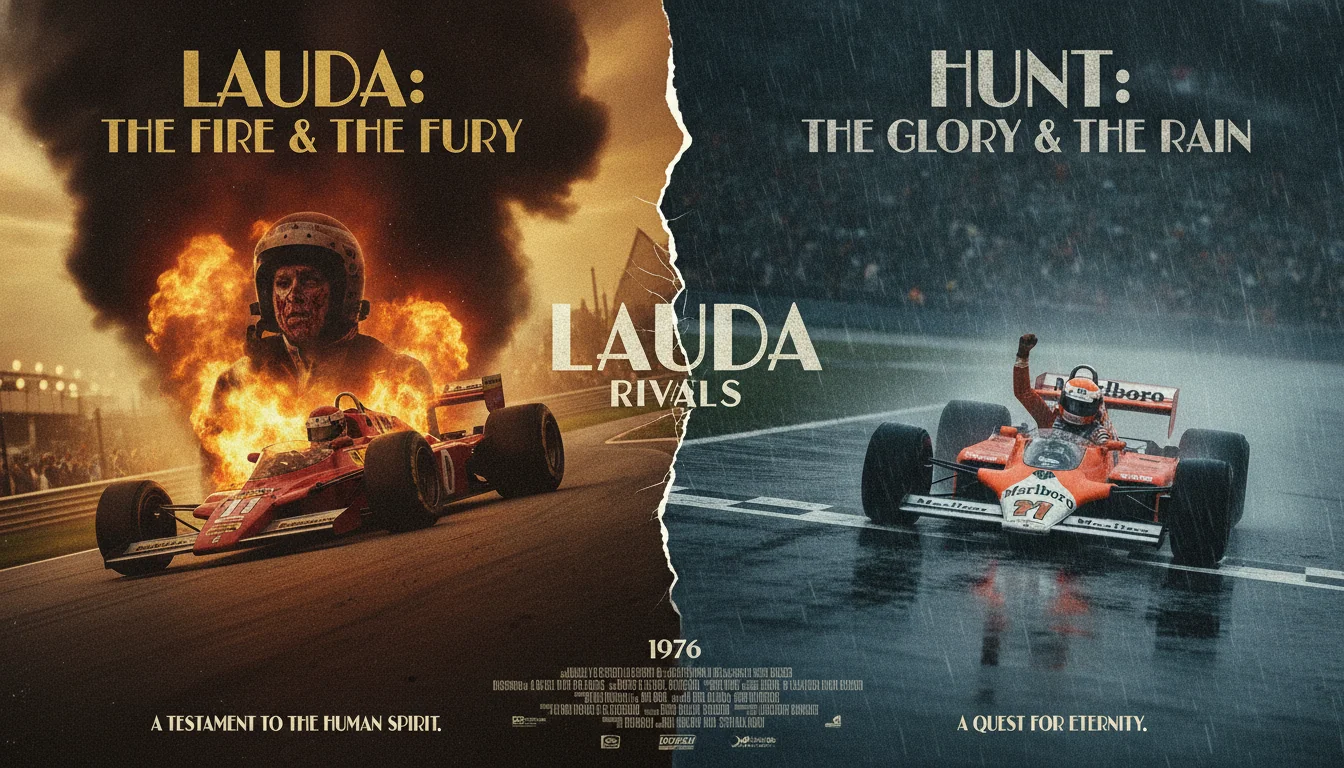
Ron Howard's Rush (2013) tells the story of the 1976 Formula One season, when Austrian driver Niki Lauda and British driver James Hunt fought for the World Championship in a year that included one of the most horrific and improbable comebacks in motorsport history. It is a film built around a real, well-documented sporting rivalry, which gives it an unusually solid factual spine for a Hollywood sports drama. It also takes real dramatic liberties with the psychology of both men and the texture of their relationship.
This Rush movie accuracy breakdown looks at how close the film comes to what actually happened on the track and off it.
What Hollywood Got RIGHT
The Nurburgring crash and its severity
The film's centerpiece, Lauda's crash at the Nurburgring Nordschleife on August 1, 1976, is grounded firmly in fact. Lauda's Ferrari 312T2 struck an embankment, burst into flames, and was then hit by another car. He was trapped in the burning wreckage for close to a minute before fellow drivers, including Arturo Merzario, pulled him free. He suffered severe burns to his face and scalp, and toxic fumes damaged his lungs badly enough that a priest administered last rites at the hospital. All of this is accurately reflected in the film, if visually intensified.
Lauda's return after six weeks
Perhaps the single most astonishing true fact in the film needs no embellishment: Lauda returned to competitive racing at the Italian Grand Prix just 40 days after the crash, his burns still raw and his face permanently scarred, wearing a modified helmet to protect his damaged ear. He finished fourth. The film captures both the physical horror of this decision and the sheer competitive will behind it without significant exaggeration.
The Nurburgring's danger, and its removal from the calendar
The film accurately conveys that the Nordschleife, a 14-mile circuit through the Eifel mountains, was widely regarded by drivers as too dangerous for modern Formula One cars, a track lined with insufficient barriers and minimal medical access along most of its length. Lauda himself had lobbied other drivers to boycott the circuit earlier that season over safety concerns, and after his crash, Formula One never returned to the full Nordschleife circuit for a championship race.
The Fuji finale and the single-point margin
The dramatic final race of the film, at Fuji Speedway in October 1976, torrential rain, Lauda withdrawing after two laps, and Hunt fighting through mechanical trouble to finish third and clinch the title by a single point, matches the historical record closely. Hunt's tires and fuel situation in the closing laps were as tense as depicted, and the final championship margin genuinely came down to one point, 69 to 68.
Hunt's playboy reputation
James Hunt's off-track reputation, heavy partying, numerous relationships, and a famously loose relationship with training discipline, was well documented by contemporaries and journalists of the era. Hunt himself never disputed the broad strokes of this image, and Chris Hemsworth's portrayal, while stylized, draws on real accounts from Hunt's teammates, girlfriends, and the racing press of the 1970s.
What Hollywood Got WRONG
The intensity of the personal feud
The film's dramatic engine is a bitter, almost personal rivalry between Hunt and Lauda, complete with public taunting and visible contempt. In reality, the two men were genuinely friendly, dating back to their days racing in Formula Three in the early 1970s, when Hunt reportedly lived for a period in a camper van and Lauda occasionally lent him money. Their competitiveness on track was real, but off track their relationship was closer to mutual respect between two very different personalities than the antagonism the film dramatizes. Lauda himself, who consulted on the production, later said publicly that the friendship was underplayed for the sake of narrative tension, even while praising the film's overall spirit.
Lauda's personality is flattened into pure calculation
The film leans hard into a contrast between Hunt's charisma and Lauda's cold, clinical rationality, to the point of nicknaming him "the Rat" for his prominent front teeth, a nickname that was real but is used in the film to reinforce an unflattering caricature. The real Lauda was sharp-tongued, dryly funny, and by most accounts more socially engaged than the film's austere, calculating version suggests. His decision to withdraw at Fuji, framed in the film primarily as pure risk calculation, was also influenced by a documented conversation with his wife and genuine fear following the crash, a more human motivation than the film's chess-move framing implies.
Marlene Lauda's role is compressed
Niki Lauda's wife, Marlene, appears in the film primarily as a supportive presence reacting to her husband's decisions. In life, she was reportedly a more active influence on Lauda's outlook during his recovery and his decision-making about risk, though detailed public accounts of her exact role remain limited since the couple largely kept their private life away from the press.
Some race sequences are compressed or reordered
As with most sports films covering a full season in under two hours, several races are compressed, reordered, or given more narrative weight than they carried at the time. The film's treatment of the mid-season races blurs together events that unfolded over months into a tighter dramatic arc, standard practice for the genre but a departure from the literal season calendar.
Hunt's championship-winning car controversy is simplified
Hunt's title was briefly complicated in real life by a post-race disqualification earlier in the 1976 season over a technical infringement at the Spanish Grand Prix, later overturned on appeal, a bureaucratic subplot that added real tension to the standings throughout the year. The film mostly omits this appeals process, streamlining the championship math for clarity.
Historical Accuracy Score: 7.5/10
Rush gets the two career-defining events of 1976, Lauda's crash and comeback and the Fuji title decider, right in their essential facts, and it correctly conveys the physical stakes and improbability of Lauda's return. Where it takes liberties is almost entirely in the emotional register of the Hunt-Lauda relationship, compressing a genuine friendship between two contrasting personalities into a more conventional rivals-turned-respectful-adversaries arc that plays better as drama than it reflects the historical record.
What the film gets most right: the crash, the recovery, and the specific, almost unbelievable stakes of the 1976 championship.
What it gets most wrong: the depth of personal animosity between the two drivers, who were closer friends than the film ever quite admits.
Lauda's own verdict, given in interviews after the film's release, was that Rush captured the spirit of that season even where it took liberties with the details, a rare endorsement from a subject notoriously unsentimental about his own legend. For a sport this dangerous and a season this dramatic, Hollywood barely needed to invent anything at all.
For another motorsport story built on the same era of Formula One racing, see our accuracy check on Ferrari, which covers Enzo Ferrari's team a generation before Lauda drove for it. For another film about an athlete's improbable comeback against impossible odds, see our accuracy check on Nyad.
The wider 1976 season the film leaves out
Rush compresses an entire Formula One calendar into a two-hour runtime, and the races it skips are worth knowing about for context. The 1976 season included sixteen rounds across four continents, run on a mix of purpose-built circuits and closed public roads, at a time when driver safety standards lagged badly behind the speeds the cars were capable of reaching. Several drivers besides Lauda were seriously injured or killed across the decade, a grim backdrop the film gestures at through Hunt and Lauda's own conversations about mortality but does not dramatize directly.
The McLaren and Ferrari teams that Hunt and Lauda drove for were also locked in a broader engineering and political rivalry that extended well beyond the two lead drivers, involving team principals, sponsors, and constructors' championship points that carried their own separate stakes. The film, by design, narrows this sprawling institutional contest down to a two-man story, which is dramatically effective but leaves out just how many people and how much money were riding on a rivalry the film frames as almost personal.
Both men's careers after 1976 also diverge from where the film leaves them. Lauda won two more world championships, in 1977 and 1984, the second coming after a brief retirement and comeback with McLaren, a second improbable return that the film does not cover. Hunt retired from racing in 1979, moved into broadcasting as a commentator for the BBC, and died of a heart attack in 1993 at age 45. Lauda went on to found two airlines and remained a fixture in Formula One as a team principal and television analyst until his death in 2019, a life arguably stranger and more eventful than the single season the film chooses to tell.
Quick Answers
Common questions about this topic
Is Rush based on a true story?
Yes. Rush dramatizes the real 1976 Formula One World Championship, in which Niki Lauda and James Hunt fought for the title after Lauda survived a near-fatal fiery crash at the Nurburgring and returned to racing just six weeks later. Director Ron Howard and screenwriter Peter Morgan drew on interviews, race footage, and both drivers' own accounts.
How accurate is Niki Lauda's crash in Rush?
The Nurburgring crash on August 1, 1976 is depicted with reasonable fidelity to the public record: Lauda's Ferrari struck a barrier, burst into flames, and he was trapped in the wreckage for roughly a minute before being pulled free by fellow drivers. His lungs were damaged by toxic fumes and he received last rites. The film keeps the sequence of events but heightens the visual drama for cinematic effect.
Were James Hunt and Niki Lauda really friends?
They were genuine friends off the track, going back to their Formula Three days, though the film exaggerates the intensity of their personal rivalry for dramatic effect. Both men later confirmed a real mutual respect, and Lauda personally consulted on the film and praised its portrayal of their relationship as more true than false.
Who won the 1976 F1 championship?
James Hunt won the title by a single point at the season's final race in Fuji, Japan, after Lauda withdrew partway through in heavy rain, judging the conditions too dangerous just weeks after his crash. Lauda finished third at Fuji, enough for Hunt to overtake him in the standings by exactly one point.

Debate the Accuracy with the Real Figures
Ask the real people what Hollywood got wrong about their lives.
Create your free account →No card required. Some figures and features require a paid plan.
Join the HistorIQly Club
Get smarter about the past.
Weekly stories, deep dives, and exclusive content straight to your inbox.