Golda vs. History: How Accurate Is the Yom Kippur War Drama?
Golda 2023 accuracy, checked: the Yom Kippur War drama gets the intelligence failure and Meir's hidden cancer right, but softens her wartime culpability.
Read Wikipedia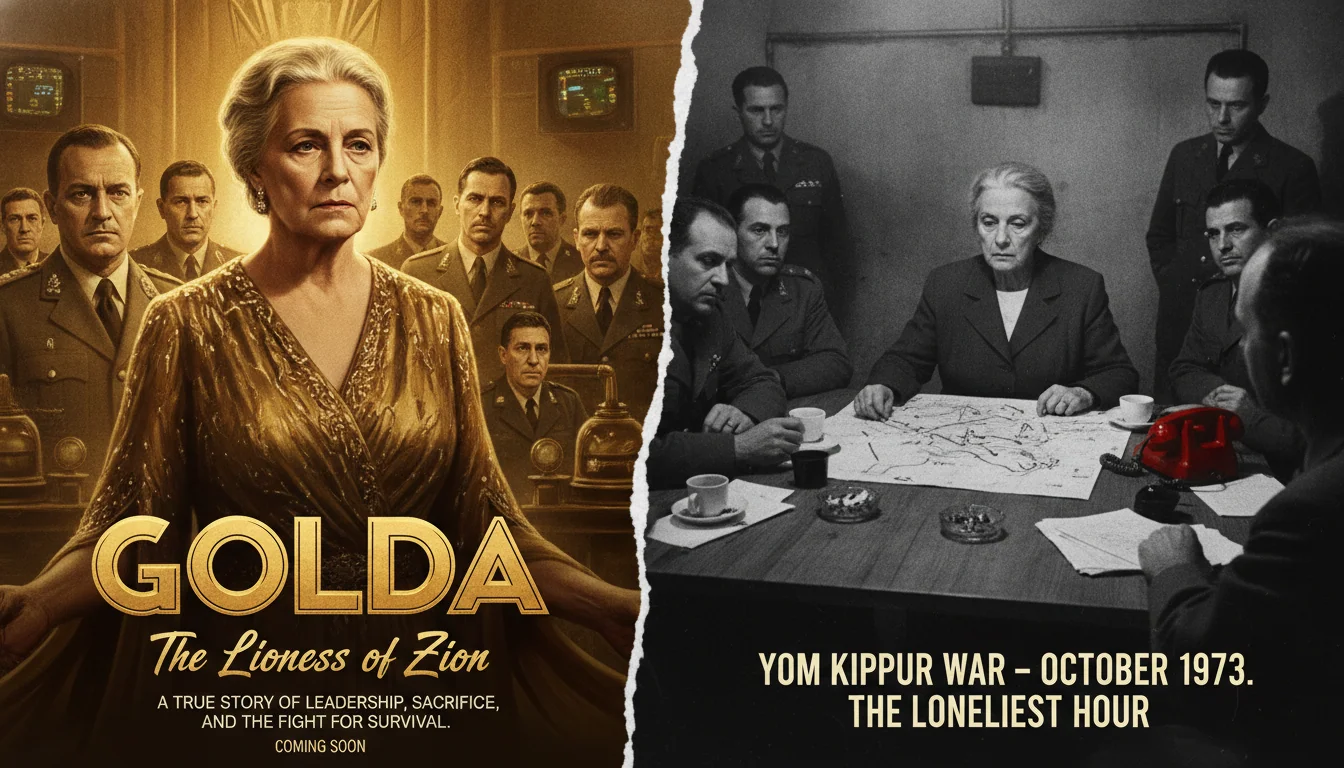
The 2023 biographical film Golda, directed by Guy Nattiv and starring Helen Mirren under layers of prosthetic makeup, confines itself deliberately to a narrow 19-day window: the Yom Kippur War of October 1973. No childhood, no political rise, no Six-Day War. Just the crisis, the war room, the aging woman with cancer who had to decide whether Israel would survive.
That disciplined focus makes the film easier to fact-check than most biopics. There are documents, declassified files, memoirs from every major figure, and the findings of the Agranat Commission, which investigated the intelligence failure afterward. So how does Golda hold up?
Historical accuracy: 7 out of 10.
What Hollywood Got RIGHT
The Concept and the intelligence failure
The film's most significant historical contribution is its honest depiction of haKontseptzia, the intelligence theory that led Israel to be blindsided on October 6, 1973. Israeli military intelligence had concluded that Egypt would not attack until it could destroy Israel's air superiority, and that Syria would not move without Egypt. Both assumptions were wrong in exactly the way the film shows.
The attack came at 2 p.m. on Yom Kippur, the holiest day in the Jewish calendar, from both directions simultaneously. The southern Suez Canal crossings and the northern Golan Heights were hit at once. The film accurately captures the paralysis in the war room as commanders realized the model they had built their defense around had simply failed.
Warnings had come. A CIA source, later identified as Egyptian president Anwar Sadat's advisor, had signaled an attack was imminent. Jordan's King Hussein had personally warned Meir. The film shows those warnings being discounted, which is historically accurate. The failure was not a lack of intelligence; it was a failure of interpretation shaped by institutional confidence in an incorrect theory. For another film covering how Israel's leadership responded to a national crisis in this same era, see Munich vs. History, on the aftermath of the 1972 Olympics massacre.
Golda Meir's health
The film makes Meir's lymphoma central to its visual and dramatic texture. This is accurate. She was diagnosed with non-Hodgkin's lymphoma in 1973 and kept her illness completely secret during the war. The chemotherapy sessions, the exhaustion, the careful management of her appearance - all of it was real. Meir did not publicly disclose her illness until 1976, years after resigning as Prime Minister.
Moshe Dayan's despair
The scene in the film where Defense Minister Moshe Dayan tells Meir that "the Third Temple is falling" is historically documented. In the opening days of the war, as Israeli tank and aircraft losses mounted at alarming rates, Dayan's confidence collapsed. He reportedly appeared on Israeli television looking shattered. The film's portrayal of Dayan as a man oscillating between despair and partial recovery matches the historical record.
The nuclear dimension
The film depicts, with deliberate ambiguity, Israel preparing to arm nuclear warheads during the most dangerous hours of the war. This element is grounded in serious historical reporting. American intelligence detected unusual activity at Israeli nuclear sites during the October 1973 crisis, and declassified US documents suggest Secretary of Defense James Schlesinger was aware of the possibility. Seymour Hersh's 1991 book The Samson Option, which documented Israel's nuclear weapons program in substantial detail, described the October 1973 episode as the closest Israel came to actual deployment. The film does not overstate this; it leaves the sequence incomplete, which is the appropriate level of uncertainty given that Israel has never confirmed its nuclear program and no official Israeli source has ever acknowledged what happened in those days.
Kissinger's centrality
Liev Schreiber's portrayal of Henry Kissinger as the indispensable intermediary between Israel and the United States is historically sound. Kissinger, then serving simultaneously as National Security Advisor and Secretary of State, managed both the US airlift of military supplies to Israel and the eventual ceasefire negotiations. His role was enormous. The film's depiction of him as a man who was simultaneously sympathetic to Israeli survival and focused on broader Cold War positioning reflects the historical complexity well.
What Hollywood Got WRONG
The airlift delay
One point the film soft-pedals is Kissinger's role in initially delaying the US military airlift to Israel. In the opening days of the war, the Nixon administration took several days to begin significant resupply, partly due to Kissinger's concern about Soviet reactions and European sensitivities. Israeli historians have argued that this delay cost lives and territory in the critical early phase. The film presents Kissinger as more immediately supportive than the full historical record suggests, which tilts the portrayal slightly in his favor. (For more on how the Nixon administration's inner workings have been dramatized on screen, see Frost/Nixon vs. History.)
Golda's pre-war accountability
The film is sympathetic to Meir in a way that several Israeli historians have found unsatisfying. She had received warnings about Egyptian and Syrian preparations in the weeks before the attack. She had the power to order a preemptive strike - as Israel had done successfully in 1967 - and declined to do so, partly from concern about international opinion and partly because she trusted the Concept.
The Agranat Commission, which investigated the war's failures, concluded that the primary responsibility lay with the military intelligence directorate rather than with Meir herself. But Israeli historians have subsequently argued that political responsibility should have reached higher. The film largely follows the commission's framing, presenting Meir as a leader who inherited bad intelligence rather than one who contributed to the failure. That framing is contested.
The Agranat Commission's aftermath
The film ends, essentially, with the ceasefire. What followed is skipped almost entirely. Meir resigned as Prime Minister in April 1974, less than a year after the war, under intense political pressure from the Israeli public. The country was traumatized by the near-catastrophe and held its leaders accountable in ways that the film does not depict. Showing Mirren's Meir only inside the crisis removes the reckoning that historically followed it.
Ariel Sharon
The general who arguably turned the military tide of the war - Ariel Sharon, commanding a reserve armored division on the southern front - barely registers in the film. Sharon's controversial decision to push his forces across the Suez Canal and encircle the Egyptian Third Army was the move that gave Israel the leverage to negotiate from a position of strength. His relationship with the Israeli government during the war was deeply contentious: Sharon ignored direct orders on at least one occasion to consolidate his bridgehead before it was fully authorized, acting on his own judgment about the strategic opportunity. He was right, and it probably saved Israel from a worse ceasefire. The film's decision to focus tightly on the war room means the actual turning of the battlefield - and the man most responsible for it - happens largely off-screen.
Golda 2023 Accuracy: The Verdict
Golda is a serious, carefully researched film about a genuinely difficult historical moment. Its accuracy on the broad mechanics - the intelligence failure, the opening crisis, Kissinger's role, the nuclear uncertainty, Meir's health - is solid. Its sympathetic portrayal of Meir is defensible but not the only defensible position. And its decision to end before the political consequences of the war arrived makes it a more comfortable portrait than the history fully allows.
Helen Mirren is exceptional in the role. The film respects the intelligence of its subject. It just respects Golda Meir's reputation slightly more than the historical record strictly requires.
Score: 7/10.
Quick Answers
Common questions about this topic
How accurate is the 2023 Golda film?
Golda is reasonably accurate on the broad mechanics of the Yom Kippur War: the intelligence failure, Meir's cancer, Dayan's early despair, and Kissinger's centrality to the ceasefire. It is criticized, primarily by Israeli historians and critics, for being too sympathetic to Meir and not fully reckoning with her pre-war failures. We rate it 7/10 for accuracy.
Did Golda Meir really have cancer during the Yom Kippur War?
Yes. Golda Meir was diagnosed with lymphoma - specifically non-Hodgkin's lymphoma - in 1973 and kept her illness entirely secret during the war. She received chemotherapy treatments while serving as Prime Minister. The film accurately depicts her declining health as a backdrop to the crisis.
What was the Israeli intelligence failure the film refers to?
Israeli military intelligence had developed what became known as haKontseptzia - the Concept - a theory that Egypt would not attack Israel until its air force could neutralize the Israeli air force, and that Syria would not attack without Egypt. Both premises were wrong. The October 1973 attack caught Israel almost completely off guard, and the film accurately portrays this as the central catastrophe at the start of the war.
What did Moshe Dayan mean by the Third Temple?
In the opening days of the Yom Kippur War, as Israeli defenses were being overwhelmed on two fronts, Defense Minister Moshe Dayan reportedly told Golda Meir that 'the Third Temple is falling,' a reference to the biblical destructions of the Jerusalem Temple. It indicated how seriously Dayan believed the situation threatened Israel's survival. The remark is historically documented and appears in the film.

Debate the Accuracy with the Real Figures
Ask the real people what Hollywood got wrong about their lives.
Create your free account →No card required. Some figures and features require a paid plan.
Join the HistorIQly Club
Get smarter about the past.
Weekly stories, deep dives, and exclusive content straight to your inbox.