No, Custer's 'Last Stand' Wasn't Heroic: What the Battlefield Evidence Actually Shows
The 'Last Stand' painting shows a slow, heroic siege. Cartridge case mapping and Native American accounts show a fast, chaotic collapse instead.
Read Wikipedia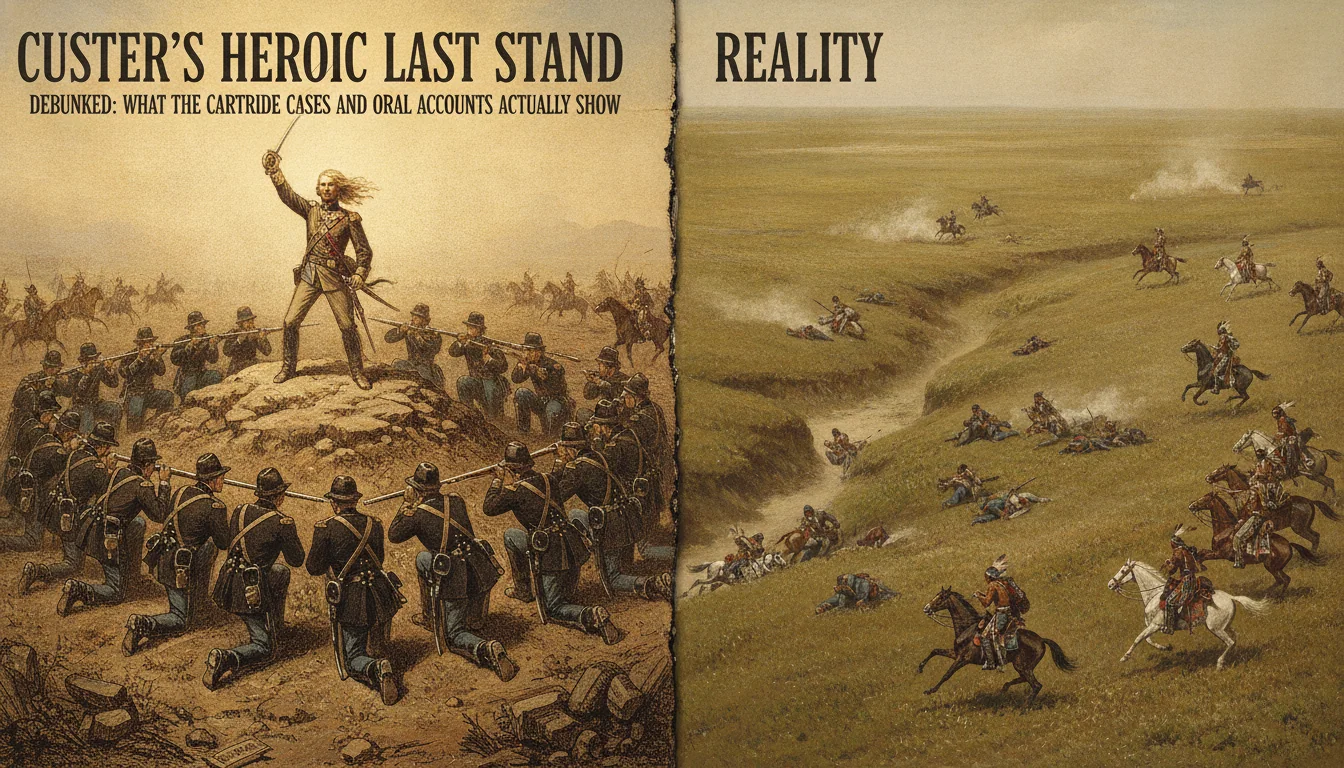
Picture the painting. It hung in saloons across the country for decades: George Armstrong Custer standing tall at the center of a shrinking circle, saber raised, golden hair catching the light, his men firing outward in a tight ring against a sea of mounted warriors. They know they are going to die, and they are dying anyway, gloriously, to the last man. That image, not the actual battlefield, is what most Americans mean when they say "Custer's Last Stand." The trouble is that the ground itself, read carefully by archaeologists a century later, tells a very different and far less orderly story.
The myth, stated fairly
The popular version goes like this: on June 25, 1876, Custer led roughly 210 troopers of the 7th Cavalry onto a hilltop above the Little Bighorn River, dismounted, and organized a disciplined defensive perimeter against a Native American force that vastly outnumbered them. Surrounded on all sides, the soldiers supposedly fought for hours, shooting their horses for breastworks, holding the line company by company, buying time with their own blood until the last of them fell where they stood. It is a story of discipline under impossible pressure, a doomed but dignified defense, the cavalry equivalent of Thermopylae. Given who was leading them, that reading was not absurd on its face. Custer had been a genuine Civil War prodigy, a brevet major general by twenty-five, a man with a real record of aggressive, sometimes reckless competence. A soldier with that resume, the thinking went, does not simply fall apart. He organizes a defense.
Why it is so believable
The myth stuck for reasons that have nothing to do with dishonesty. Every single man in Custer's immediate battalion, about 210 soldiers, died on that field. There were no survivors from his command to contradict the story, which meant that for decades nobody who had actually stood in that circle could say what really happened. The only voices left belonged to Marcus Reno and Frederick Benteen, who commanded separate battalions miles away and never saw Custer's final fight at all, and to the Lakota, Cheyenne, and Arapaho fighters who won it, whose testimony white historians spent the better part of a century declining to take seriously.
Into that vacuum stepped a genuinely tireless advocate: Custer's widow, Elizabeth Bacon Custer, who outlived him by 57 years and spent much of that time writing and lecturing to protect his name. Her books, including "Boots and Saddles" in 1885 and "Following the Guidon" in 1890, painted her husband as a gallant, wronged hero, and her public campaigning made criticizing Custer socially costly for a very long time. Commerce did the rest. In 1896, the Anheuser-Busch brewing company distributed a chromolithograph titled "Custer's Last Fight," adapted by Otto Becker from an earlier painting, to thousands of saloons nationwide, putting the heroic circle in front of millions of eyes who would never read a history book on the subject. Buffalo Bill Cody's Wild West show restaged the battle for live audiences for years. A story that starts as an unfalsifiable gap in the record and then gets reinforced by a beer company and a traveling circus has every advantage a myth could ask for.
Where it actually came from, and how it spread
The legend was already forming within days. Newspapers broke the news of the defeat in early July 1876, during the United States Centennial summer, and editors reached instinctively for the vocabulary of martyrdom rather than military error. A national audience primed to celebrate a hundred years of American triumph did not want to read that its most famous living cavalry officer had walked his men into a trap through overconfidence. It wanted a sacrifice. From there the story moved through exactly the channels you would expect for the era: dime novels that turned Custer into a recurring pulp hero, popular illustrated histories, the Anheuser-Busch lithograph on barroom walls, Wild West show reenactments, and eventually early Western films that inherited the same tidy, circled-wagon staging without much interest in reexamining it.
What the primary sources actually show
For most of the twentieth century, the myth had no serious physical evidence to contend with, because the Custer battlefield's surface had never been systematically surveyed. That changed by accident. A grass fire swept across the site in August 1983, stripping away a century of vegetation and exposing the ground itself for the first time in living memory. The National Park Service brought in archaeologists Richard Fox and Douglas Scott, who led metal-detecting surveys across the field in 1984 and 1985, recovering and precisely mapping thousands of cartridge cases and bullets. Because individual firearms leave distinctive marks on the shells they fire, the team could trace specific weapons as they moved across the landscape, essentially reconstructing where individual soldiers and warriors stood, moved, and died.
What the map showed was not a single tight ring of defenders. It showed scattered, disconnected clusters of spent cartridges strung out across ridgelines and down into ravines, consistent with small groups of men making brief, isolated stands, being overrun, and then having the fight roll on to the next knot of soldiers rather than one unified perimeter holding for hours. The named terrain features that mark the battlefield today, Calhoun Hill, the Keogh sector, and Last Stand Hill itself where the visitor center now stands, correspond to distinct clusters where different companies appear to have fallen at different points in the fight rather than one continuous line. Skeletal remains recovered during the same period showed trauma patterns that researchers have linked to men shot while moving or grouped in ones and twos rather than fighting from fixed, prepared positions. Fox and Scott, along with later researchers who have built on their work, describe a battle that likely collapsed in a cascading sequence, moving roughly from south to north across the ridge, rather than a coordinated last defense held in one place.
Native American oral testimony had been saying something close to this for a hundred years, largely without a receptive audience among white historians. Cheyenne and Lakota participants interviewed in the decades after the battle, including accounts later gathered and published from figures such as Wooden Leg, Two Moons, and Kate Bighead, described a fight that moved fast: soldiers dismounting in confusion, horses bolting with ammunition still in the saddlebags, groups of troopers breaking and running toward the river rather than holding ground, and warriors closing in on foot and horseback as the soldiers' formation came apart. These accounts vary in detail, as eyewitness testimony collected years later from a chaotic, fast-moving fight naturally does, and historians continue to debate exactly how to reconcile some of the differences between them. But their broad shape, a rapid collapse rather than a grinding siege, lines up closely with what the cartridge mapping later confirmed independently.
What is true instead
None of this erases the courage of individual soldiers who almost certainly did fight hard in isolated pockets before they died. But the "last stand" as popularly imagined, a unified, hours-long defensive siege, does not match the physical record. What actually happened looks more like a rapid tactical collapse brought on by decisions Custer made before the shooting even started. He split his roughly 600-man regiment into detachments under himself, Reno, and Benteen, weakening each individually, then sent his trumpeter Giovanni Martini back with a scrawled note for Benteen that survives today: "Come on. Big village, be quick, bring packs." It is the closest thing to a message from inside the collapse, and it reads like a man who already sensed the situation was worse than planned. Reno's battalion had already been thrown back across the river in disorder, and Benteen, delayed and cautious, never reached Custer's field before the fighting there was finished, leaving roughly 210 men to face the encampment alone. Custer also seems to have badly underestimated the size of the encampment along the Little Bighorn, which held perhaps 7,000 to 10,000 people, including a warrior force in the range of a thousand or more led in the field by figures like Crazy Horse and Gall, while Sitting Bull, the camp's most influential spiritual leader, remained in the village rather than fighting directly. Once Custer's battalion was engaged, exactly how the final minutes unfolded, and how long they lasted, remains genuinely debated among historians. Some archaeological and testimonial reconstructions suggest the fighting on the Custer field itself may have run under an hour once fully joined, dramatically shorter than the multi-hour siege of legend, though estimates differ and the fog of a fast, dusty, close-range fight makes precision difficult even now. What is not seriously disputed anymore is the shape of the thing: not a slow, glorious siege, but a fast, disorganized rout that overtook men who had badly misjudged what they were riding into.
Quick Answers
Common questions about this topic
Is it true that Custer made a heroic last stand?
Not in the way the legend describes. Cartridge case mapping from the 1980s and Native American oral accounts both point to a fast, disorganized collapse rather than a coordinated, hours-long defensive siege. Individual soldiers likely fought hard in scattered pockets, but there was no unified last-stand perimeter.
Where did the myth come from?
It grew from 1876 newspaper coverage during the US Centennial, decades of advocacy from Custer's widow Elizabeth Bacon Custer, and commercial promotion, especially the Anheuser-Busch 'Custer's Last Fight' lithograph distributed to saloons nationwide and Buffalo Bill Cody's Wild West show reenactments.
What really happened at Little Bighorn?
Custer split his roughly 600-man 7th Cavalry into three battalions and appears to have badly underestimated the size of the Lakota, Northern Cheyenne, and Arapaho encampment. His isolated battalion of about 210 men was overrun in a cascading collapse across the ridge, not a single organized defense.
How long did the battle actually last?
The exact duration is genuinely debated. Some archaeological and testimonial reconstructions suggest the fighting on Custer's own field may have run under an hour once fully engaged, far shorter than the multi-hour siege of popular legend, though estimates vary and the chaos of the fight makes precision difficult.

Ask What Really Happened
Chat with the figures behind the myths everyone still believes.
Create your free account →No card required. Talk to anyone in history with 8 free credits a day. Some features require a paid plan.
Join the HistorIQly Club
Get smarter about the past.
Weekly stories, deep dives, and exclusive content straight to your inbox.