Debunked: Napoleon Was Not Actually Short
Was Napoleon short? His reputation comes from a mixed-up unit of measurement. His actual autopsy records tell a very different story.
Read Wikipedia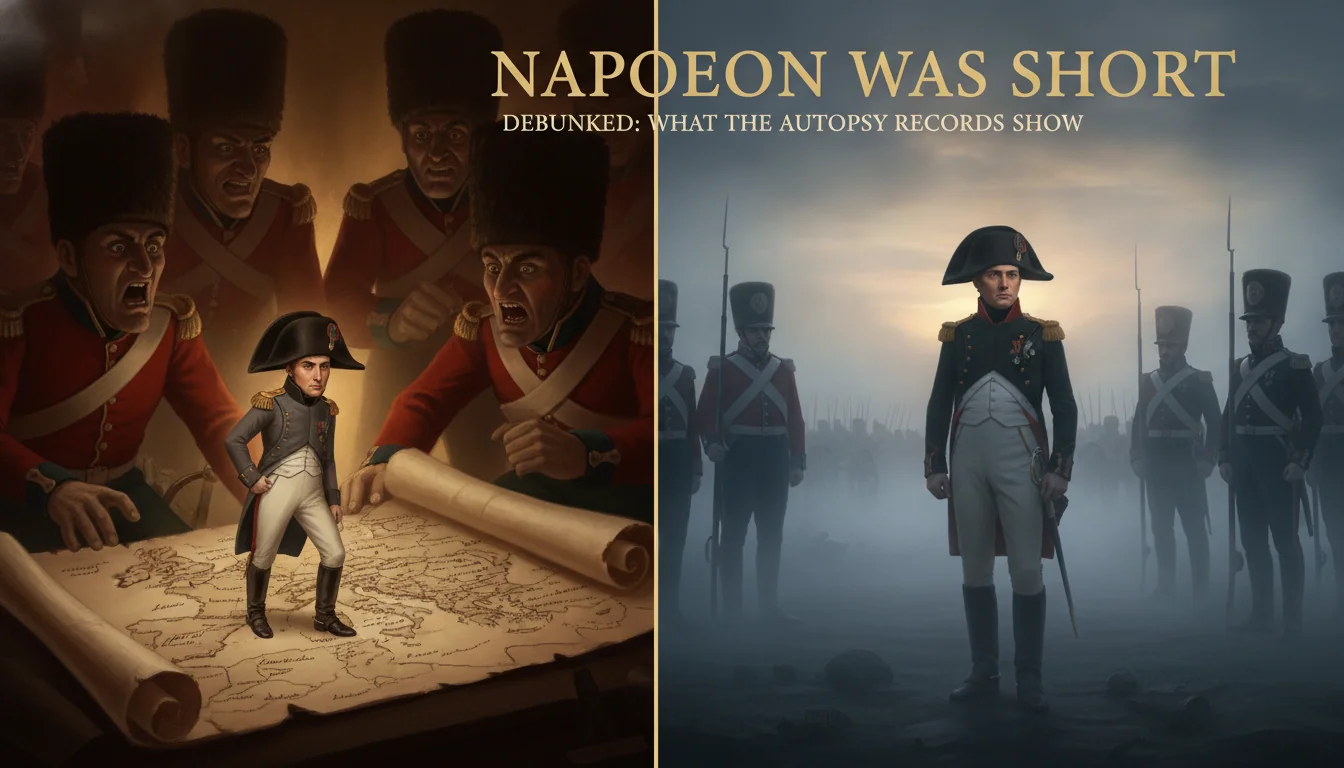
Was Napoleon short? Few historical trivia facts get repeated with as much confidence as this one: Napoleon Bonaparte, the man who crowned himself emperor and rearranged the map of Europe, was a small, angry man compensating for his height. The idea is so entrenched that psychologists still use his name for it, and it turns up in classrooms, pub quizzes, and internet memes with the same unshakable confidence every single time. There is just one problem. The measurement behind the whole story was never converted correctly, and the man it describes was roughly the height of an average British infantryman, standing at eye level with plenty of the soldiers who eventually beat him.
The myth, stated fairly
The popular version goes like this: Napoleon stood about 5 feet 2 inches tall, a full head shorter than most of his generals and marshals. His diminutive stature, the story goes, explains everything about him: the outsized ambition, the aggressive posturing, the need to conquer a continent to compensate for what he lacked in inches. The condition even has a clinical-sounding name, "Napoleon complex," used casually to describe short men who overcompensate with dominance and bravado. British cartoons of the era show him as a tantrum-throwing child-emperor, stamping his tiny boots on a world map. It is a vivid, coherent, satisfying story, and it has survived pretty much unchanged for two centuries.
Why it is so believable
The myth sticks because it is built from real material, just misassembled. Napoleon's own soldiers really did nickname him "le petit caporal," the little corporal, reportedly during the 1796 Italian campaign, a phrase that sounds like a physical description if you do not know its context. His elite Imperial Guard, especially the grenadiers, were recruited partly for size and presence, tall, imposing men chosen to look formidable on parade and immovable in a square. Napoleon reviewing his own guard, a comparatively average-sized man surrounded by hand-picked giants, would naturally look smaller by contrast, and painters and cartoonists of the period were not shy about exaggerating that contrast for effect.
Then there is the psychology. "Napoleon complex" is a genuinely useful shorthand that gets used constantly, in offices, in sports commentary, in casual conversation, and every use of it silently reinforces the premise that the historical Napoleon really was unusually short. A term that convenient does not need to be true to survive. It just needs to be useful.
Visual habit does the rest of the work. Court and battlefield paintings of Napoleon, most of them commissioned to flatter him, tend to show him on horseback or standing slightly forward of everyone else, a composition choice that reads as commanding rather than diminutive. But the caricatures that mocked him did the opposite on purpose, shrinking him next to soldiers, ministers, and foreign monarchs to make the point that his ambitions outran his person. Once both traditions were floating around in the same visual culture, casual viewers absorbed the contrast without noticing it was manufactured from two entirely different sets of motives.
Where it came from
The traceable origin of the myth runs through two separate channels that eventually merged into one story.
The first is wartime propaganda. British satirists during the Napoleonic Wars, most famously the caricaturist James Gillray, built a recurring character out of Napoleon: a strutting, tantrum-prone miniature tyrant, often drawn barely reaching the knees of the men around him. This was not measurement, it was mockery. Diminishing an enemy physically is one of the oldest tricks in wartime propaganda, and "Little Boney" became a stock figure in British satirical prints, later recycled in nursery rhymes used to frighten British children into good behavior. Generations of British readers grew up on an image of Napoleon that was never meant to be taken as an accurate physical description in the first place.
The second channel is a genuine measurement error, and it is the more interesting one. When Napoleon died in exile on Saint Helena on 5 May 1821, his personal physician Francesco Antommarchi performed an autopsy the following day, with British army medical officers present as witnesses. The recorded height, transcribed in French units of the era, was 5 pieds 2 pouces, five French feet and two French inches. The trouble is that a French pied du roi was not the same length as an English foot. It measured roughly 12.8 English inches rather than 12, and the pouce, its subordinate inch, was correspondingly longer too. Anyone reading "5 feet 2 inches" and assuming it meant English feet and inches, which is exactly what happened as the figure crossed the Channel into British and later American accounts, would arrive at a height about five inches shorter than the real one.
How it spread
Once the propaganda image and the mistranslated measurement pointed in the same direction, the myth had no reason to correct itself. British newspapers and historians repeating the "5 feet 2 inches" figure from the Saint Helena autopsy were, in effect, quoting a real primary source. They simply never adjusted it for the unit difference, and nobody had an incentive to check. The figure matched the caricature everyone already had in their heads from Gillray's prints and decades of "Little Boney" folklore, so it read as confirmation rather than as a number worth questioning. It moved from newspapers into biographies, from biographies into schoolbooks, and eventually into the kind of trivia that gets repeated at dinner parties without anyone tracing it back further than "I read it somewhere."
By the twentieth century the myth had acquired a second life in psychology. The idea that short stature drives compensatory aggression was popularized under Napoleon's name well after his death, cementing "Napoleon complex" into the language even as historians who had actually done the unit conversion knew the premise was shaky. The myth has proven remarkably resistant to correction ever since. Even a recent big-budget Hollywood biopic about his life, made with historians on hand as consultants, still leaned on the height joke for a laugh in its marketing, which says less about the historical record and more about how durable a two-hundred-year-old caricature can be once it has become the punchline everyone already knows.
What the primary sources actually say
Convert the autopsy figure properly and the picture changes substantially. Five pieds two pouces in the old French royal measure works out to somewhere around 168 to 170 centimeters, or about 5 feet 6 to 5 feet 7 inches in English measure. That is not a giant, but it is not remotely the stunted figure of the myth either. Estimates of average height among Frenchmen of Napoleon's generation, hampered by the poor nutrition common across pre-industrial Europe, tend to fall somewhat below that figure, which would put Napoleon at roughly average height for his time, or a touch above it.
The surviving physical evidence backs this up. Napoleon's uniforms, boots, and other personal effects preserved in French collections are consistent with a man of ordinary adult proportions, not the doll-sized emperor of the caricatures. Contemporaries who actually met him in person, rather than looking at satirical prints, generally did not remark on his height at all, which is itself telling. People tend to comment when someone's stature is genuinely unusual. Napoleon's contemporaries were far more likely to write about his intensity, his rapid speech, and his physical energy than about how short he was, because by the standards of the room he was standing in, he was not short.
It is worth putting that figure next to the men who actually fought him. Horatio Nelson, the British admiral whose fleet broke Napoleon's navy at Trafalgar, is commonly described in his own era's records as standing around 5 feet 6 inches, essentially the same height historians now attribute to Napoleon once the French pied is converted correctly. The supposed giant-versus-shrimp contrast that the caricatures sold so effectively simply is not there in the numbers. Two of the most consequential rivals of the entire Napoleonic Wars were, by any honest measure, close to the same size.
What is true instead
The real story is less about Napoleon's body and more about a translation error that outlived its own correction. A French unit of measurement, roughly a finger's width longer per foot than its English counterpart, got quietly dropped somewhere between an autopsy table on a remote South Atlantic island and a British newspaper column, and the resulting number fit a caricature that already existed for entirely separate political reasons. Two centuries later, the error is more famous than the fact it replaced.
Napoleon Bonaparte was, by the numbers his own doctors recorded, an unremarkable height for a man of his era and nation, likely somewhat above the national average rather than below it. What actually made him stand out had nothing to do with inches. It was the speed of his thinking, the reach of his ambition, and an ego that needed no help from his stature to become one of the largest in recorded history.
Quick Answers
Common questions about this topic
Is it true that Napoleon was short?
No. Autopsy and tailoring records place him at roughly 5 feet 6 to 5 feet 7 inches, about average or slightly above average for a Frenchman of his generation. The 'short' figure comes from a unit conversion error.
Where did the myth come from?
It came from confusing the French pied du roi, a slightly longer unit than the English foot, with English feet and inches, combined with British wartime caricatures that drew him as a childlike, miniature figure to mock him.
How tall was Napoleon really?
His postmortem measurement of 5 pieds 2 pouces in French units converts to roughly 168 to 170 centimeters, or about 5 feet 6 to 5 feet 7 inches in English measure, not the 5 feet 2 inches often quoted.
Why was Napoleon called 'the little corporal'?
The nickname reportedly dates to the 1796 Italian campaign, given by his own soldiers as an affectionate reference to his youth and relatively junior rank at the time, not a comment on his physical height.

Ask What Really Happened
Chat with the figures behind the myths everyone still believes.
Create your free account →No card required. Some figures and features require a paid plan.
Join the HistorIQly Club
Get smarter about the past.
Weekly stories, deep dives, and exclusive content straight to your inbox.