Origins: Who Invented the University?
Who invented the university? Bologna, al-Qarawiyyin, and Nalanda all have claims - and which answer is correct depends entirely on what you think a university is.
Read Wikipedia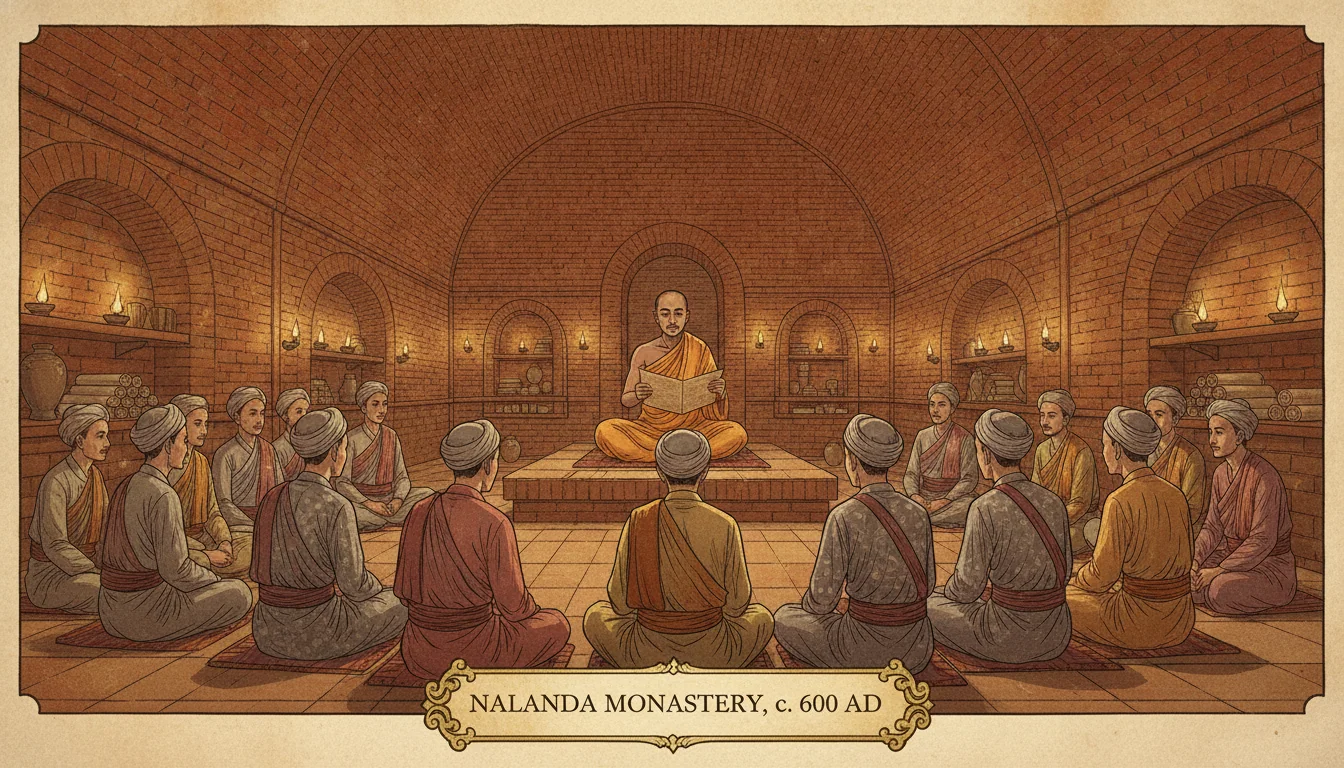
The popular version of university history is straightforward: medieval Europe, cathedral schools, Paris and Bologna in the 12th century, monks and scholars in Latin, the whole thing arising from the Christian intellectual tradition as naturally as cathedrals arose from the same soil. It is the kind of clean origin story that collapses immediately on contact with the actual evidence.
The university was not invented in medieval Europe. It was invented in several places, for several different purposes, across a span of roughly fifteen centuries, and the institution that emerged in Bologna in the late 11th century was the beneficiary of all of them.
What Nalanda was
The great Buddhist monastic university of Nalanda stood in what is now the state of Bihar in northeastern India, and it operated continuously from approximately the 5th century AD until its destruction in the early 1190s by forces under the command of Bakhtiyar Khilji, a general of the Delhi Sultanate. At its height, it housed several thousand students and hundreds of teachers and attracted scholars from China, Korea, Japan, Sri Lanka, Indonesia, and Central Asia. Its library was reportedly so large that it burned for three months when the complex was destroyed.
Nalanda is the most uncomfortable institution for Western-centric histories of the university because it predates Bologna by six centuries and exhibits, in reasonably well-documented form, the features that are supposed to distinguish universities from other schools: a residential community of scholars, formal admissions (there was an entrance examination), multiple disciplines (Buddhist philosophy, logic, grammar, medicine, mathematics, and astronomy), a hierarchy of teachers, and an international student body. Travelers who visited and wrote about it, including the Chinese Buddhist pilgrim Xuanzang in the 7th century AD, describe something that a modern student would recognize as an institution of higher learning.
Nalanda does not figure in most European histories of the university because it did not produce the degree, the portable credential, the chartered legal corporation that is usually cited as the university's distinguishing feature. It also does not figure because it was comprehensively destroyed and because the history of institutions is largely written by the institutions that survived.
What al-Qarawiyyin was
Fatima al-Fihri was the daughter of a prosperous merchant from Kairouan, in present-day Tunisia, who had relocated to Fez in the 9th century. When her father died and left his estate to his daughters, Fatima used her inheritance to build a mosque and attached educational institution in Fez in 859 AD. The institution, named after the family's Kairouan origin, grew over the following centuries into one of the Islamic world's most significant centers of religious and intellectual life.
Guinness World Records recognizes al-Qarawiyyin as the oldest continuously operating university in the world. This claim is contested, partly because al-Qarawiyyin in its original form was primarily a mosque with educational functions rather than an institution organized around secular scholarship and the granting of degrees in the European sense. Its curriculum centered on Islamic law, Arabic language, and religious sciences. It did not grant degrees in the Western sense until the 20th century, when it was reorganized and incorporated into the Moroccan state university system.
The question of whether this continuous operation represents a continuous university or a continuous mosque-school that eventually became a university is exactly the definitional problem that every claim in this history runs into.
Al-Azhar in Cairo, founded in 970 AD by the Fatimid caliphate, operates under the same ambiguity. It is older than Bologna and has operated continuously, and it has always provided systematic higher education. Whether it is a university by the European corporate-legal definition is a question that depends entirely on where you put the definitional boundary.
What Bologna actually invented
The studium generale that emerged in Bologna in the late 11th century was organized around Roman law. Italy in this period had a particular need for legal expertise: a society of competing city-states, merchants, and ecclesiastical institutions needed people who could read, interpret, and apply the corpus of Roman legal texts that had been rediscovered and were being systematically studied for the first time in centuries.
The conventional date of 1088 is associated with the jurist Irnerius, who is credited with the systematic teaching of the Corpus Juris Civilis - Justinian's 6th-century codification of Roman law. The 1088 figure was retrospectively established in the 19th century as a foundation date, somewhat arbitrarily, for the university's 800th anniversary celebration. The institution emerged gradually from an environment in which masters and their students organized themselves around legal study without any formal charter.
What Bologna invented - and this is the actual innovation - was the student guild.
At Bologna, the students organized themselves into corporations called universitates - which is where the word "university" comes from, meaning a corporation or guild rather than anything specifically academic. These student guilds hired their professors, set the schedule, fined teachers who started lectures late or left town without permission, and negotiated with the city for their legal rights as foreigners. The professors were the employees; the students ran the institution.
This arrangement is almost exactly the inverse of the modern university, and it tells you what the original problem was. The students at Bologna were largely adult men, often wealthy, who had come to study law for professional reasons. They needed guarantors of quality and they needed legal protection in a city that was not their home. The guild structure solved both problems.
The degree as legal credential
The degree - the licentia docendi, or license to teach - was the key technological innovation that spread the university model. Before the degree, education was local. A student who had studied with a great master in Paris could not prove that fact in Bologna or London without the master's personal testimony. The degree created a portable credential, recognized across Christendom, that certified competence without requiring the original teacher's presence.
Pope Alexander III's 1179 Third Lateran Council began the process of formalizing degree-granting authority, and subsequent papal legislation created a framework in which certain institutions had the right to grant the licentia docendi in ways that other institutions were obligated to recognize. This made the degree not just a certificate but a legal instrument.
The Church's involvement was not purely benevolent. The license system was also a mechanism for controlling who could teach theology, which was the most politically sensitive discipline of the era. You could study law or medicine under almost any qualified master; you could only teach theology with explicit ecclesiastical authorization. The degree was simultaneously liberation and control, which is perhaps why it has survived so well.
Paris, Oxford, and the spread
The University of Paris emerged in the late 12th century from the cathedral school of Notre-Dame. Where Bologna was organized around student guilds, Paris was organized around masters' guilds - the professors grouped themselves and negotiated collectively with the bishop and the king. This masters' guild model became the template for most northern European universities.
Oxford's origins are typically dated to around the late 12th century, with a significant expansion following the expulsion of English students from Paris around 1167. Cambridge emerged from a migration of scholars from Oxford in 1209 following a dispute between the university and the town. The English college system - the residential unit within the larger university - became a distinct institutional feature that shaped how higher education worked in Britain and its colonial sphere.
By 1300, there were more than twenty universities across Europe. By 1500, there were over sixty. They shared a Latin language of instruction, a recognizable curriculum structure (trivium, quadrivium, then the higher faculties of law, medicine, and theology), a degree system with comparable credentials, and a culture of disputation and commentary that constituted a genuinely international intellectual community.
The research university and the Humboldtian revolution
The medieval university was essentially a teaching institution. Professors transmitted an established corpus of knowledge; students learned it. Original research was not the institution's purpose and was barely a recognized category.
This changed in the early 19th century at the University of Berlin, founded in 1810 by Wilhelm von Humboldt under the intellectual influence of figures including Friedrich Schleiermacher and Johann Gottlieb Fichte. The Humboldtian model combined teaching and research in a single institution, arguing that the professor should be actively producing new knowledge, not merely transmitting established knowledge, and that students should be participants in the research process rather than passive recipients.
The Berlin model was the template for the modern research university. American universities, reformed in the 19th century partly through German influence (many American academics trained in Germany), adopted the research model and built the PhD system that now governs graduate education globally. Japanese, Korean, and Chinese research universities follow a version of the same model.
The medieval university transmitted knowledge. The Humboldtian university produces it. Both call themselves universities, and both trace their lineage to Bologna and Paris, but they are quite different institutions pursuing quite different goals.
What the origin debates reveal
The question of where the university was invented is ultimately a question about what you value in institutions of learning. If you value continuous operation and broad education, al-Qarawiyyin has the longest track record. If you value the international, residential, multi-disciplinary model, Nalanda got there centuries before Bologna. If you value the chartered legal corporation with portable credentials and the self-governing faculty - the form that produced modern universities as legal entities with rights and obligations recognized by states - Bologna has the strongest claim.
What no single institution can claim is having invented the entire thing. The idea of gathering scholars together, transmitting accumulated knowledge, and certifying that transmission with some form of credential is old enough to predate writing. The particular legal and institutional form that became the modern university assembled itself over about eight centuries from Roman law, Islamic educational traditions, Christian ecclesiastical organization, and the practical needs of merchant cities that needed lawyers.
Fatima al-Fihri in Fez in 859, the students' guilds of Bologna in the 1080s, and Wilhelm von Humboldt in Berlin in 1810 all contributed something essential. None of them started from nothing.
For related origins histories, see Origins: Who Invented the Hospital? and Origins: The Printing Press.
Quick Answers
Common questions about this topic
What is the oldest university in the world?
The answer depends on the definition. The University of al-Qarawiyyin in Fez, Morocco, founded in 859 AD by Fatima al-Fihri, is recognized by Guinness World Records as the oldest continuously operating university. Bologna (1088) is the oldest in Europe. Nalanda in India predates all of them but was destroyed in the 13th century.
When was the University of Bologna founded?
The University of Bologna is conventionally dated to 1088, when scholars organized to study Roman law under teacher Irnerius. The 1088 date is somewhat symbolic - the institution emerged gradually through the late 11th and 12th centuries - but it remains the oldest continuously operating university in the Western tradition.
What made medieval universities different from earlier schools?
Medieval universities were self-governing corporations of scholars with the legal right to grant degrees. Earlier schools and academies depended on the authority of a single teacher or institution. The university's key innovation was the degree as a portable legal credential - a license to teach that could be recognized anywhere in Christendom, independent of the institution that granted it.
What is the Humboldtian university model?
The Humboldtian model, developed at the University of Berlin founded in 1810, combined research and teaching in a single institution, replacing the medieval model of universities as purely teaching bodies. This model - the professor as both researcher and teacher, the university as a site of knowledge production rather than knowledge transmission - is the foundation of modern research universities worldwide.

Ask the Inventors Themselves
Chat with the people who were there when familiar things began.
Create your free account →No card required. Talk to anyone in history with 8 free credits a day. Some features require a paid plan.
Join the HistorIQly Club
Get smarter about the past.
Weekly stories, deep dives, and exclusive content straight to your inbox.