Debunked: Vikings Never Wore Horned Helmets
Did Vikings wear horned helmets? No: the image came from a German opera stage, not a Scandinavian battlefield. Here is what the graves and sagas actually show.
Read Wikipedia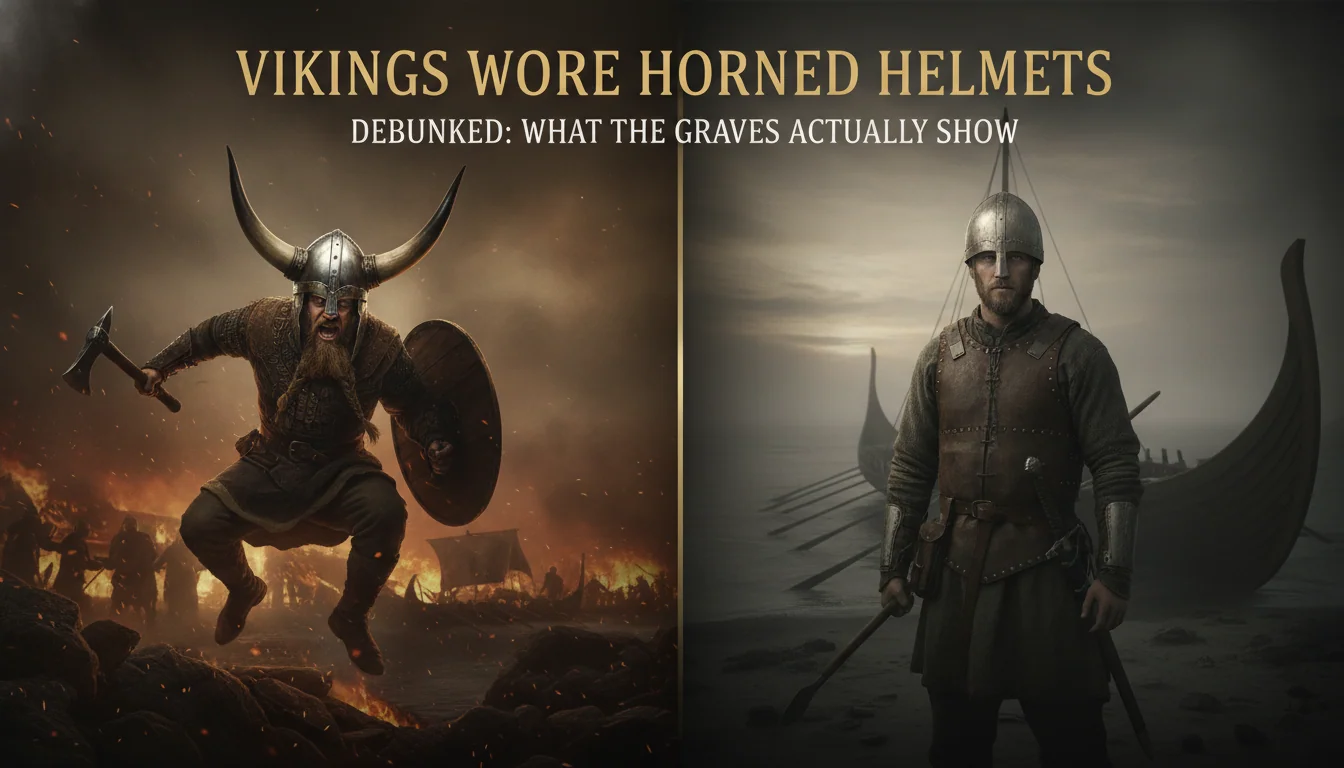
Ask almost anyone to picture a Viking and they will describe the same helmet: a rounded iron cap with two curved horns jutting from the sides, ideally lit by firelight as its owner leaps off a longship. It is one of the most durable images in popular history, stamped onto football helmets, opera posters, breath mints, and a thousand Halloween costumes. So did Vikings wear horned helmets? According to every scrap of physical evidence recovered from the Viking Age, the answer is no: the image is invented.
The myth, stated fairly
The image deserves to be taken seriously before it gets taken apart, because it is not a stupid guess. Warrior cultures across the ancient world did wear elaborate, intimidating headgear designed to make an already frightening army look monstrous. Horns, wings, and animal crests appear on ceremonial armor from the Bronze Age onward, and the psychological logic holds up: a raiding force that already had a reputation for terror could plausibly have leaned into that reputation with its equipment. Add to that the fact that Vikings raided and traded across an enormous swath of Europe, from the British Isles to the Volga, and it is easy to imagine some local artistic memory of a horned raider surviving into folklore. The myth is wrong, but it is wrong in a way that sounds right.
It also helps that the popular picture is so specific. Not just any Norse warrior, but one caught mid-leap off a longship prow, axe raised, horns catching the firelight of a burning monastery behind him. That is a scene built for a movie poster, and it turns out that is more or less exactly where it came from.
Why it is so believable
Part of the myth's staying power is pure visual efficiency. A horned silhouette reads instantly as savage and otherworldly in a way a plain iron cap never will, which is exactly why illustrators, filmmakers, and marketing departments have never wanted to let it go. It also survives because it gets reinforced constantly rather than just once. The Minnesota Vikings, who entered the NFL in 1961, wear a horned helmet on their logo. The newspaper comic strip Hagar the Horrible, launched in the early 1970s, put horns on its lovable brute. Countless children's books, breakfast cereal mascots, and costume shops have quietly agreed on the same design for generations. Nobody sat down and fact-checked it, because nobody needed to. It already looked correct. It is the same mechanism that keeps other durable historical myths alive, like the idea that Columbus set out to prove the earth was round or that Napoleon was unusually short: a vivid, simple image beats a complicated truth every time.
Where it actually came from
The traceable origin point is the German opera stage. When Richard Wagner's four-opera cycle Der Ring des Nibelungen premiered in full at Bayreuth in 1876, its costume designs, often attributed to the artist Carl Emil Doepler, dressed the cycle's Norse and Germanic gods and heroes in winged and horned helmets. Doepler was not working from Viking Age archaeology, which was still a young and unsettled field at the time. He was working in the spirit of nineteenth-century Romantic nationalism, a movement across Germany and Scandinavia that reimagined the pre-Christian north as a land of noble, primal warriors, and reached for the most dramatic silhouette available to sell that idea on stage. Some art historians push the trail back even further, to Scandinavian Romantic book illustrations from earlier in the 1800s, decades before Wagner's opera reached an audience. Either way, the source is theatrical costuming and nationalist myth-making, not a single dig site or burial mound.
How it spread
Wagner's operas toured opera houses across Europe and North America for decades, and the horned-helmet image traveled with them, reprinted on programs, sheet music covers, and posters long after most audiences had forgotten which opera introduced it. Illustrators working on history textbooks and children's adventure stories copied the costume uncritically because it was the version everyone already recognized, and recognizability sells books. Hollywood picked it up in the twentieth century, and advertisers followed close behind, slapping horned helmets on everything from butter to insurance mascots. By the time a Minnesota football franchise needed a fierce Nordic logo in the early 1960s, the horned helmet required no explanation at all. It had stopped being a costume decision and become common knowledge, which is exactly how a myth wins.
What the primary sources say
Archaeology has had well over a century to find a genuine Viking Age helmet with horns, and it has never once turned one up, despite excavating hundreds of Viking graves across Scandinavia, the British Isles, and the Baltic. The single most important piece of physical evidence works directly against the myth. In 1943, excavators at Gjermundbu farm in Norway uncovered a warrior's grave containing the only substantially complete helmet that can be confidently dated to the Viking Age, today held in a Norwegian museum collection. It is a rounded iron dome with a distinctive spectacle-shaped guard protecting the eyes and nose. There is no trace of horns, no fittings for horns, and no reason to think its owner, whoever he was, ever wanted any. A handful of fragmentary helmet pieces have surfaced elsewhere in Scandinavia and England, and every one of them fits the same plain, functional pattern.
Contemporary written sources tell the same story. Frankish and Anglo-Saxon chroniclers who lived through Viking raids and had every reason to describe their attackers as monstrous never once mention horned helmets. The Anglo-Saxon Chronicle's account of the raid on the monastery at Lindisfarne describes fire, slaughter, and terror, but it does not describe headgear, and neither do the continental annals that recorded later raids along the Frankish coast. The Old Norse sagas, written down generations after the events they describe, name helmets plainly and discuss them as ordinary equipment, never treating horns as standard war gear. When the sagas do reach for something supernatural, like the legendary "helm of terror" said to paralyze enemies with fear, they describe an aura or a spell cast over the wearer, not a physical pair of horns bolted to iron.
What is true instead
Here is the twist that makes the real story better than the myth. Actual horned bronze helmets do exist in the Scandinavian archaeological record, just not anywhere near the Viking Age. The Vekso helmets, discovered in a peat bog on the Danish island of Zealand, date to the Nordic Bronze Age, something like 1,700 years before the first Viking longship ever put to sea. Their bronze is thin, their horns are hollow, and the metal shows none of the dents or repairs a working helmet accumulates in a lifetime of combat. Most archaeologists read them as ceremonial or ritual regalia, likely worn by a priest or a chieftain in a procession rather than a soldier in a shield wall.
The real Viking helmet, by contrast, was almost defiantly practical. Most were rounded or conical caps hammered from iron, sometimes fitted with a simple nasal bar to protect the nose and occasionally paired with a mail curtain hanging down to guard the neck, the same basic silhouette that shows up on Norman and English fighters in the years just after the Viking Age on the Bayeux Tapestry. Iron was expensive and forging a helmet took real skill and a skilled smith's time, which means a metal helmet was as much a status symbol as it was protective equipment, the kind of thing a chieftain or a wealthy landholder owned rather than every man in a raiding party. Plenty of Viking Age warriors likely went into battle in a boiled leather cap, or nothing at all, trusting their shield and their reach with an axe or spear to do the real work.
There is also a plain tactical reason horns never caught on. A pair of curved horns is an excellent handle for an opponent to grab in close combat, and an even better way to snag rigging, rope, or another man's shield in the packed chaos of a shield wall or a ship's deck. Bronze Age priests processing through a ritual had no such problem. Warriors fighting for their lives very much did.
It is a less cinematic image than a horned demon leaping off a longship, but it says something truer about who these people actually were: resourceful shipbuilders, traders, and raiders operating on the hard economics of iron and labor, not opera extras. The myth gave the Vikings a costume designed for a German stage. The archaeology gives them a helmet that actually did its job in a shield wall, which, if you think about it, is the more Viking outcome anyway.
Quick Answers
Common questions about this topic
Is it true that Vikings wore horned helmets?
No. Not a single Viking Age helmet ever recovered by archaeologists has horns. The one largely intact helmet from the period, the Gjermundbu helmet found in Norway, is a plain rounded iron cap with a guard over the eyes and nose.
Where did the horned Viking helmet myth come from?
It traces to nineteenth-century Romantic art and costume design, most famously the horned and winged helmets designed for Richard Wagner's opera cycle Der Ring des Nibelungen, which premiered in 1876. Illustrators, advertisers, and later Hollywood copied the look until it became the default image of a Viking.
Did any ancient Scandinavians ever wear horned helmets?
Yes, but not Vikings. The Vekso helmets, found in a Danish bog, date to the Nordic Bronze Age, roughly 1,700 years before the Viking Age began. Their thin, undamaged bronze horns suggest they were ceremonial regalia rather than battle gear.
What did real Viking helmets look like?
Simple and functional: rounded or conical caps of iron, sometimes fitted with a nose guard, occasionally with a mail curtain to protect the neck. Helmets were expensive to forge, so many warriors likely fought in leather caps or bare-headed instead.

Ask What Really Happened
Chat with the figures behind the myths everyone still believes.
Create your free account →No card required. Some figures and features require a paid plan.
Join the HistorIQly Club
Get smarter about the past.
Weekly stories, deep dives, and exclusive content straight to your inbox.