Debunked: Salem's Witches Were Hanged, Not Burned
Salem's convicted witches went to the gallows, never the stake. Here is what the 1692 court records actually say, and why the flames stuck in memory anyway.
Read Wikipedia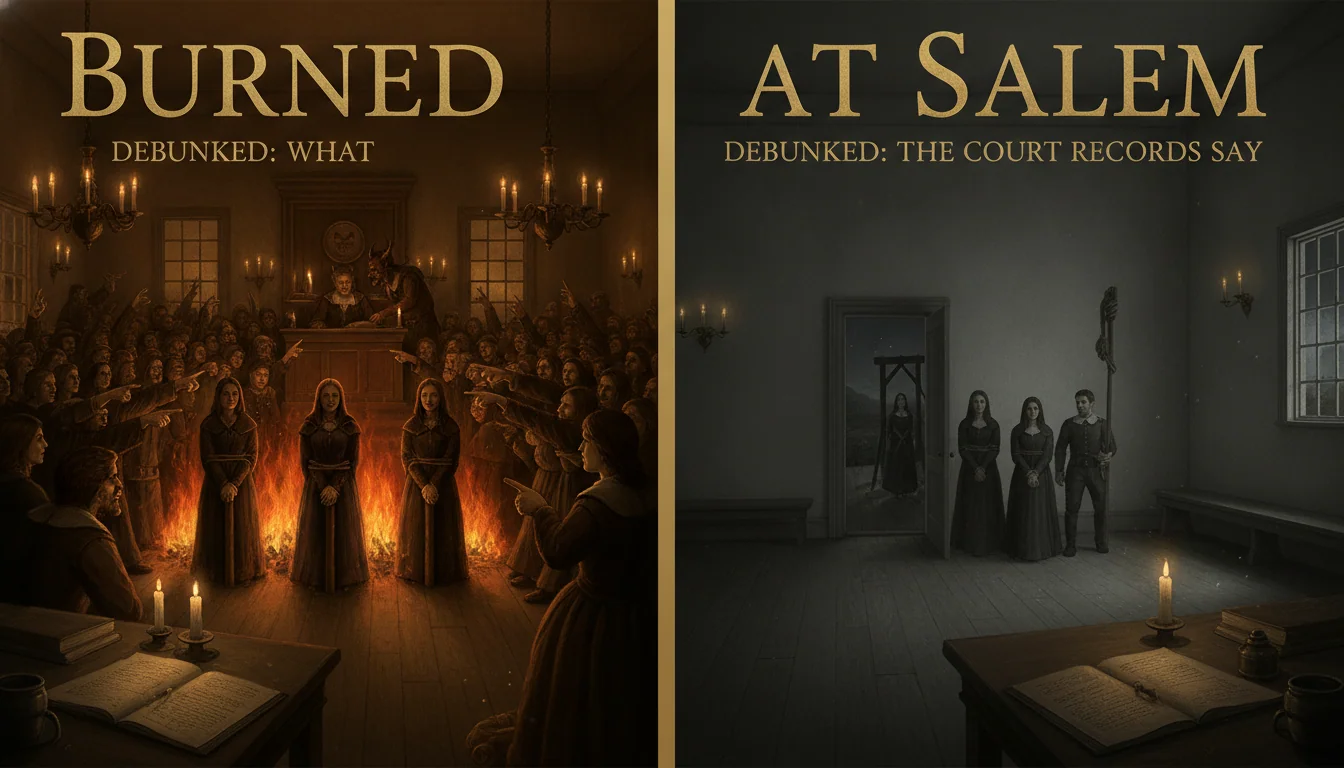
Ask someone to picture how the Salem witch trials ended and most people describe the same scene: a woman lashed to a wooden stake, flames climbing around her skirt, a crowd of Puritans in black watching from a New England square. It is a vivid image, and it is completely wrong. Nobody convicted of witchcraft in Salem in 1692 was burned. They were hanged, on a hill outside town, in front of a crowd that genuinely believed it was watching justice done. The stake and the flames belong to a different story that got grafted onto this one so thoroughly that the swap barely registers as a swap anymore.
The myth, at full strength
The burning version of Salem is not a fringe misconception. It shows up in casual conversation, in Halloween decorations, in half-remembered high school lessons, and occasionally in journalism that should know better. People are not being careless when they picture flames. They are drawing on a genuinely enormous, genuinely real history of witches being burned across Europe for three centuries, and folding Salem into it because the two events occupy the same mental folder: religious panic, accused women, an unjust death sentence, the seventeenth century. If you had to bet on how a witch died in that era without checking, burning is the reasonable guess. It is just the wrong one for this particular town.
Why the flames feel true
The reason the myth is so sticky is that burning witches was not invented by Hollywood. Across the Holy Roman Empire, France, and other parts of continental Europe, witchcraft prosecutions that ran through the sixteenth and seventeenth centuries frequently ended at the stake, sometimes for the condemned burned alive and sometimes after being strangled first as a mercy. Scotland, whose legal system leaned closer to continental practice than to English common law, also burned convicted witches, usually strangling them at the stake before the fire was lit. Estimates of the total European death toll vary a great deal depending on the historian and the period counted, but tens of thousands of documented executions is a reasonable working figure, and older claims running into the millions, once repeated widely in twentieth century popular writing about a supposed "burning time," have been discredited by later archival research.
Add to that the deep well of fairy tale and folk imagery, the witch shoved into her own oven in "Hansel and Gretel," the crackling bonfire on every Halloween lawn display, centuries of religious art showing heretics and sorcerers alike consumed by flame, and you have a cultural default so strong that it overwrites whatever a specific court record actually says. Salem did not need to be burned in reality. It only needed to resemble, in outline, a hundred stories where burning was the ending.
Where the confusion actually started
There is no single moment where someone invented the false claim about Salem specifically. It accumulated. Early American textbooks and popular histories, writing about "the witch trials" in general terms, often described European persecutions and Salem in the same breath without being careful to separate methods of execution between the two very different legal systems that produced them. Twentieth century occult and neo-pagan writing, which popularized the phrase "the burning times" to describe an imagined continuous, cross-continental witch genocide, further blurred the line between what happened in the Holy Roman Empire and what happened in a Massachusetts village, treating both as interchangeable chapters of the same persecution. Film and television, always hungry for a visually dramatic ending, defaulted to fire because fire reads on screen in a way that a rope and a scaffold simply do not.
Arthur Miller's 1953 play "The Crucible," the single most influential piece of art about Salem, actually gets the method right. Its condemned characters are hanged, not burned, and generations of students have read or watched it in school. Yet the accurate ending in the culture's most famous Salem story still lost out to the broader, older image of the burning witch. That tells you how powerful the general myth is: it can survive direct contact with a correct, popular, widely taught counterexample.
Who kept the story going
Once folklore and film had planted the association, ordinary cultural repetition did the rest. Halloween marketing, casual references in conversation, offhand lines in unrelated movies and TV shows set in colonial New England, and the simple fact that "burned at the stake" is a punchier phrase than "convicted, sentenced, and hanged on Gallows Hill" all worked in the myth's favor. Nobody had to be lying. The wrong image was simply more available, more cinematic, and easier to reach for than the accurate one.
What the court records actually say
The documentary record from 1692 is unambiguous, and it survives in enough detail to settle the question completely. Bridget Bishop, the first person executed in the Salem trials, was hanged on June 10, 1692, on the strength of a death warrant issued by the court that explicitly ordered her "to be hanged by the neck." Eighteen more people followed her to the same fate across three further execution dates that summer and early autumn, the largest single day being September 22, 1692, when eight people were hanged together. Cotton Mather's contemporary account, "Wonders of the Invisible World," published in 1693, describes these hangings directly, as does Robert Calef's later and considerably more critical "More Wonders of the Invisible World." Neither source, nor any surviving court document, mentions burning as a method of execution used in Salem.
The single execution that departs from hanging makes the point even more clearly, because it is not burning either. Giles Corey, a farmer in his eighties, refused to enter a plea of guilty or not guilty to the charges against him, a legal maneuver meant to prevent his estate from being confiscated. Under the English common law practice of the day, refusing to plead could be answered with "peine forte et dure," pressing the accused under increasing weight until they entered a plea. Corey never did. He was pressed to death on September 19, 1692, reportedly demanding more weight rather than confessing. It is a horrifying death, and it is not a burning.
Beyond the executions themselves, at least four or five more accused people died in the overcrowded, unsanitary jails of Essex County while awaiting trial, victims of the process rather than of a formal sentence. Modern historians, working from Sidney Perley's early twentieth century property surveys and later confirmed through additional archival and physical investigation announced in 2016, have identified Proctor's Ledge, a rocky outcropping below the traditionally cited Gallows Hill in Salem, as the actual execution site where the condemned were hanged.
What is true instead, and why it is stranger
The real explanation for why Salem hanged rather than burned is not dramatic, but it is genuinely revealing about how colonial law worked. Massachusetts Bay was an English colony operating under English common law, the same legal inheritance that still governed Boston generations later, and English law treated witchcraft as a felony under the Witchcraft Act of 1604, in the same broad legal category as murder or theft. English felonies were punished by hanging. Burning at the stake existed in English law, but it was reserved for a narrow set of specific crimes, chiefly petty treason, meaning a servant murdering a master or a wife murdering a husband, and heresy. Witchcraft, as prosecuted under the 1604 statute, simply was not one of them. Scotland and continental Europe operated under different legal traditions closer to Roman canon law, which is why their witch trials so often ended in flame while New England's did not.
The stranger truth sitting underneath the execution method is the trial itself: confessing to witchcraft, however implausible the confession, tended to spare the accused, while maintaining innocence under interrogation was often what sent someone to the gallows. The panic finally broke in October 1692, after the governor's own wife came under suspicion, and the special court that had authorized the executions was dissolved before it could hang anyone else. Nobody in Salem burned. What actually happened there, a legal system turning its own procedural logic into a machine for killing the people who told the truth, needs no invented flames to be remembered.
Quick Answers
Common questions about this topic
Is it true that Salem's witches were burned at the stake?
No. Every person executed for witchcraft in Salem in 1692 was hanged. The one exception, Giles Corey, was pressed to death with heavy stones for refusing to enter a plea. No one convicted in the Salem trials was burned.
Where did the idea that Salem witches were burned come from?
Mostly from conflating Salem with continental European and Scottish witch trials, which did use burning, plus centuries of folklore, fairy tales, and film that show witches dying in flames regardless of where or when the story is set.
How many people died in the Salem witch trials?
Nineteen people were hanged across four execution dates in 1692, one man was pressed to death, and at least four or five more accused people died in jail while awaiting trial.
Why were English colonies more likely to hang witches instead of burning them?
Massachusetts operated under English common law, where the Witchcraft Act of 1604 classified witchcraft as a felony. English law punished felonies, including witchcraft, murder, and theft, by hanging. Burning was reserved for a narrow set of crimes such as petty treason and heresy, which witchcraft was not classified as.

Ask What Really Happened
Chat with the figures behind the myths everyone still believes.
Create your free account →No card required. Some figures and features require a paid plan.
Join the HistorIQly Club
Get smarter about the past.
Weekly stories, deep dives, and exclusive content straight to your inbox.