Time Traveler's Guide to Revolutionary Boston, 1773
Colonial Boston in 1773 is a city on the edge of explosion. Here is how to dress, navigate, eat, and survive a visit to the year the Tea Party changed everything.
Read Wikipedia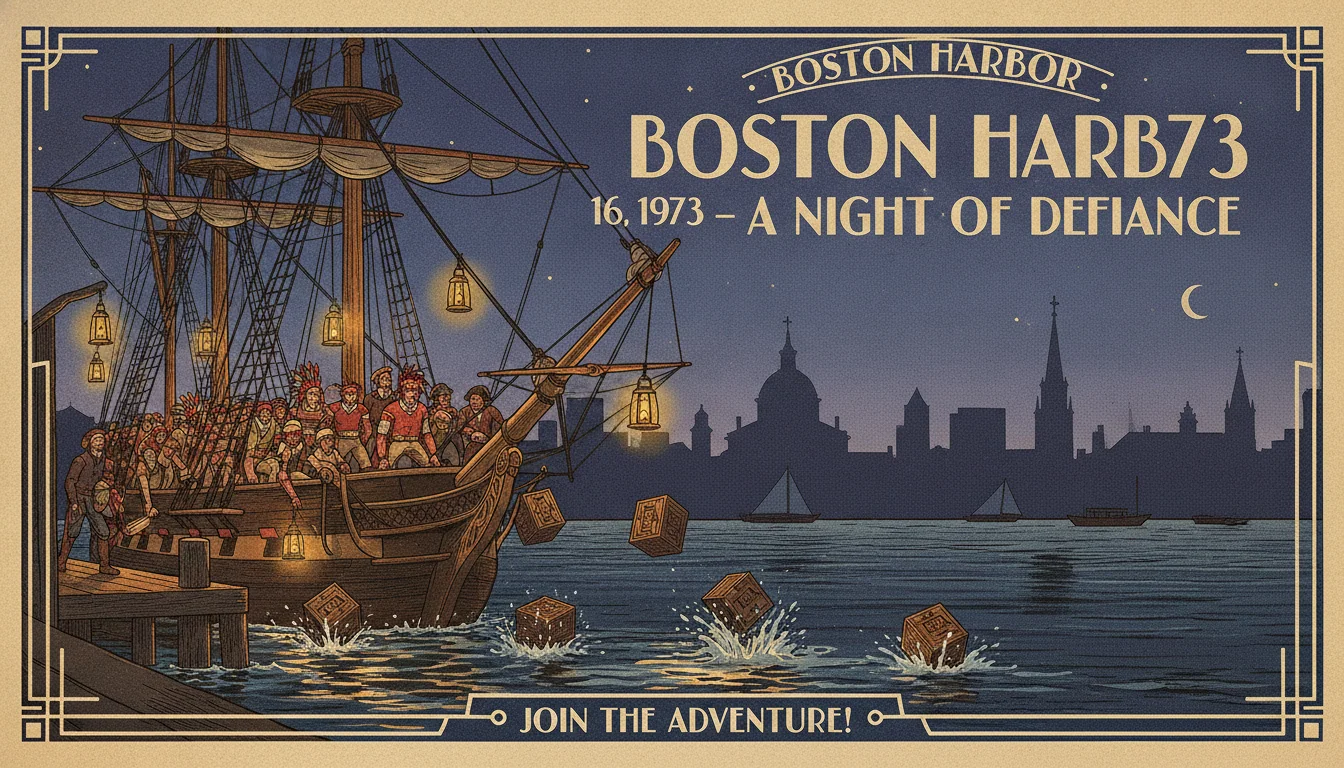
Colonial Boston in 1773 is the most politically charged city in the English-speaking world outside of London, and even London would struggle to match the intensity of feeling packed into its roughly sixteen thousand residents. The British army has been here before - quartered in people's homes, parading on the Common, involved in a street confrontation three years ago that killed five colonists and has been referred to as a massacre ever since. The soldiers left after the massacre, but the memory has not.
What you are stepping into is a city that knows a crisis is coming. Not everyone agrees on what form it will take, or who will survive it. But the sense of acceleration, of a place that has been heading somewhere for years and is now approaching the moment, is impossible to miss if you spend more than an hour here.
What kind of place you're entering
Boston is a Puritan city that has become a merchant city, and neither identity has fully displaced the other. The descendants of the Massachusetts Bay Colony founders sit in the same meetinghouses and counting-houses as men who have made fortunes in cod, molasses, rum, and the slave trade. The harbor - one of the best natural harbors on the Atlantic coast - is the reason for everything: wealth, commerce, and now the British customs regime that has made almost every successful merchant here into a potential sympathizer with the radical cause.
The population divides, very roughly, into three camps. There are the Patriots - the majority in the streets and taverns, organized around Samuel Adams's committees and Paul Revere's Mechanics. There are the Loyalists - wealthy merchants and officeholders who understand that the Crown's protection is also the Crown's patronage, and who have too much to lose from disorder. And there is the bulk of the city that simply wants to live: craftsmen, apprentices, sailors, servants, and slaves who will follow whoever seems most likely to protect their immediate interests.
Do not assume everyone here wants a revolution. At this point, most colonists still hope to resolve the dispute within the British constitutional framework. What they want is the right to be taxed only by their own elected assemblies. What they are about to discover is that Parliament considers this a provincial fantasy.
Dress like you belong
Your instinct may be to dress simply, but simple in 1773 is a specific thing. Boston craftsmen wear wool breeches, linen shirts with the collar open or loosely tied, and leather shoes with large brass buckles. Hats are universal for men outdoors: a tricorne, worn with the front point forward, is the safe choice. Sailors wear shorter jackets called pea coats and canvas trousers. Gentlemen add a coat and waistcoat over the shirt, with a neckcloth or cravat wound at the throat.
For women: a linen shift as the base layer, a short gown or bedgown over a petticoat for working women, a more structured bodice and skirt for middling women, and an elaborate gown with wide skirts for ladies of quality. Everyone wears a cap indoors and outdoors. Leaving the house without one marks you as either very poor or very eccentric. Stays - a stiff bodice support - are universal across all classes. You will find them uncomfortable. Wear them anyway.
Avoid anything synthetic. The fabrics here are linen, wool, and silk. Your cover story as a visitor: you are recently arrived from either Philadelphia or London, which explains any accent and any minor sartorial oddity.
Navigating the political terrain
The first thing to understand is that the argument happening in Boston in 1773 is not yet about independence. It is about taxation and representation. To blend in, your position should be that Parliament has no right to tax the colonies without colonial representation, but that you remain loyal to the Crown as an institution. This is the mainstream Patriot position.
Avoid speaking warmly of Governor Thomas Hutchinson, who is deeply unpopular. He has been publishing letters to the British government arguing that colonial liberties should be curtailed, and Benjamin Franklin has recently arranged for those letters to become public. Hutchinson's position is now widely known and widely resented.
If you are near the waterfront or the taverns where Mechanics gather, it is safe to be sympathetic to the Sons of Liberty. In the neighborhoods around Beacon Hill, where the Loyalist merchant families live, be more guarded. Read the room. The town is small enough that people know each other, and a stranger who voices strong opinions in the wrong direction will be remembered.
Three places you must visit
The Green Dragon Tavern
The tavern on Union Street is the organizational heart of the Patriot movement. Paul Revere's Mechanics, a network of artisans and tradesmen who gather intelligence on British troop movements, meet here. The Sons of Liberty, the St. Andrew's Masonic Lodge, and the Committee of Correspondence all use the upstairs rooms. Daniel Webster will later call it the headquarters of the American Revolution, and that is not much of an exaggeration.
Go for the beer - Boston's taverns serve a dark, slightly sour ale brewed locally - and stay for the conversation. What you will hear in the Green Dragon in late 1773 is the specific texture of revolutionary thinking before it becomes revolutionary action: the arguments about legal right, the frustrations with Hutchinson, the anxious calculations about whether the merchants in New York and Philadelphia will hold together, the debates about what exactly should be done with the tea ships sitting in the harbor.
Faneuil Hall
The market and meeting hall donated to the city by Peter Faneuil in 1742 sits at the center of commercial Boston. Downstairs is a working market selling fish, meat, and produce. Upstairs is the great hall where town meetings are held, and in 1773, town meetings are the primary arena for political debate. When a major crisis breaks, five thousand people will try to fit themselves into a hall that holds twelve hundred, and the overflow will pack the street outside.
Attend a meeting if one is scheduled. The quality of the oratory is extraordinary by any standard. Samuel Adams in particular speaks with a cadence and argumentative precision that has made him the most effective political agitator in the colonies.
Long Wharf
The longest wharf in the city runs six hundred feet into the harbor. Walk it on a clear morning. The ships in the harbor - merchant vessels, Royal Navy frigates at anchor, fishing boats, coastal traders - tell you everything about what Boston is economically and what it is at risk of losing. In December 1773, three tea ships will moor here: the Dartmouth, the Eleanor, and the Beaver. The chests they carry will end up at the bottom of the harbor.
What to eat and drink
Boston's taverns are your safest option for food and drink. A typical meal in a mid-range establishment will include salt cod or boiled beef, some form of cornbread or wheaten bread, and a tankard of ale. The ale is safer than the water, which comes from contaminated wells and cisterns. Cider is common and generally reliable. Tea is politically complicated in 1773 - boycotts of British goods have been on and off for years - but coffee is widely available and a neutral choice.
Avoid raw shellfish from the harbor in warm months. The harbor is also a sewer. In December you are safer.
The night of December 16
If you are present on the night of December 16, 1773, know the sequence of events before they happen. A town meeting convenes at the Old South Meeting House and runs for most of the day. Governor Hutchinson will refuse a final request to let the ships leave without paying the tea duty. Samuel Adams will speak. At some point in the evening, a signal will go through the crowd, and a group of men - some disguised as Mohawks with painted faces and blankets, others not bothering with disguises - will move toward Griffin's Wharf.
The tea will go into the harbor in an operation that takes roughly three hours and is conducted in near-total silence. The crowd that watches does not cheer loudly. This is an organized act of political protest, not a riot. No property other than the tea is touched, no one is harmed, and the organizers make a point of sweeping the ships' decks clean afterward.
Do not follow the group onto the ships. You will be noticed and remembered. Watch from the wharf at a respectful distance. What you are seeing is the event that makes a military response from London politically inevitable, that closes the port of Boston, that forces the other colonies to decide whether to treat it as a local problem or a common cause, and that begins the irreversible sequence toward 1776.
What to avoid
The British army regiments that were quartered in the city during the occupation left after the 1770 Massacre, but British customs officials and Royal Navy vessels remain. Do not involve yourself in any confrontation with customs authority. The seizure of a merchant's goods for unpaid duty is a common and violent business here, and getting caught up in one as a foreigner has no upside.
At night, the city is poorly lit and the streets between the North End and the South End can be dangerous after dark without local company. Sailors' neighborhoods around the waterfront are lively but unpredictable. Stay on the main streets - King Street, Milk Street, Cornhill - after sunset if you are alone.
Do not get sick. Boston has had repeated outbreaks of smallpox, and the hospitals that exist are not places you want to enter. If you have not been inoculated, be careful in crowds.
Come in the autumn if you can manage the timing. The harbor is clear, the new-harvest provisions are good, and the political crisis is building to a point where you will be watching history compress itself into a single evening in December.
For what came three years later, when colonial grievance became formal rebellion, see our time traveler's guide to Philadelphia in 1776. And for the young officer whose earlier wartime experience shaped the general who would lead the fight Boston set in motion, see Young Washington vs. History.
Quick Answers
Common questions about this topic
What was Boston like in 1773?
Boston in 1773 was a port city of roughly 16,000 people, politically fractured between Patriots and Loyalists, and under the shadow of British military occupation that had begun after the 1770 Massacre. It was one of the most radical cities in the American colonies, with an active network of agitators centered on figures like Samuel Adams and Paul Revere.
When was the Boston Tea Party?
The Boston Tea Party took place on the night of December 16, 1773. Members of the Sons of Liberty, some dressed as Mohawks, boarded three ships in Griffin's Wharf and dumped 342 chests of East India Company tea into Boston Harbor. The action was organized in response to the Tea Act of 1773, which maintained Parliament's right to tax the colonies without their consent.
Who ran Boston in 1773?
Formally, Massachusetts was governed by Crown-appointed Governor Thomas Hutchinson, a Loyalist who had been deeply unpopular since the 1770 Massacre and whose refusal to let the tea ships leave without paying duty in December 1773 directly triggered the Tea Party. Informally, the city's political life was dominated by the Sons of Liberty and figures like Samuel Adams, who organized resistance through a network of committees and tavern meetings.
What was the Green Dragon Tavern?
The Green Dragon Tavern on Union Street was the informal headquarters of Boston's Patriot movement. The Sons of Liberty, Paul Revere's Mechanics, and various Masonic lodges met there to organize. Daniel Webster later called it the headquarters of the Revolution. It is not an exaggeration.

Need Advice from Someone Who Lived There?
Get firsthand accounts from people who actually lived through these moments in history.
Create your free account →No card required. Some figures and features require a paid plan.
Join the HistorIQly Club
Get smarter about the past.
Weekly stories, deep dives, and exclusive content straight to your inbox.