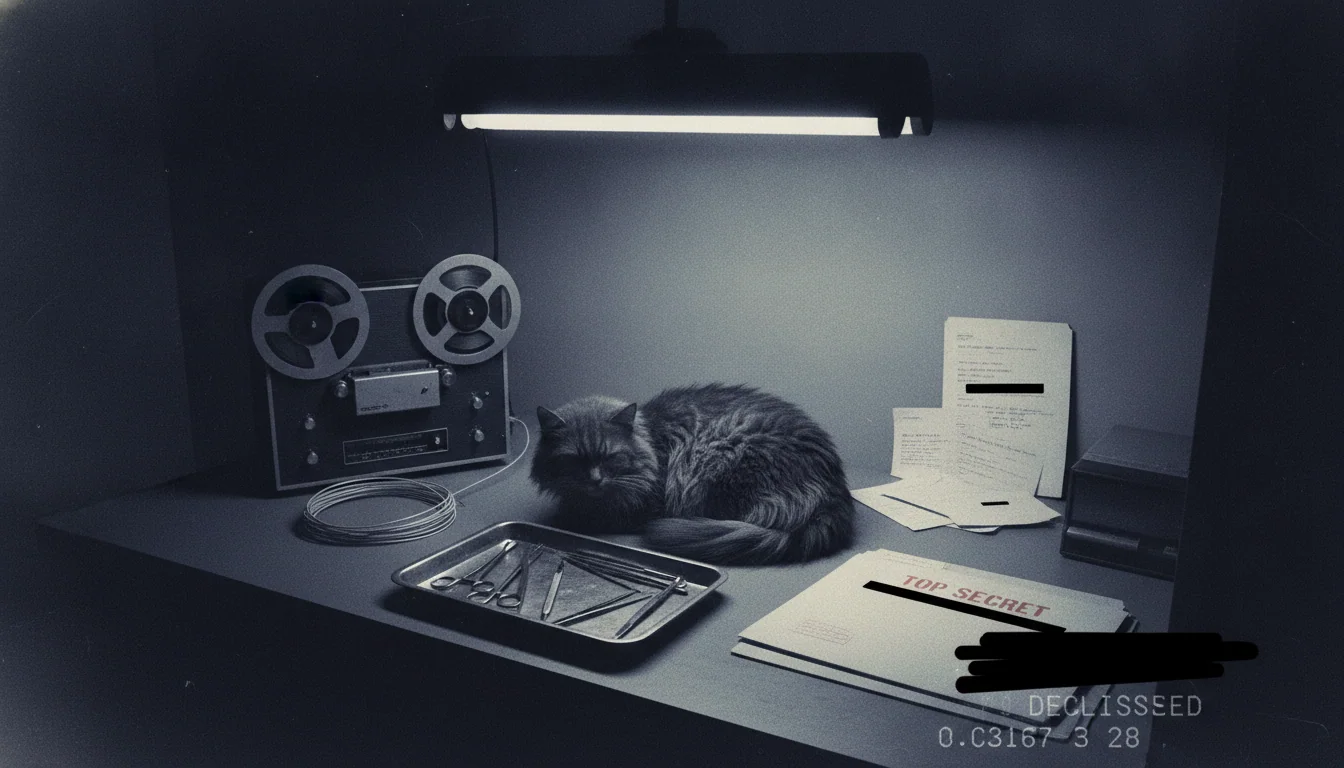
Declassified: The Air Force File Behind the Roswell Incident
The 1994 Air Force report on Project Mogul is the government's official answer to America's most famous UFO story. Here is what the file says.
Read Wikipedia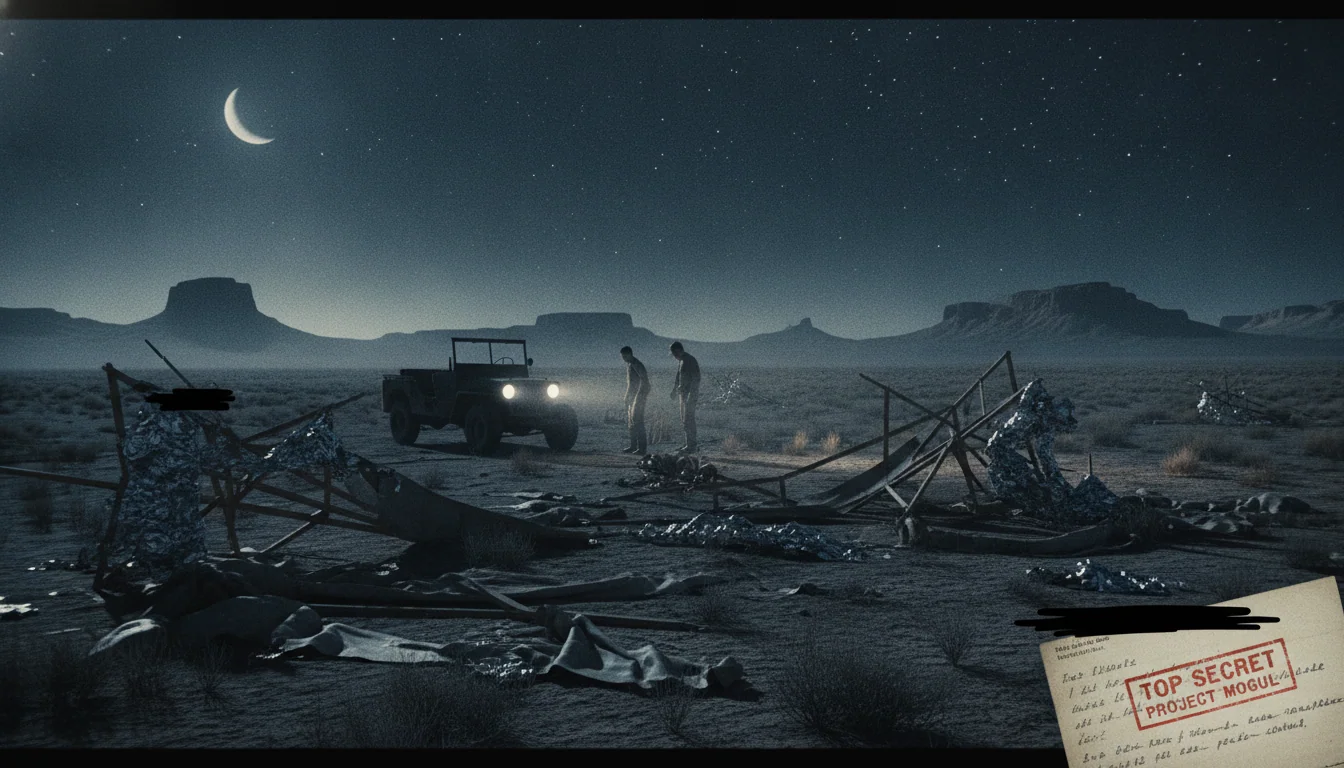
In July 1947, a rancher named W.W. "Mac" Brazel found a field on the Foster ranch he managed scattered with what he described as sticks, tinfoil, rubber strips, and tough paper, some of it stamped with odd tape bearing flower-like symbols. He hauled some of it into Roswell, New Mexico, and mentioned it to the local sheriff. Within days, the story had gone from a rural curiosity to a headline the world has never quite let go of: "RAAF Captures Flying Saucer On Ranch in Roswell Region."
Almost half a century later, the United States Air Force opened a file on its own history and released a very different kind of story. Not a saucer. Not an alien. A balloon train, several hundred feet of them strung together, floating quietly above New Mexico as part of a nuclear-espionage program so secret that even its own name was hidden from most of the people who launched it.
The secret
The program was called Project Mogul, and its purpose had nothing to do with weather forecasting, despite the cover assigned to it at the time. According to the Air Force's declassified account, Mogul was designed to detect the acoustic signature of Soviet atomic bomb tests from vast distances, using strings of balloons carrying sensitive low-frequency microphones high into the stratosphere, where sound channels could theoretically carry a detonation's signal thousands of miles.
This was 1947. The Soviet Union would not test its first atomic device for another two years. American scientists and military planners were racing to build any early-warning capability they could, and acoustic detection from balloon-borne sensors was one of several approaches under study. Because the program touched both nuclear intelligence and balloon reconnaissance technology, both areas the military wanted kept far from public or Soviet attention, Mogul itself was classified. Personnel working the New Mexico launches reportedly were not told what they were actually listening for.
Origins
The balloon trains were launched from Alamogordo Army Air Field, not far from the Roswell Army Air Field where the famous debris eventually landed. Each train could stretch for hundreds of feet and combine dozens of neoprene or polyethylene balloons with radar reflectors, sensitive equipment packages, and instrumentation designed to be tracked from the ground.
The radar targets are one of the more consequential details in the declassified file. Built from balsa wood struts, reinforced with tape, and covered in metallic foil to make them visible on radar, they were fragile, disposable, and, crucially, unfamiliar to almost anyone who might stumble across their wreckage. According to the Air Force's report, this is a strong match for Brazel's description: foil, sticks, rubber, and tape stamped with symbols, which investigators later linked to a commercially produced tape with a similar floral pattern used to reinforce seams on some of the targets, not to any exotic or unearthly material.
The operation
Flight records for Project Mogul from mid-1947 are incomplete, and the Air Force's 1994 investigation openly acknowledges the gap. Rather than a single surviving log tying one specific flight directly to Brazel's field, investigators reconstructed the likely sequence from surviving weather data, interviews with retired Mogul personnel including project scientist Charles B. Moore, and records of nearby launches, concluding that a launch designated in project shorthand (commonly cited as Flight 4) was the most probable source, having gone missing from tracking not far from the debris site around the relevant dates.
What happened next, according to the released record, followed a predictable and unremarkable military bureaucracy. Brazel reported the debris to Sheriff George Wilcox, who alerted the Roswell Army Air Field. Major Jesse Marcel, an intelligence officer at the base, was sent to collect the material. A public information officer, reportedly acting without higher authorization, issued a press release describing the recovery of a "flying disc," a phrase almost certainly used informally, echoing the era's slang for unidentified aerial debris, rather than as a claim of extraterrestrial origin.
The story detonated. Within roughly a day, the Army's Fort Worth headquarters moved to contain it, holding a press conference at which the debris, or debris represented as the same material, was displayed and identified as a weather balloon and its radar target. Reporters photographed Marcel posing with the material. The story faded from the news within about a week, and Roswell went back to being an obscure New Mexico town for the next three decades.
Exposure
For most of the postwar era, "the Roswell weather balloon" was not controversial. It was the accepted, boring explanation, and few people questioned it. That changed in the late 1970s and 1980s, when researchers, several drawing on renewed interviews with aging witnesses including Jesse Marcel himself, argued that the original weather balloon cover story could not account for the volume and unusual character of the debris some witnesses recalled, and floated the possibility that the crash involved something extraordinary that the military had deliberately concealed.
The resulting UFO literature grew into one of the most durable subgenres in American pop culture, incorporating alleged crash retrievals, autopsies, and long-running claims about bodies recovered from the site, the same appetite for a hidden truth that later attached itself to Project Stargate's psychic espionage program. Congressional pressure, driven substantially by a persistent line of inquiry from New Mexico's congressional delegation on behalf of constituents seeking answers, eventually pushed the General Accounting Office to formally request Pentagon records related to Roswell in the early 1990s.
That request is what produced the Air Force's own reinvestigation. Unable to locate the original Roswell Army Air Field records, which had reportedly been destroyed decades earlier under routine records-retention schedules unrelated to any cover-up, investigators instead pieced together the explanation from Project Mogul's own surviving files, since Mogul had been declassified separately years earlier as its Cold War sensitivity faded.
What the files say
The Air Force released its findings in two reports. The 1994 report, "The Roswell Report: Fact versus Fiction in the New Mexico Desert," concluded that the debris recovered by Brazel was consistent with a Project Mogul balloon train, most likely the missing Flight 4 launch, and that the original "flying disc" language had been an unfortunate, informal phrase that took on a life its author probably never intended.
A second report, released in 1997 and titled "The Roswell Report: Case Closed," addressed a separate strand of the legend that had grown alongside the debris story: witness claims of small humanoid bodies recovered near the crash. That report concluded these accounts likely stemmed from a conflation of decades of memories, pointing to a later and unrelated Air Force program in the 1950s that used anthropomorphic test dummies dropped from high altitude during parachute and ejection-seat research in the same general region of New Mexico. According to the report, aging witnesses recalling events separated by years may have folded the dummy recoveries and the 1947 debris story into a single memory over time, a well-documented pattern in long-term recollection of high-stress or high-publicity events.
What remains genuinely open is narrower than the popular legend suggests. The specific flight-by-flight paper trail for the exact Mogul launch is incomplete, reconstructed rather than found intact, and some witness testimony describing the volume of debris and its distribution across the field does not map perfectly onto the size of a single balloon train, a discrepancy the Air Force attributes to the fallibility of decades-old memory rather than to any withheld evidence. No official document, declassified or otherwise, describes the recovery of alien technology or extraterrestrial remains at Roswell. The redactions that do exist in Cold War-era files from this period overwhelmingly concern nuclear detection methods, balloon telemetry, and unrelated intelligence programs still sensitive for reasons that have nothing to do with UFOs.
Roswell endures less because the file is thin than because the Army's own initial phrase, "flying disc," was too good a headline to ever fully take back. The declassified record does not describe a cover-up of alien contact. It describes a cover-up of a balloon, in service of a listening program aimed squarely at Moscow, the same pattern of mundane secrecy that later explained the UFO reports swirling around Area 51's secret test flights, and a bureaucracy that badly fumbled its own messaging on a slow news day in July.
Quick Answers
Common questions about this topic
What was Project Mogul?
Project Mogul was a classified United States Army Air Forces program that flew long trains of high-altitude balloons carrying microphones and radar reflectors, built to detect sound waves from Soviet nuclear tests before the Soviet Union had even tested a bomb. According to the Air Force's declassified 1994 report, debris from one of these balloon trains, launched from Alamogordo, New Mexico, is what came down on the Foster ranch near Roswell in July 1947.
Did the Air Force really cover up a UFO at Roswell?
The declassified record shows the original cover story, that the debris was a weather balloon, was itself a deliberate deception, but the secret being protected was Project Mogul's nuclear-detection work, not an alien spacecraft. The Air Force's 1994 and 1997 reports conclude that ordinary classification secrecy, not extraterrestrial evidence, drove the decades of official evasiveness.
Why did witnesses describe strange material and bodies?
The report attributes the unusual foil, rubberized paper, and balsa-wood debris to the specialized construction of Mogul's balloon trains and radar targets. It attributes reports of small bodies to a later, unrelated period of the 1950s when crash-test dummies were dropped in the same general region during high-altitude parachute research, memories the Air Force says likely became conflated over decades of retelling.
Is anything about Roswell still classified?
The core physical explanation is not classified: the flight logs, balloon-train diagrams, and personnel interviews behind the Mogul explanation were released and are public. What remains genuinely unresolved is not a hidden document but a gap in the paper trail, since the specific Mogul flight tied to the debris field was reconstructed from surviving fragments of records and the memory of surviving project scientists rather than a single unbroken flight log.

Interrogate the Spymasters
Chat with the agents and analysts the files were about.
Create your free account →No card required. Some figures and features require a paid plan.
Join the HistorIQly Club
Get smarter about the past.
Weekly stories, deep dives, and exclusive content straight to your inbox.