Declassified: Operation Paperclip and America's Nazi Scientists
The declassified files on Operation Paperclip: how the US recruited Hitler's rocket engineers and quietly built NASA on their expertise.
Read Wikipedia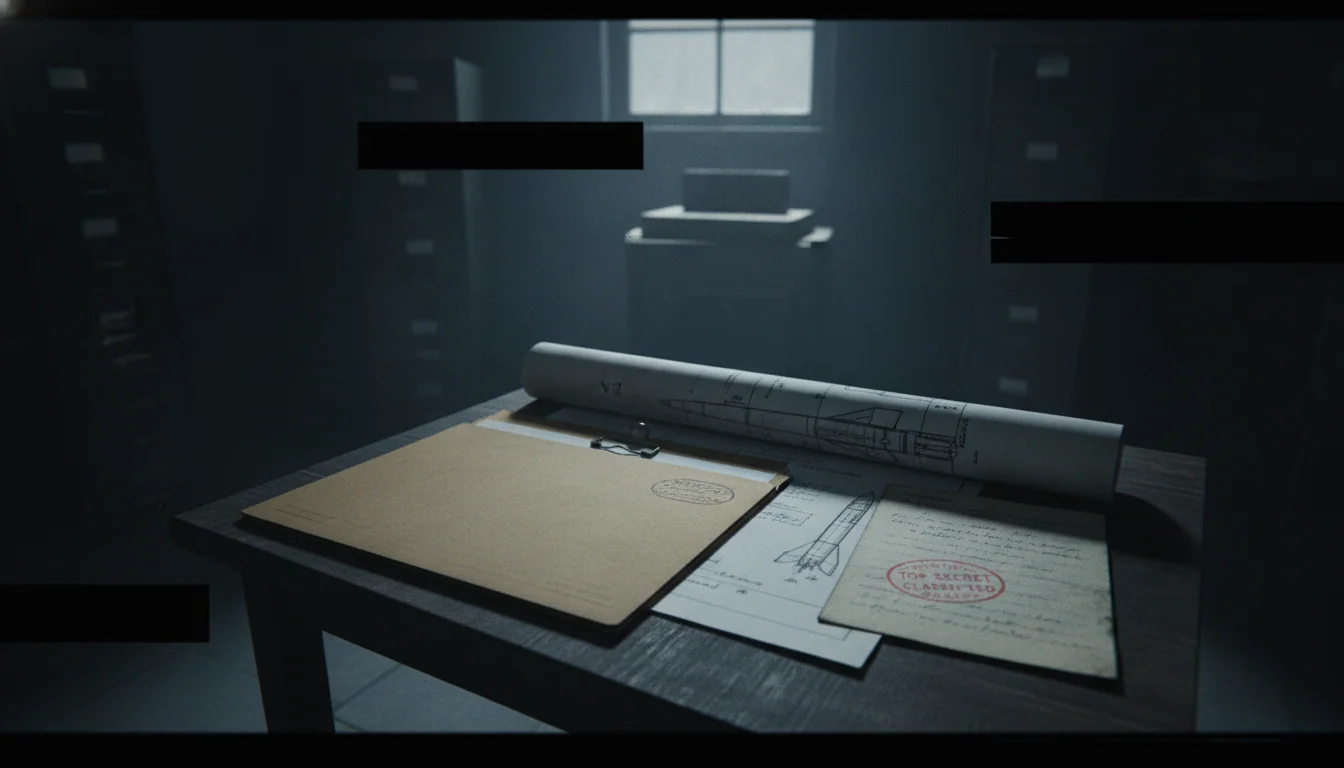
The file cover reads like a filing-room accident: a paperclip fastened to a folder to mark it for a second look. In practice, that small stationery detail decided which German engineers got a ticket to America after World War II and which ones got left behind for the war crimes tribunals. The declassified record now shows how deliberately that sorting was done, and how much of it was quietly rewritten along the way.
The secret Washington didn't want examined
Operation Paperclip was the US government's program to identify, recruit, and relocate German scientists, engineers, and technicians after the collapse of the Third Reich, embedding them in American military research and, eventually, the civilian space program. The secrecy was not really about whether the recruitment happened. Reporters and members of Congress knew, in general terms, that German specialists were being brought over. The part Washington wanted kept quiet was who, specifically, was on the list, and what their SS and Nazi Party files actually said before officials sanded the details down.
Public policy, laid out by the War Department, explicitly barred recruiting anyone who had been "more than a nominal participant" in Nazi Party activities or who was likely to be a war crimes suspect. The declassified files show that officers running the vetting frequently treated that policy as an obstacle to route around rather than a rule to enforce.
Origins: a race against the Soviets
The program's roots go back to the final months of the war, when American, British, and Soviet forces were all racing to reach German rocket, aviation, and chemical weapons research sites before rival powers did. The prize was the team behind the V-2, the world's first long-range ballistic missile, developed at the Peenemunde research facility on the Baltic coast under the technical direction of Wernher von Braun.
American intelligence officers moved quickly to secure von Braun's team, along with tons of V-2 components and documentation, ahead of the advancing Red Army. The initial recruitment effort ran under the codename Operation Overcast before being renamed Paperclip, reportedly for the literal paperclips attached to the files of scientists cleared for the American program.
The underlying justification given at the time was straightforward: better that this expertise work for the United States than for the Soviet Union, and better still that it not simply vanish or resurface for a hostile power. That Cold War logic, more than any admiration for the recruits themselves, is what the declassified authorization memos describe as the operating rationale.
The Soviets ran their own version of the same calculation. Under what later became known as Operation Osoaviakhim, Soviet forces rounded up German technical personnel from their own occupation zone, including specialists who had worked on rocketry and small arms development, and transported them east. Both sides understood the contest in identical terms: the war had ended, but the engineers who built the Reich's advanced weapons were now assets to be won rather than simply former enemies to be processed.
How the operation actually ran
The Joint Intelligence Objectives Agency oversaw recruitment, working through military intelligence units that combed occupied Germany for scientific personnel and their research files. Recruits were offered contracts, housing, and a path to American residency, first working under military supervision at facilities including Fort Bliss in Texas, later moving into more permanent postings as programs matured.
Vetting was supposed to filter out committed Nazis and anyone implicated in war crimes. In practice, according to files released decades later, the security dossiers on a number of recruits were edited to remove or minimize references to Nazi Party rank, SS commissions, and proximity to forced labor operations. Von Braun himself held an SS commission during the war, a fact his American file did not emphasize.
By the time the program wound down, more than a thousand German specialists, along with their families in many cases, had been resettled in the United States. Rocketry drew the most attention, but recruits also went into aviation medicine, guided missile guidance systems, aerodynamics, and chemical research, spread across Army, Navy, and Air Force facilities as well as private contractors. Some ended up in relatively obscure defense contracting roles. Others, particularly the rocket team around von Braun, moved into the center of American missile and space development, first building the Redstone and Jupiter missile programs for the Army, and eventually the Saturn V rocket that would carry Apollo astronauts to the Moon.
Von Braun himself became a naturalized American citizen in the mid-1950s and, alongside his technical work, turned into a genuine public figure, appearing in television specials on space travel and consulting on Disney programming about future spaceflight. By the time NASA stood up its Marshall Space Flight Center in Huntsville, Alabama, he was its director, a former SS officer now the public face of the agency's most ambitious engineering project. The declassified files make plain that this second act was not an accident of talent alone. It was the intended outcome of a recruitment program built specifically to convert wartime weapons expertise into peacetime, and eventually orbital, results.
The Nordhausen problem
The uncomfortable center of the Paperclip story is not the V-2 rocket itself but where it was built in the war's final year. Production of the missile moved underground to the Mittelwerk factory near Nordhausen, staffed with forced labor drawn from the nearby Mittelbau-Dora concentration camp. Conditions there were brutal, and an estimated tens of thousands of prisoners died from starvation, disease, exhaustion, and executions tied to the production effort. Historians researching the plant's output have noted the grim arithmetic: more people appear to have died building the V-2 than were killed by the missiles it eventually launched at London and Antwerp.
Arthur Rudolph, who served as production manager at Mittelwerk and later became a key figure on the Saturn V program at NASA, is the case most directly tied to that history. Decades after his recruitment, the Justice Department's investigators reopened his wartime record. Rather than face a denaturalization trial, Rudolph agreed in 1984 to leave the United States and renounce his citizenship. Von Braun, who died in 1977, did not live to face a comparable reckoning, and biographers still argue over how much operational knowledge he had of conditions at the plant versus how much he was able to distance himself from on paper.
Exposure: the files come open
For decades, the fuller picture of Paperclip's vetting process sat buried in classified and semi-classified archives. Investigative reporting in the late twentieth century, drawing on Freedom of Information requests and interviews with former intelligence officers, pushed the whitewashed dossiers into public view and forced the government to acknowledge that screening standards had been quietly relaxed for scientists judged too valuable to lose.
The Nazi War Crimes Disclosure Act of 1998 accelerated the process, requiring federal agencies to review and release Nazi-era records held across the intelligence community, including material connected to recruited scientists. That later release confirmed much of what investigative journalists had already reported: the vetting process had been treated as negotiable when the recruit's technical value was judged high enough.
What the files say, and what still isn't
The declassified record confirms the shape of the story that once sounded like a conspiracy theory: the United States knowingly recruited scientists with documented Nazi affiliations, softened their security files to get them past a policy designed to exclude exactly that kind of recruit, and folded their expertise directly into American rocketry, culminating in the technology that reached the Moon. It also confirms that at least one senior figure, Rudolph, was later judged by American investigators to have a wartime record serious enough to warrant losing his citizenship rather than standing trial.
What the files do not settle, and probably never will, is a clean verdict on individual conscience. How much did von Braun know, and when, about conditions at Mittelwerk? How many of the more than a thousand recruits genuinely believed in the ideology they served, versus those who were, as the postwar phrase went, merely along for the technical ride? Some personnel files were reportedly incomplete or destroyed over the years, and the intelligence community's internal judgments about individual recruits remain thinner than the public wants them to be.
What is not in dispute is the outcome. The same expertise that built a weapon designed to terrorize European cities went on, within a generation, to put American astronauts on the lunar surface. For the mission that expertise ultimately delivered, see First Man vs. History and Apollo 13 vs. History.
Quick Answers
Common questions about this topic
Was Operation Paperclip real?
Yes. It was a real, officially sanctioned US government program that ran from the mid-1940s into the 1950s, bringing more than a thousand German scientists and engineers to the United States. Records on the recruitment process were declassified in stages starting in the 1990s and again after the Nazi War Crimes Disclosure Act of 1998.
Did the US know these scientists had Nazi ties?
According to the declassified record, yes, at least in broad terms. Vetting files show military intelligence officers were aware of Nazi Party and SS memberships and, in a number of documented cases, altered or softened dossiers so recruits could pass a security screening meant to exclude ardent Nazis and war criminals.
Who was the most famous Operation Paperclip scientist?
Wernher von Braun, the lead designer of Nazi Germany's V-2 rocket, is the best known. He went on to direct the development of the Saturn V rocket that carried the Apollo missions to the Moon, making him both the program's most celebrated success story and its most uncomfortable one.
Is anything about Operation Paperclip still classified?
Some individual personnel files and intelligence-community internal assessments remain partially redacted or were reportedly destroyed over the decades, so historians cannot fully reconstruct every recruit's wartime record. The broad shape of the program, however, is no longer secret.

Interrogate the Spymasters
Chat with the agents and analysts the files were about.
Create your free account →No card required. Some figures and features require a paid plan.
Join the HistorIQly Club
Get smarter about the past.
Weekly stories, deep dives, and exclusive content straight to your inbox.