Declassified: The Pentagon Papers
The Pentagon Papers proved the government had lied about Vietnam for years. Here is what the declassified files actually document.
Read Wikipedia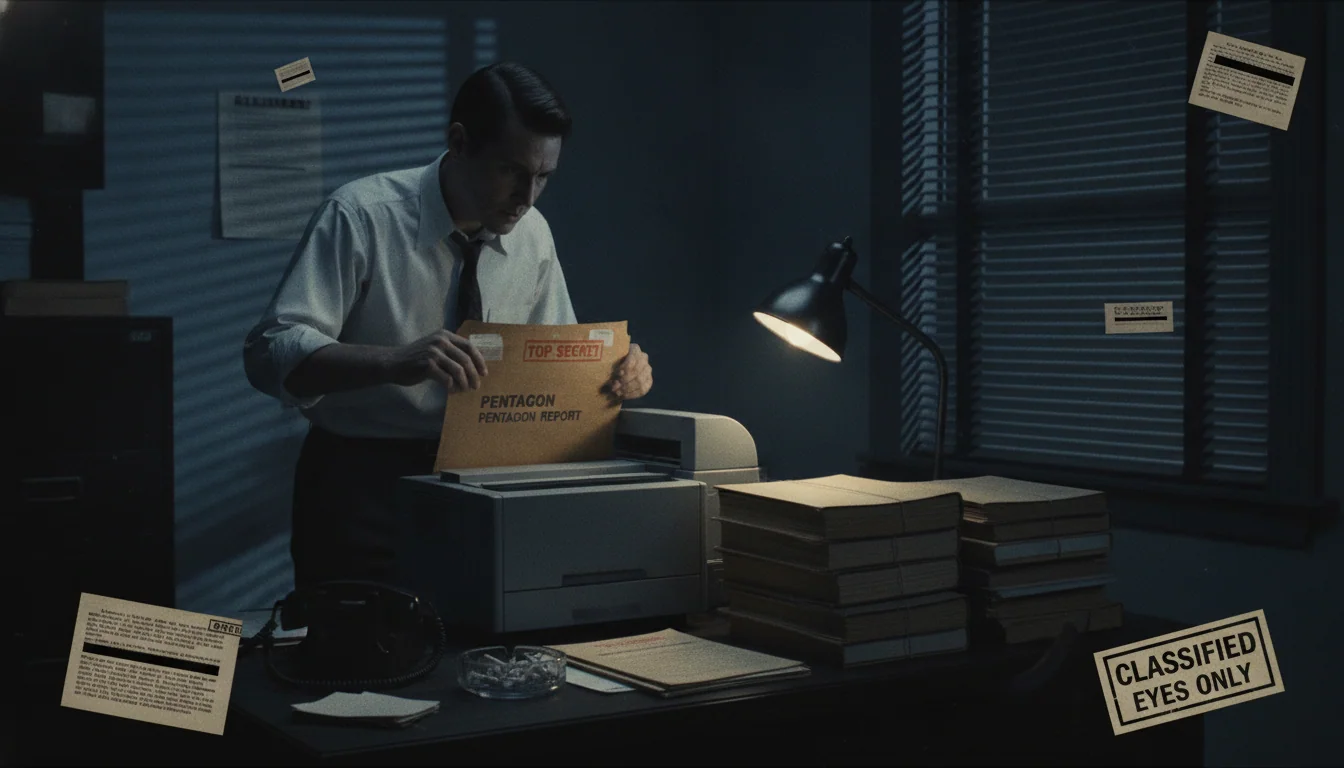
In June 1967, Secretary of Defense Robert McNamara quietly ordered a full internal history of how the United States had gotten into Vietnam. He did not commission it to make anyone look good. He commissioned it, according to later accounts from people who worked on it, because he had come to doubt the war he had spent years running, and he wanted a record before the truth got buried along with everything else. Four years later, that record became public anyway, not through McNamara's choice but through a leak so consequential it reached the Supreme Court within weeks.
The secret
The study that resulted, later known to the public simply as the Pentagon Papers, was a sprawling internal history of American decision-making on Vietnam from the end of World War Two through 1967. It ran to roughly 7,000 pages across 47 volumes, and it was classified at the highest levels precisely because it was never meant to be read outside a small circle of officials. Its value, and its danger, lay in its candor. Analysts writing for an internal audience with no expectation of public scrutiny had little reason to soften what the record showed: that across several administrations, officials had escalated the war, expanded covert operations, and continued bombing campaigns while privately doubting, and at times flatly disbelieving, that the war could be won.
That gap between the public case for the war and the private assessment of it was the actual secret. Not a single covert operation, but a pattern, laid out in the government's own words, of telling the public one story while acting on another.
Origins
By the mid-1960s, McNamara had grown quietly skeptical of a war he had helped architect. He ordered the study without, according to several accounts, fully informing President Lyndon Johnson of its scope, and assembled a team of several dozen military analysts, historians, and researchers, some pulled from the Pentagon and others from the RAND Corporation, a defense-focused think tank that did extensive contract work for the Department of Defense. Their brief was to reconstruct the internal decision-making of the Truman, Eisenhower, Kennedy, and Johnson administrations using classified cables, memos, and planning documents, not press accounts or public statements.
The irony, often noted afterward, is that the study was not even finished until 1969, after McNamara himself had already left the Pentagon. The man who ordered an honest reckoning with the war never saw the finished product land on his own desk. It landed instead with his successor, Clark Clifford, and then simply sat in a Pentagon safe and a RAND vault, filed away rather than acted on, exactly the outcome an internal history with no publication plan was always going to produce.
The operation
The task force worked largely in isolation, drawing only on internal government documents and largely avoiding outside interviews, a method meant to preserve secrecy but that also gave the finished study an unusually documentary, warts-and-all quality. Diplomatic volumes covering sensitive negotiations were reportedly kept separate at the State Department's request. When it was done, the study was stamped Top Secret, Sensitive, and only a small number of complete copies were ever produced, distributed to a handful of senior officials and archived at RAND, where several of the analysts who had helped write it still worked.
One of them was Daniel Ellsberg, a former Marine officer with a doctorate in economics who had worked inside the Pentagon under McNamara and had spent time in Vietnam observing the war firsthand. Ellsberg had entered government service a believer in the war's necessity. By the time the study reached RAND's vault, he had become convinced the war was unwinnable and that the public had been misled about it for years. Access to the finished volumes, according to his later accounts, hardened that conviction into a decision to act.
Working at night with a RAND colleague, Anthony Russo, Ellsberg began photocopying the study page by page, volume by volume, an undertaking that reportedly took months given the primitive office copiers of the era and the sheer bulk of the material. He first approached members of Congress, reportedly including Senator William Fulbright, hoping a sitting senator might read the papers into the public record under the protection of congressional privilege. When that avenue produced nothing, he turned to the press, and specifically to New York Times reporter Neil Sheehan.
Exposure
The New York Times began publishing excerpts of the study on June 13, 1971, under a headline announcing a secret Pentagon history that contradicted years of public statements about the war. The Nixon administration, which had inherited the war rather than started it, reacted with alarm anyway, obtaining a rare prior-restraint injunction to halt further publication, the first such order against a major American newspaper in the nation's history. When the Washington Post obtained its own copy and continued publishing, the government sought to block it too, and the dispute escalated to the Supreme Court within roughly two weeks.
While the Times and the Post fought their injunctions in court, copies of the study reportedly kept moving. Ellsberg and his contacts distributed sections to at least a dozen other American newspapers, which began publishing their own excerpts even while the two biggest papers in the country were legally barred from doing so, an improvised distribution network that made any single injunction nearly meaningless as a way of actually containing the material.
On June 30, 1971, the Court ruled 6 to 3 in New York Times Co. v. United States that the government had not met the heavy burden required to justify prior restraint on publication, and the papers kept printing. It remains one of the defining First Amendment rulings in American history.
The legal fight over publication was only half the story. Ellsberg and Russo were indicted on charges including conspiracy, espionage, and theft of government property, facing a combined sentence well over one hundred years if convicted. During the prosecution, evidence emerged that a White House unit known informally as the Plumbers, formed partly in response to the leak, had broken into the office of Ellsberg's psychiatrist, Dr. Lewis Fielding, searching for material to discredit him, and that Ellsberg had also been the subject of improper wiretapping. In May 1973, Judge William Matthew Byrne Jr. dismissed all charges, citing what he called improper government conduct that had violated Ellsberg's rights so thoroughly that a fair trial was no longer possible.
What the files say, and what is still classified
The declassified record supports a clear conclusion: officials across several administrations knew, in their own internal documents, that the war's public justification did not match its private assessment. The study documented covert operations against North Vietnam, expanded bombing in Laos, and planning assumptions that treated the war's likely failure as an internal working premise even as public statements promised steady progress. That is the documented finding, not a conspiracy theory layered on top of it.
What the files do not show is any Nixon administration wrongdoing in Vietnam itself, since the study's coverage stopped in 1967, before Nixon took office. Nixon's furious reaction, and the illegal countermeasures it triggered, are better read as a president protecting the precedent of executive secrecy than as an attempt to hide his own war conduct, though the break-in and wiretapping used against Ellsberg became, in their own right, part of the broader pattern of abuses that surfaced during the Watergate era.
Much of the study itself is no longer secret. Large sections were declassified during and after the 1971 litigation, and in 2011, on the fortieth anniversary of publication, the National Archives released the complete text, with only a small number of pages still withheld. What remains genuinely uncertain is narrower: the precise details of how thoroughly the Plumbers unit's broader activities were ever fully accounted for, and how many of Ellsberg's private conversations with sources and colleagues were monitored beyond what has been documented. The core story, though, the one the files were built to hide, is no longer in dispute. The government had spent years telling the public one thing about Vietnam while its own records said another, and the study written to preserve an honest account of that gap ended up, against its authors' intentions, delivering it straight to the public it was written to keep in the dark.
For two other declassified files that reshaped how the public understood the Cold War, see Operation Paperclip and the Iran-Contra Affair.
Quick Answers
Common questions about this topic
Was the Pentagon Papers leak real?
Yes. In 1971, military analyst Daniel Ellsberg photocopied a classified Pentagon study of the Vietnam War and gave it to the New York Times and other papers, triggering a Supreme Court case, a failed espionage prosecution, and a scandal that reached the Nixon White House.
Who leaked the Pentagon Papers?
Daniel Ellsberg, a former Pentagon and RAND Corporation analyst who had helped compile the study, copied it with the help of a colleague, Anthony Russo, after Ellsberg concluded the war could not be won and the public deserved to know it.
What did the Pentagon Papers reveal?
The declassified record shows that several administrations privately doubted the war was winnable while publicly claiming progress, and that covert operations and expanded bombing were kept from Congress and the public. The study's coverage stopped in 1967, so it did not document the Nixon administration's own conduct of the war.
Are the Pentagon Papers still classified?
Mostly no. The government declassified large portions during the 1971 litigation and later releases, and in 2011, on the fortieth anniversary of publication, the National Archives released the complete text, with only a small number of pages still withheld.

Interrogate the Spymasters
Chat with the agents and analysts the files were about.
Create your free account →No card required. Some figures and features require a paid plan.
Join the HistorIQly Club
Get smarter about the past.
Weekly stories, deep dives, and exclusive content straight to your inbox.