The Hindenburg Disaster: Minute by Minute
The Hindenburg disaster killed 36 people in 34 seconds when the airship burned at Lakehurst, New Jersey, on May 6, 1937. Its exact cause is still argued over.
Read Wikipedia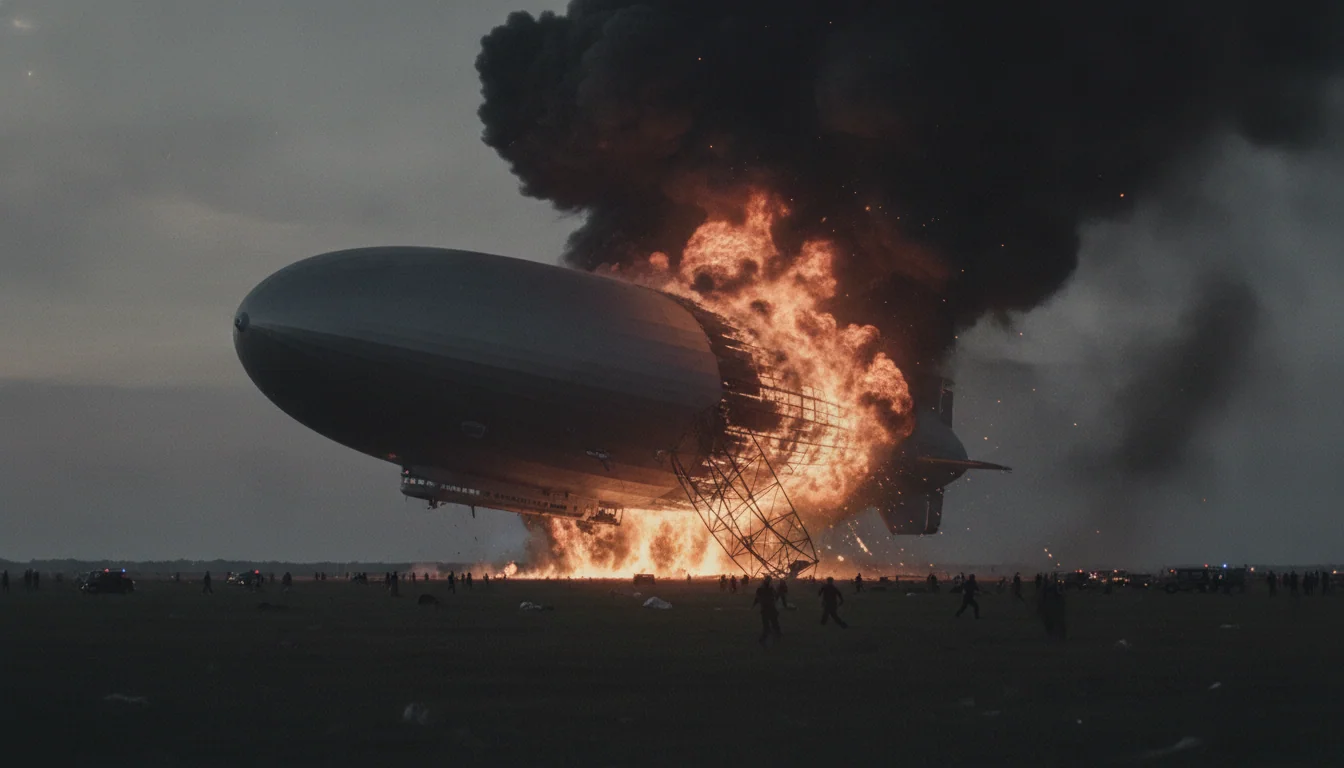
At a few minutes past seven on the evening of May 6, 1937, the largest flying machine ever built floated low over a New Jersey airfield, engines idling, mooring lines already snaking down toward the ground crew. Ninety-seven people were aboard the Hindenburg, most of them looking forward to a hot bath and a rail connection to New York after three days crossing the Atlantic. Within half a minute of the first spark, thirty-six people, thirty-five of them aboard and one member of the ground crew, would be dead, and the pride of German aviation would be a smoking skeleton of girders on the grass.
A giant built on a compromise
The Hindenburg, officially LZ 129, was a rigid airship nearly 804 feet long, nearly as long as the Titanic though a small fraction of its weight. It could carry up to 72 passengers in real comfort: private cabins, a dining room, a lounge, and, astonishingly given what it was flying on, a smoking room sealed behind an airlock and fitted with an electric lighter, since matches were forbidden anywhere else aboard.
That caution existed because the ship flew on hydrogen rather than helium. Zeppelin's engineers had designed the Hindenburg to use helium, the inert and non-flammable gas that the United States controlled almost the world's entire supply of. Washington restricted helium exports, wary of arming Nazi Germany's aviation program, so the ship was filled instead with more than seven million cubic feet of hydrogen: cheap, plentiful, and explosive.
By 1937 the Hindenburg was already a celebrity. It had crossed the Atlantic many times in its first full year of service, carrying wealthy passengers, mail, and no small amount of propaganda for the Nazi government, which had a stake in the Zeppelin company and required swastikas painted on the tail fins. This flight, the first scheduled transatlantic crossing of the 1937 season, had left Frankfurt on May 3 with a lighter passenger list than the ship's capacity allowed. Strong headwinds over the Atlantic had already put it roughly half a day behind schedule.
A delayed approach
The Hindenburg reached the New Jersey coast on the afternoon of May 6, but thunderstorms rolling through Lakehurst forced Captain Max Pruss to keep the ship circling over the shore and nearby towns for hours rather than attempt a landing. Passengers watched the same stretch of coastline pass beneath them again and again. Ground crews at Naval Air Station Lakehurst waited out the rain.
Around 7:00 in the evening, with the weather clearing, the station commander radioed clearance to land. Pruss chose a faster method than usual, a "high landing" that dropped mooring lines from several hundred feet so ground crews could walk the ship down by hand rather than wait for it to descend gradually under engine power. It was meant to make up time after the delay, and nobody involved considered it reckless. In hindsight, investigators would note that it left the airship making sharp maneuvers at low altitude with a full load of hydrogen, in air still carrying the electrical charge of a passing storm front.
Minute by minute
At about 7:21 p.m., the Hindenburg dropped its landing lines to the crew below. A few minutes later, at roughly 7:25, witnesses on the field saw a flicker of flame near the tail, close to the upper fin, in the vicinity of one of the rearmost gas cells.
What followed took roughly 34 seconds. The flame ballooned into a fireball that ran forward along the ship's spine as one hydrogen cell after another ignited. The tail dropped first, slamming into the ground while the nose, still partly buoyant, pointed briefly skyward. Passengers and crew near the front were thrown against bulkheads as the frame buckled beneath them. Within half a minute the entire ship, a rigid structure of metal girders and doped cotton fabric years in the building, was collapsing in flames onto the airfield.
Some survived by leaping from windows as the gondola neared the ground. Others clambered out through torn fabric once the frame settled. A teenage cabin boy reportedly owed his life to a water ballast tank that burst open just above him at the critical moment, dousing him as the fire reached his section of the ship. Ground crew members, some of whom had been holding the mooring lines only seconds earlier, ran back into the flames to pull survivors clear.
Herbert Morrison's broadcast
Watching from the field was Herbert Morrison, a radio announcer sent by a Chicago station to record color commentary on the landing for broadcast later that evening. He and an engineer had been capturing routine descriptions of the ship's arrival onto a disc-cutting machine when the fire broke out. Morrison's composure cracked in real time. "It's broken into flames... this is terrible... oh, the humanity," he said, his voice climbing toward tears as he narrated a disaster he could barely process while it was happening in front of him.
Contrary to popular memory, none of it went out live. Morrison's recording was made for delayed broadcast, and it was, in fact, aired later that night and picked up widely afterward, its raw emotion turning it into one of the most replayed pieces of audio of the century. It would be nearly fifty years before another famous aviation disaster, the Challenger explosion, was watched by a horrified public in real time. Newsreel cameras on the field captured the fire on film separately, without synchronized sound. It was only later, when broadcasters and documentary makers laid Morrison's audio over the silent newsreel footage, that generations of viewers came away with the mistaken impression they were hearing the disaster exactly as it happened, live and in sync.
The toll
Thirty-six people died: passengers and crew caught in the fire or the fall, and one member of the Lakehurst ground crew, struck by the collapsing structure. Sixty-two of the 97 people aboard survived, a remarkable figure given the size of the fireball and the fact the ship was still tens of feet above the ground when the fire began. Ernst Lehmann, a former Zeppelin captain riding along as an observer, escaped the wreck but died of his injuries the following day. Captain Pruss himself survived with severe burns.
What the inquiry found, and what still gets argued
Both the United States Commerce Department's board of inquiry and a separate German commission investigated the disaster within weeks. Neither found evidence of a bomb or deliberate sabotage, despite persistent suspicion at the time, some of it fueled by Nazi officials eager to blame anti-fascist saboteurs rather than their own airship program. The leading conclusion from both inquiries was that hydrogen escaping from a leaking or ruptured gas cell near the tail was ignited by a discharge of static electricity, likely generated as the ship's fabric skin moved through the electrically charged air of the recent storm while its metal frame was already grounded by the mooring lines.
That verdict has never fully settled the argument. Some later researchers have pointed to a snapped bracing wire that may have torn open a gas cell during the sharp final turn. Others, most prominently a NASA engineer researching material flammability starting in the 1990s, have argued that the aluminum-infused doping compound painted onto the ship's outer fabric, chemically similar to some solid rocket propellants, was the true accelerant, with the hydrogen playing a secondary role once the skin itself caught fire. Most airship historians remain unconvinced by that theory.
Public confidence in hydrogen airships collapsed within days, and the ships that might have followed the Hindenburg into commercial service never got the chance. It was an early example of a pattern later repeated at Chernobyl, where a single catastrophic failure could end public trust in an entire technology almost overnight.
The Hindenburg disaster remains one of the most heavily documented catastrophes in aviation history, but exactly which spark, or which torn seam, started the fire will probably never be settled beyond doubt. Of the theories on the table, the one that has held up best since 1937 remains the one the original inquiries reached: a leak of hydrogen from a damaged gas cell, ignited by static electricity, in a sky still charged from the storm that had delayed the landing in the first place.
Quick Answers
Common questions about this topic
What caused the Hindenburg disaster?
The American and German inquiries both concluded that hydrogen leaking from a damaged gas cell near the tail was most likely ignited by a spark of static electricity that had built up on the airship's fabric skin. A minority of researchers have argued that the fabric's flammable doping compound, not the hydrogen, was the real accelerant, and a few have floated sabotage, but no inquiry has ever found solid evidence of a bomb or a deliberate act.
How many people died in the Hindenburg disaster?
Thirty-six people died: passengers and crew caught in the fire aboard the airship, plus one member of the Lakehurst ground crew struck by the collapsing structure. Sixty-two of the 97 people aboard survived, many by jumping clear as the tail dropped.
Was Herbert Morrison's famous broadcast really live?
No. Morrison was recording the landing onto a disc for delayed broadcast that evening, not narrating live over the airwaves as the fire happened. The recording's raw emotion, later paired with silent newsreel footage of the fire, created the lasting false impression that America heard the disaster as it unfolded.
Why did the Hindenburg use hydrogen instead of safer helium?
Zeppelin's engineers designed the ship with helium in mind, but the United States controlled almost the world's entire helium supply and restricted its export, partly out of wariness toward Nazi Germany. The Hindenburg flew on hydrogen instead, gaining lift but losing any margin of safety if the gas ever escaped and found a spark.

Talk to the Survivors
Hear firsthand accounts from people who lived through history's darkest days.
Create your free account →No card required. Some figures and features require a paid plan.
Join the HistorIQly Club
Get smarter about the past.
Weekly stories, deep dives, and exclusive content straight to your inbox.