Challenger: 73 Seconds Over Florida
On January 28, 1986, Space Shuttle Challenger broke apart 73 seconds after launch. Engineers had warned against the cold the night before. Here is what happened, minute by minute.
Read Wikipedia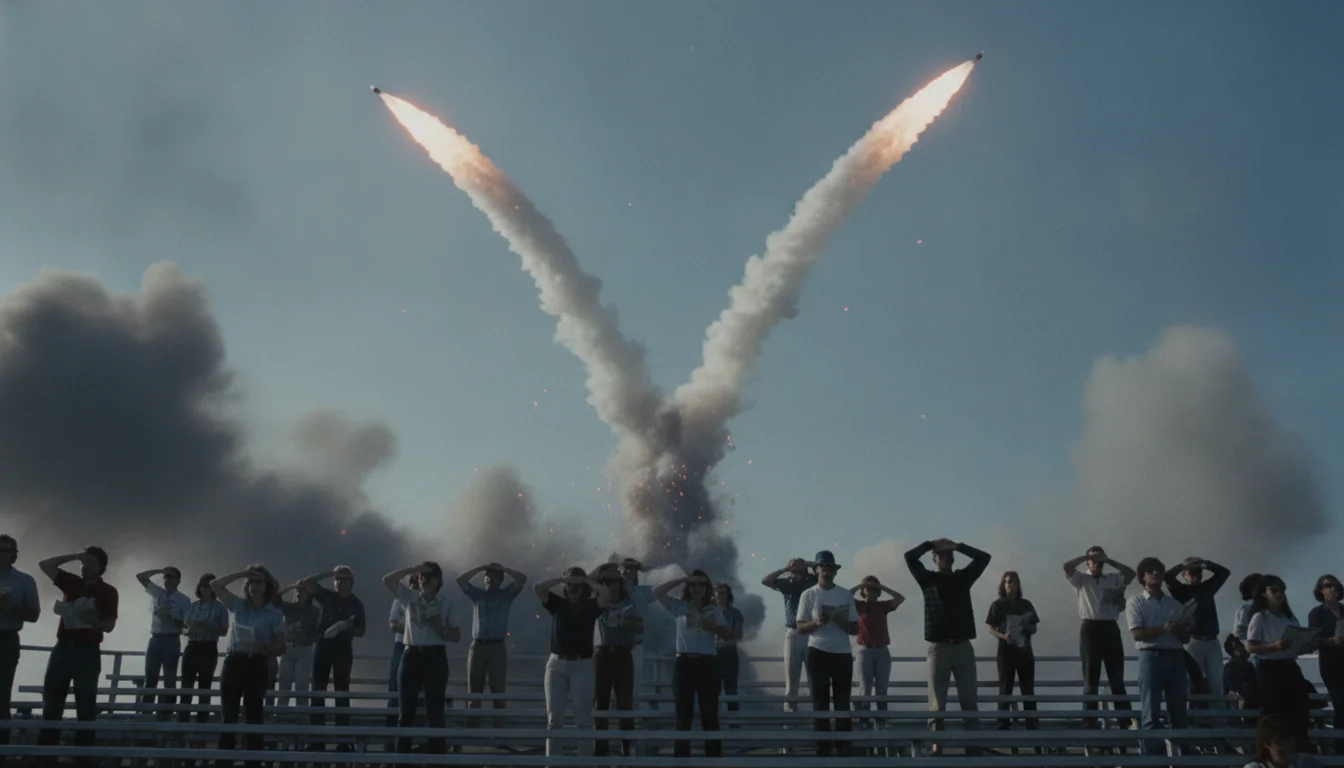
At 11:38 a.m. on January 28, 1986, Space Shuttle Challenger lifted off from Kennedy Space Center in Florida, watched live on television by millions of schoolchildren tuning in because a public school teacher was aboard. Seventy-three seconds later, the vehicle broke apart in a plume of smoke and fire over the Atlantic, in view of the launch crowd and the cameras. All seven crew members died.
The setting
The mission, designated STS-51-L, carried a crew of seven: commander Francis "Dick" Scobee, pilot Michael Smith, mission specialists Judith Resnik, Ellison Onizuka, and Ronald McNair, payload specialist Gregory Jarvis, and Christa McAuliffe, a New Hampshire social studies teacher selected from over 11,000 applicants through NASA's Teacher in Space Project. McAuliffe's presence, and NASA's plan to have her broadcast lessons from orbit, meant the launch drew unusually heavy media and classroom attention even by shuttle-program standards.
The morning of January 28 was unusually cold for Florida, with overnight temperatures dropping into the low twenties Fahrenheit and icicles visible on the launch tower. The launch had already been delayed several times over the preceding days for weather and technical issues, and by the morning of the 28th there was real pressure, reported later in the investigation, to avoid another slip.
The warning the night before
The night before launch, engineers at Morton Thiokol, the contractor that built the shuttle's solid rocket boosters, held a teleconference with NASA officials to discuss the forecast cold. Engineer Roger Boisjoly and several colleagues argued strongly against launching in temperatures that cold, pointing to data from a previous cold-weather launch in which the booster's rubber O-ring seals, joints designed to contain the extreme pressure and heat of burning solid propellant, had shown signs of erosion and reduced resilience at low temperatures. Thiokol management initially recommended against launch. Under pressure from NASA managers concerned about further delays, Thiokol reversed its position and gave a formal go-ahead, a decision that later became the central focus of the disaster's investigation.
The timeline
Challenger launched on schedule at 11:38 a.m. Within the first second, cameras later showed a puff of dark smoke escaping from a joint on the right solid rocket booster, a sign, investigators would later determine, that the O-ring seal at that joint had failed to seal properly against the cold and the force of ignition. For roughly a minute, the booster held together despite the compromised seal, aided incidentally by charred propellant residue that temporarily plugged the breach.
At around 58 seconds into the flight, that temporary seal gave way under increasing aerodynamic stress as the vehicle passed through a period of maximum dynamic pressure. A flame plume became visible, growing rapidly and burning through the booster's external strut connecting it to the large external fuel tank. At approximately 73 seconds, the strut failed, the booster rotated into the external tank, and the tank's liquid hydrogen and liquid oxygen ignited and ruptured. The resulting aerodynamic forces tore the orbiter itself apart, not through an explosion in the popular sense but through structural breakup as the vehicle was subjected to forces far beyond what it was designed to withstand.
The decisions
The Rogers Commission, the presidential panel that investigated the disaster, concluded that the technical cause was the O-ring failure, but that the more consequential failure was organizational. The commission found that NASA's launch-decision process had, over years of successful flights, developed what later analysts called a normalization of deviance: prior instances of O-ring erosion on earlier missions had been treated as an acceptable, managed risk rather than as a warning sign requiring the program to stand down. Physicist Richard Feynman, a commission member, famously demonstrated the O-ring's loss of resilience in cold temperatures during a televised hearing by placing a sample in a glass of ice water and showing how it failed to spring back to its original shape. The commission's report was sharply critical of communication failures between engineers, who understood the risk, and higher-level NASA managers, who approved the launch without that risk being adequately conveyed up the chain or weighed against the cost of another delay.
The crew and the aftermath
The vehicle's breakup did not instantly kill the crew. The crew cabin, a reinforced structure separate from the rest of the orbiter, survived the initial disintegration largely intact and continued on a ballistic arc for approximately two minutes and forty-five seconds before striking the ocean surface at a velocity investigators estimated at well over 200 miles per hour, an impact that was almost certainly not survivable. Investigators later recovered the wreckage and found that at least some of the crew's emergency air packs, personal egress air packs meant to provide breathing air in a depressurization emergency, had been manually activated, evidence that at least some crew members survived the initial breakup and were aware something had gone wrong. Whether any crew member remained conscious for the full descent to the ocean has never been conclusively established, and NASA's official position has been to avoid speculating beyond what the physical evidence supports.
The inquiry's findings
Beyond the O-ring and the flawed launch decision, the Rogers Commission report detailed a pattern of engineers' concerns being filtered out or softened as they moved up NASA's management structure, and it criticized a broader agency culture that had, in the commission's words, come to accept escalating risk as normal because previous flights had not failed despite known problems. The commission's recommendations led to a substantial redesign of the solid rocket booster joint, including a third O-ring and a heater to keep the joint within a safer temperature range, and to the creation of an independent NASA safety office intended to give engineering objections a clearer channel to senior decision-makers that could not simply be overruled at a lower level.
The shuttle program did not fly again for 32 months, the longest grounding in the program's history to that point. Challenger's destruction, and the failures the Rogers Commission documented, became one of the most widely taught case studies in engineering ethics and organizational risk management, cited for decades afterward as an example of how technical warnings can be diluted or overridden once they collide with institutional pressure to keep to a schedule.
What the record still leaves open
Some details of the disaster's final moments remain genuinely uncertain rather than deliberately withheld. The precise sequence of events inside the crew cabin during its fall toward the ocean, including how quickly the cabin lost pressure and how long any crew member may have remained conscious, was reconstructed from physical evidence and engineering analysis rather than from any surviving account, and NASA's investigators were careful to describe their conclusions in terms of probability rather than certainty. What the inquiry did establish without ambiguity was the chain of decisions that placed Challenger on the launch pad on an unusually cold Florida morning despite a formal engineering warning issued the night before, a warning that, had it been heeded, would very likely have kept the vehicle grounded until conditions changed.
The watching classrooms
Part of what made the disaster land so hard on the American public was the audience NASA itself had cultivated for this specific mission. The Teacher in Space Project had generated months of coverage in schools across the country, and many classrooms had arranged special live broadcasts of the launch specifically so students could watch McAuliffe reach orbit. Instead, millions of children watched the vehicle break apart in real time, an image that network news replayed for days afterward and that became, for an entire generation, one of the defining shared memories of watching live television as a child. NASA's public affairs office, caught unprepared for a tragedy unfolding on a broadcast built around celebration, faced its own separate criticism in the disaster's immediate aftermath for how slowly and unclearly it communicated basic facts to a stunned audience in the first hour after the breakup.
Reagan's response and the funeral
President Ronald Reagan postponed a scheduled State of the Union address and instead delivered a nationally televised address that evening from the Oval Office, a speech written by Peggy Noonan that closed by describing the astronauts as having "slipped the surly bonds of earth to touch the face of God," a line drawn from a poem by aviator John Gillespie Magee Jr. The speech is still widely regarded as one of the more effective examples of presidential crisis communication in the modern television era, delivered with a directness that contrasted with NASA's own halting public statements in the hours immediately following the accident. Memorial services were held in Houston, and Congress later established a permanent Challenger Center education program, founded by the families of the crew, to continue the science education mission the flight had originally been designed to promote.
The longer reckoning
The Rogers Commission's findings did more than trigger a hardware redesign. They prompted a lasting cultural shift within NASA's own engineering ranks toward formal risk-communication protocols intended to ensure that a dissenting engineer's warning could not simply be absorbed and softened as it moved up a management chain, a lesson the agency would nonetheless have to relearn, in a different form, when the shuttle Columbia disintegrated during reentry in 2003 after a similar pattern of a known technical risk being downgraded through years of successful flights. Historians and engineering-ethics scholars have since treated the two disasters together as a linked case study in how large technical organizations can develop blind spots around risks that individual engineers inside the same organization had already identified and tried, without success, to escalate.
Quick Answers
Common questions about this topic
What caused the Challenger disaster?
A rubber O-ring seal in the right solid rocket booster failed to seal properly in unusually cold launch-morning temperatures, allowing hot gas to escape and ignite the external fuel tank. Engineers at contractor Morton Thiokol had warned NASA managers the night before the launch that the cold weather made the O-rings unreliable, but the launch proceeded anyway.
How many astronauts died on Challenger?
All seven crew members died: commander Francis Scobee, pilot Michael Smith, mission specialists Judith Resnik, Ellison Onizuka, and Ronald McNair, payload specialist Gregory Jarvis, and teacher Christa McAuliffe, who had been selected through NASA's Teacher in Space Project.
Did the crew survive the initial breakup?
The vehicle broke apart 73 seconds after launch, but the crew cabin itself remained largely intact and continued on a ballistic trajectory for roughly two minutes and forty-five seconds before hitting the ocean surface. Investigators found evidence that at least some emergency air packs had been activated, suggesting some crew members may have survived the initial breakup, though it remains uncertain whether any were conscious by the time of impact.
What changed after the Challenger disaster?
NASA grounded the shuttle program for 32 months, redesigned the solid rocket booster joints, created an independent safety office, and restructured its launch-decision process to give engineering concerns more weight against schedule pressure. The Rogers Commission's report also became a widely studied case in how organizations suppress internal warnings.

Talk to the Survivors
Hear firsthand accounts from people who lived through history's darkest days.
Create your free account →No card required. Talk to anyone in history with 8 free credits a day. Some features require a paid plan.
Join the HistorIQly Club
Get smarter about the past.
Weekly stories, deep dives, and exclusive content straight to your inbox.