Elvis (2022) vs. History: How Accurate Is Baz Luhrmann's Biopic?
Elvis 2022 accuracy: Baz Luhrmann gets the Memphis roots and music right but reduces Colonel Tom Parker to a cartoon and gives Elvis a pass on his own choices.
Read Wikipedia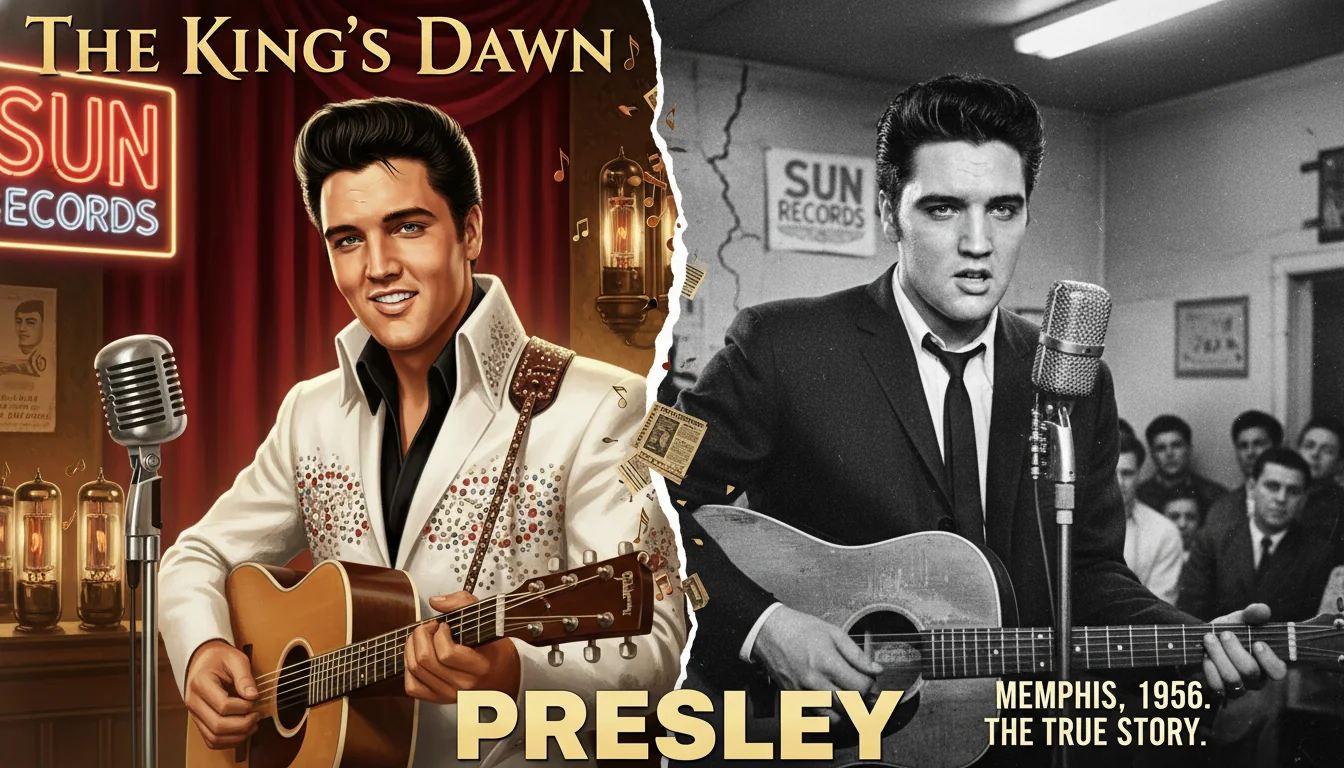
Elvis 2022 accuracy debates have followed the film since its Cannes premiere, centering on how Luhrmann portrays Colonel Tom Parker. Baz Luhrmann's 2022 film arrives in a tradition of rock biopics so long and uneven that viewers have developed a reflex: assume the liberties. Some directors compress. Some invent. Some simply flatter their subject and call it love. What is unusual about Elvis is how unevenly it distributes its accuracy. When the film concentrates on music - specifically on how a white boy from a Mississippi housing project absorbed the African American gospel and blues of the postwar South and turned it into something the world had never quite heard - it is honest and illuminating. When it turns the same lens on Colonel Tom Parker, it produces something closer to a pantomime villain, and that villain then dominates the film's final act in ways that distort the actual history.
Austin Butler's performance as Presley earned him an Academy Award nomination and is generally considered the film's strongest element. Tom Hanks, buried in prosthetics as Parker, is doing something more problematic: creating a character who is vivid but not quite real.
What Hollywood Got RIGHT
The Memphis musical education
The film is correct and admirably specific about the musical world Elvis grew up in. The Presley family attended Pentecostal Assembly of God churches in Tupelo and later in Memphis, where the services were emotionally intense and rhythmically unlike the more restrained Protestant worship of white middle-class Tennessee. Beale Street's Black-owned clubs, the gospel sound of the Stamps Quartet, the country blues of the Mississippi Delta - this is where Presley absorbed the rhythmic and vocal language that made him unusual.
The film's recreation of Beale Street and the moment when young Presley wanders into Black Memphis and hears what is happening there is historically grounded. Biographer Peter Guralnick, whose two-volume life of Presley remains the definitive account, has been consistent: Elvis did not invent anything from scratch. He heard everything, had a natural ear for synthesis, and synthesized it with a conviction that made the result sound inevitable rather than borrowed.
Sam Phillips and Sun Records
The early Sun Records scenes are among the film's most accurate passages. Sam Phillips was genuinely looking for a white singer who could perform with the energy and feeling of Black blues and gospel without the racial barrier that kept Black artists off mainstream radio in 1954. The chemistry between Phillips and Presley, the famous "That's All Right" session of July 1954, and the way a local radio play by DJ Dewey Phillips turned into national attention within months - all of this is documented, and the film conveys it with reasonable fidelity.
The 1968 Comeback Special
One of the most important events in Elvis's career is the 1968 NBC television special, and the film handles it well. By 1968, Presley had spent most of the previous five years making formulaic Hollywood films that had eroded his credibility as a musician. Colonel Parker wanted the TV special to be a safe Christmas show - seasonal songs, warm lighting, broad middle-American comfort. Producer Steve Binder fought for something rawer.
What aired was Elvis in black leather, sitting with old friends on a small stage, playing the music he had grown up on. The film accurately shows Parker trying to prevent the raw format and Presley overriding him - which is consistent with Binder's own published account of the production and with the recollections of people who were present.
The Las Vegas trap
The film is also correct that Parker locked Presley into residencies at the International Hotel beginning in 1969, and that the arrangement contributed to his physical and psychological decline. Parker had gambling debts at the hotel. The contracts he negotiated for Elvis were below what other artists of his stature commanded. Between 1969 and 1976, Presley performed more than 800 consecutive sold-out shows in Las Vegas - a relentless commitment that kept him from the tours, new recordings, and creative challenges that might have sustained him.
Parker's documented commission eventually reached 50 percent of Elvis's earnings. The film puts this on screen without apology, and is correct to do so.
What Hollywood Got WRONG
Parker is flattened into a pure villain
The film's most significant historical distortion is Tom Hanks' Colonel Parker. The real Parker was manipulative, extractive, and ultimately harmful to Presley's career and health - but he also cared for Elvis in his way, spent decades building a global star from a regional novelty act, and was valued by Presley himself for most of their relationship. Presley could have fired him. He chose not to, repeatedly, even when the costs were obvious.
The film's Parker is a carnivalesque schemer who appears to understand precisely what he is doing and to feel little beyond calculation. The historical relationship was messier. Parker's defenders argue he was a brilliant promoter operating before the professional management infrastructure artists take for granted today. His critics, who have the better case, point to the 50 percent commission and the blocked international tours. But reducing him to a circus-tent villain flattens a story that is more interesting when Parker is understood as someone who genuinely could not see past his own interests, rather than someone who consciously sacrificed Elvis for sport.
Priscilla Presley's story is compressed
Priscilla Presley's marriage to Elvis, which lasted from 1967 to 1973, received limited treatment in the film. The film was structured around the Parker relationship, which made some compression of other storylines inevitable - but Priscilla ended up reduced to a peripheral presence. Her own account of the relationship, in her 1985 memoir, is genuinely interesting and would have complicated the film's thesis in useful ways. The film chose not to complicate it.
Priscilla made public comments indicating the film did not capture her relationship with Elvis accurately. She later softened those remarks, but her initial response was notable.
The victimhood narrative is too clean
The film presents Elvis as a sensitive artist repeatedly exploited by the system around him - by Parker, by the Vegas hotels, by a culture that wanted the idol rather than the man. There is real truth in this. But Guralnick's biography makes equally clear that Presley was a willing participant in many of the arrangements that confined him. He liked the money, the security, and the insulation that Parker provided. He resisted change in ways his situation could not sustain. He self-medicated in ways that compounded his decline long before Parker's management decisions became the primary cause of anything.
The linear victim narrative is emotionally satisfying and historically incomplete. Elvis made choices. The film lets him off the hook for most of them.
The Dutch origins of Parker are underplayed
The film does mention Parker's real identity as a Dutch national and his undocumented immigration status, but this thread is not followed with the depth it warrants. Parker's inability to travel internationally without risking exposure of his real identity is presented primarily as the explanation for why Elvis never toured Europe or Australia - markets where promoters offered substantial fees. This is correct, but the fuller picture is that Parker was managing a secret so serious that the nature of his control over Elvis had to be absolute. He could not afford Elvis to become independently powerful enough to hire different management, because independent inquiry into Parker's past was a genuine threat to his freedom. The film gestures at this without following it through.
Historical Accuracy Score: 7/10
Elvis gets the music right, gets the Memphis origins right, and gets the Las Vegas decline right. Austin Butler's performance captures enough of the real Presley to carry the film even when the script oversimplifies the surrounding history.
What it gets most right: the musical roots in Black Memphis, the Sun Records sessions, the 1968 Comeback Special, and the broad mechanism of Parker's financial exploitation.
What it gets most wrong: reducing Parker to pantomime villainy, marginalizing Priscilla Presley's story, and smoothing over Elvis's own complicity in the arrangements that eventually destroyed him.
If you want the fuller picture, read Guralnick's two-volume biography - Last Train to Memphis and Careless Love - before you watch the film. Then watch the film. The music will sound even better once you understand the story underneath it.
For other music biopics fact-checked against the historical record, see Bohemian Rhapsody vs. History on Queen's rise and Freddie Mercury's life, and Back to Black vs. History on Amy Winehouse.
Quick Answers
Common questions about this topic
How accurate is Baz Luhrmann's Elvis biopic?
The film is accurate on the broad strokes: Elvis's Memphis roots, his absorption of Black gospel and blues, Colonel Tom Parker's controlling influence, the 1968 Comeback Special, and the Las Vegas residencies that consumed his final years. It takes significant liberties with Parker's motivation, compresses the Priscilla Presley relationship, and presents a more linear victim narrative than the actual history supports.
Was Colonel Tom Parker really an illegal immigrant?
Parker's real name was Andreas Cornelis van Kuijk and he was born in Breda, the Netherlands, in 1909. He entered the United States without documentation in the late 1920s and never became a naturalized citizen. His inability to travel internationally without risking exposure was one practical reason Elvis never toured outside North America.
Did Colonel Tom Parker really have gambling debts to the International Hotel in Las Vegas?
Yes. Parker had a serious gambling addiction and accumulated significant debts at the International Hotel in Las Vegas, later renamed the Las Vegas Hilton. This is one reason he locked Elvis into Las Vegas residency deals at below-market rates - the arrangement partly serviced his own gambling losses.
How did Elvis really die?
Elvis Presley died on August 16, 1977, at Graceland in Memphis. He was found unconscious on his bathroom floor by his fiancee, Ginger Alden. The official cause of death was cardiac arrhythmia, but the autopsy revealed multiple chronic health conditions and a combination of prescription medications that contributed to heart failure at age 42.

Debate the Accuracy with the Real Figures
Ask the real people what Hollywood got wrong about their lives.
Create your free account →No card required. Some figures and features require a paid plan.
Join the HistorIQly Club
Get smarter about the past.
Weekly stories, deep dives, and exclusive content straight to your inbox.