Harriet vs. History: How Accurate Is the Harriet Tubman Biopic?
Harriet 2019 accuracy review: what director Kasi Lemmons got right about Tubman's visions, gun, and Combahee River Raid, and what she invented for dramatic effect.
Read Wikipedia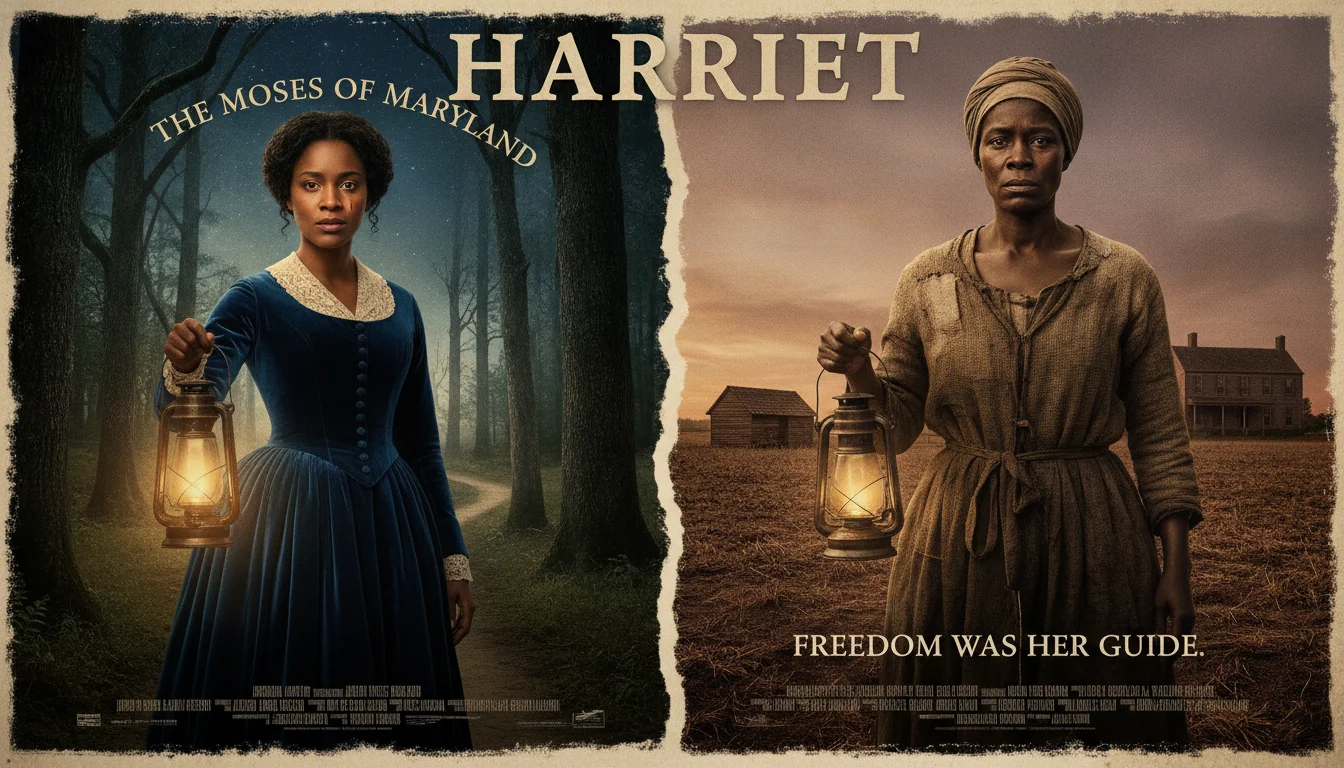
The life of Harriet Tubman is one of those historical cases where the documented facts are more dramatic than anything a screenwriter would risk inventing. She escaped from slavery alone. She went back, thirteen times, and brought roughly seventy people out with her. She carried a gun and told every person in her group she would use it on anyone who lost nerve and tried to turn back. During the Civil War she planned and led a military raid that liberated more than 700 people in a single night.
Director Kasi Lemmons' Harriet, released in 2019 with Cynthia Erivo in the lead role, covers the years from Tubman's escape in 1849 to the Civil War. The film earned Erivo an Academy Award nomination for Best Actress and introduced Tubman's story to an audience that had mostly encountered her as a name on a currency proposal or a middle-school biography. What it does with the history is worth examining carefully.
What Hollywood Got RIGHT
The visions
The film's most distinctive element is also its most historically accurate. Tubman suffered from narcoleptic episodes caused by a traumatic head injury inflicted when she was a teenager. An overseer threw a heavy metal weight at an escaping enslaved man and hit her instead, fracturing her skull. She lived with sudden blackouts for the rest of her long life.
Tubman reframed these episodes as divine communication - visions that told her which direction to move, when to stop, which paths were safe. She spoke about them in documented interviews and conversations with abolitionists including Thomas Garrett, the Quaker stationmaster in Wilmington, Delaware, who assisted her numerous times. Frederick Douglass, who met Tubman and corresponded with her, treated her accounts with the same seriousness she gave them. The film depicts this accurately and without condescension: the visions function in the story as what Tubman herself said they were, a navigational system she trusted completely.
The gun
Tubman said, in multiple documented accounts, that she carried a revolver on every mission and that she would shoot anyone who turned back. This was not theatrical intimidation. The logic was operational: someone who was captured could be interrogated, and could reveal names, meeting points, safe houses, and the identity of free people who had provided shelter. The safety of everyone moving forward depended on no one reversing course. She was explicit about it, and it worked. No one on any of her missions was ever captured or turned back.
Harriet shows the gun and shows her meaning it. It is one of the things the film handles with complete fidelity.
The Underground Railroad's actual infrastructure
The film accurately depicts the Underground Railroad not as a single organized network but as a loose web of individuals - Quakers, free Black communities, sympathetic white farmers, church networks - who took escalating personal risk. Thomas Garrett, played in the film with understated conviction, really did assist Tubman and other freedom seekers, and really was bankrupted by fines after being prosecuted for it, and really did respond, as the film suggests, that losing everything had only strengthened his resolve.
The Combahee River Raid
The final act of Harriet covers Tubman's Civil War service, culminating in the Combahee River Raid of June 2, 1863. Tubman had spent months in South Carolina's Low Country working as a spy and scout for the Union Army, recruiting a network of local informants to map Confederate fortifications, supply routes, and - critically - the positions of Confederate torpedoes (water mines) placed in the Combahee River.
She used this intelligence to guide Colonel James Montgomery and about 150 soldiers of the 2nd South Carolina Infantry, a Black Union regiment, upriver at night. The flotilla passed the torpedoes, landed at plantations along the river, destroyed rice stores and Confederate infrastructure, and returned with more than 700 enslaved people who had rushed to the riverbanks as the boats appeared. Montgomery's official report named Tubman as essential to the operation. The film's representation of this event is accurate in its essentials.
The marriage to John Tubman
Tubman's first husband, John Tubman, was a free Black man in Maryland who refused to escape with her and later remarried after she left. The film depicts his indifference to her plans accurately. After she escaped in 1849 she sent word asking John to come north and join her. He had already taken another wife and declined. She married a Union veteran named Nelson Davis in 1869, late in the film's timeline.
What Hollywood Got WRONG
Bigger Long is fictional
The film's primary antagonist is Bigger Long, a free Black slave-catcher played by Omar J. Dorsey, who pursues Tubman across multiple missions. He does not exist in the historical record. Bigger Long is either a composite or a wholly invented character.
This is the film's most consequential fabrication. The actual machinery of slave-catching was distributed and systemic: enslavers, hired patrollers, federal marshals operating under the Fugitive Slave Act, and an entire legal apparatus designed to enforce the recapture of people who had escaped. Collapsing that into a single Black antagonist creates a dramatic opponent for Erivo to face in the third act, but it inadvertently relocates the moral weight of the institution onto an individual who did not exist, and away from the structures that did. That systemic portrait is handled more directly in 12 Years a Slave, where the institution itself remains the antagonist throughout.
Specific escape routes are dramatized
The routes Tubman used were carefully kept secret and many specifics were never recorded, for obvious security reasons. The film reconstructs probable escape sequences - hiding in attics, crossing rivers, moving through farmland at night - based on what was generally known about Underground Railroad operations, not on a documented itinerary of Tubman's specific missions. The filmmakers have acknowledged this and it is a reasonable creative choice given the available sources. But viewers should understand they are watching a plausible reconstruction, not a documented record.
The recognition she received was gradual, not immediate
The film presents Tubman becoming quickly celebrated in abolitionist circles after her first return missions. Her reputation did grow, but more slowly than the film implies. Her relationship with key figures in Philadelphia and Boston developed over years. Her famous letter to her former enslaver, which the film references, was dictated after considerable time had passed. The abbreviation of that growth gives the film a more triumphant arc than the history strictly supports.
Her life after the war is absent
Harriet ends essentially at the Civil War and does not address what followed: Tubman's decades of advocacy for women's suffrage alongside Susan B. Anthony and Elizabeth Cady Stanton, her establishment of a home for elderly Black Americans in Auburn, New York, or her prolonged and ultimately successful campaign to receive a federal pension for her wartime service, a fight that lasted into her eighties. These are outside the film's scope, but the woman the film celebrates was only partway through her extraordinary life when the credits roll.
Historical Accuracy Score: 7/10
Harriet earns its high marks for getting the visions, the gun, and the Combahee River Raid right, and for presenting Tubman as a tactically rigorous operator rather than a saint. Cynthia Erivo's performance communicates the specific kind of courage Tubman possessed: not fearlessness, but the ability to act precisely despite fear.
What the film gets most right: Tubman's narcoleptic visions as a genuine operational system, her willingness to use her revolver, and the scale and reality of the Combahee River Raid.
What it gets most wrong: the invention of Bigger Long, which personalizes a systemic evil and places a fictional Black man at the center of it.
For the full historical record, Kate Clifford Larson's Bound for the Promised Land (2004) covers the documented details of Tubman's missions in more depth than any two-hour film can manage. The film is a useful introduction. The book is where the actual story lives.
Quick Answers
Common questions about this topic
Is the 2019 film Harriet historically accurate?
Broadly yes, with significant dramatizations. The core facts - Tubman's 1849 escape from Maryland, her return missions on the Underground Railroad, and her work as a Union Army scout - are grounded in the historical record. The main fabrication is the character of Bigger Long, a composite villain who did not exist, and certain escape sequences invented for dramatic effect.
Did Harriet Tubman really have visions?
Yes. Tubman suffered narcoleptic episodes caused by a severe head injury inflicted in childhood by an overseer. She described the episodes as divine guidance that directed her choices on Underground Railroad missions. Contemporaries including Thomas Garrett, a Quaker stationmaster, documented her accounts, and her trust in the visions was by all reports genuine and absolute.
Did Harriet Tubman really carry a gun?
Yes. Tubman carried a revolver on Underground Railroad missions and said she would shoot anyone who tried to turn back, because a captured runaway could expose the route and endanger everyone still moving. She was not bluffing, and no one on any of her missions turned back or was captured.
What was the Combahee River Raid?
The Combahee River Raid of June 2, 1863 was a Union operation in South Carolina in which Tubman guided Colonel James Montgomery and about 150 Black Union soldiers upriver past Confederate torpedoes to destroy infrastructure and liberate more than 700 enslaved people in a single night. It was the first military operation in US history planned and led by a woman.

Debate the Accuracy with the Real Figures
Ask the real people what Hollywood got wrong about their lives.
Create your free account →No card required. Some figures and features require a paid plan.
Join the HistorIQly Club
Get smarter about the past.
Weekly stories, deep dives, and exclusive content straight to your inbox.