The Last Morning of Pompeii
August 24, 79 AD began as an ordinary market day in Pompeii. By nightfall the city was buried, and Pliny the Younger had watched the whole thing from across the bay.
Read Wikipedia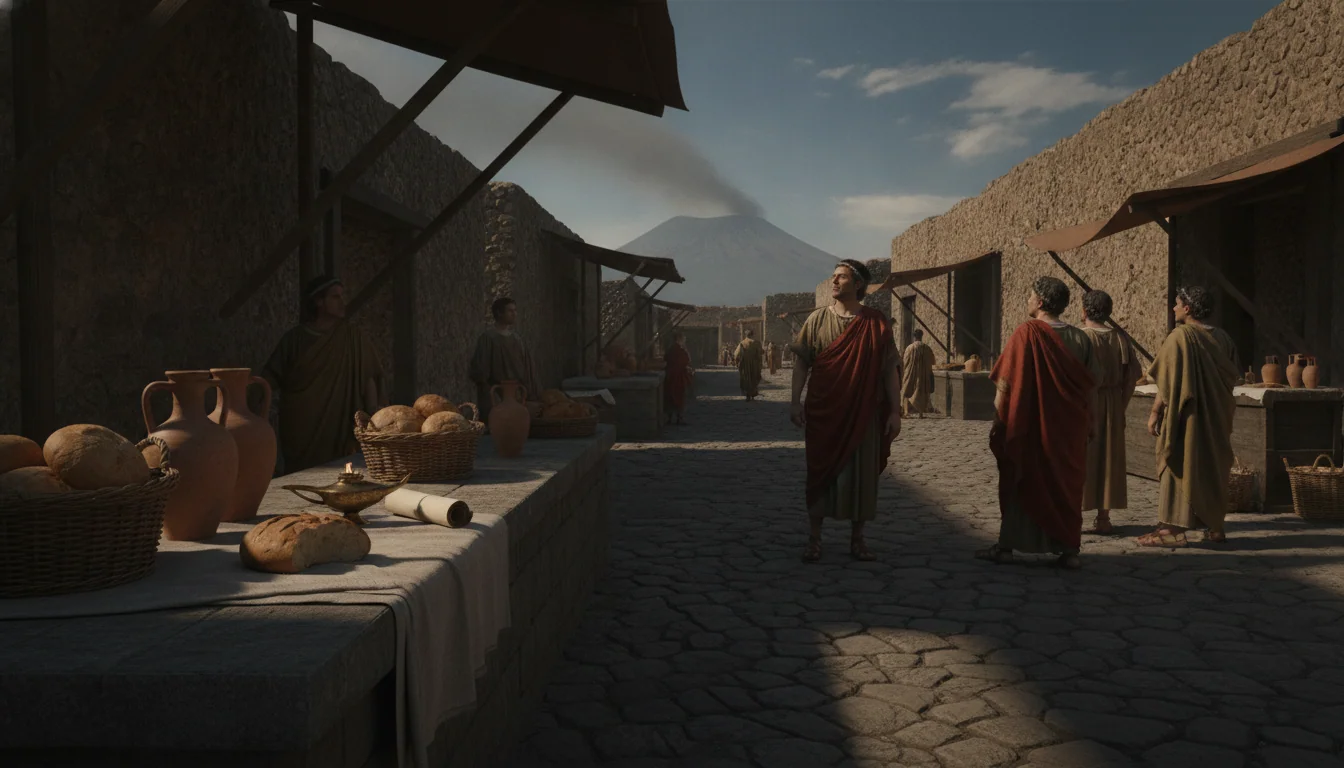
On the morning of August 24, in the year 79 AD, the residents of Pompeii went to market. Bread was baking in at least one bakery whose loaves would later be found carbonized in the oven. Wine was fermenting in cellars. A dog was chained in a courtyard. None of it was unusual, because nothing about that morning felt unusual, even though the mountain looming over the town had been rumbling on and off for days, and a strong earthquake seventeen years earlier had already cracked open buildings that were still, in some cases, unrepaired. By nightfall, the city and most of the people still in it would be gone, buried under meters of pumice and ash, and would stay that way, largely forgotten, for over a millennium and a half.
The day before: an ordinary town under a mountain nobody feared
Pompeii in the summer of 79 AD was a prosperous, mid-sized Roman port town of perhaps 12,000 people, a market center for the fertile volcanic farmland of the Bay of Naples and a resort destination for wealthy Romans with villas nearby. Mount Vesuvius rose a few miles to the north, green and cultivated on its slopes, and while the earthquake of 62 AD had done serious damage across the region, including the near-destruction of the neighboring town of Herculaneum, the mountain itself was not widely understood as an active volcano. Roman writers of the period, including the geographer Strabo, had noted the mountain's scorched summit rock and speculated it might once have burned, but no living resident had any personal memory of an eruption, because none had occurred in recorded history.
In the days before August 24, minor earthquakes had reportedly been felt around the bay, unremarkable in a region that had lived through the 62 AD quake and smaller tremors since. Wells and springs may have shown unusual behavior, a detail consistent with the kind of underground pressure changes that precede volcanic activity, though the ancient sources do not describe this in any systematic way. Whatever warning signs existed, they were not enough to prompt any evacuation. Pompeii went about its business.
The turning point
According to Pliny the Younger, writing decades later in two letters to the historian Tacitus, the eruption began in the early afternoon with a column of ash and pumice shooting miles into the sky, a shape he famously compared to an umbrella pine tree, spreading out at its top the way that distinctive Mediterranean tree spreads its canopy. Pliny watched this from Misenum, a naval town across the Bay of Naples where he was staying with his uncle, Pliny the Elder, commander of the Roman fleet stationed there.
His uncle, a career naval officer and the author of an enormous encyclopedic work called the Natural History, first observed the column purely out of scientific curiosity and ordered a light vessel prepared so he could get a closer look. Then a message arrived from Rectina, the wife of a friend living near the base of the mountain, begging for rescue by sea, since the coastal roads out were already choked. Pliny the Elder changed his plan from observation to rescue, ordered war galleys launched, and sailed directly toward the eruption, a decision his nephew, who stayed behind at Misenum with his mother, later described with clear admiration.
By the time the elder Pliny's ships reached the coast near Stabiae, several miles south of Pompeii itself, ash and pumice were already falling heavily on the vessels, and burning rock fragments made landing dangerous. He put in anyway, at the villa of his friend Pomponianus, reportedly reassuring the frightened household with a show of calm, even asking for a bath and a meal, and lying down to rest that evening while ash continued to fall outside.
The final hours in Pompeii
Inside Pompeii itself, the early hours of the eruption gave people a genuine, if narrowing, window to escape. Pumice stones, light and porous, began falling on the town within roughly half an hour to an hour of the eruption's start, accumulating at a rate archaeologists estimate reached something like twelve to fifteen centimeters an hour. This first phase did not typically kill outright; it buried streets, collapsed some roofs under the growing weight, and forced residents to decide, in real time, whether to run or wait it out. Skeletal evidence recovered by archaeologists, including the roughly 1,150 sets of remains cataloged in Pompeii to date, shows some residents fled early and successfully, since a meaningful share of the town's population, likely most of it, escaped in these hours toward the countryside or the coast.
Others stayed, sheltering in cellars, upper rooms, or under stairwells, whether from confusion, injury, elderly frailty, enslaved status that limited their freedom to leave, or simple miscalculation of how bad the night would get. In one house, seventeen adults and children, likely a household of a family and its enslaved servants, were later found together in a single room, apparently gathered there as the pumice fall worsened. A gladiator barracks nearby held bodies suggesting some occupants had been locked in or unable to leave.
The lethal turn came overnight and into the early hours of August 25, when the eruption column, no longer sustainable at its earlier height, began to collapse under its own weight in a series of pyroclastic density currents, fast-moving avalanches of superheated gas, ash, and rock racing down the volcano's slopes at speeds that could exceed 100 kilometers an hour. The first of these surges to reach Pompeii arrived at temperatures modern volcanologists studying the deposits estimate at several hundred degrees Celsius, hot enough to kill through thermal shock in seconds, well before suffocation from ash or physical burial became a factor. Body casts made by pouring plaster into the cavities left by decomposed bodies in the hardened ash, a technique pioneered by the excavator Giuseppe Fiorelli in the 1860s, capture people in postures consistent with sudden collapse rather than a struggle, a detail that supports the thermal-shock reading of how they died.
The end
By the time the pyroclastic surges finished sweeping through, Pompeii lay under an accumulated depth of volcanic material that archaeologists estimate at four to six meters, a mixture of fallen pumice and the denser deposits left by the surges. Herculaneum, closer to the volcano and hit earlier and more directly by the surges, was buried even more deeply, in places under nearly twenty meters, which paradoxically helped preserve organic material there, including wooden furniture and carbonized food, that did not survive at Pompeii.
Across the bay at Stabiae, Pliny the Elder did not wake from the rest he had reportedly taken the evening before. His nephew's account describes him being roused by companions as the danger worsened, walking down toward the shore supported by servants, and then collapsing, dead, amid ash and fumes on the beach, his body found intact and apparently unmarked days later when his companions were finally able to return. Modern historians have suggested his heavyset build and a chronic breathing difficulty his nephew mentions elsewhere may point toward a heart attack or asphyxiation from volcanic gas rather than direct burial, though the ancient account does not specify a cause with certainty.
Aftermath: how the account survives, and what remains uncertain
Pliny the Younger, watching from Misenum with his mother, describes his own night and following day in vivid, first-person detail: earthquakes strong enough to make furniture move on its own, a darkness "not like a moonless or cloudy night, but the darkness of a sealed room with the light put out," and crowds of refugees on the road, some crying out that the gods themselves had been abandoned to chaos. He and his mother survived, and it was his letters to Tacitus, written some twenty-five years after the event at Tacitus's request for material toward a historical work, that preserved the only detailed eyewitness account historians have of the eruption's course.
The traditional date of August 24 comes from surviving manuscript copies of Pliny's letters, though the manuscript tradition is not fully consistent on the exact date, and in recent decades some archaeologists have argued for an autumn eruption instead, pointing to evidence including braziers and warm clothing on victims, wine-making equipment suggesting the grape harvest had already occurred, and a coin found in the ruins that some researchers date to no earlier than September of that year. The debate remains unresolved, a reminder that even the single best-documented ancient disaster still carries real uncertainty at its edges. What is not disputed is the shape of that day: an ordinary town, a mountain nobody feared, and a matter of hours between a market morning and a burial that would keep the city sealed and largely intact for more than 1,600 years.
For two other ancient deaths reconstructed hour by hour, see the final hours of Julius Caesar and the final hours of Cleopatra.
Quick Answers
Common questions about this topic
What time did Mount Vesuvius erupt on the last day of Pompeii?
Pliny the Younger's letters describe the eruption beginning in early afternoon, traditionally placed around 1 pm on August 24, 79 AD, though some modern researchers, working from charred fruit and warm-weather clothing found on bodies, argue the eruption may have actually occurred in the autumn, closer to October or November.
How did most people in Pompeii die?
The initial hours of falling pumice killed relatively few people, since it gave residents time to flee or shelter. Most of the deaths documented by archaeologists came later, from a series of pyroclastic surges, fast-moving clouds of superheated gas and ash, that swept through the city and killed people almost instantly from thermal shock.
Did Pliny the Elder really die trying to rescue people from Pompeii?
According to his nephew Pliny the Younger's account, the elder Pliny sailed toward the disaster partly to observe it as a natural philosopher and partly to rescue a friend's family from the coastal town of Stabiae. He died there, and his nephew's letter describes a collapse that some historians now suspect matches a heart attack or asphyxiation brought on by volcanic fumes rather than direct burial.
How do we know what happened during Pompeii's last hours?
The main written source is a pair of letters Pliny the Younger wrote decades later to the historian Tacitus, describing what he saw from Misenum across the Bay of Naples as a teenager. Archaeological excavation of Pompeii and the nearby town of Herculaneum, including body casts, skeletal remains, and layered ash deposits, has filled in most of the physical detail Pliny's letters do not cover.

Ask Them About the End
Chat with historical figures about their final days, in their own words.
Create your free account →No card required. Some figures and features require a paid plan.
Join the HistorIQly Club
Get smarter about the past.
Weekly stories, deep dives, and exclusive content straight to your inbox.