Hamnet vs. History: How Accurate Is the Shakespeare Grief Film?
Hamnet film accuracy examined: Paul Mescal's 2026 drama gets the family history right, but Agnes's mystical gifts and the plague's baroque infection route were invented.
Read Wikipedia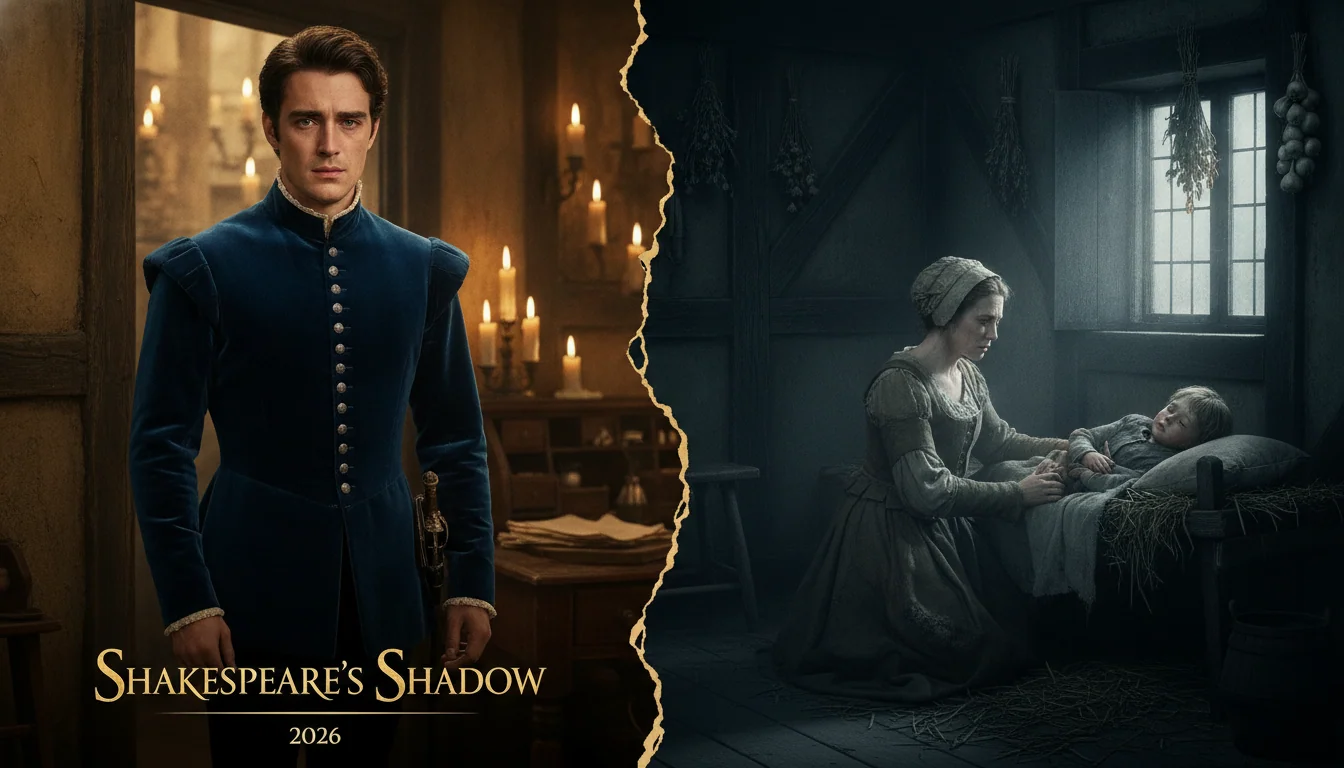
Hamnet Shakespeare died on August 11, 1596, in Stratford-upon-Avon. He was eleven years old. His father was forty miles away in London, working. The parish register records the burial. It records nothing else: no cause, no circumstance, no witness, no grief in the margin. Shakespeare himself left not a single sentence about his son's death in any document that has survived.
That silence is the space Maggie O'Farrell's 2020 novel moved into, and it is the space the 2026 film adaptation, directed by Lenny Abrahamson and starring Paul Mescal, brings to the screen. The question worth asking about Hamnet film accuracy is: how much of what they built in that silence is documented, and how much is well-researched imagination?
The answer is roughly what you'd expect from a literary adaptation made by serious artists. The bones of the story are real. The flesh was invented. The question is how far the invention departs from the probable, and in one or two places it wanders quite far.
What the film gets RIGHT
The basic facts hold
Hamnet Shakespeare was real. He was born on February 2, 1585, the twin of Judith, at a time when Shakespeare was twenty years old and had been married for just over two years. The Holby-Hill parish records confirm both the baptism and the burial, the latter on August 11, 1596.
Anne Hathaway - or Agnes, as O'Farrell calls her throughout the novel and the film follows - was real. She married Shakespeare in November 1582. She was older than he was: born around 1556, she was approximately twenty-six when they wed and he was eighteen. Their three children, Susanna born in May 1583, and the twins Hamnet and Judith born in February 1585, are all documented in the Stratford registers. The film does not invent the family.
Shakespeare's absence is historically grounded
The film's emotional engine is the gulf between a father in London chasing a career and a family in Stratford navigating a child's death without him. This is not invention. By 1596, Shakespeare had been working primarily in London for at least several years. He was a playwright, actor, and shareholder in the Lord Chamberlain's Men, and the theatre business was not a trade that allowed you to split your attention between two cities permanently.
The exact nature of his relationship with Stratford during these years is genuinely unclear, but no evidence places him at Hamnet's deathbed. He would have made the roughly forty-mile journey from London to Stratford by horse when circumstances permitted. In August 1596, circumstances apparently did not permit it in time.
The plague backdrop is accurate
The film and novel present Hamnet's death as plague-related. No cause of death is recorded in the parish register, but the summer of 1596 was bad for plague in the English Midlands, and Stratford itself had experienced serious outbreaks across the 1560s and 1590s. A child dying in August 1596 in Stratford had a credible chance of having died from plague. The film's choice to anchor the disease as the cause is consistent with the evidence, even if it cannot be proven.
Agnes's name is historically contested, not invented
One of the film's key choices, following O'Farrell's novel, is to call Shakespeare's wife Agnes rather than Anne. This is not simple revisionism. Agnes appears in her father Richard Hathaway's will of 1581, which leaves goods to "my daughter Agnes." Anne appears in the Stratford marriage documents. Some scholars argue the two names refer to the same person and that Agnes was the more intimate or domestic form. Others argue they were distinct. O'Farrell's choice acknowledges the ambiguity rather than pretending it doesn't exist.
The Hamnet-Hamlet connection is honestly framed
The film does not claim that Hamlet the play is a direct elegy for Hamnet the child. It suggests the connection, which is what responsible interpretation does with this material. The names are variants of the same root, both common in Stratford: John Shakespeare's friend Hamnet Sadler was godfather to the twins. The play Hamlet was written around 1600-1601, four or five years after the boy's death. Whether one informed the other is unverifiable. The film treats it as a haunting possibility rather than a settled fact, which is the honest position.
What the film gets WRONG
The mechanism of plague infection is invented
O'Farrell's novel and the film that follows it construct an elaborate route by which the plague reaches Hamnet: a glass bead from Venice carries the disease through a series of hands including a sailor, a glassblower, and eventually a family member before arriving at the Shakespeare house. This is literary invention of the highest order. It is also completely unverifiable and, in its specifics, almost certainly not how any individual infection in 1596 Stratford occurred.
Bubonic plague spreads via flea bites from infected rats. The transmission pathway O'Farrell imagines, however beautifully rendered, does not correspond to the epidemiology of Yersinia pestis. The film is not a medical documentary, and this was a choice to create a narrative through-line rather than a documentary claim. But viewers who take the mechanism literally are being misled.
Agnes is not documented as a healer or mystic
The film draws heavily on O'Farrell's characterisation of Agnes as a woman with unusual perceptive gifts, a healer who reads people through touch, a figure who exists partly at the edge of the social and natural world. No contemporary source describes Anne Hathaway in any such terms. She left almost no documentary trace at all beyond the legal records of her marriage, her children, and Shakespeare's will, in which he famously left her his "second-best bed."
The second-best bed is not the slight it is often read as. In 16th-century England, the best bed was typically reserved for guests; the marital bed was the second-best, and its bequest to a widow had legal and sentimental weight. But neither that detail nor anything else in the record supports the particular character the novel and film have built around Agnes. She is a magnificent fictional creation. She is not a historical portrait.
Shakespeare's guilt and inner emotional life are projection
The film gives Paul Mescal's Shakespeare a coherent emotional arc around guilt, distance, and eventual grief. This is drama doing its proper work. The historical Shakespeare is a man who expressed himself almost entirely through his plays and almost not at all in personal correspondence. He did not leave a diary. His plays contain depths of feeling about fathers and sons, about loss and time, about children who die too young. Whether any of that reflected personal grief over Hamnet is inference from fiction, not documentation.
The timeline of the play gets compressed
The film implies a relatively direct line from Hamnet's death in 1596 to the writing of Hamlet. In practice, four or five years passed, and in between Shakespeare wrote a substantial portion of his middle comedies and histories. The connection, if it exists, is not a man sitting down to write a grief play in the immediate aftermath of loss. It is something more diffuse and less easy to dramatise. The film's handling of this compression is understandable, and it's the kind of thing narrative cinema routinely does. It's still a distortion.
Historical Accuracy Score: 6.5/10
Hamnet earns its score through seriousness and care. It doesn't invent events wholesale. It doesn't give Shakespeare speeches he couldn't have given or attributes him actions he is documented to have refused. The facts it establishes - the child's death, the plague year, the absentee father, the ambiguous name of the wife, the eventual appearance of a play with an almost identical name - are all real.
What pulls the score down is the invention of interiority. Agnes's gifts, the baroque plague transmission mechanism, the direct grief arc from 1596 to the stage: these are literary embellishments that the historical record cannot support. For a film based on a literary novel rather than a biography, that is not a failure. It is the nature of the form.
What the film gets most right: the basic family history, the atmosphere of plague-era England, and the genuine mystery of Hamnet's death and its possible echo in his father's most famous play.
What it gets most wrong: attributing specific mystical gifts to Agnes and presenting the plague's route to Hamnet with false precision.
Other Shakespeare-era dramas face the same challenge of building narrative from fragmentary records. The Other Boleyn Girl and Elizabeth both construct interior lives for Tudor figures whose documented record is thin, and both earn similar scores for mixing scrupulous detail with inevitable invention.
The history underneath Hamnet is thin: a baptism record, a burial record, a name in a father's will, and the silence of a playwright who never wrote about his son directly. The film does what good historical drama is supposed to do - build a human world in the gaps the archive left empty. Whether the world it built resembles the real one is, appropriately, unknowable.
Quick Answers
Common questions about this topic
Did Shakespeare really have a son named Hamnet?
Yes. Hamnet Shakespeare was baptized on February 2, 1585, in Stratford-upon-Avon, twin to his sister Judith. He died on August 11, 1596, aged eleven. The cause of his death was not recorded in the parish register. His twin Judith outlived him by more than seventy years, dying in 1662.
Was Shakespeare's wife really called Agnes?
Her name appears as both Anne and Agnes in historical records. The name Anne Hathaway derives from parish and legal documents. Her father's will, however, names her Agnes. Maggie O'Farrell chose Agnes for her novel partly to signal that the woman behind the familiar name was more complicated than the figure who exists mainly as a footnote to her husband's biography.
Is the connection between Hamnet and Hamlet real?
The connection is a matter of literary inference, not documented fact. Shakespeare left no letters or diary entries explaining the origin of any play. Hamnet and Hamlet are variants of the same name, common in Stratford in the late 16th century. The play Hamlet was written around 1600-1601, roughly four to five years after Hamnet's death. Whether one inspired the other is a question scholars have debated for centuries without a definitive answer.
Was Shakespeare in London when Hamnet died?
Almost certainly yes. By 1596, Shakespeare was an established playwright and shareholder in the Lord Chamberlain's Men, based at the Theatre in Shoreditch. He maintained a residence in London while his family remained in Stratford. The practicalities of 16th-century travel mean he likely learned of Hamnet's death by messenger and would have arrived in Stratford some days after the child died.

Debate the Accuracy with the Real Figures
Ask the real people what Hollywood got wrong about their lives.
Create your free account →No card required. Some figures and features require a paid plan.
Join the HistorIQly Club
Get smarter about the past.
Weekly stories, deep dives, and exclusive content straight to your inbox.